Written by Anneri Fourie | Crises Control Executive
Banks rarely struggle because they lack ways to contact people. The problem shows up when something goes wrong and communication becomes fragmented, slow, or unclear. A branch loses power. A security incident unfolds. A cyber issue affects several locations at once. Suddenly, leaders need to reach the right staff, give clear instructions, and prove that action was taken. Many banks discover at that moment that their existing approach does not hold up under pressure.
This is where a Mass Notification System for Banking becomes more than a technical tool. It becomes part of how the organisation maintains control during disruption.
At a practical level, mass notification in banking solves a simple but difficult problem. How do you communicate quickly and clearly with staff across multiple branches, roles, and regions while keeping visibility, accountability, and compliance intact?
This article explains why that problem exists, where common approaches fail, and what effective communication at scale looks like in real banking environments.
What a Mass Notification System for Banking Is
A Mass Notification System for Banking is a structured way to send time-critical messages to staff across branches and functions, while tracking delivery, acknowledgement, and response.
Unlike email or collaboration tools, it is designed for moments when normal working patterns break down.
In practice, it allows banks to:
- Target messages by location, role, or incident type
- Use multiple channels such as mobile apps, SMS, voice calls, and email
- Receive confirmations and status updates from staff
- Record what was sent, when it was received, and how people responded
These capabilities are not about volume. They are about control, clarity, and evidence during disruption.
Why Communication Breaks Down During Banking Incidents
Most banks already have communication tools. What they lack is a communication model that works under stress.
Organisational complexity
Banks operate across branches, regions, and business units. Contact lists, escalation paths, and responsibilities often differ by location. During an incident, this complexity slows decision-making and creates inconsistent messaging.
Dependence on informal methods
Email, messaging platforms, and phone calls work when people are available and calm. During incidents, staff may be dealing with customers, safety concerns, or technical failures. Messages are missed, misunderstood, or delayed.
Pressure to show control
Banks must be able to demonstrate that they communicated appropriately. Manual approaches make it difficult to show who received instructions and who acted on them. This becomes a serious issue during audits or reviews.
Human behaviour under pressure
When people are uncertain, they hesitate. Vague or generic messages force staff to interpret relevance themselves. That hesitation can lead to operational drift or safety risks.
Real Situations That Expose Communication Gaps
Local branch disruptions
A power outage, a water leak, or a security alert may affect a single branch. These incidents still require fast, targeted communication. Without location-based messaging, updates go too wide or arrive too late.
Incidents affecting multiple branches
Cyber incidents, transport disruption, or severe weather can affect dozens of locations at once. Manual coordination struggles to scale. Instructions become inconsistent, and local teams begin to improvise.
Staff safety events
Medical emergencies or aggressive behaviour require immediate two-way communication. One-way alerts provide no visibility into who needs help or whether instructions were understood.
How Banks Commonly Communicate Today and Where It Fails
Email and collaboration tools
These tools are useful once stability returns. They are poorly suited to urgent situations where staff may not be logged in or able to read long messages.
Call cascades and manual lists
Phone trees rely on availability and discipline. They fail quietly when someone is unreachable and leave little evidence behind.
Local decision-making in isolation
Branch managers often take control when central communication is slow. While well intentioned, this leads to inconsistent responses and uneven risk exposure.
What Banks Get Wrong About Mass Notification
A common belief is that sending one clear message to everyone reduces confusion. In reality, it often does the opposite.
Different roles need different instructions. A branch manager, a teller, a security officer, and an IT responder will read the same message in very different ways. Generic alerts push responsibility onto staff to decide what applies to them.
Effective communication at scale depends on targeted, role-specific messaging that removes guesswork rather than adding to it.
Employee Mass Notification System for Banks in Practice
An Employee Mass Notification System for Banks changes how incidents are handled operationally.
Instead of creating messages from scratch during an incident, teams rely on predefined scenarios and templates. Instructions are clear, short, and relevant to the recipient.
Operational benefits include:
- Faster decision-making without constant calls
- Reduced cognitive load for staff and leaders
- Secure follow-ups for those who do not respond
- Central visibility without removing local authority
This approach supports consistent behaviour across branches without forcing a rigid structure.
Emergency Communication Solutions for Multi-Branch Banks
Banks with multiple locations need precision, not blanket messaging.
Effective emergency communication solutions focus on:
- Geographic targeting to limit disruption
- Escalation paths that adapt as incidents develop
- Consistent language across regions
- Access during office closures or system outages
Cloud-based delivery plays an important role here. When internal networks or buildings are unavailable, communication still needs to work.
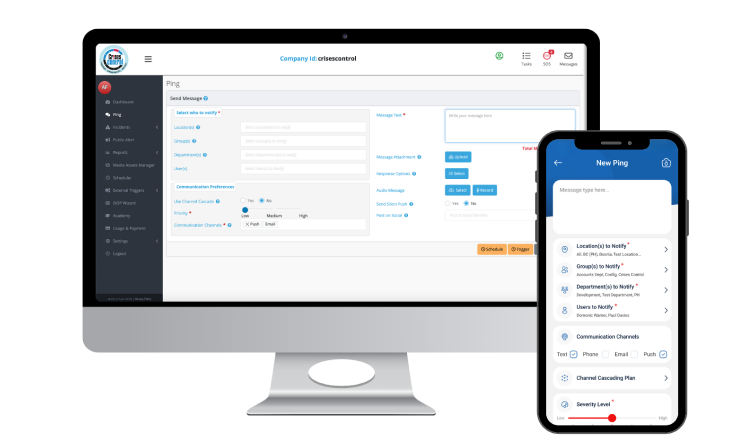
Interested in our Ping Mass Notification Software?
Efficiently alert everyone in seconds at scale with our Mass Notification Software.
Communication as Part of an Incident Management Platform
Communication on its own does not resolve incidents. It must connect to action.
When notification sits within an Incident Management Platform, banks gain:
- Clear ownership of tasks and decisions
- Real-time tracking of actions taken
- A single operational view across branches
- Reliable records for internal and external review
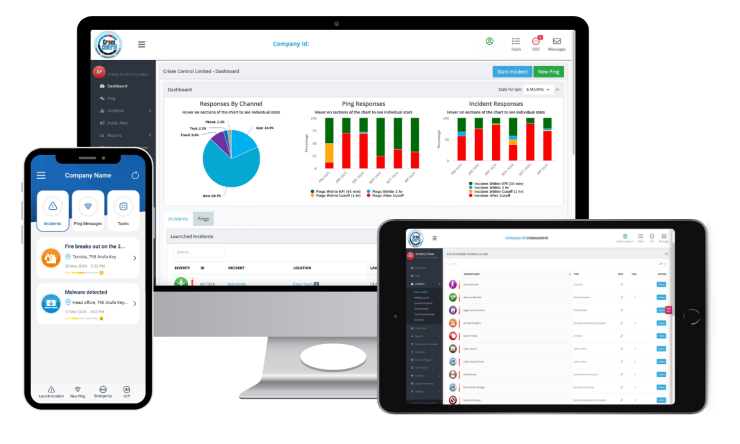
Platforms such as Crises Control show how communication, task management, and reporting can operate as one system rather than disconnected tools.
Mass Notification for Staff Safety in Banking Emergencies
Banks have a duty of care to their staff. During emergencies, leaders need to know who is safe, who needs help, and where attention is required.
Two-way communication and SOS features allow staff to:
- Confirm they have received instructions
- Request assistance discreetly
- Share status updates without leaving their location
This is especially relevant for public-facing staff, lone workers, and teams handling cash or sensitive data.
Incident Communication and Response Tracking for Regulated Banks
Regulators expect evidence that communication and response were managed properly.
Effective systems provide:
- Time-stamped records of messages sent
- Confirmation of receipt and acknowledgement
- Logs of decisions and actions
- Exportable reports suitable for audits
This supports regulatory expectations across the UK, EU, North America, and the Middle East without adding pressure during live incidents.
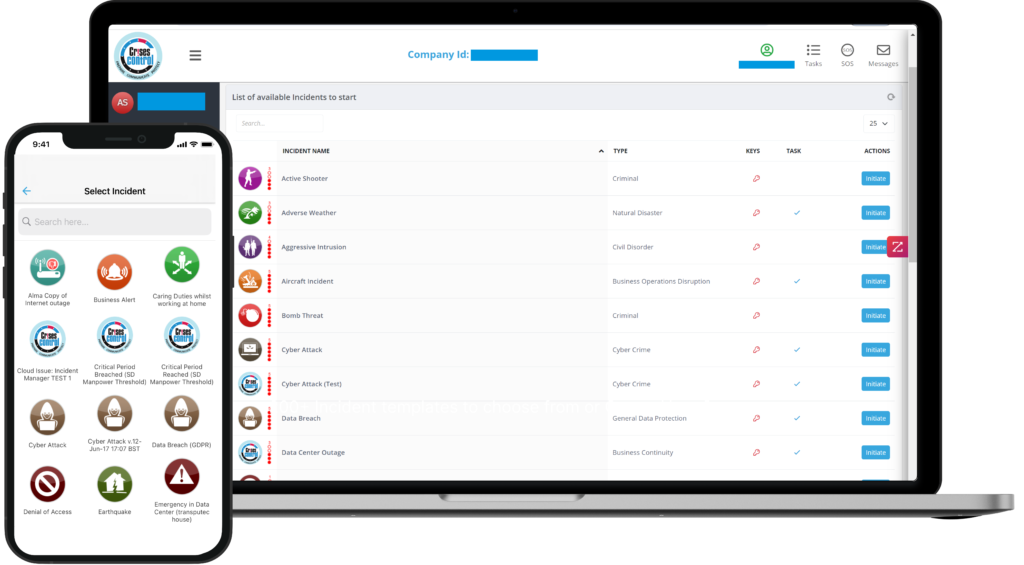
Interested in our Incident Management Software?
Flexible Incident Management Software to keep you connected and in control.
How Banks Communicate with Staff During Incidents Across Multiple Branches
Banks that handle incidents well tend to follow a repeatable pattern:
- Identify affected locations and roles
- Activate a predefined communication scenario
- Send short, clear instructions through multiple channels
- Track acknowledgements and responses centrally
- Adjust messaging as the situation develops
This pattern supports speed, clarity, and accountability without creating noise.
Building Confidence for Future Incidents
Banks that adopt structured notification and response models experience a shift in how incidents feel internally. Teams move away from reactive coordination towards controlled execution. Leaders gain visibility without constant calls. Staff trust that messages are relevant and current.
Over time, this builds confidence. Incidents become manageable events rather than moments of uncertainty.
Next Steps
Communication failures tend to surface only when the pressure is high. By then, options are limited.
If you are reviewing how your organisation communicates with staff across branches during incidents, strengthening this capability is a practical place to start.
Request a FREE Demo