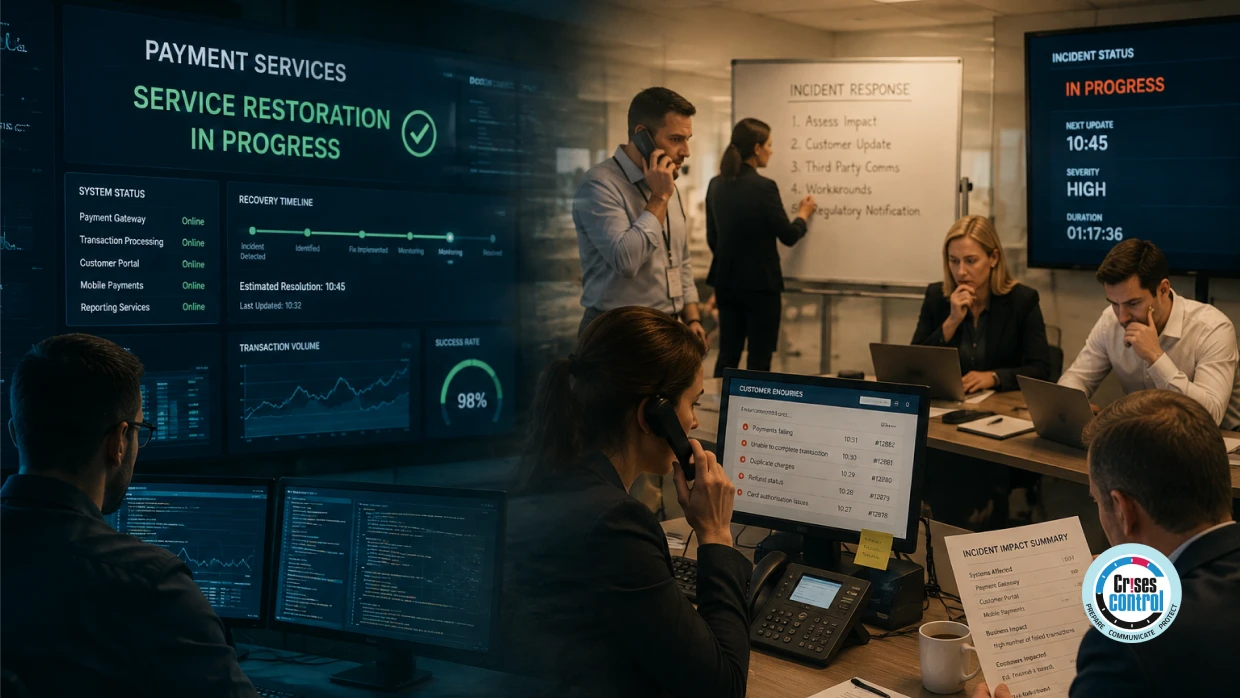
A payment platform goes down. Customers cannot complete transactions. IT starts investigating the fault, while Operations, Risk, Compliance, Customer Services and senior management begin dealing with the consequences.
Within minutes, there are several questions to answer. Which services are affected? What should customers be told? Are alternative processes available? Who is making each decision? Has anyone contacted the relevant third parties? What information can leadership rely on?
The technical problem may be clear. The response often is not.
This is where Incident Coordination Software can make a difference. It gives teams a shared place to coordinate information, decisions, communications and actions instead of relying on separate emails, spreadsheets, calls and messaging threads.
The underlying problem is easy to miss. An organisation can be technically recovering while still struggling operationally.
That means the cost of an incident is not simply the length of time a system is unavailable. Poor coordination can create duplicated work, delayed decisions, inconsistent customer communications and hours of management time spent finding out what is happening.
The solution is not simply more communication. It is better coordination.
What Is Incident Coordination Software?
Incident Coordination Software is technology that helps organisations coordinate people, information, communications, decisions and actions during an incident from a shared operational environment.
For financial institutions, this can help connect the technical response with the wider business response, giving different teams the information and tasks relevant to their roles.
The Incident Is Bigger Than The Technical Failure
Consider the payment disruption again.
After 30 minutes, IT has identified a likely cause and is working towards restoring the service. From a technical perspective, the incident is moving towards recovery.
For the rest of the organisation, the work is still expanding.
Customer Services is dealing with enquiries. Operations is identifying affected processes and possible workarounds. Risk is assessing potential exposure. Compliance needs a clear record of what has happened. Executives need to decide whether contingency arrangements or customer communications are required.
None of these teams can fix the underlying technology. They are managing its consequences.
This is the difference between technical recovery and operational recovery.
A system can be coming back online while the organisation is still trying to establish what happened, who needs to act and what customers or stakeholders need to know.
What Happens When Everyone Has A Different Picture?
During a financial services incident, information often travels through whatever channel is easiest at the time. Someone posts an update in a messaging group. Another team starts an email chain. A manager phones a colleague. An incident lead records actions in a spreadsheet.
Each method works in isolation. Together, they can create confusion.
People may not know:
- Who owns a particular action
- Which information has been confirmed
- Which information is still being investigated
- Whether another team has already completed a task
- Which decisions have been approved
- What customers have been told
- When the next update is expected
The result is an additional operational burden. People begin spending time finding out what other people know.
For a Business Continuity Manager, COO or Head of Operational Resilience, this raises a useful question:
Can your organisation execute its response as a coordinated process, or does it depend on people knowing who to call, where information is stored and what they are expected to remember?
The Hidden Cost Of Poor Incident Coordination
The cost of poor incident coordination rarely appears as a single figure.
Instead, it is spread across the response.
A senior leader spends time chasing an update. Two teams investigate the same issue. Customer Services receives an old version of the situation. Risk has to reconstruct decisions after the event because the reasoning was spread across calls and messages.
The costs can include:
- Management time: Leaders spend time collecting information instead of making decisions.
- Duplicated work: Teams repeat checks because ownership is unclear.
- Decision delays: People wait for information before they can act.
- Communication problems: Different groups receive different versions of the situation.
- Weak accountability: Actions are discussed without clear owners or deadlines.
- Reporting effort: Teams have to piece together the incident record afterwards.
This is why downtime alone can give an incomplete view of an incident’s impact.
A service might be restored after an hour, while customer enquiries, transaction reconciliation, outstanding actions and internal reporting continue for much longer.
The technical incident may be over. The operational response may not be.
Why More Communication Can Make An Incident Harder To Manage
It is natural to respond to uncertainty by communicating more.
More emails are sent. More people join the incident call. More messages appear in collaboration channels.
The problem is that more information does not automatically create better situational awareness.
During an incident, people need to know what has changed, what is confirmed and what they need to do. They do not necessarily need every conversation taking place.
Good financial services incident response therefore depends on information being:
- Current
- Relevant to the recipient
- Structured
- Actionable
- Traceable
This is particularly important when different teams have different responsibilities.
IT may need technical detail. Customer Services needs an approved customer position. Risk needs information about operational impact. Executives need a concise view of the situation, key decisions, risks and next actions.
Sending everyone the same information can create noise. Sending too little can create uncertainty.
Role-based communication provides a better middle ground.
It also helps reduce assumptions. A manager may assume another team has contacted a supplier. Customer Services may assume a workaround has been approved. An executive may assume that identifying the technical cause means recovery is close.
A structured response makes those gaps visible.
Where Traditional Approaches Struggle
Most financial institutions already have business continuity plans, escalation procedures, contact lists and communication templates.
The problem is often not the plan itself. It is how easily people can use it during a real incident.
Spreadsheets And Documents
Spreadsheets are useful for recording information, but a complex incident can change faster than a document can be updated and shared.
Different versions can circulate. Actions can be recorded without clear ownership. Important information can become difficult to find.
The same applies to plans stored across multiple documents. Responders may know the information exists but still have to find the right document, confirm that it is current and work out what applies to the incident in front of them.
Email, Messaging And Conference Calls
Email and collaboration platforms are useful everyday tools, but they are not necessarily designed to coordinate a complex incident.
A decision can become buried in a long conversation. Someone joining the response later may not know what has already been agreed. A conference call can create useful discussion without creating a clear record of actions and ownership.
This creates a common problem: people can be communicating constantly without actually coordinating effectively.
A Better Approach To Operational Incident Coordination
Effective financial services incident management does not mean removing human judgement. It means giving people a clearer structure in which to use it.
A useful response should answer seven questions:
- What happened?
- What is affected?
- What is confirmed and what remains uncertain?
- Who owns each critical action?
- What decisions have been made?
- What needs to happen next?
- When should the situation be reviewed again?
Actions should be assigned to named people rather than simply to departments. Decisions should be recorded as they are made. Significant updates should form part of a clear incident timeline.
This approach also improves incident recovery management because the organisation does not have to reconstruct the response from scattered emails and meeting notes after the event.
Digital tools can support this process by bringing plans, communications, actions and records into one accessible environment.
For example, Crises Control supports the digitalisation of response plans, role-based communication and cloud access during incidents. Its value in this context is not simply sending messages or storing plans. It is helping organisations turn those plans into a coordinated response that people can follow when pressure is high.
Recovery Is Not The Same As Resolution
One assumption deserves particular attention: restoring the affected system does not necessarily mean the incident is resolved.
The organisation may still need to confirm that services are operating normally, communicate with customers, reconcile transactions, close outstanding actions and review the impact on critical processes.
This is why operational incident coordination should continue beyond technical restoration.
A better question than “Is the system back?” is: “Has the organisation recovered?”
That question changes how incidents are measured and reviewed.
It encourages resilience teams to look beyond downtime and examine whether poor coordination contributed to the overall impact.
How To Assess Your Current Response
Business continuity and resilience leaders can use a simple test.
Ask whether your organisation can:
- Give everyone access to the latest operational information
- Assign critical actions to named individuals
- Show leadership current risks, decisions and outstanding actions
- Send relevant information according to role
- Maintain an accurate incident timeline
- Continue the response if key individuals are unavailable
- Produce a reliable incident record without reconstructing events from emails and calls
If several answers are no, the issue may not be the absence of a business continuity plan.
It may be the gap between having a plan and coordinating its execution.
Industry practices such as ISO 22301 and established operational resilience principles place emphasis on the ability to maintain and recover important business services. That requires more than documented procedures. Organisations also need practical ways to activate responsibilities, communicate clearly and make informed decisions during disruption.
Measure The Cost Of Coordination, Not Just Downtime
Financial institutions already understand that outages carry a cost. The less visible issue is what happens when the organisation struggles to coordinate its response.
Delayed decisions, duplicated work, inconsistent communication and time spent chasing information can increase the operational impact of an incident even when the technical fault is being resolved.
The strongest response is therefore not simply one that restores technology quickly. It is one that helps the organisation understand what is happening, assign responsibility, make decisions and recover as a coordinated whole.
Crises Control can support that approach by bringing digitalised plans, role-based communication and response activity into a structured environment.
Because restoring the system is only part of recovering the organisation.
Frequently Asked Questions
What Is Incident Coordination Software?
Incident Coordination Software helps organisations coordinate people, information, communications, decisions and actions during an incident. It provides a shared operational view so teams can work from consistent information.
Why Is Incident Coordination Important For Financial Institutions?
Incident coordination for financial institutions is important because a single disruption can affect IT, Operations, Risk, Compliance, Customer Services and senior leadership at the same time. Coordinating these teams helps reduce duplicated work, conflicting information and delayed decisions.
What Is The Cost Of Poor Incident Coordination?
The cost can include management time, duplicated work, delayed decisions, inconsistent communications and additional reporting effort. These costs may continue after the technical problem has been resolved.
What Is The Difference Between Incident Management And Incident Coordination?
Incident management covers the wider process of responding to and recovering from an incident. Incident coordination focuses on keeping people, information, actions and decisions aligned throughout that process.
Can Incident Reporting Software Improve Incident Response?
Incident Reporting Software can help organisations create a clearer record of incidents, actions and decisions. When reporting is connected to the live response, it can also reduce the amount of manual work needed for post-incident review and reporting.
This article was drafted with AI assistance and reviewed by the Crises Control team. Featured image: AI-generated.