
Incident Management Software is a digital platform that enables organisations to detect, log, communicate, coordinate, and review incidents within a structured and fully auditable framework. At its core, the software replaces informal, unrecorded response processes with a system that logs every action taken, captures every response received, and assigns clear ownership to every decision made during an event.
Consider a financial services organisation running operations across seven regional locations. A power failure hits one of its processing centres during peak business hours. Within minutes, calls are being made on personal mobiles, messages are moving through unofficial channels, and the incident manager at head office has no coherent view of who knows what, what has been done, or which sites remain unaffected. An hour later the power is restored. But when the compliance function asks for a record of the response, the organisation has nothing to present except the recollections of the people involved.
This is not an unusual situation. It describes what incident accountability looks like when it depends entirely on informal process and individual initiative rather than structured systems.
What Incident Accountability Actually Means
Incident accountability is the organisational capacity to demonstrate, after any event, exactly who was informed, what decisions were made, who bore responsibility for each action, and whether the response met the standards defined in advance. For organisations in financial services and insurance, this is not a conceptual goal. It is a regulatory requirement.
The difficulty is that accountability is extremely hard to enforce through informal channels. When a crisis unfolds, people default to the tools they know: personal calls, email chains, and messaging applications. These are not wrong in themselves, but they leave no auditable trace. There is no way to prove that escalation procedures were followed, that the right people were reached within a required timeframe, or that responses were collected and verified.
Genuine incident accountability is not about assigning blame. It is about building a real-time record that proves the response was structured, proportionate, and properly managed.
Incident Reporting Software exists to solve exactly this problem. But many organisations confuse the presence of a system with having achieved accountability. A system that sends alerts but does not capture responses, log task completion, or produce a post-incident report does not deliver accountability. It delivers notification. These are different things.
Why Informal Channels Create Accountability Gaps
When incidents are managed through informal channels, accountability gaps open almost immediately. A team leader sends a voice note to a group chat. Half the recipients are unavailable. The message is seen but never formally acknowledged. Later, when a regulator asks whether staff were informed within the required timeframe, there is no evidence in either direction.
This pattern appears consistently across regulated organisations of every size. A small pension fund with a close-knit senior management team may manage adequately through informal means in quieter periods. But when a power outage or severe weather event affects multiple sites simultaneously, the limitations of that approach become apparent. Without Crisis Management Software that logs every action and every response, the post-event review is limited to what individuals can recall.
The Pressure Regulated Organisations Are Under
Financial services firms operating in the United Kingdom work within a regulatory framework that requires documented evidence of operational resilience. The FCA’s operational resilience framework reached its implementation deadline in March 2025, requiring firms to identify their important business services, set impact tolerances, and demonstrate through evidence that they can remain within those tolerances during disruptions. That demonstration depends entirely on records, and records require systems that generate them automatically.
Insurance organisations face parallel demands. When an insurer coordinates a response across multiple branches because of a serious physical or operational event, it must be able to show auditors that the response was structured, that affected staff were contacted through documented channels, and that responses were tracked from end to end. Mass Notification Software with two-way confirmation and built-in logging is not a convenience in this environment. It is what makes evidence-based compliance possible.
The same logic applies to periodic continuity testing. Some organisations conduct quarterly notification tests across their entire workforce, not because they expect an emergency, but because they are required to prove to their auditors that the system functions as specified. The output of that test is the incident management report: a timestamped log of who received the alert, who responded, and when. Organisations conducting this at scale, across thousands of users and multiple locations, need the reporting infrastructure that purpose-built platforms provide.
Quarterly continuity testing generates compliance value only if it produces structured, exportable records. A test with no documentary output is operationally indistinguishable from a test that never took place.
Where Manual Processes Break Down
Manual processes break down under the cognitive pressure of a real incident. This is not a criticism of the people who rely on them. It is a structural observation about how informal systems perform when speed and accuracy both matter.
When an incident is developing in real time, response teams are already working at the edge of their capacity. Expecting them to simultaneously manage the situation, update a log, send individual confirmation messages, and document every decision is not realistic. The result is that records are incomplete. Decisions get made in verbal exchanges and are never written down. Escalation happens through personal relationships rather than defined protocols.
A fire warden relaying updates through a personal messaging group, rather than through a platform that captures those updates centrally, is a common example. The warden may be doing precisely the right thing: evacuating the floor, confirming the headcount, reporting back to the incident lead. But if that communication runs through an unofficial channel, none of it appears in the incident record. Incident Reporting Software replaces that informal layer with a structured one. Every message sent, every response received, every task assigned and completed, every escalation triggered: all of it captured in a single auditable log.
A Structured Approach to Incident Accountability
Building genuine incident accountability requires more than a logging tool. It requires a structured approach across four areas: role definition, communication, task tracking, and post-incident review.
- Role definition. Accountability must be personal. Before an incident occurs, it must be clear who is responsible for what. In a properly configured incident management system, roles are pre-assigned. Fire wardens are identified. Key holders are flagged. Senior managers responsible for specific decision categories are listed against the incident types they own. When an event triggers, those roles activate automatically and their actions are recorded from the first moment.
- Communication across multiple channels. During a significant disruption, email alone will not reach everyone. An organisation with thousands of employees across multiple locations needs to push alerts simultaneously via SMS, voice call, push notification, and mobile app, with confirmation tracking built in. If a staff member does not acknowledge a message within a defined window, the system escalates. That escalation is logged automatically.
- Task tracking. An alert that tells someone there is a fire is only the start. People need to know what to do. Incident management platforms that include task assignment allow organisations to push specific instructions to specific roles, track completion in real time, and capture any deviations for the post-incident review.
- Post-incident review. The review closes the accountability loop. Without a structured record of the incident, it is confined to what participants can recall. With a full audit trail, the review can identify which steps were completed on time, where delays occurred, and which communication paths performed as specified.
The Common Assumption Worth Questioning
There is a widely held assumption that accountability problems in incident response are fundamentally people problems. The logic runs: if teams communicated more clearly, or if managers made decisions more decisively, incidents would produce better records and better outcomes.
This is only partially correct. People can be highly capable and still produce no usable accountability record if the systems they work with do not capture their actions. A fire warden who evacuates a floor correctly, confirms the headcount, and reports back to the incident lead may leave no traceable record of any of it if the communication ran through unofficial channels.
Accountability is a systems problem as much as a people problem. Capable people performing well under pressure will still fail a compliance audit if the tools they relied on generated no evidence.
How Incident Management Software Closes the Gap
Most crisis notification tools are built to send alerts. That is where their functionality ends. The alert is delivered, and the organisation’s informal systems are expected to manage, coordinate, and document everything that follows. Some planning tools store business continuity documents. But during a live incident, accessing a plan stored in a separate document management system is slow, impractical, and leaves no record of who accessed what and when.
Most competitors either notify people or document plans. Crises Control executes the response.
Interested in our Incident Management Software?
Flexible Incident Management Software to keep you connected and in control.
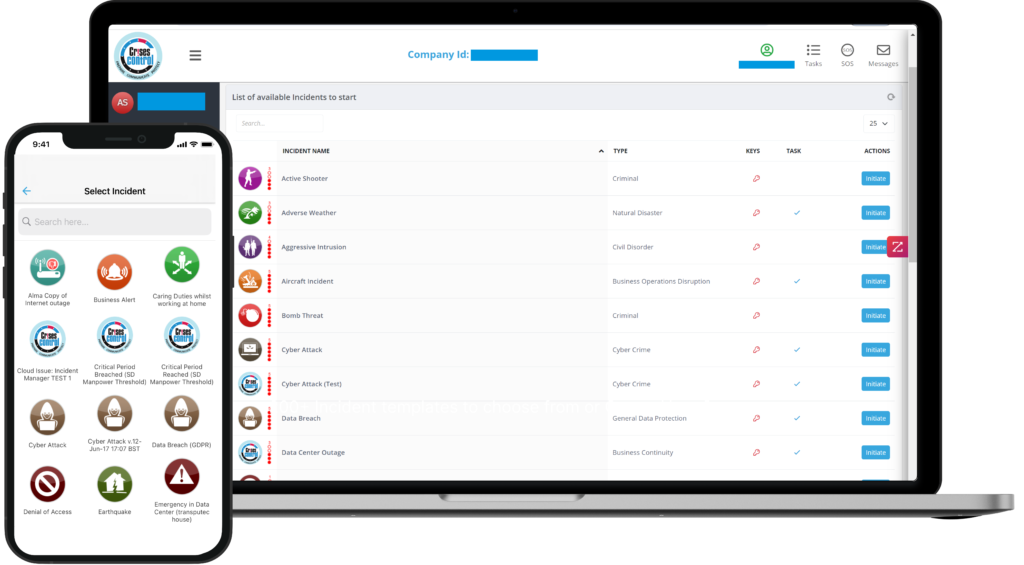
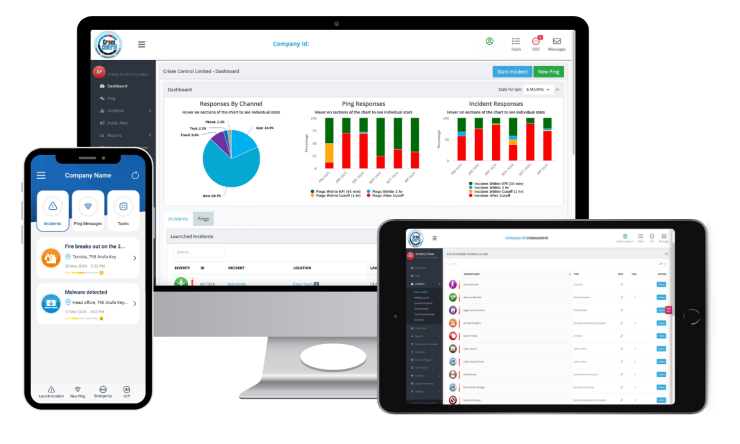
Crises Control operates as an execution layer. When an incident is activated, the platform delivers multi-channel alerts via SMS, voice, email, push notification, and mobile app. It tracks which recipients received the alert, which responded, and what they said. It assigns tasks to pre-defined roles and monitors completion in real time. Every action from activation through to resolution is logged with a timestamp and the identity of the individual or role responsible.
For a regulated financial services organisation, this means that when an auditor requests evidence of a quarterly continuity test, the report already exists on the platform. For an insurance organisation managing an event across several locations, the incident record shows which sites were contacted, which staff confirmed their safety, how the incident was escalated, and how it was closed.
For organisations that require GDPR-aligned handling of employee data during incidents, Crises Control operates within GDPR-compliant workflows. For those working within DORA requirements or ISO 22301 frameworks, the platform’s audit trail and post-incident reporting capabilities align directly with those standards.
The SOS panic button available on the mobile application adds an individual layer of accountability. If a staff member needs immediate assistance, the request is logged, timestamped, and assigned for response, creating a record of both the need and its resolution.
Practical Guidance for Organisations Reviewing Their Approach
For organisations evaluating their current incident response against an accountability standard, four areas warrant immediate examination.
First: review whether your current tools generate auditable records. If your incident response relies on personal messaging apps, unstructured email threads, or voice calls with no logging, you have an accountability gap. The question is not whether an incident will surface that gap, but when.
Second: define roles before incidents occur. Role-based response cannot be improvised in the moment. Pre-assigning responsibilities in your incident management system means that when an event triggers, the right individuals are activated automatically and their actions are recorded without additional effort from anyone.
Third: test regularly and document the tests. Periodic continuity testing is only useful as compliance evidence if it produces structured records. Running a mass notification test and capturing the results, including receipt confirmation, response rates, and response times, provides the evidence base that demonstrates your systems work as specified.
Fourth: embed your business continuity plans into the platform. Keeping plans in a separate document system means they are inaccessible in real time during an event. Platforms that allow plans to be embedded and activated as part of an incident workflow eliminate that operational gap entirely.
Conclusion
Incident accountability is a practical operational requirement for any organisation managing significant risk under regulatory oversight. Incident Management Software provides the foundation for real accountability by replacing informal, unrecorded response processes with structured, auditable ones.
The organisations that meet this standard consistently are not necessarily the largest or the most resourced. They are the ones that have treated accountability as a design principle and built it into how they respond to every event, from a fire drill to a full business continuity activation, and invested in the systems that make that consistent.
To see how a structured approach to incident accountability works in practice, get a free personalised demo.
FAQs
1. What is Incident Management Software and why does it matter for accountability?
Incident Management Software is a digital platform that manages the full lifecycle of an operational event, from detection and communication through to resolution and post-incident review. It matters for accountability because it replaces informal, unrecorded response processes with a structured system that captures every decision and action in real time, producing the auditable evidence that regulators and auditors require after any significant event.
2. How does Incident Reporting Software differ from general communication tools?
Incident Reporting Software is purpose-built to structure, log, and report on incidents rather than simply deliver messages. Unlike general tools such as email or messaging applications, it generates timestamped records with role attribution, confirmation tracking, and task completion logs that can be presented directly as compliance evidence. General communication tools produce message histories. Incident Reporting Software produces auditable incident records
3. What should Crisis Management Software include to support compliance in financial services?
Crisis Management Software for financial services should include multi-channel notification with delivery confirmation, two-way response tracking, task assignment with completion logging, a full audit trail of every incident action, and post-incident reporting that maps directly to regulatory evidence requirements. It should also support integration with existing directory systems and operate within GDPR-aligned data handling frameworks to ensure employee data is handled correctly during a crisis.
4. How does Mass Notification Software support quarterly continuity testing?
Mass Notification Software enables organisations to send alerts to large groups simultaneously across multiple channels, collect structured responses, and generate reports that document receipt and response rates. For organisations required to demonstrate system readiness to auditors each quarter, that report is the compliance evidence. Without a platform that generates it automatically, a test has no documentary value regardless of how well it runs operationally.
5. How do you create an incident audit trail for compliance using software?
To create an incident audit trail for compliance, organisations need a platform that automatically logs every communication, response, task assignment, and escalation during an incident, with timestamps and user attribution. The best Incident Management Software for Finance delivers this as a native function, producing post-incident reports that align with regulatory evidence requirements. Every quarterly test, every real event, and every escalation decision is documented automatically, without requiring additional manual effort from the response team.