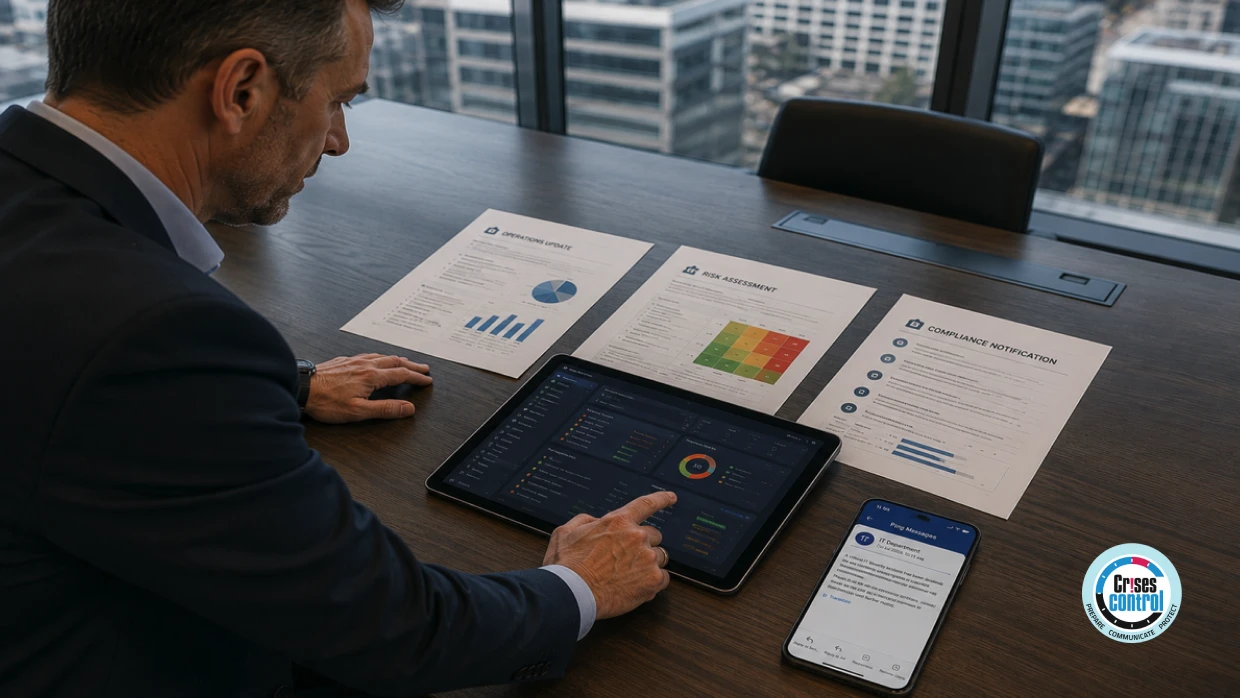
A major operational incident rarely becomes difficult because people stop doing their jobs.
More often, it becomes difficult because every team is trying to solve the problem using different information.
Imagine a payment platform begins experiencing intermittent failures. Customers can no longer complete online transactions, call centres see a sharp increase in enquiries and branch employees begin reporting similar issues. IT starts investigating what appears to be a technical fault, Operations focuses on the impact on important business services, Risk assesses operational exposure and Compliance begins reviewing potential regulatory obligations. At the same time, Customer Services needs accurate information before speaking to customers, while the executive team is expected to brief the Board with confidence.
Every department is responding exactly as it should.
The difficulty is that each department is building its own understanding of the incident.
IT believes the issue is limited to one payment service. Operations suspects the disruption is affecting several customer channels. Customer Services receives new information from branches, while leadership continues receiving updates that change every few minutes. None of those updates are necessarily wrong, but they do not present one complete picture of what is happening.
This is often where operational pressure begins to increase. Leaders spend more time validating information than making decisions, departments begin prioritising different actions and the response gradually becomes harder to coordinate.
This is where Incident Management Software plays an important role. Rather than allowing every team to manage its own version of the incident, it creates a shared operational picture where information, decisions, responsibilities and response activities are visible across the organisation. Working alongside Incident Coordination Software and Operational Incident Management Software, it helps financial institutions coordinate their response using verified information instead of assumptions.
The organisations that recover most effectively are not always those that restore systems first. They are the organisations where every critical decision starts with the same trusted information.
What Is Incident Management Software?
Incident Management Software helps organisations coordinate operational incidents from the moment they are identified until recovery has been completed. It brings together incident information, communication, task management, reporting and decision-making within one structured environment, replacing disconnected email chains, spreadsheets, phone calls and departmental updates with a single source of truth.
For financial institutions, this means IT, Operations, Risk, Compliance, Customer Services and Executive Leadership can all work from the same verified information while maintaining clear ownership of actions and responsibilities.
The objective is not simply to record an incident after it has happened. It is to help the organisation make faster, better informed decisions while the incident is still unfolding.
Why Information Becomes Fragmented During Financial Services Incidents
Major operational incidents rarely stay within a single department. A payment platform outage may begin as an IT issue, but the effects quickly spread across the wider organisation. Customer Services manages increased call volumes, Operations assesses disruption to important business services, Risk evaluates operational exposure, Compliance reviews regulatory obligations and Communications prepares updates for customers and other stakeholders. Throughout all of this, leadership needs reliable information before making strategic decisions.
Every team naturally views the incident through the lens of its own responsibilities. The problem begins when those individual perspectives are never brought together into one shared operational picture.
One team may believe the issue has been contained. Another may report that the disruption is continuing to spread. A third may already be communicating with customers using information that has changed since the message was drafted. None of these teams are necessarily wrong. They are simply working with different information at different moments.
The result is slower decision-making, duplicated effort and unnecessary operational pressure. Many financial institutions invest heavily in strengthening technical resilience while giving far less attention to how operational information is shared and managed during a live incident. That weakness often remains hidden until the organisation is responding under genuine pressure.
The Common Assumption That Slows Decision-Making
One of the biggest misconceptions in incident management is that more updates automatically lead to better coordination.
In practice, the opposite is often true.
As an incident develops, information begins arriving from multiple sources. IT provides technical updates, Operations reports customer impact, Risk shares operational assessments, Compliance raises regulatory considerations and Customer Services feeds back what customers are experiencing. Leadership receives a constant stream of information, but very little certainty.
The problem is not communication.
The problem is that there is no single operational picture that allows everyone to understand the same situation at the same time.
Recognised incident management guidance, including the principles of the Incident Command System (ICS), places strong emphasis on maintaining common situational awareness so that decisions are based on consistent, verified information rather than isolated departmental updates. Financial institutions face exactly the same challenge during major operational incidents. Without one shared view of the situation, even experienced teams can find it difficult to coordinate an effective response.
Why Traditional Incident Management Approaches Fall Short
Most financial institutions have invested heavily in resilience and incident response. They have dedicated cyber security teams, business continuity plans, disaster recovery procedures, risk frameworks and clearly documented escalation processes. On paper, the organisation appears well prepared.
The challenge is not a lack of planning. It is that the information needed to manage an incident is often scattered across different teams and different systems.
IT monitors infrastructure and application performance. Operations tracks customer impact. Risk assesses business exposure. Compliance reviews regulatory obligations, while Customer Services manages a growing volume of enquiries. Executive leadership depends on all of these teams to build an accurate picture before making strategic decisions.
Every department is doing exactly what it should be doing.
The difficulty is that everyone is building their own view of the incident.
Without a shared operational picture, leaders spend valuable time comparing updates instead of directing the response. Different teams may unknowingly duplicate work, prioritise conflicting activities or communicate inconsistent information to customers, regulators or other stakeholders.
This is one reason why some payment outages appear to become more complex as they continue. The technical issue may be moving towards resolution, while the organisation’s understanding of the incident becomes increasingly fragmented.
Emergency management frameworks have recognised this challenge for many years. The Common Operating Picture described by the Joint Emergency Services Interoperability Principles (JESIP) highlights the importance of ensuring everyone involved in an incident works from the same verified information so decisions remain coordinated throughout the response.
What Effective Incident Coordination Looks Like
Effective incident coordination is not about collecting more information.
It is about making sure everyone is making decisions using the same information.
When a significant operational incident occurs, every response team should be able to answer a consistent set of questions.
- What has happened?
- Which important business services are affected?
- What actions are already underway?
- Who owns each activity?
- Which risks need immediate attention?
- What decisions have already been made?
- What still needs to happen?
Instead of each department maintaining its own version of events, information is captured once, updated as the situation develops and shared with everyone who needs it.
An effective incident management approach typically includes:
- A live operational dashboard showing the current status of the incident
- Clearly defined roles and responsibilities
- Task management with ownership and progress tracking
- Role-based communication so information reaches the right people
- A live incident log recording decisions and actions
- Audit trails that support governance and regulatory review
- Reporting that captures lessons learned and supports continual improvement
When these capabilities work together, leadership no longer spends valuable time assembling information from multiple sources. Instead, they can focus on making informed decisions, allocating resources and keeping the organisation moving towards recovery.
How Incident Management Software Supports Financial Services
This is where Incident Management Software becomes much more than an incident logging tool.
Its real value lies in helping the entire organisation coordinate its response through one shared operational picture.
When an incident is declared, authorised personnel can activate predefined response plans immediately. Relevant teams receive role-based notifications, responsibilities are assigned automatically and leadership gains a live view of how the situation is developing. Rather than relying on separate email chains, spreadsheets and verbal updates, every team contributes to the same incident record, giving decision-makers confidence that they are working from current, verified information.
As the response progresses, leadership can quickly see:
- Which teams have acknowledged the incident
- What actions have been assigned and completed
- Outstanding operational or regulatory risks
- Which important business services remain affected
- Communication issued to employees, customers and regulators
- Decisions, approvals and actions recorded throughout the incident
This shared operational picture gives Heads of Business Continuity, COOs, Risk Managers and Executive Leadership the confidence to make decisions based on evidence rather than assumptions.
Solutions such as Crises Control support this approach by helping organisations digitalise incident response plans while bringing communication, task management, operational dashboards, audit trails and reporting together within one coordinated platform. Rather than replacing existing resilience programmes, the platform complements them by helping every response team work from the same trusted information throughout the incident.
Technology will never replace experienced decision-makers.
What it can do is give them the visibility, context and confidence to make better decisions using one version of the truth instead of several competing versions.
Strong Decision-Making Begins Before The Next Incident
A payment outage rarely becomes difficult because people stop doing their jobs.
It becomes difficult because everyone is trying to make good decisions using different pieces of information.
IT may believe recovery is progressing well. Operations may be seeing growing customer disruption. Compliance may already be preparing regulatory notifications, while Executive Leadership is still waiting for enough certainty to make strategic decisions.
None of these teams are wrong.
They are simply looking at different parts of the same incident.
The organisations that manage major incidents most effectively understand that incident management is about far more than resolving the technical issue. It is about making sure every decision-maker has access to the same accurate information throughout the response, allowing the organisation to move forward with confidence instead of uncertainty.
That preparation starts long before an incident occurs. Leadership should already know who owns the response, how information will be shared, who has decision-making authority and how actions will be recorded from beginning to end.
One of the most valuable exercises after a simulation or real incident is to ask questions that go beyond whether the plan was followed.
For example:
- Did every team have access to the same operational information?
- Were decisions based on verified facts or assumptions?
- Did leadership spend more time directing the response or requesting updates?
- Were responsibilities understood by everyone involved?
- Could every major decision be explained afterwards through a complete audit trail?
- If the same incident happened tomorrow, what would we change?
Questions like these often uncover practical weaknesses that are difficult to spot by reviewing documentation alone. They also help organisations improve coordination before the next incident puts those weaknesses under real operational pressure.
This thinking is reflected in regulatory expectations across the financial sector. Guidance increasingly encourages organisations to establish structured incident management processes, define clear responsibilities and maintain effective communication throughout an incident so response and recovery remain coordinated.
One Shared Operational Picture Creates Better Outcomes
Financial institutions invest heavily in reducing operational risk, strengthening resilience and preventing disruption. Those investments remain essential, but preventing incidents is only one part of the challenge.
When a payment platform fails or another critical service is disrupted, leadership needs confidence that every important decision is based on the same trusted information. Without that shared operational picture, even experienced teams can lose valuable time reconciling conflicting updates instead of focusing on customers, recovery and business continuity.
Solutions such as Crises Control help organisations strengthen incident management by bringing communication, incident coordination, task management, operational dashboards, audit trails and reporting together in one platform. Rather than replacing existing governance or resilience programmes, the platform supports them by giving every response team access to the same verified information throughout the incident.
Ultimately, incident management is not about creating more reports or holding more meetings.
It is about making better decisions while the situation is still unfolding.
Organisations that consistently perform well during major incidents are rarely the ones with the most documentation. They are the ones that give every team, from IT and Operations to Risk and Executive Leadership, a shared understanding of what is happening, what needs to happen next and who is responsible for making it happen.
If your organisation is reviewing its incident management approach, ask one simple question.
If a major payment platform failed this afternoon, would every decision-maker be working from the same version of the truth?
The answer may reveal opportunities to strengthen coordination long before the next incident occurs.
If you would like to see how Crises Control helps financial institutions build a shared operational picture through structured incident coordination, role-based communication and real-time operational visibility, get a free personalised demo.
Frequently Asked Questions
What Is Incident Management Software?
Incident Management Software helps organisations coordinate operational incidents by bringing together communication, task management, operational visibility, reporting and audit trails within a single platform. It enables every response team to work from the same verified information throughout an incident.
Why Is A Shared Operational Picture Important During Financial Services Incidents?
Major incidents involve multiple departments responding at the same time. A shared operational picture helps IT, Operations, Risk, Compliance and Executive Leadership make informed decisions using the same up-to-date information, reducing delays and conflicting actions.
What Is Incident Coordination Software?
Incident Coordination Software helps organisations organise people, communication and response activities during an incident. It supports role-based task assignment, operational dashboards, communication tracking and audit trails so response teams remain aligned from the initial response through to recovery.
What Should Financial Institutions Look For In Incident Management Software?
Key capabilities include role-based communication, operational dashboards, task management, audit trails, incident reporting, escalation workflows, cloud access and integration with business continuity and operational resilience processes.
How Often Should Incident Management Processes Be Tested?
Incident management processes should be tested regularly through realistic scenarios, tabletop exercises and operational resilience exercises. Plans should also be reviewed after significant incidents so lessons learned can be incorporated into future response procedures and improve organisational readiness.
This article was drafted with AI assistance and reviewed by the Crises Control team. Featured image: AI-generated.