
Incident response software is a dedicated digital platform that enables organisations to detect, escalate, and coordinate their response to operational incidents in real time. Unlike general communication tools, incident response software structures the entire response workflow: from the first alert through task assignment, team coordination, and post-incident reporting to regulatory audit.
At 06:14 on a winter morning, a major European airport received a security alert. Three teams needed activating immediately: ground operations, passenger services, and the emergency services liaison. The duty manager reached for a group email chain. Fourteen minutes later, only one team had confirmed receipt. By the time all three were coordinated, 4,000 passengers had queued in the terminal and the airline had issued a public statement that contradicted what ground staff were being told.
That gap, between the moment an incident occurs and the moment every relevant team is coordinated, is where aviation and transport operations lose control. In many organisations, manual relay chains can introduce delays measured in minutes rather than seconds.
Why Aviation and Transport Face a Distinct Incident Challenge
Aviation is one of the most operationally complex sectors on earth. A single busy airport coordinates thousands of aircraft movements per day, connecting airlines, ground handlers, fuel suppliers, security contractors, air traffic control, and emergency services. Transport and logistics networks face the same challenge at a different scale: a major distribution hub manages tens of thousands of vehicle movements daily across drivers, dispatchers, warehouse teams, and customers spread across multiple geographies.
When something goes wrong, these networks do not fail quietly. They fail loudly, expensively, and in public.
GPS spoofing incidents affecting commercial aviation spiked 500% between 2023 and 2024 (IATA 2025). The July 2024 CrowdStrike software failure cost Delta Air Lines approximately 500 million dollars over five days (CNBC 2024), cascading simultaneously across IT, operations, customer service, and communications teams. When Southwest Airlines experienced its December 2022 scheduling collapse, nearly 17,000 flights were cancelled and the company faced a 140 million dollar regulatory fine (NPR 2023). In each case, the technology or environment failed first. Then the response organisation failed to compensate.
These are not isolated events. They are a pattern. And the pattern reveals a structural gap: most aviation and transport organisations have invested heavily in the systems that run their operations, but not in the technology that coordinates their response when those systems fail or when external events overwhelm them.
The 5 Most Common Incident Response Failures in Aviation and Transport
1. Alerts reach the wrong people first
In most aviation and transport operations, the first notification of an incident arrives at a control room or dispatch centre, which manually forwards information to relevant teams. Each relay introduces delay and distortion. By the time five teams are in the loop, the incident picture has fractured into five different versions. The response begins with a disagreement about the facts.
2. No confirmation that the alert was received
Sending a message is not the same as delivering information. Phone calls go unanswered. Emails land in busy inboxes. Radio calls are missed in noisy environments. In a high-pressure incident, the assumption that an alert has been received can be as operationally dangerous as sending no alert at all. The response proceeds while a key team is still unaware.
3. Teams work the incident in parallel silos
Ground operations knows what it is doing. Security knows what it is doing. The airline knows what it is doing. Without a shared operational picture, teams may duplicate effort, work at cross-purposes, or slow each other down without realising it. In a passenger emergency, this delays evacuation. In a hazardous materials incident, it escalates a contained situation into a regulatory exposure and a reputational crisis.
4. Escalation depends on individual memory and judgement under pressure
When does a delayed flight trigger full airline disruption protocols? When does a staff injury become a mandatory regulatory report? When does a cargo discrepancy require immediate security escalation? In manual systems, these thresholds live in policy documents and institutional memory. Under the pressure of a live incident, both resources fail at the worst possible moment.
5. Post-incident reporting is reconstructed rather than recorded
Regulators from the CAA, EASA, FAA, and national transport authorities require detailed incident records. In organisations relying on phone calls, emails, and verbal briefings, those records are assembled after the fact: partial, inconsistent, and legally vulnerable. A single gap in the incident log can become a significant compliance exposure, especially when the regulator’s timeline differs from the organisation’s reconstruction.
What Incident Response Software Does Differently
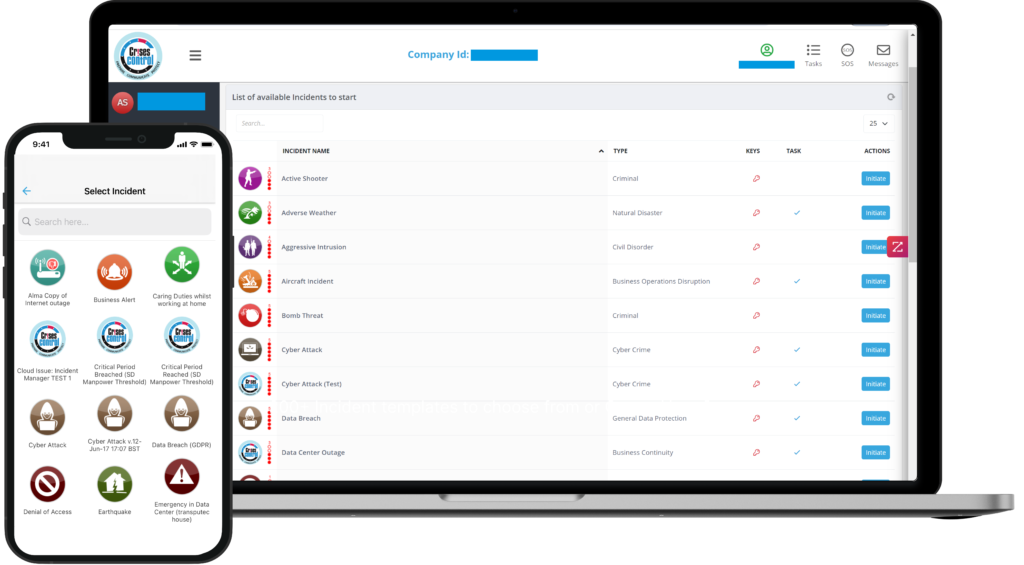
Incident response software replaces manual relay chains with automated, structured workflows. When an incident is declared, the platform simultaneously alerts every relevant team across multiple channels: SMS, voice call, push notification, email, and app. Every alert is timestamped. Every acknowledgement is logged. Nothing is assumed.
GPS spoofing incidents affecting commercial aviation spiked 500% between 2023 and 2024 (IATA 2025). Each event required immediate multi-team coordination within minutes. Manual relay chains cannot move at that speed.
The platform does not just notify. It assigns tasks. An operations manager sees in real time which teams have acknowledged, which tasks are complete, and where the response is stalling. Escalation rules fire automatically: if a team does not confirm within a defined window, the alert escalates to the next level without requiring a manual decision under pressure.
For aviation teams, this means that a ground emergency, a security alert, or a runway incursion can trigger the right response chain within seconds, not minutes. For transport teams, a multi-vehicle collision involving hazardous materials, a warehouse fire, or a cyberattack on fleet management systems can activate the full response plan without waiting for a manual cascade through radio and phone.
The critical difference is not speed of notification. It is speed of coordination. Every team, acting on the same information, at the same moment, without waiting for a manual relay.
Interested in our Incident Management Software?
Flexible Incident Management Software to keep you connected and in control.
The Coordination Layer That Most Tools Miss
Most aviation and transport operations already have some form of notification capability. Radio systems, group chats, and mass email tools can push information to many people quickly. The problem is that notification is not coordination.
General communication tools such as Microsoft Teams and Slack were built for everyday conversation. They have no escalation logic, no task assignment, no audit trail, and no response confirmation workflow. When an incident strikes, they create noise rather than structure. Message volume increases as the situation worsens, and the ability to distinguish signal from noise decreases at exactly the moment clarity is most needed.
Dedicated business continuity planning tools document what should happen during a crisis. They are not built to execute that plan in real time, or to coordinate the people carrying it out.
The gap is execution.
Effective Incident Response Software should bridge the gap between notification and execution. Rather than simply informing people that an incident has occurred, it should coordinate tasks, communications, escalation and reporting from a single operational workflow. Crises Control is designed around that principle, helping organisations execute their response rather than manage it through disconnected systems.
How Crises Control Supports Aviation and Transport Incident Response
Crises Control is built as an execution layer for real-time incident response. For aviation and transport organisations, the platform provides the following capabilities.
Multi-channel mass notification across SMS, voice, push, app, and email reaches all relevant teams simultaneously, regardless of location or device. The Crises Control aviation incident management platform is designed to meet the speed requirements set by IATA for critical aviation communications, reaching all contacts in seconds.
Two-way response tracking means the operations centre sees immediately who has acknowledged and who has not, without making follow-up calls across multiple contact lists.
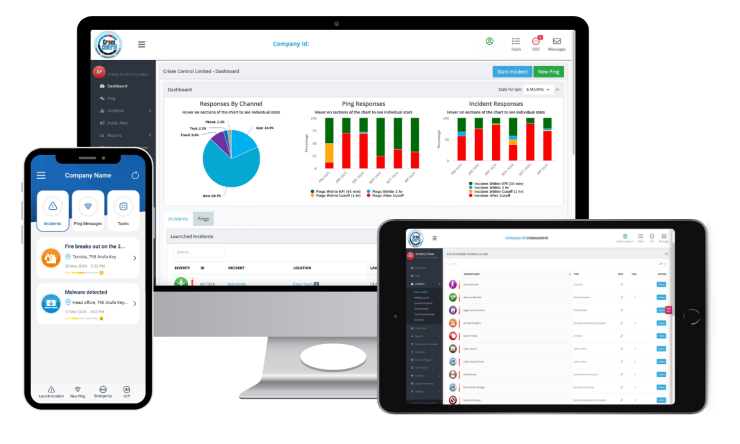
Task assignment and live status tracking allows the incident commander to assign responsibilities, set deadlines, and monitor completion in a single view, rather than across multiple phone calls, radio checks, and spreadsheets.
Automated escalation ensures that if a team does not respond within a defined window, the alert automatically moves to the next level. The response chain does not stop because one person missed a notification.
SOS panic button on mobile gives field-based staff, cabin crew, and transport personnel a direct line to activate an incident response, even in environments where raising an alarm verbally is not safe or possible.
Full audit trail and post-incident reporting captures every alert, acknowledgement, task update, and communication with a timestamp, supporting regulatory documentation under EASA, CAA, FAA, and RIDDOR standards. Read more about Crises Control aviation emergency response solutions for the complete capability set.
ISO 22301 and ISO 22320 aligned workflows ensure the incident response process matches international business continuity and incident management standards. The Crises Control transport and logistics response tools apply the same execution layer to ground-level transport and supply chain incidents.
For mass communication needs specific to aviation, the Crises Control mass notification software for aviation capability brief covers the multi-channel alerting architecture in detail.
The 7 Ways Incident Response Software Closes the Aviation and Transport Gap
- Automated simultaneous alert distribution across all teams, eliminating manual relay chains and the distortion they introduce.
- Confirmed acknowledgement tracking, replacing assumed receipt with verified, timestamped response.
- Shared incident picture across all operational silos, giving every team the same information at the same moment.
- Automatic escalation without manual intervention, ensuring the response chain continues even when individuals miss notifications.
- Assigned tasks with live completion tracking, replacing ad hoc coordination with structured, accountable response.
- Real-time audit trail capturing every action from first alert to resolution, supporting regulatory compliance.
- Post-incident reports built during the incident itself, not reconstructed from partial memory after the fact.
Aviation and transport operations don’t fail because people stop working. They fail when coordination breaks down. Incident Response Software helps ensure every team works from the same operational picture, making faster, better-informed decisions when every minute matters.
Ready to see what this looks like in practice? Book a free personalised Crises Control demo and explore how the platform coordinates aviation and transport incidents from the first alert through to resolution.
FAQs
1. What is incident response software and how does it apply to aviation and transport?
Incident response software is a platform that automates the detection, escalation, and coordination of an organisation’s response to operational incidents. In aviation and transport, this covers the full spectrum from aircraft ground emergencies and security threats to supply chain disruptions, port shutdowns, and cyberattacks on fleet management systems. The software replaces manual relay chains with structured workflows that activate all relevant teams simultaneously from the moment an incident is declared.
2. How does incident response software differ from a standard mass notification tool?
Mass notification tools push messages to many people at once. Incident response software goes further: it confirms receipt, assigns tasks, tracks completion, escalates automatically when teams do not respond, and builds a full audit trail throughout the response. The difference is between informing people that something has happened and coordinating what every team does about it from that moment forward.
3. What regulations does incident response software help aviation operators meet?
Aviation operators must comply with standards from EASA, the CAA, the FAA, ICAO, and national authorities. Incident response software supports compliance by providing timestamped records of every alert, acknowledgement, decision, and action taken during an incident. This documentation is essential for mandatory incident reporting and regulatory audit. ISO 22301 and ISO 22320 alignment ensures the response process itself meets international standards.
4. Can incident response software handle both major incidents and routine drills?
A well-designed incident response platform handles the full operational spectrum: major emergencies such as aircraft incidents or terminal evacuations, medium events such as passenger medical emergencies or IT outages affecting flight scheduling, and routine activities such as fire drills and safety inspections. Using the same platform for drills as for live incidents means teams are already familiar with the system when a major event occurs.
5. How quickly can incident response software activate a response in aviation and transport?
The best platforms alert all designated teams within seconds of an incident being declared, across SMS, voice, push notification, email, and app simultaneously. The key operational advantage is that simultaneous multi-channel notification removes the sequential delay of manual phone cascades and radio relay chains. In incidents where response time is measured in minutes, that difference is significant.