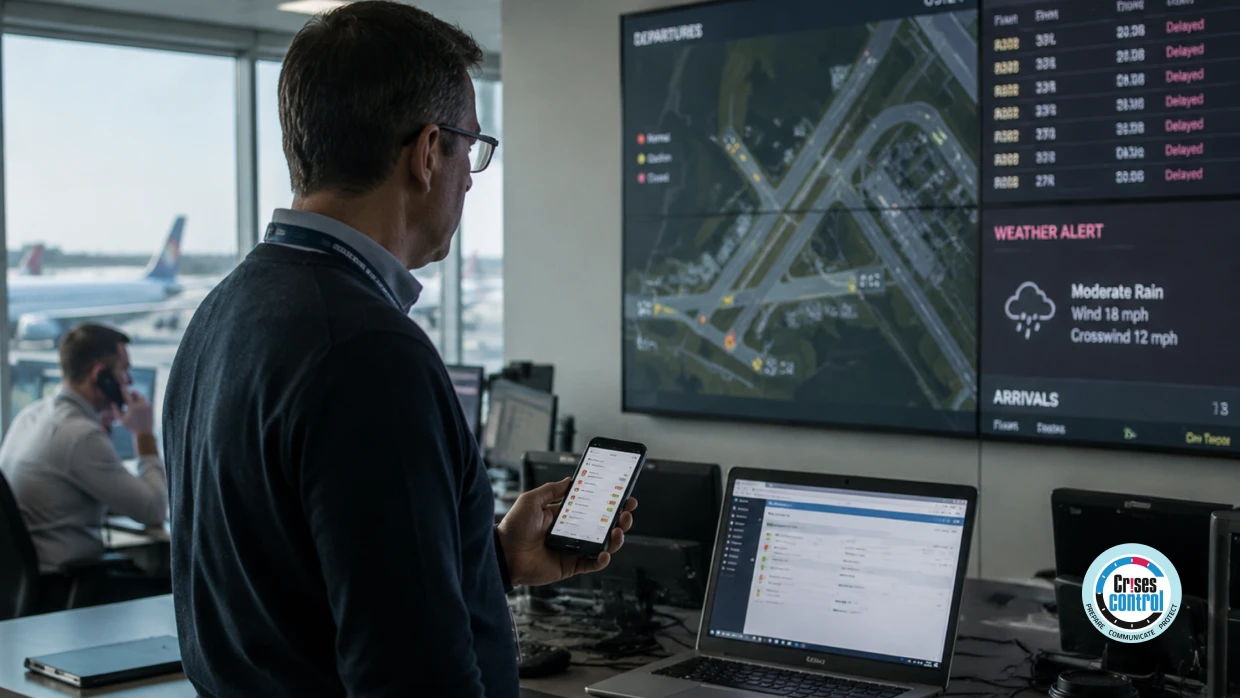
Incident response software is often viewed as a tool for sending alerts or managing tasks during an emergency. In reality, its value is measured long before and long after an incident begins. The right platform helps organisations activate response plans quickly, maintain operational visibility as events unfold and keep teams working from the same information when disruption spreads across multiple locations.
Recent transportation outages have shown what happens when that capability is missing. Whether the trigger is a technical fault, a cyber incident or severe weather, the biggest losses rarely come from the original event. They happen when organisations struggle to coordinate people, communicate consistently and adapt as the situation changes.
The December 2022 Southwest Airlines collapse remains one of the clearest examples. Over ten days, nearly 17,000 flights were cancelled, costing the airline around 800 million dollars. Regulators later imposed a 140 million dollar fine. Investigations found that outdated crew scheduling systems, overwhelmed communication channels and operational processes could not keep pace with the scale of the disruption. While the technology failure triggered the crisis, the organisation’s ability to coordinate its response determined how far it spread.
A similar pattern emerged during the July 2024 CrowdStrike outage. Although the software update error originated outside Delta Air Lines’ systems, the airline still reported losses of approximately 500 million dollars over five days. Once again, the speed of the disruption exceeded the organisation’s ability to coordinate a large-scale operational response.
These incidents highlight an important point. Major disruptions cannot always be prevented, but their impact can often be reduced. The organisations that recover fastest are not necessarily those with the most detailed incident plans. They are the ones with incident response software that enables rapid activation, clear communication, shared operational visibility and coordinated decision-making under pressure.
The lessons from these transportation outages are relevant to every aviation and transport operator. Here are six of the most important lessons, and what they mean for building a stronger incident response capability.
Why The Same Things Break In Every Major Transportation Outage
No two major disruptions begin in exactly the same way.
One starts with severe weather. Another with a cyberattack. Another with a software failure or industrial action. Yet when investigators look back at what happened, they often find the same weaknesses.
Teams struggle to share accurate information. Decision-makers work from different versions of the situation. Resources are deployed without a complete picture, and recovery takes longer than expected because nobody has full visibility of what has already been done.
These aren’t failures of commitment or planning. They happen because the organisation’s response capability cannot keep pace with the disruption.
This is where incident response software makes a difference. A well-designed platform helps organisations activate their response quickly, coordinate multiple teams and maintain a shared operational picture as events unfold. Without those capabilities, even well-rehearsed plans become difficult to execute.
Real-world incidents continue to reinforce this lesson. UK rail networks lose an estimated 42 million passenger hours every year because of delays, while around one in three UK airline passengers experienced delays or cancellations during 2023. Although every incident has a different cause, the organisations that recover most effectively are usually those that can coordinate their response from the moment disruption begins.
The following six lessons appear repeatedly in transportation outages and offer valuable guidance for strengthening incident response in aviation and transport.
Lesson 1: Communication Infrastructure Fails Before The Operation Does
The first thing to fail during a major transportation outage is often not the technology that triggered the disruption. It is the communication surrounding the response.
As pressure builds, phone trees become overloaded. Group chats fill with messages faster than anyone can process them. Different teams rely on different communication channels, meaning critical updates reach some people while others continue working with outdated information.
The Southwest Airlines disruption highlighted this clearly. While the scheduling systems attracted most of the attention, investigators also found that crew coordination became increasingly difficult. Reaching crew members, confirming their availability and organising reassignments became a challenge, allowing a technical failure to grow into a much larger operational problem.
The lesson: communication during major incidents should not rely on the same processes used in day-to-day operations. Incident response software should be able to notify the right people immediately, confirm acknowledgements and provide a single source of truth for everyone involved.
Lesson 2: Incident Plans Exist But Activation Tools Do Not
Many organisations have detailed incident response plans.
The challenge is putting those plans into action quickly enough.
A plan may state that response teams must be notified within fifteen minutes, that an incident management team should be established immediately and that regular stakeholder updates should begin straight away. None of those actions happen automatically.
If the organisation is relying on phone calls, emails or manual messaging during a large-scale disruption, valuable time is lost before the response even begins.
The issue isn’t the plan itself. It’s the lack of tools that can execute it.
The lesson: incident response software should transform written procedures into automated workflows. If a plan requires multiple teams to be notified at once, the technology should make that happen within seconds rather than relying on manual coordination.
Lesson 3: Organisations Prepare For Single Incidents, Not Multiple Failures
Major disruptions rarely stay confined to one problem.
The CrowdStrike outage in July 2024 illustrates this well. What began as a software issue quickly affected flight operations, crew scheduling, customer communications and passenger support at the same time.
Many incident response plans still treat these as separate events, each with its own workflow and ownership. Reality is rarely that straightforward.
The lesson: aviation incident response best practices include testing plans against situations where several critical functions fail together. Incident response software should support multiple response workflows running simultaneously, allowing teams to coordinate across departments without losing visibility.
Lesson 4: Recovery Starts Long Before The Incident Ends
Recovery doesn’t begin once operations return to normal.
It begins during the response itself.
Organisations that maintain a clear operational picture throughout an incident already know which tasks have been completed, which resources remain deployed and which priorities still need attention.
Those relying on fragmented communication often have to rebuild that picture before recovery can even begin.
Southwest Airlines’ recovery took weeks because restoring operations required far more than fixing the original scheduling issue. Crews, aircraft and operational priorities all had to be coordinated using information that was no longer complete or current.
The lesson: the speed of recovery depends largely on the quality of the response. Incident response software that provides continuous operational visibility helps organisations move into recovery with confidence instead of uncertainty.
Lesson 5: Documentation Matters Long After The Incident Ends
Major incidents rarely end when operations resume.
For many organisations, they are followed by audits, regulatory reviews and requests for evidence explaining how decisions were made.
In aviation, regulators such as the FAA, EASA and the CAA expect organisations to demonstrate not only what happened but how they responded.
If records are incomplete or reconstructed afterwards, organisations may struggle to show that appropriate procedures were followed.
The lesson: incident documentation should be created as part of the response, not afterwards. Modern incident response software automatically records alerts, acknowledgements, tasks and key decisions, making post-incident reporting far more accurate and less time-consuming.
Lesson 6: Organisations Repeat The Same Mistakes
Perhaps the biggest lesson from transportation outages is that many organisations already know where their weaknesses are.
The challenge is turning those lessons into lasting improvements.
Post-incident reviews identify opportunities to strengthen communication, improve coordination and update response procedures. Yet those recommendations often remain in reports instead of becoming part of future response plans.
The next disruption arrives, and many of the same problems appear again.
The lesson: every incident should improve the organisation’s ability to respond to the next one. Incident response software should support continuous improvement by capturing lessons learned, updating response workflows and making those improvements part of future exercises and live incidents.
Interested in our Incident Management Software?
Flexible Incident Management Software to keep you connected and in control.
How Crises Control Helps Aviation And Transport Operators Strengthen Incident Response
The six lessons above all point to the same conclusion. Responding effectively to a major disruption isn’t about having more procedures. It’s about having the right tools to put those procedures into action when people are under pressure.
This is where Crises Control’s Incident Response Software helps aviation and transport organisations strengthen their operational resilience.
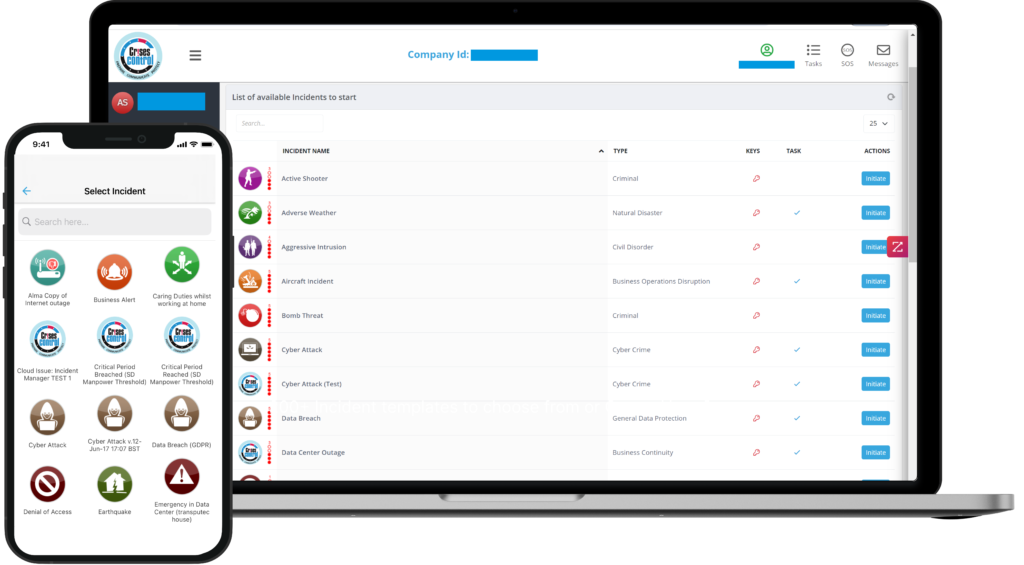
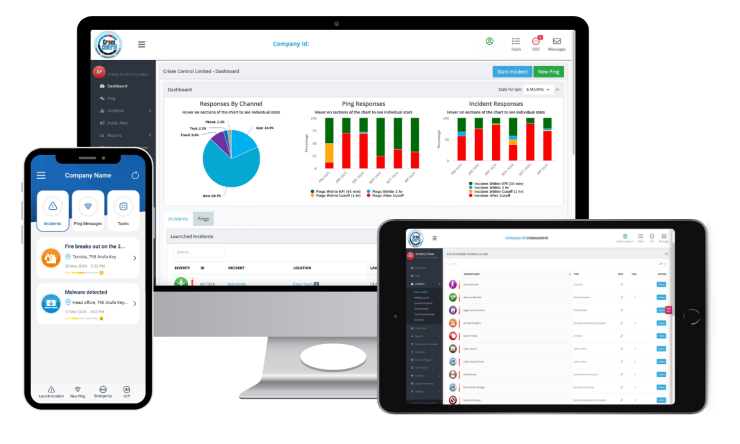
The platform brings incident response into a single, coordinated workflow. When an incident is declared, the right teams are notified immediately across multiple communication channels, with acknowledgement tracking so incident managers know who has received critical information and who still needs to respond.
As the situation develops, response teams can share updates, complete assigned tasks and report progress in real time. Rather than relying on emails, phone calls and separate messaging platforms, everyone involved works from the same operational picture.
The platform also supports organisations managing complex incidents involving multiple teams or simultaneous disruptions. Whether responding to a cyberattack affecting operational systems, severe weather disrupting airport operations or a major transport incident, response activities can be coordinated through a single platform while maintaining visibility across the entire operation.
Every alert, acknowledgement, task and operational decision is automatically recorded, creating a complete audit trail that supports regulatory reporting, post-incident reviews and continuous improvement.
For aviation operators looking to strengthen incident coordination, our Aviation Incident Management Software page explains how the platform supports airport and airline operations.
If your organisation manages road, rail or logistics networks, explore how our Transport And Logistics Incident Management Software helps coordinate complex operational responses across distributed teams.
Applying These Lessons Before The Next Major Disruption
Every major transportation outage leaves behind valuable lessons.
The challenge isn’t identifying what went wrong. Investigations, audits and post-incident reviews usually do that well. The real challenge is making sure those lessons change how the next incident is managed.
The organisations that recover most effectively are rarely the ones with the longest incident response plans. They’re the ones that can activate those plans quickly, coordinate teams confidently and maintain operational visibility throughout the response.
For aviation and transport operators, that means investing in response capabilities that support the people making decisions, not just documenting what they should do. Strong communication, automated workflows, real-time visibility and structured post-incident learning all play an important role in reducing the impact of future disruptions.
The lessons from transportation outages are already available. The opportunity now is to apply them before the next incident tests your organisation.
If you’d like to see how Crises Control’s Incident Response Software helps aviation and transport organisations coordinate major incidents, maintain operational visibility and improve response performance, book a personalised demo and explore the platform in action.
FAQs
1. What Is Incident Response Software?
Incident response software helps organisations coordinate their response to operational disruptions, emergencies and major incidents. It brings communication, task management, operational visibility and reporting into a single platform, allowing response teams to work from the same information. For aviation and transport operators, this reduces delays in decision-making and helps ensure incidents are managed in a structured and coordinated way.
2. What Can Aviation And Transport Operators Learn From Major Transportation Outages?
The biggest lessons from transportation outages are that communication alone is not enough. Organisations also need rapid incident activation, clear operational visibility, coordinated decision-making and accurate documentation. Events such as the Southwest Airlines disruption and the CrowdStrike outage demonstrate how quickly operational issues can escalate when response capabilities cannot keep pace with the disruption.
3. What Are Aviation Incident Response Best Practices?
Aviation incident response best practices include activating response teams quickly, maintaining a shared operational picture, using predefined workflows, tracking response tasks in real time and documenting decisions throughout the incident. Regular training exercises and post-incident reviews also help organisations strengthen their response capability before the next disruption occurs.
4. Why Is Operational Visibility Important During A Major Incident?
Operational visibility allows everyone involved in the response to work from the same real-time information. Instead of relying on separate emails, phone calls or messaging groups, decision-makers can see incident status, completed tasks, outstanding actions and team updates in one place. This helps reduce confusion and improves coordination across multiple departments and locations.
5. How Does Incident Response Software Improve Business Continuity?
Incident response software supports business continuity by helping organisations activate plans faster, coordinate multiple teams, maintain operational visibility and automatically record response activities. It also provides valuable information for post-incident reviews, allowing organisations to learn from previous events and continually improve their response processes.