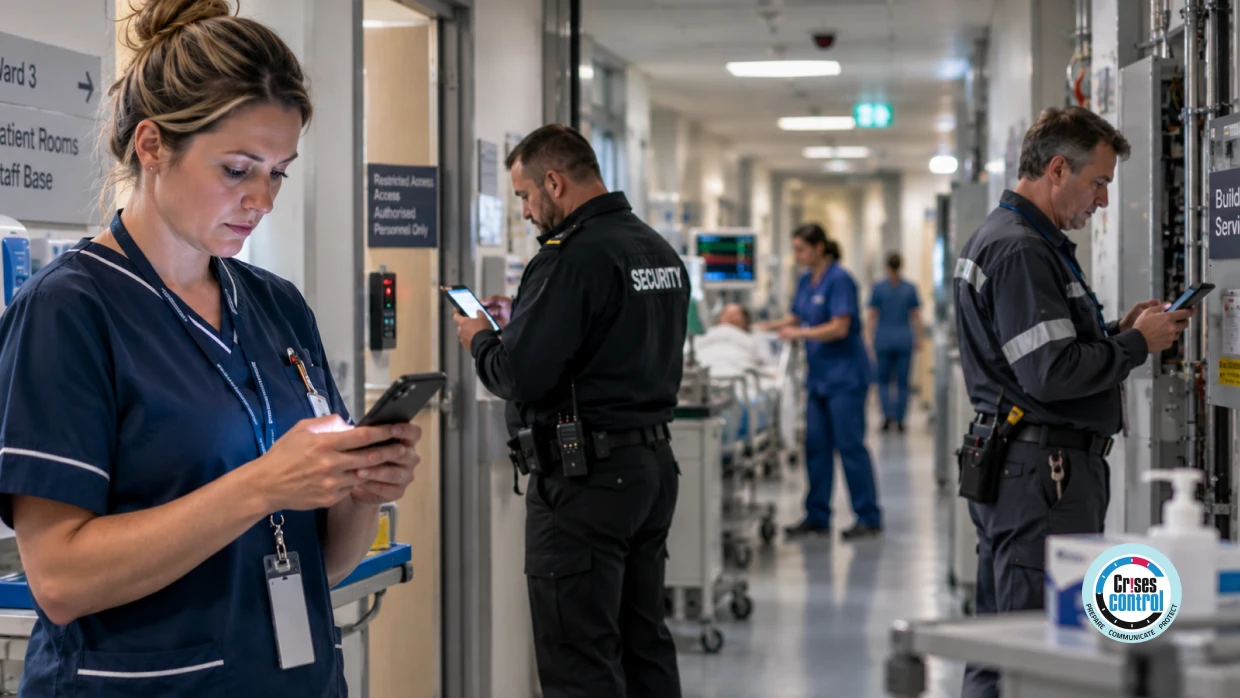
Imagine it is 03:15 on a Sunday morning and a security incident develops in an outpatient building connected to a hospital. Staff in the affected area need to move patients away from the location. Security needs to secure access points. Facilities need to check the building. Clinical leaders need to understand whether patient services are affected. The on-call operations manager needs a clear picture of what is happening.
The first message is not necessarily the difficult part.
The difficult part is knowing who needs to receive it, whether they have responded, what they need to do next and what happens if they cannot be reached.
This is where Emergency Notification Software can provide practical support. A structured system can help healthcare organisations target the right groups, send instructions through appropriate channels, track acknowledgements and escalate when a response is missing.
For hospitals operating across wards, buildings, campuses and shifts, the real test is not whether a message can be sent. It is whether communication can be managed as the incident develops.
When Reaching Staff Becomes An Operational Problem
Return to the hospital incident.
The security team may need to contact people working in the affected building. Clinical staff in nearby areas may need different instructions. Facilities may need to investigate an infrastructure issue. Senior leadership may need a concise operational update.
That is several communication requirements arising from one incident.
A single staff email or general messaging group may reach a large audience, but that does not mean it has reached the people who need to act. Sending more messages can create another problem: people receive information that is not relevant to their role, while the incident team still has limited visibility of who has actually responded.
For a Hospital Operations Director or Emergency Preparedness Manager, a better starting point is to ask:
Can we identify the people who need to act by role, location or responsibility, rather than searching through individual names?
This matters because healthcare staffing changes constantly. On-call rotas change. People move between departments. Agency and temporary workers join teams. Staff may work across multiple sites.
A response process based on yesterday’s contact list can quickly become disconnected from today’s operation.
NHS England’s EPRR standards require organisations to maintain appropriate arrangements for incident response and communications, including a 24-hour, seven-day on-call mechanism and tested communication arrangements.
An Alert Is Only The Start
It is easy to judge an emergency communication system by whether it can send a notification.
That is only one part of the problem.
Consider an evacuation instruction sent to 40 staff members. The message has been delivered, but the incident manager now needs to know whether the people responsible for patient movement have acknowledged it.
If five people have not responded, does the incident manager know who they are?
If one of them is responsible for a critical action, is there an agreed escalation route?
If the situation changes, can the relevant group receive an updated instruction without starting the entire communication process again?
This is where Mass Notification Software can move beyond simple broadcasting. The useful question is not how many messages the system can send. It is whether the system gives the response team enough information to manage what happens after the message has gone out.
A practical communication process should answer five questions:
- Who needs to receive the alert?
- What does each group need to know?
- What action is expected?
- Who has acknowledged the instruction?
- What happens when someone does not respond?
Those questions turn communication from a broadcast exercise into part of the incident response itself.
Why Healthcare Communication Is Different
A hospital does not have a conventional workforce pattern.
A consultant may be on call from home. A nurse may be moving between wards. A facilities engineer may be working on another site. Security staff may be positioned at different entrances. A senior manager may be travelling between locations.
The organisation may have hundreds or thousands of employees, but the people needed for a particular incident could be a relatively small group.
That creates an important distinction between having contact information and having usable response information.
A spreadsheet may tell you that someone works in Facilities.
It may not tell you whether they are on call tonight, whether they are responsible for the affected building or whether another person has taken over that responsibility.
This is why healthcare communication groups should be built around how the organisation actually responds to incidents.
Useful groups might include:
- The current on-call security team
- Facilities managers for a specific site
- Clinical leadership for an affected ward
- Emergency preparedness personnel
- Senior operational leadership
- IT responders for a systems incident
- Staff responsible for patient movement or evacuation
The exact groups will differ between organisations. The principle is consistent: contact structures should reflect response responsibilities, not simply organisational charts.
Acknowledgement Gives The Incident Team Better Information
Imagine the incident manager receives the following information:
Alert sent: 42
That tells them very little.
Now imagine the response picture shows:
Acknowledged: 34
Pending: 5
Failed: 2
Escalated: 1
The second picture is much more useful because it helps identify where communication still needs attention.
Acknowledgement does not prove that someone has completed an action. It confirms that the communication process has received a response from that person. That distinction matters.
A staff member can acknowledge an evacuation instruction without having completed the evacuation. The response team may still need task tracking, verbal confirmation or another operational check.
This is why Emergency Notification Software should support the wider response process rather than be treated as a standalone messaging tool.
The technology provides visibility into communication. People remain responsible for decisions, actions and clinical judgement.
What Happens When Someone Does Not Respond?
Non-response is where many manual communication processes begin to struggle.
A person does not acknowledge the alert.
Someone calls them.
There is no answer.
A colleague tries another number.
Nobody is sure whether that person is unavailable, has missed the message or has already been contacted by someone else.
The incident manager now has another problem to solve.
A defined escalation process can remove some of this uncertainty.
For example:
Initial alert → No acknowledgement → Secondary contact → Manager escalation → Incident lead informed
The actual sequence should be determined by the organisation’s emergency plan. The important point is that the next action should be known before the incident occurs.
This is particularly relevant for emergency communication for healthcare staff, where a missed response may need attention without requiring the incident manager to remember who should be contacted next.
Escalation also needs to reflect changing circumstances. A local security issue may initially involve Security and Facilities. If the incident affects patient services, Clinical leadership may need to be brought into the response. If several sites become affected, senior leadership may require a wider operational picture.
Communication therefore needs to be capable of changing with the incident.
The Assumption That Everyone Should Receive Everything
One common assumption is that emergency communication is safer when everyone receives the same message.
It sounds reasonable. More information should mean better awareness.
In practice, it can make instructions harder to follow.
A nurse caring for patients needs to understand what is expected on the ward. A security officer may need access-control instructions. A facilities engineer may need information about the affected infrastructure. A senior executive may need the operational impact and current response status.
Giving all four people the same detailed message does not necessarily improve the response.
Targeted communication is often more useful.
The incident information should be consistent, but the instruction can be shaped around the recipient’s role.
This principle aligns with the wider approach to incident management found in recognised guidance. ISO 22320:2018 focuses on roles, responsibilities, tasks, information and cooperation within incident management. The standard was reviewed and confirmed in 2024.
For healthcare organisations, this means emergency communication should answer a practical question:
What does this person need to know or do because of their role in this incident?
Where Manual Coordination Starts To Break Down
Manual communication still has a place.
If a small team needs to be contacted about a minor issue, a phone call may be the most sensible option.
The problem appears when several groups need different instructions and the incident team has to monitor responses at the same time.
A manual process might involve finding a contact list, sending messages, waiting for replies, checking responses, calling people who have not replied, recording the results and repeating the process when the situation changes.
The person managing those calls is also trying to understand the incident.
That creates competing demands.
A digital approach can reduce some of the administrative work by bringing contact groups, notifications, acknowledgements and escalation into a defined workflow.
This does not mean removing human decision-making. It means reducing the amount of information the incident manager has to assemble manually.
For organisations reviewing their current approach, this is a useful distinction:
Automation should support the response process, not replace the people responsible for running it.
What A Better Healthcare Communication Process Looks Like
A better emergency communication process starts before the incident.
1. Build Groups Around Response Roles
Identify who needs to be contacted for each scenario. Use roles, locations and responsibilities rather than relying solely on individual names.
2. Prepare Clear Instructions
Decide what each group needs to know and what action is expected. Pre-prepared messages can help reduce the need to write critical instructions from scratch during an incident.
3. Use Appropriate Communication Channels
Different situations may require different channels. SMS, email, voice calls, push notifications or other approved methods may each have a role. Plans should also consider what happens if the normal communication route is unavailable.
NHS England specifically advises healthcare organisations to plan for disruption to communications as part of resilient communications planning.
4. Track Acknowledgement
For important instructions, identify who has acknowledged the message and who has not. This gives the incident team a clearer communication picture.
5. Escalate Non-Responses
Decide in advance what happens when someone does not respond. The escalation route should be clear enough that another team member can follow it without relying on personal knowledge.
6. Test The Process Outside Normal Hours
A process that works at 10:00 on a Tuesday may behave differently at 03:00 on a Sunday.
NHS England’s core standards include communications exercises every six months, alongside other forms of exercising. Its guidance also states that communications plans should be tested alongside incident plans.
This is one of the simplest ways to discover whether contact groups, escalation routes and communication methods reflect how the organisation actually operates.
Where Crises Control Fits
The technology should fit around the hospital’s existing emergency arrangements, helping teams put their plans into action without changing how responsibilities are defined.
Crises Control can support this by bringing targeted notifications, role-based contact groups, acknowledgement tracking and escalation into a structured digital process. Emergency plans can also be digitalised and accessed through the cloud, giving authorised users a practical way to access the information they need during an incident.
For a closer look at how hospitals can structure their emergency arrangements, see our guide to emergency response plans for hospitals.
The focus should remain on the process, not the technology itself. When communication tools are connected to clear roles, responsibilities and escalation procedures, they can make an existing emergency response easier to activate, manage and review.
Test The Process, Not Just The Plan
A hospital can have a detailed emergency plan and still struggle to communicate effectively when an incident occurs.
The most useful test is often surprisingly simple.
Choose one realistic scenario and work through the first 30 minutes.
Ask:
- Who receives the first alert?
- Can those people be identified without searching through individual contacts?
- Does each group receive instructions relevant to its role?
- Can the incident team see who has acknowledged the message?
- What happens when a key person does not respond?
- Can communication continue if the preferred channel is unavailable?
- Who owns the communication process?
- What changes if the incident spreads to another building or department?
This approach tests the part of emergency preparedness that is often hardest to see on paper: whether the process can actually be operated under pressure.
For NHS organisations, these questions also sit within a wider EPRR framework covering planning, response, communications and exercising.
The Real Question Is Whether Communication Can Be Managed
The ability to send an emergency message is useful.
It is not the full measure of emergency communication readiness.
The stronger question is whether the organisation can identify the right people, give them relevant instructions, see who has responded, follow up on non-responses and adapt communication as the situation changes.
That is particularly important in healthcare, where teams work across different locations, shifts and responsibilities and where communication may need to support patient care as well as operational decisions.
Emergency Notification Software can provide the communication layer, but it should sit within a wider response process that defines roles, responsibilities, escalation and decision-making.
For healthcare leaders reviewing their current arrangements, the place to start is not necessarily a new system. Start by testing what happens when the first message goes out.
If the organisation cannot clearly explain who receives it, what they do, who has responded and what happens next, there is an opportunity to strengthen the process.
Crises Control can support that work by connecting emergency communication with structured response workflows, helping organisations move from sending an alert to managing the communication around an incident.
Frequently Asked Questions
What Is Emergency Notification Software?
Emergency Notification Software helps organisations communicate with staff and other relevant groups during an emergency. Depending on the system, it can support targeted alerts, multiple communication channels, acknowledgement tracking and escalation.
Why Do Healthcare Organisations Need Emergency Notification Software?
Healthcare organisations operate across multiple sites, shifts and departments, so the people required for an incident can vary significantly. Emergency Notification Software can help teams identify relevant contacts, communicate instructions and see who has responded.
What Is The Difference Between Mass Notification Software And Emergency Notification Software?
Mass Notification Software generally focuses on sending alerts to groups of people, while a broader emergency notification process can include targeting, acknowledgement, escalation and follow-up. The distinction depends on the capabilities of the system and how the organisation uses it.
How Can Hospitals Improve Emergency Communication For Healthcare Staff?
Hospitals can improve communication by organising contacts around roles and responsibilities, preparing clear instructions, tracking acknowledgements, defining escalation routes and testing alternative communication methods. These arrangements should be exercised regularly so weaknesses can be identified before a real incident.
Can Employee Safety Software Support Healthcare Emergency Response?
Yes. Employee Safety Software can support emergency response by giving staff a way to receive information, request assistance or communicate during an incident, depending on the platform. It should complement the organisation’s wider emergency preparedness and incident response arrangements rather than replace them.
This article was drafted with AI assistance and reviewed by the Crises Control team. Featured image: AI-generated.