Employee Safety Software helps organisations communicate with workers, track responses and maintain visibility of personnel during an emergency. In oil and gas operations, that becomes especially useful during an evacuation because sending an instruction does not tell the incident commander whether everyone is safe.
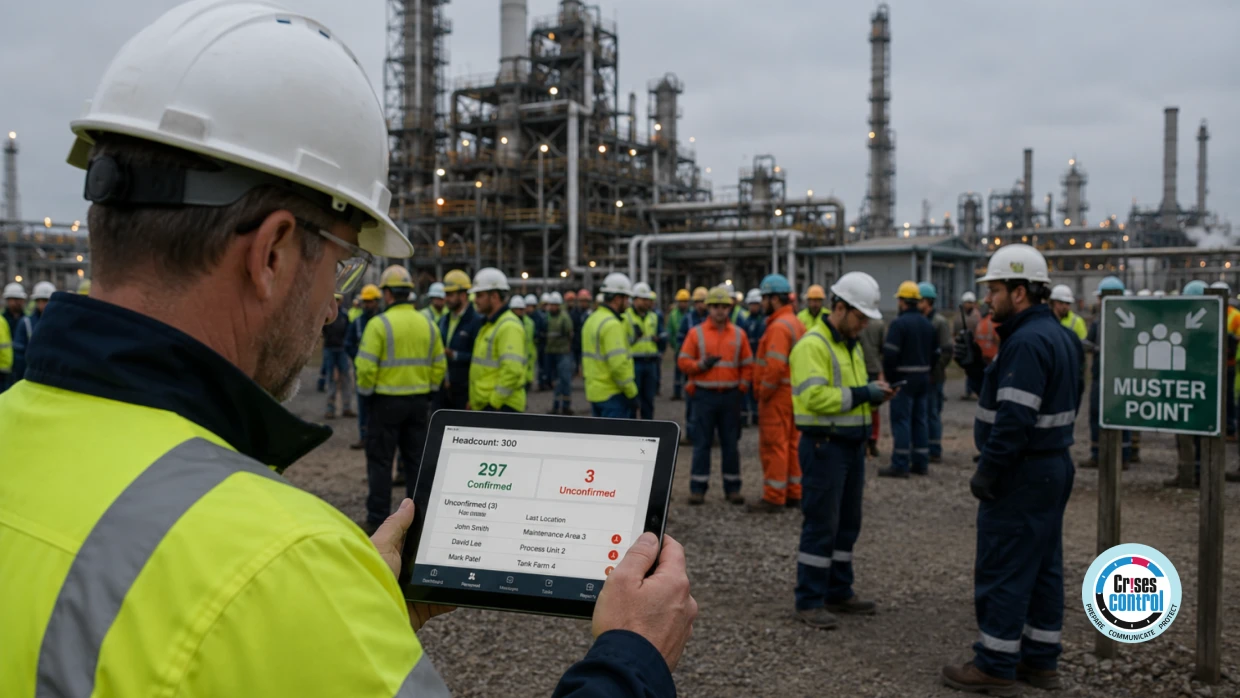
Consider a gas release at a large refinery. An alarm has been raised and the affected processing area is being evacuated. Operations personnel move towards designated muster points, contractors leave maintenance areas and a visiting engineering team follows site personnel towards the assembly area. A lone technician had been inspecting equipment towards the edge of the facility shortly before the alarm.
Within minutes, most personnel have been accounted for, but several remain unconfirmed. One may have left the site before the incident. Another could be at a different muster point. A contractor’s location is unclear, while the lone technician has not responded.
At that point, worker accountability stops being an administrative exercise and becomes operational information. The question is no longer simply whether everyone received the evacuation instruction. The incident commander now needs to know who remains unconfirmed, where they might be and what should happen next.
The solution is not to replace muster points, evacuation procedures or trained response teams with software. It is to connect those processes with better information. A structured accountability process combines physical evacuation procedures with reliable communication, acknowledgement tracking, clear escalation rules and a shared view of unresolved cases.
That distinction is central to effective oil and gas worker accountability during emergencies.
What Is Worker Accountability During An Emergency?
Worker accountability is the process of establishing the status of people who may be affected by an incident and identifying those whose status remains unknown.
During an oil and gas evacuation, that population may extend well beyond permanent employees. Depending on the facility, it can include employees, contractors and subcontractors, shift workers, maintenance personnel, visitors, drivers, lone workers, temporary workers and external specialists.
The objective is not simply to produce a list of names.
The incident response team needs reliable information about who was expected to be affected, who has responded, who has been confirmed safe and who still requires investigation.
This distinction matters because an evacuation instruction answers one question: what were people told to do?
It does not automatically answer the more difficult question: what happened to them afterwards?
The Accountability Problem Begins After The Alert Is Sent
Return to the refinery.
The evacuation instruction has been issued. Most workers are moving towards their muster points. From the outside, the response appears to be working.
Then the accountability reports start arriving.
Muster Point A has one contractor missing from its expected list. Muster Point B has two people who were not expected there because they had been working temporarily in another area. Security believes a missing visitor may have signed out shortly before the alarm, but nobody has confirmed it. A maintenance supervisor cannot reach the lone technician.
The incident commander is now dealing with uncertainty rather than evacuation instructions.
Are these people actually missing? Are they at another muster point? Have they already left the facility? Did they receive the warning? Has anybody spoken to them? Could someone still be inside the affected area?
This is why refinery evacuation accountability cannot be solved by mass notification alone.
The response team needs a process for turning incomplete information into confirmed status, while making sure unresolved cases receive attention.
An Alert Delivered Does Not Mean A Worker Is Safe
One assumption deserves particular scrutiny: if an evacuation alert was successfully delivered, the worker knows what to do and can therefore be treated as accounted for.
That is not enough information to establish someone’s safety.
A message may reach a mobile device while its owner is working in a noisy environment. A worker may acknowledge an instruction but be unable to use the expected evacuation route. Someone may respond to a message and then encounter another hazard.
There are several different states that an incident commander may need to distinguish:
Status | What It Actually Tells The Response Team |
Alert Sent | The system initiated the communication |
Alert Delivered | The communication reached its intended destination |
Alert Acknowledged | The recipient actively responded |
Status Reported | The individual supplied requested information |
Accounted For | The organisation has enough information, according to its emergency procedures, to establish the person’s status |
These states should not be treated as interchangeable.
Emergency Notification Software can help establish whether communications have been delivered and acknowledged. The wider emergency procedure must determine what that acknowledgement means and what further evidence is required before somebody is considered accounted for.
That decision needs to be made before an emergency, not while the incident commander is looking at a list of unanswered names.
Why Oil And Gas Sites Make Worker Accountability Difficult
The accountability problem becomes more complicated in oil and gas because the workforce is rarely static.
Contractors May Not Follow The Same Routine As Employees
Refineries, processing plants, terminals and other facilities can have contractors working alongside permanent employees on maintenance, inspection, construction or engineering work.
Their location may change during a shift. They may also be less familiar with site evacuation procedures than permanent employees.
An accountability process that relies solely on the permanent employee structure may therefore start with an incomplete picture of who is actually affected.
Shift Changes Create A Moving Population
An incident around a shift change creates another problem.
Some workers may already have arrived for the next shift while others are preparing to leave. The people scheduled to be on site and the people physically present may not be the same.
The response process needs to establish who was actually present rather than assuming the staff roster provides the answer.
Lone Workers Create Different Information Gaps
A lone worker may not have a colleague who can immediately confirm their status.
If that person fails to respond, the absence of an acknowledgement becomes useful operational information, but it still does not explain what has happened.
The emergency plan should define what comes next. Who attempts contact? Which channels are used? When is the person’s status escalated? Who investigates their last known work area if that becomes necessary and safe?
Those decisions should not depend on somebody improvising during the evacuation.
Visitors Need To Be Part Of The Process
Visitors may have limited knowledge of alarm signals, muster arrangements and evacuation routes. Their safety may depend heavily on their host, escort or nearby personnel.
Visitors therefore need to be part of the accountability process rather than treated as an administrative exception.
Why Paper Muster Lists Can Struggle Under Pressure
Paper muster lists can remain useful, including as a contingency when digital systems are unavailable. The problem is not paper itself. The difficulty is consolidating changing information from several places.
Imagine three muster points reporting independently.
One list has a worker marked absent who appears on another list. A supervisor reports by radio that a contractor went home early. Security is checking whether a visitor signed out. The response team is trying to reach an unconfirmed technician.
Someone now has to turn those separate updates into one accurate picture.
That can lead to duplicate names, outdated information, delayed reconciliation, confusion between absent and unconfirmed workers, verbal updates that are not recorded and uncertainty about when someone’s status changed.
The useful question is therefore not whether a manual process can work. It is whether that process can provide sufficiently accurate and timely information for the size, workforce structure and risk profile of the facility.
Manual Accountability Vs Digitally Supported Accountability
Digital systems do not remove the need for muster points, supervisors, trained response teams or site-specific evacuation procedures. They change how information moves between those people and processes.
Manual Approach | Digitally Supported Approach |
Calls and radio updates consolidated manually | Response information available centrally |
Paper lists reconciled between muster points | Digital responses available to authorised teams |
Supervisors manually chase non-responders | Predetermined escalation supports follow-up |
Updates may remain with individual teams | Relevant response information can be shared |
Records reconstructed after the event | Activity recorded as the response develops |
Status depends heavily on verbal reporting | Acknowledgements and responses can be tracked |
The objective is not digitalisation for its own sake.
It is to reduce the amount of important information that exists only in someone’s notebook, radio conversation, memory or spreadsheet when the incident commander needs it.
How Employee Safety Software Helps Identify Unconfirmed Workers
This is where Employee Safety Software can support the accountability process.
Suppose an evacuation notification is issued through several communication channels and workers are asked to acknowledge the instruction. Responses begin arriving while the physical evacuation continues.
The response team can now distinguish between people who have responded and those who remain unresponsive.
An acknowledgement does not prove that somebody is safe. What it provides is another piece of information that can be combined with the physical accountability process.
A simple response sequence might be:
Alert issued → acknowledgement requested → no response received → follow-up communication → escalation under the emergency plan.
Instead of relying on somebody to remember which workers require another call, the process can be defined in advance.
For a large site, this can make the unconfirmed population easier to identify and investigate.
What Should Happen When Someone Remains Unconfirmed?
An unconfirmed worker should trigger a predefined process, not an assumption that the person is missing or safe.
A practical five-step structure can help.
Step 1: Confirm Whether The Person Should Be Included
Establish whether the individual should actually be part of the affected population. Check available shift, contractor, visitor and site information.
Step 2: Check Existing Responses
Has the person acknowledged the emergency communication? Have they responded through another approved route? Has a supervisor or muster coordinator already reported their status?
Step 3: Attempt Follow-Up Communication
Where the emergency plan allows it, use appropriate communication channels to request confirmation.
A worker who misses a push notification may respond to an SMS or telephone call. Multi-channel communication provides more than one route for contact.
Step 4: Escalate The Unconfirmed Status
If the person remains unconfirmed, responsibility should pass through a predetermined escalation route.
Someone should own the next action. The process should not depend on an incident commander noticing a name on a list and deciding from scratch what to do.
Step 5: Update The Shared Record
If the worker is subsequently confirmed safe, that information should reach the people who need it.
The objective is to prevent one team from continuing to treat somebody as missing after another team has already established their status.
Two-Way Communication Changes The Accountability Question
Emergency communication is often measured by reach: how many people can receive an alert?
Worker accountability introduces another question: what information comes back?
The incident team may need recipients to confirm an instruction, answer a question or report their status.
That means an emergency communication process should define:
- who needs the message
- which channels should be used
- what response is required
- what that response means
- how long the team waits
- what happens when there is no response
- who owns the next action
This turns communication into part of the incident workflow rather than a one-way broadcast.
For more detail on the wider coordination problem during the opening phase of an incident, see Oil And Gas Emergency Response: Why The First 10 Minutes Determine Everything.
Worker Accountability Is Also An Information Problem
Physical safety measures remain fundamental in oil and gas operations. Detection systems, evacuation routes, muster arrangements, PPE, trained personnel and emergency response teams cannot be replaced by software.
But during an evacuation, the incident commander’s ability to protect people also depends on knowing what is known, what remains uncertain and where action is required.
Imagine a facility with 300 people in the affected population. If 297 have been confirmed, the response is not finished because 99 per cent of the population has been accounted for.
Operationally, the three unresolved names may now be the most important information available.
Those workers cannot disappear into a percentage. Their status needs to be investigated and resolved according to the emergency plan.
That is why accountability should focus on exceptions, not just totals.
What Recognised Emergency Planning Guidance Says About Accountability
Worker accountability is not simply a software concept.
For US workplaces where an Emergency Action Plan is required, OSHA states that the plan must include procedures to account for workers following an evacuation. OSHA’s emergency preparedness guidance also recommends identifying the names and last known locations of anyone who remains unaccounted for and passing that information to the person in charge or emergency responders.
Requirements differ between jurisdictions and facilities, so oil and gas operators need to follow the legislation and recognised guidance applicable to their own operations.
The broader operational principle is useful across locations: an evacuation process needs a way to identify unresolved people, communicate that information and assign responsibility for what happens next.
Where Crises Control Fits Into The Process
Crises Control does not replace physical evacuation procedures or determine whether somebody is safe.
Its role is to support the information and coordination around those procedures.
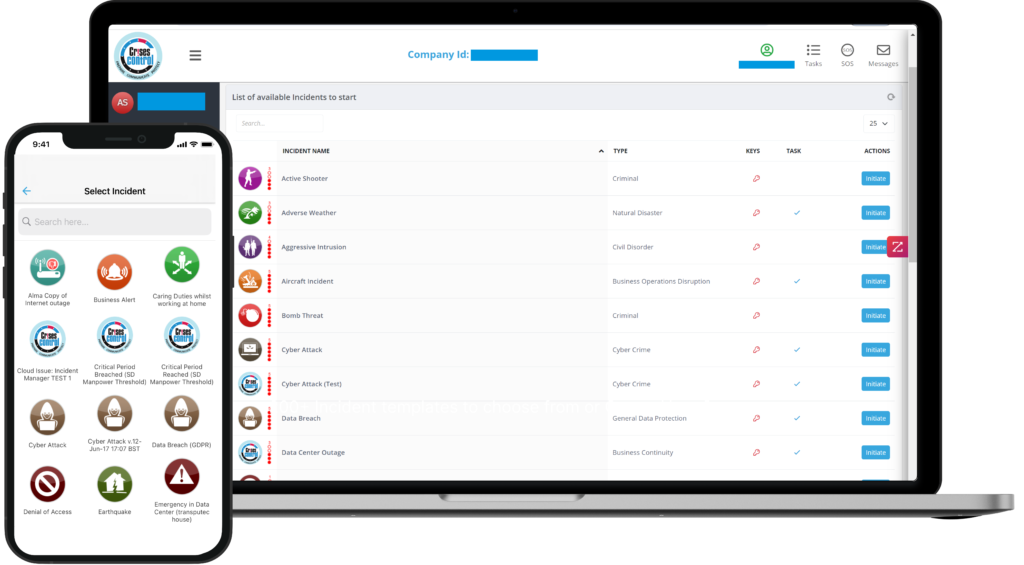
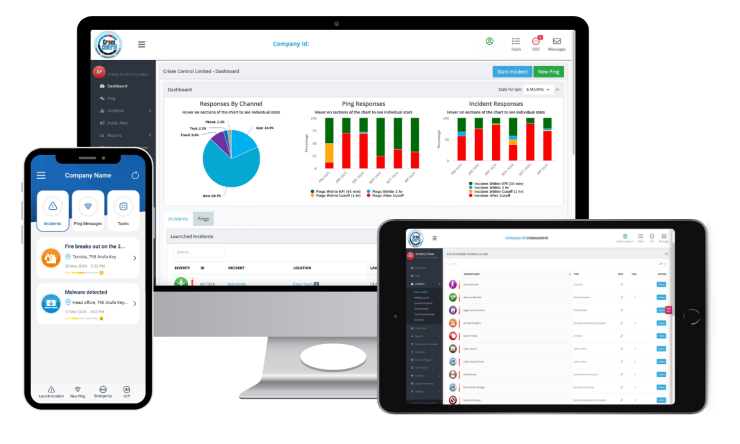
For example, response plans can be digitised so predefined roles, actions and communications are available when an incident is activated. Multi-channel notifications can be sent through SMS, email, push notifications and voice calls, with responses and acknowledgements visible to authorised users. Crises Control also supports task management and incident records, allowing response activity to be tracked as the incident develops.
This can help an HSE Manager or Emergency Response Manager answer practical questions such as: who received the communication, who responded, which actions remain outstanding and who owns the next task?
Our Workplace Safety Software provides further information on how these capabilities can support employee safety and incident response.
The important limitation remains the same: software cannot declare every worker safe. What it can do is make communication gaps and outstanding responses easier to see, while maintaining a structured record of what happened next.
Interested in our Incident Management Software?
Flexible Incident Management Software to keep you connected and in control.
Test Accountability, Not Just Evacuation
An evacuation drill should test more than whether workers know where to go.
It should test the complete information chain.
Could the organisation identify the people actually affected? Did the right population receive the instruction? Could workers respond? Were contractors, visitors and lone workers included? Could the response team distinguish acknowledgement from confirmed safety? Were unconfirmed people identified and escalated? Did each unresolved case have an owner?
The drill should also test conflicting information.
What happens if a worker acknowledges the emergency notification but does not appear at the expected muster point? What if somebody appears at the wrong muster point? What if a contractor is on the roster but their supervisor says they left the site before the alarm?
These are useful exercise injects because they test the part of accountability that is hardest to reproduce on a checklist: uncertainty.
A successful exercise is not simply one in which everyone eventually reaches the right place. It is one that shows whether the organisation can recognise incomplete information, assign responsibility and resolve it without creating confusion elsewhere in the response.
Can You Account For Every Worker?
Sending an evacuation instruction is only the beginning of worker accountability.
The harder part comes afterwards, when most people are safe and a small number remain unconfirmed. That is where the quality of the process becomes visible.
A strong approach combines clear emergency procedures, realistic exercises, reliable communication, acknowledgement tracking, defined escalation and a shared incident record. Employee Safety Software can support that structure by making communication gaps and unresolved responses easier to identify without replacing physical accountability procedures or professional judgement.
For an HSE Manager, Emergency Response Manager or Site Operations Manager, there is one useful question to take into the next evacuation exercise:
If three people were still unconfirmed ten minutes into the evacuation, would we immediately know who they were, who was responsible for following up and what should happen next?
If the answer is unclear, the exercise has identified a gap worth fixing.
If your organisation is reviewing how it accounts for employees, contractors, visitors and lone workers during emergencies, Crises Control can help structure the communication, acknowledgement, escalation and incident response processes that support worker accountability.
FAQs
1. What Is Employee Safety Software?
Employee Safety Software helps organisations communicate with workers and monitor responses during safety incidents and operational disruptions. During an emergency, it can support notification, acknowledgement tracking, two-way communication and escalation so response teams can identify people who have not responded.
2. Does Acknowledging An Evacuation Alert Mean A Worker Is Safe?
No. An acknowledgement confirms that somebody responded to the communication. It does not necessarily confirm their physical safety. Organisations should define how acknowledgements contribute to their wider evacuation and accountability procedures and what further confirmation is required.
3. How Can Oil And Gas Operators Account For Contractors During An Evacuation?
Contractors should be included in the site’s emergency accountability process rather than treated separately from the affected population. Operators need a way to identify who is present, communicate evacuation instructions, reconcile their status and escalate cases where somebody remains unconfirmed.
4. How Does Emergency Notification Software Support Refinery Evacuations?
Emergency Notification Software can distribute instructions through multiple communication channels, request acknowledgements and help response teams identify recipients who have not responded. This information can then support the wider refinery evacuation accountability process.
5. What Should Organisations Test During An Evacuation Drill?
Organisations should test more than evacuation speed. Exercises should assess whether the correct population can be identified and contacted, whether responses can be monitored, whether unconfirmed personnel are escalated correctly and whether the incident team can maintain an accurate operational picture throughout the exercise.