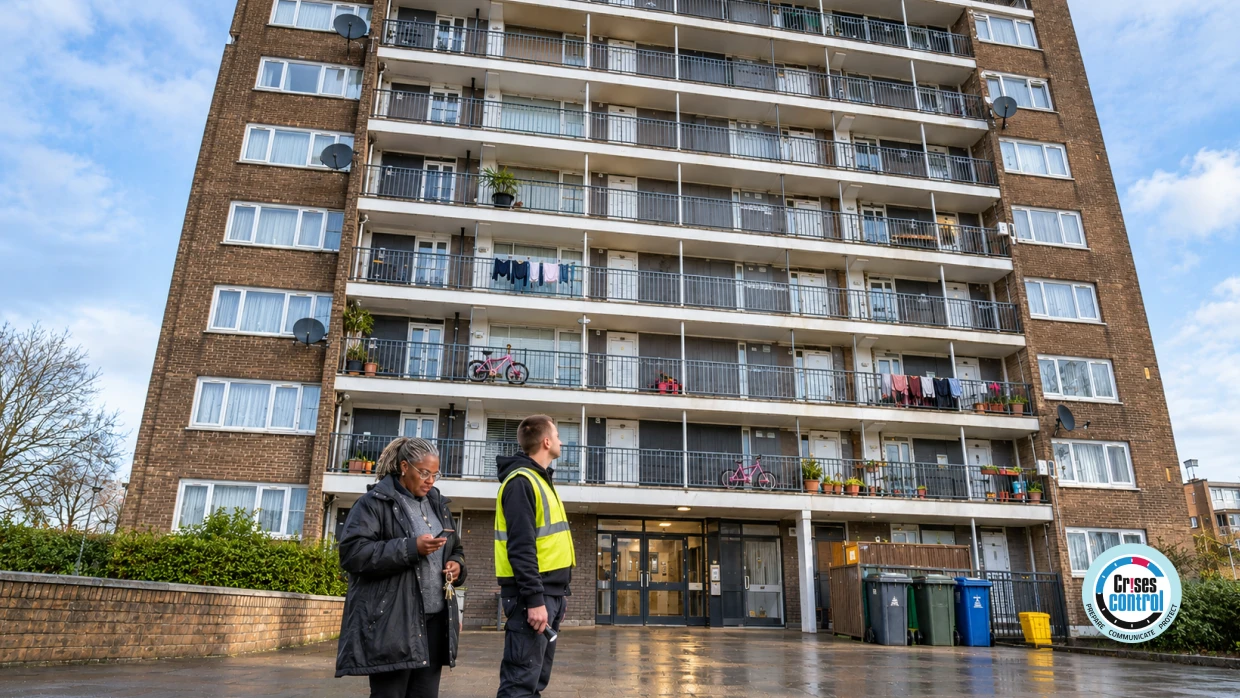
The fire alarm panel in a fourteen-storey block reports a fault across four floors shortly after midnight. By 02:00 a waking watch is walking the corridors, and the building has moved from stay put to simultaneous evacuation until the system is repaired. In 120 flats, nobody knows any of this.
Resident communication is the part of a building incident that residents actually experience, and a printed notice in the lobby does not deliver it. The engineering job comes with a contractor and a phone number attached. The job of telling 120 households what has changed and what to do tonight often comes with neither.
Resident communication during a building incident means sending each household the instruction that applies tonight, in a form they can act on, and recording which households received it. Displayed fire safety instructions cover the permanent evacuation strategy. They are not a channel for an unfolding incident.
What Is Resident Communication In A Building Incident?
Resident communication is the practice of sending every household in a building the instruction that applies to the incident in front of them, in a form each household can act on, and then confirming who received it. It is separate from the fire safety information a block displays permanently, which describes the standing evacuation strategy rather than tonight.
The test is whether the message changes what somebody does. “The fire alarm system has a fault” gives a resident nothing to act on. “Do not wait for the alarm tonight, and leave by the nearest staircase if you see fire or smell smoke” does.
Why Does A Lobby Notice Not Count As Telling Residents?
A lobby notice satisfies a display duty, and a display duty is not a channel. The residents who most need to know about a fault at one in the morning are already home and asleep, and will not pass the noticeboard until they leave for work. The notice reaches them hours after the decision that affects them.
Resident communication fails at exactly that point, and three practical problems follow. None of them is about compliance:
- It cannot be revised at speed. A watch arranged at 02:00 and stood down the next afternoon needs two notices, printed and walked to the building twice
- It carries no sender and no route back, so a resident who reads it has nobody to ask
- It leaves no record, so the question of how residents were told has no answer six weeks later
What Does The Law Require You To Tell Residents?
Two separate regimes apply to blocks of flats in England. The Fire Safety (England) Regulations 2022 require the responsible person to display fire safety instructions and give every resident a copy. The Building Safety Act 2022 requires the accountable person for a higher-risk building to provide building safety information and run a residents’ engagement strategy.
Regulation 9 of the Fire Safety (England) Regulations 2022 has applied in England since 23 January 2023. It covers any building with two or more sets of domestic premises and common parts residents would evacuate through. The instructions must be in a comprehensible form residents can reasonably be expected to understand, and must cover the evacuation strategy for the building, how to report a fire to the fire and rescue authority, and anything else residents must do once a fire has occurred.
The two duties are not interchangeable, and the regulations say so. Regulation 8 of the Higher-Risk Buildings (Management of Safety Risks etc) (England) Regulations 2023 states that the duty to display prescribed information is without prejudice to the duty to give that information to residents. Displaying is one obligation and delivering is another. This summary is orientation rather than legal advice, and the position is as at November 2026.
How Should The Message Match The Building’s Evacuation Strategy?
The evacuation strategy sets the words, not the person writing the message. A stay put block asks residents to remain in their flat unless their own flat is affected, because compartmentation is doing the work. A simultaneous evacuation block asks everybody to leave. A message contradicting the strategy on the front door is worse than none.
A fault suspends that arrangement temporarily, which is what catches teams out. When detection cannot be relied on, a stay put building may move to simultaneous evacuation with a waking watch until repairs are finished. An instruction residents have followed for years is off for two days, and nobody deduces that from a fault code.
“The fire alarm in your building has a fault and is not working on floors 8 to 11. A fire warden is patrolling tonight. Until the alarm is repaired, do not wait for it to sound. If you see fire or smell smoke, leave by the nearest staircase and call 999. Reply 1 to confirm you have read this.”
That message names the fault, the floors, the interim arrangement and the instruction replacing the standing one, and it asks for one thing back. The standing arrangements are separate work, set out in this guide to the evacuation process.
Which Approach Actually Reaches A Whole Block?
A targeted message reaches a whole block, and displayed instructions reach whoever walks past them. Both have a job and a building needs both, but only one can carry an instruction that changes at 02:00 and stands down the next afternoon. The difference shows up in four places.
The table compares the two on what they carry, how fast they change, who they reach and what they leave behind. Public safety communication software is judged on the right-hand column.
How Do You Reach Residents Who Are Not On A Staff Directory?
Residents are not employees, so no joiners and leavers process maintains the list. Lettings records hold what is needed to collect rent, which is not what is needed to reach somebody at 01:30. Mobile numbers change, flats get sublet, and the leaseholder on file may live two hundred miles away.
The Building Safety Act 2022 legislates around that gap. A copy of the information an accountable person must provide goes to residents and to owners of residential units, and the duty towards a resident the accountable person does not know about falls away only if all reasonable steps have been taken to find out who lives there. Reasonable steps are continuing work, not a one-off data cleanse.
Comprehensible form is the other half of the problem, and a legal standard rather than a courtesy. Section 89 of the Building Safety Act 2022 allows regulations to require information in an accessible form, and the 2023 regulations ask for plain English summaries of anything technical. In 120 flats that means planning for four groups a standard message misses:
- Households where nobody reads English comfortably, who need the message in their own language rather than a leaflet about translation services
- Residents who cannot use stairs unaided, for whom leaving by the nearest staircase is not an instruction they can follow
- Residents who are deaf or hard of hearing, who will not hear a sounder or a warden knocking
- Residents with no smartphone, where SMS and a voice call are the only routes in
Teams running a portfolio usually find the list is the bottleneck rather than the sending. That is the case for holding resident contacts alongside the incident record in Property Management Incident Management Software, rather than in a spreadsheet owned by whoever is on call.
How Does Crises Control Support Resident Communication?
Crises Control supports resident communication through Ping, its mass notification software. Ping notifies tenants, staff and contractors across SMS, voice, email, push notification and Microsoft Teams, so one message reaches every household in a building, or across a portfolio, at once. Recipients acknowledge with one tap and every delivery is timestamped.
Acknowledgements are tracked as they arrive, which turns a send report into something a warden can use. A list of forty flats that have not acknowledged is a set of doors to knock on. A delivery report of 120 out of 120 is a comfort and nothing more. Notifications can also be set to cascade across channels until somebody acknowledges.
Groups are the part worth building before the night. A block can be held as its own group, with sub-groups by floor, for non-resident leaseholders who need to know about the incident but must not be told to evacuate, and for residents who need another language or a second contact. On the night the on-call manager picks the floors affected rather than assembling recipients from a tenancy spreadsheet. This is what Public Safety Communication Software is built to do.
What the software does not do is decide whether a block stays put or leaves. That decision sits with the responsible person, on advice from the fire and rescue service, and it stays a human judgement. The platform carries the decision to 120 households and records which households it reached. Alert-only tools stop at the sending, and planning platforms hold the strategy without running the night; the work sits between the two.
Resident Communication Checklist
Eight checks, each answerable yes or no tonight by whoever is on call, without ringing anybody for help:
- Every household has at least one contact route tested in the last six months
- Resident groups match the building, by floor and by core, with non-resident leaseholders held apart
- Language and accessibility needs are recorded against households rather than remembered
- Templates exist for a detection fault, a temporary change of evacuation strategy and a stand-down
- Those templates were checked against the building’s real evacuation strategy by whoever owns it
- The on-call manager can send to a floor range without help from an office-hours team
- Acknowledgement is switched on, and the unacknowledged list reaches whoever is in the building
- Messages, acknowledgements and times are retrievable as one record months afterwards
Getting The First Hour Right In A Block Of Flats
The first hour is the part residents remember, and it is decided by preparation rather than speed. A block where the groups, the templates and the language preferences already exist can tell 120 households what has changed in minutes. A block without them spends that hour building a contact list instead, which is the gap public safety communication software is meant to close.
Reaching residents is also only the opening move. The fault needs an engineer, the waking watch needs a rota and a brief, and somebody has to decide when the arrangement ends. Resident communication is where an incident becomes visible to the people living inside it, which is why it belongs in the response rather than beside it. If a building team can answer the eight checks above tonight, the next question worth asking is who coordinates everything that follows, across a landlord, a managing agent and several contractors.
Frequently Asked Questions
What is resident communication in a block of flats?
Resident communication in a block of flats is the practice of sending every household the instruction that applies to a live incident and confirming who received it. It is a separate duty from displaying fire safety instructions in the common parts. Displayed instructions describe the building’s permanent evacuation strategy, while an alert describes what has changed tonight and what residents should do about it.
Is a notice in the lobby enough to tell residents about a fire alarm fault?
No. Displaying fire safety instructions meets regulation 9 of the Fire Safety (England) Regulations 2022, and regulation 8 of the Higher-Risk Buildings (Management of Safety Risks etc) (England) Regulations 2023 states that the duty to display prescribed information is without prejudice to the duty to give that information to residents. Displaying and delivering are two separate obligations. A notice also cannot be revised quickly and leaves no record of who read it.
Who is responsible for telling residents about a fire safety issue?
Under the Fire Safety (England) Regulations 2022 the responsible person must display fire safety instructions and give each resident a copy. Under Part 4 of the Building Safety Act 2022 the accountable person for a higher-risk building must provide building safety information to residents. The same organisation often holds both roles, and where a managing agent is involved it should be confirmed in writing.
How to alert residents in a high-rise building when the alarm has a fault?
Send a targeted message to every household on the floors affected, naming the fault, the interim instruction and any waking watch, then ask for an acknowledgement. Treat it as a sequence rather than a single alert: the fault, the interim arrangements, then the stand-down. Use SMS or a voice call alongside any app, because every resident list contains people without a smartphone. The property management incident management approach keeps those groups ready in advance.
How do you reach tenants in a social housing emergency when contact details are out of date?
Treat the contact list as standing work rather than incident work. Capture a mobile number and a language preference at tenancy start and at every property visit, hold non-resident leaseholders separately, and send a harmless test message twice a year so failures surface before an emergency does. Good contact data is the part that cannot be bought on the night.
This article was drafted with AI assistance and reviewed by the Crises Control team. Featured image: AI-generated.