
Incident Management Software is a digital platform that structures how organisations detect, respond to, and learn from operational events. Incident governance is the framework that sits around that software: the policies, roles, oversight mechanisms, and accountability structures that determine who has authority to do what during a crisis, how decisions are made, and how performance is reviewed. Without strong governance, even the best incident management platform will underperform, because the people using it will not have the clarity and authority they need to act decisively.
Consider a financial services firm that has invested in a capable incident management platform, integrated its business continuity plans, and conducted quarterly testing. On a Tuesday morning, a confirmed cyber attack hits its core banking systems. The Head of Information Security triggers the incident in the platform. Notifications go out. Tasks are assigned. But within fifteen minutes, there is confusion about who has the authority to take the affected systems offline. Two senior managers hold different views. One believes it is an operational decision. The other believes it requires board-level sign-off. The system is waiting for a decision. The decision is waiting for clarity about who can make it.
The platform is functioning exactly as designed. The governance framework has failed. And the delay is the difference between a contained incident and a significant one.
What Incident Governance Means in Practice
Incident governance is not a single policy document. It is a set of interconnected structures that determine how an organisation manages incidents with consistency, accountability, and oversight. It covers five areas: authority and role clarity, escalation protocols, communication governance, compliance and audit oversight, and continuous improvement.
Authority and role clarity means that every person involved in an incident response knows what they are authorised to do, what decisions they can make without escalating, and who holds authority over decisions that exceed their remit. In regulated financial services organisations, this clarity is not just operationally useful. It is a requirement. The FCA’s operational resilience framework expects firms to have clear governance structures that ensure the right people are making the right decisions during disruptions.
Escalation protocols define the conditions under which a decision must be elevated to a higher level of authority and the mechanism for doing so. Good escalation protocols are pre-defined, proportionate, and embedded in the incident management system. They do not depend on individuals knowing the right person to call. They are triggered by conditions, and the system supports the escalation by notifying the appropriate level automatically.
Good incident governance does not slow down the response. It makes the response faster, because every person involved knows exactly what they are authorised to do and does not need to pause to ask.
The Role of Incident Management Software in Governance
Incident Management Software supports governance by making governance structures operational rather than theoretical. A governance framework that exists only in a policy document is not governance in practice. It is governance on paper. The structures need to be embedded in the tools used to manage incidents, so that they are active during the event, not consulted after it.
Role assignment in the platform is the most direct form of this. When roles are pre-configured in the incident management system, the governance structure is activated automatically when an incident is triggered. The Fire Warden receives their task assignment without needing to be individually contacted. The Head of IT receives the escalation notification at the point defined by the protocol, not at the point when someone remembers to call them. The senior management team receives the silent alert defined in the plan, allowing them to assess the situation before deciding whether to communicate more widely.
Escalation paths configured in the system mean that delays in acknowledgement trigger automatic escalation, rather than depending on an incident manager to notice the gap and take action manually. This removes the human bottleneck from the escalation process and ensures the governance structure performs consistently under pressure, when cognitive load is highest and the temptation to skip steps is greatest.
The audit trail generated by the platform is the governance record. It shows not just what happened, but whether the governance structure was followed: whether the right people were notified at the right points, whether escalation was triggered when the protocol required it, and whether decisions were made within the authority levels defined in the governance framework. Incident Reporting Software that generates this record automatically provides the evidence base for governance oversight without requiring additional documentation effort.
Incident Governance Best Practices for Regulated Organisations
For financial services and insurance organisations, incident governance needs to meet a dual standard: it needs to work operationally, enabling fast and effective responses under pressure, and it needs to satisfy regulators and auditors that the organisation has appropriate oversight and accountability structures in place. The following practices address both requirements.
How Mature Is Your Incident Governance?
Not every organisation approaches incident governance with the same level of maturity. Some rely on individual judgement and informal decision-making, while others embed governance directly into their operational processes and technology. The framework below provides a simple way to assess where your organisation sits today and where it should aim to be.
Governance Level | Characteristics | Business Impact |
Reactive | Authority is unclear and decisions depend on individuals. | Delays, inconsistent decisions and increased operational risk. |
Defined | Roles, responsibilities and escalation paths are documented in policies and plans. | Greater consistency, but governance still relies heavily on manual execution. |
Operational | Governance is embedded within Incident Management Software through role-based permissions, automated workflows and escalation rules. | Faster decision-making with fewer bottlenecks and improved response consistency. |
Integrated | Governance is connected with identity management, communications, reporting and other business systems. | Stronger oversight, improved compliance and better cross-functional coordination. |
Optimised | Governance is regularly tested, reviewed and improved using incident data, exercises and post-incident reviews. | Continuous operational resilience, stronger board confidence and greater regulatory assurance. |
Most organisations don’t progress from reactive governance to optimised governance overnight. Maturity develops through clearly defined authority, consistent processes, regular testing and the right supporting technology. The best practices below provide a practical framework for strengthening incident governance and building a more resilient organisation over time.
Define and Document Decision Authority Before Incidents Occur
The most important governance decision is made before any incident happens: defining exactly what each role is authorised to decide, without escalation. This includes decisions about system shutdowns, external communications, building evacuations, and business continuity plan activation. Each of these decisions needs a clearly named authority level, documented in the governance framework and reflected in the incident management system.
Ambiguity about decision authority is among the most common causes of delayed incident response in regulated organisations. When two senior managers hold different views about who has the authority to take a system offline, or when a team leader is unsure whether they are authorised to trigger an evacuation, the delay is a governance failure, not a capability failure. Crisis Management Software that reflects the governance structure in its role assignments and escalation paths removes that ambiguity.
Build Escalation Protocols into the Platform, Not the Policy
Escalation protocols that exist only in a policy document are consulted in calm conditions and forgotten under pressure. Escalation protocols embedded in the incident management system are active during the incident, regardless of the pressure the team is under. When a recipient does not acknowledge a notification within the defined timeframe, the system escalates without requiring a human decision. When an incident crosses a severity threshold, the system notifies the appropriate management level automatically.
For financial services organisations conducting quarterly testing, the escalation log from each test is a valuable governance data point. It shows whether escalation protocols are performing as designed: whether the defined timeframes are realistic, whether the right people are being reached at the right points, and whether the governance structure functions as intended under realistic conditions.
An escalation protocol that exists only in a document is a plan. An escalation protocol embedded in a platform is a governance structure. The difference is what happens under pressure.
Govern Communications as Carefully as Decisions
Communication governance is a component of incident governance that is frequently overlooked. Who is authorised to send what messages, to which groups, through which channels, and at what point in the incident, is a governance question with significant implications for operational efficiency and regulatory compliance.
If any member of an incident response team can send any message to any group at any time, the communication record will be chaotic and difficult to defend. If communications are governed by role assignments in the incident management platform, the record shows a structured, authorised communication flow. Mass Notification Software that supports role-based communication, where only designated roles can send specific message types to specific groups, translates the governance framework into an operational reality.
For organisations required to maintain GDPR-compliant data handling during incidents, communication governance also determines how employee personal data is used in the notification process. Platforms that support GDPR-aligned workflows ensure that data usage during incident communications is compliant with the organisation’s data protection obligations, and that the compliance record is available for review.
Establish a Board-Level Oversight Function
Incident governance in regulated financial services organisations needs to extend to board level. The board is responsible for the organisation’s operational resilience, and that responsibility requires visibility into how incidents are being managed, what the incident record shows, and what improvements are being made.
Quarterly reports to the board on incident trends, response performance against defined standards, and the status of actions arising from post-incident reviews are a standard governance practice for organisations operating under the FCA’s operational resilience framework. Incident Reporting Software that can produce these reports automatically from the platform’s data removes a significant administrative burden and ensures the board is reviewing reliable, consistent information rather than manually compiled summaries.
For pension funds and asset managers with smaller incident management teams, the governance model may differ in scale but not in principle. Even where the senior management team is small and the incident management function is embedded in a broader risk or operations role, the governance requirements are the same: clear authority, defined escalation, documented communications, and a reliable audit trail.
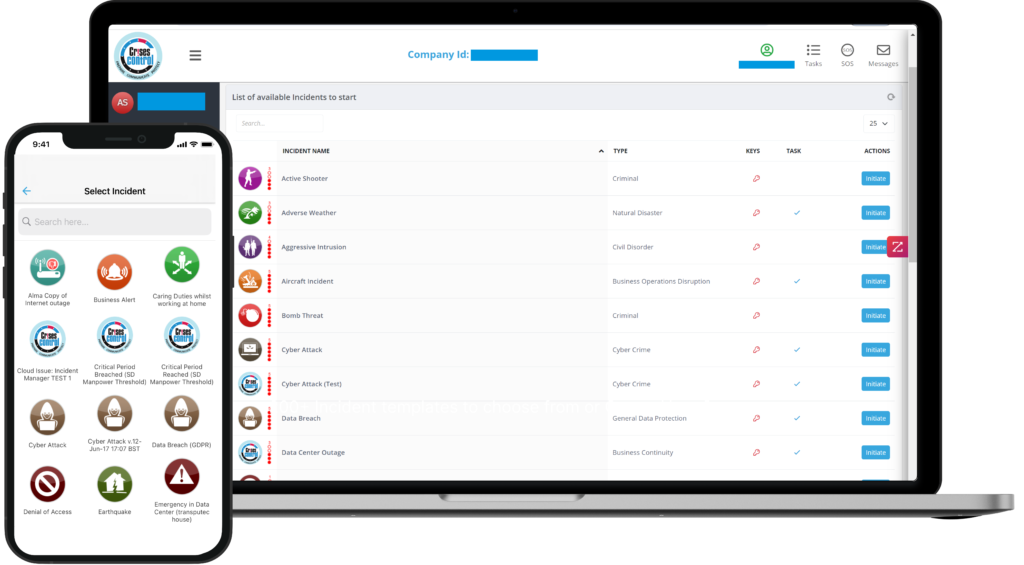
Interested in our Incident Management Software?
Flexible Incident Management Software to keep you connected and in control.
How Incident Management Software Operationalises Governance
Effective Incident Management Software should do more than notify people or store response plans. It should operationalise governance by embedding authority, escalation, communication and accountability directly into the incident response process.
The distinction matters for governance, because governance structures that are embedded in the execution layer are the ones that function consistently under pressure. Crises Control’s approach to incident management is built around operationalising governance, not just documenting it.
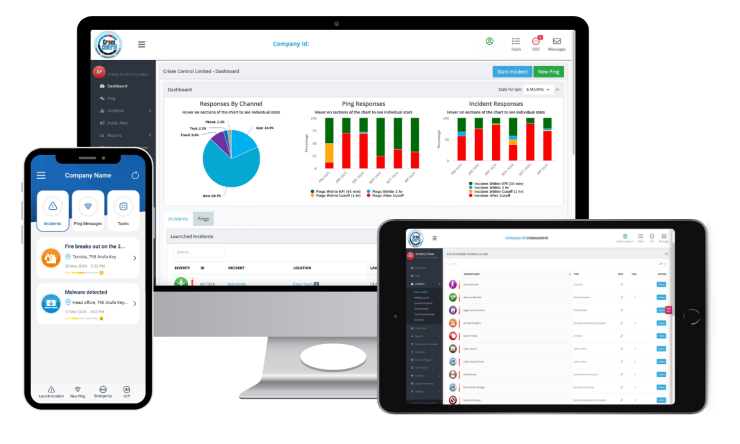
Role-based response ensures that every individual in the incident management system knows their responsibilities before an incident begins. Pre-assigned roles activate automatically when an incident is triggered. The governance structure does not depend on someone remembering to contact the right person. It is built into the system.
Configurable escalation paths translate escalation protocols from policy documents into system behaviour. When an acknowledgement is not received within the defined timeframe, the escalation happens automatically. The governance structure performs as intended regardless of whether the incident manager remembers to follow the escalation protocol manually.
The platform’s audit trail and incident reporting functions provide the governance oversight record. Every decision, communication, and task completion is logged with a timestamp and a named individual. The board-level report is drawn from the same data as the operational incident record, ensuring consistency between what the response team experienced and what governance functions review.
For organisations with specific integration requirements, such as Azure Active Directory for user management or Workday for HR data synchronisation, Crises Control supports those integrations, ensuring that the governance framework in the incident management system reflects the current organisational structure without requiring manual maintenance.
The SOS panic button on the mobile application extends the governance framework to individual employee safety, providing a logged, timestamped mechanism for staff to request immediate assistance and for that request to be assigned and tracked through the incident management system.
Conclusion
Incident governance is not a constraint on effective incident response. It is what makes effective incident response possible at scale and under pressure. The clarity of authority, the discipline of escalation, the structure of communications, and the rigour of oversight are the factors that determine whether an organisation with capable people and good technology actually performs well during a crisis.
Technology doesn’t create good governance. It makes good governance repeatable under pressure.
For financial services and insurance organisations, the governance framework is also the compliance framework. Regulators expect to see evidence that incidents are managed within defined structures, that authority is exercised appropriately, and that the organisation learns from its experience. Incident Management Software that operationalises those governance structures, embedding them in the tools used during the incident rather than the documents consulted before it, is the foundation of both operational capability and regulatory compliance.
To see how incident governance works in practice with a structured platform, get a free personalised demo.
FAQs
1. What is Incident Management Software and how does it support incident governance?
Incident Management Software is a digital platform that manages the full lifecycle of an operational event, from detection through response to review. It supports incident governance by making governance structures operational: embedding role assignments, escalation paths, and communication protocols into the tools used during the incident, so that the governance framework is active when it is needed rather than referenced only in policy documents. Well-designed platforms translate governance from a paper exercise into a consistent operational practice.
2. What are the core components of effective incident governance?
Effective incident governance has five core components: clear authority and role definition, pre-configured escalation protocols, communication governance that specifies who can send what and to whom, board-level oversight with regular reporting, and a continuous improvement process driven by post-incident review. Incident Reporting Software that captures the governance record automatically, logging every action and decision with a timestamp and named individual, is essential infrastructure for all five components.
3. How does Crisis Management Software help organisations meet FCA operational resilience requirements?
Crisis Management Software helps organisations meet FCA operational resilience requirements by providing the structured, documented incident response capability that the framework expects. This includes the ability to respond within defined impact tolerances, the governance structures that ensure appropriate authority is exercised during responses, the audit trail that demonstrates what actually happened, and the post-incident review process that shows the organisation learns and improves. All of these are capabilities that purpose-built Crisis Management Software delivers as native functions.
4. What is the role of Mass Notification Software in incident governance?
Mass Notification Software plays a specific role within the broader incident governance framework: it executes the communication layer of the response. Governed correctly, it sends role-appropriate messages to defined groups at defined points in the incident, collects structured responses, and logs the communication record. Within a governance framework, the question is not just whether notifications were sent but whether they were sent by the right person, to the right group, through the right channel, at the right point in the escalation sequence. That level of governance requires a platform that makes communication governance configurable and auditable.
5. How does Incident Management Software for Finance help meet compliance requirements for incident governance?
Incident Management Software for Finance supports compliance requirements for incident governance by embedding the organisation’s governance structures into the operational tools used to manage incidents. This means authority levels are enforced by the platform, escalation protocols are automated, communications are governed by role, and the governance record is generated automatically from the audit trail. For organisations required to demonstrate how they create an incident audit trail for compliance, and how that trail reflects appropriate governance, a platform that captures governance decisions in real time is significantly stronger than one that requires manual documentation of those decisions after the fact.