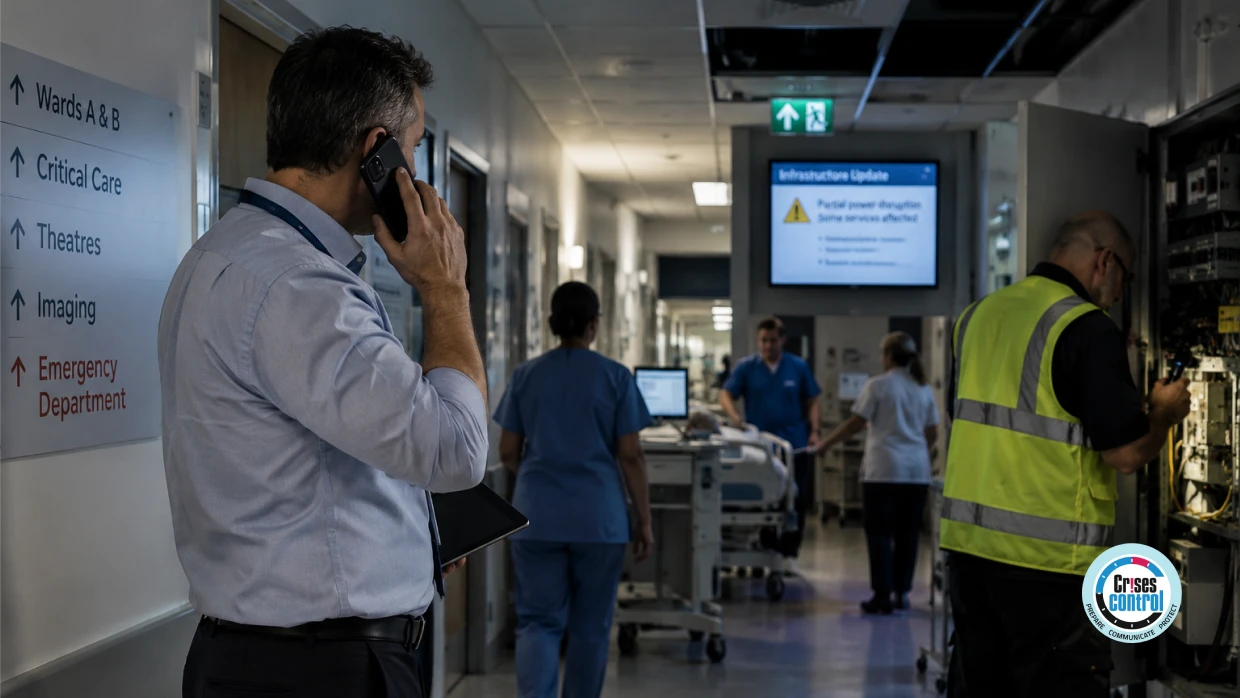
A serious hospital incident can start in one department and become everyone’s problem within minutes.
A power failure, cyber incident, security event or patient safety incident may require clinical teams, facilities, IT, security, communications, senior leadership and external responders to act at the same time.
The problem is rarely a lack of expertise. Each team may know exactly what it needs to do within its own area. The difficulty is making sure everyone is working from the same information, understands their responsibility and knows what has changed.
That is where Incident Management Software can help.
For healthcare organisations, this matters because the response is happening alongside normal patient care. Clinical teams cannot stop treating patients while an incident manager works out who has been contacted. Facilities cannot wait for several departments to agree on who owns a task. Senior leaders need a reliable picture of the situation without repeatedly calling different teams for updates.
The solution is not simply to send alerts faster. It is to create a response process that connects the alert to the actions, decisions and communication that follow.
When One Incident Becomes Everyone's Problem
Consider a realistic scenario.
It is a weekday morning at a large hospital. A fault affects part of the site’s electrical infrastructure. Emergency power activates, but several clinical areas experience disruption.
The first priority is patient safety.
Clinical teams need to establish which patients and services are affected. Facilities needs to identify the source of the problem and understand which systems remain operational. IT needs to assess the impact on clinical systems. Security may need to control access to affected areas. Communications may need to prepare information for staff, patients and families.
Senior management needs to understand the wider impact and decide whether additional resources or escalation are required.
External contractors or emergency services may also need to become involved.
Nobody is necessarily doing anything wrong.
The clinical team may know which patients are affected but not whether the infrastructure problem has been resolved. Facilities may know what has failed but not the effect on a particular ward. IT may know which systems are unavailable but not which clinical services are most exposed.
Each team has a piece of the picture.
The challenge is turning those pieces into one coordinated response.
Why Healthcare Incidents Are Difficult To Coordinate
Healthcare organisations depend on interconnected systems, departments and people. A disruption in one area can quickly create consequences elsewhere.
For example:
- A power disruption can affect clinical equipment, access control and IT systems.
- An IT outage can affect patient records, communications and diagnostic workflows.
- A security incident can restrict access to clinical areas and affect patient movement.
- A water or utility failure can affect infection control and clinical operations.
- A serious patient safety incident can require clinical, operational, communications and governance teams to act together.
The challenge becomes greater when people are working across different sites, shifts or organisations.
A healthcare provider may also depend on contractors, ambulance services, laboratories, suppliers, local authorities or neighbouring healthcare organisations.
This is why incident coordination needs more than a way to send messages.
ISO 22320:2018 identifies roles and responsibilities, tasks, resource management, information sharing, joint direction and cooperation as important parts of incident management.
For healthcare leaders, that translates into a straightforward question:
When several teams need to act at once, can everyone understand what is happening, what they are responsible for and what needs to happen next?
Activating The Right Response
The first challenge is deciding whether an incident requires a formal response and, if it does, which response process should be activated.
This becomes difficult when an event crosses departmental boundaries.
A power failure may initially appear to be a facilities problem.
If clinical systems are affected, IT becomes involved.
If patient care is compromised, clinical leadership needs to be engaged.
If the disruption continues, business continuity, communications and senior management may need to take a more active role.
A structured activation process should establish:
- What has happened?
- What is currently affected?
- What could become affected?
- Which response plan applies?
- Which roles need to be involved?
- Who has authority to make decisions?
- What information needs to be communicated?
The objective is not to involve everyone in every incident. It is to involve the right people as the situation develops.
That distinction matters. Too few people can leave important decisions without an owner. Too many can create unnecessary communication and make it harder to see who is actually responsible.
Reaching The Right People Is Only The Beginning
During a significant healthcare incident, the response team may include people who are not in the same building.
Some may be on a different site. Others may be working remotely, travelling between facilities or outside normal working hours.
A healthcare organisation should therefore know:
- Who needs to be contacted for each type of incident?
- Are response groups based on roles rather than individual names?
- How are out-of-hours contacts reached?
- Can critical messages be escalated if nobody responds?
- Can acknowledgements be seen?
- Is there an alternative communication route if the first one fails?
- Can relevant stakeholders receive updates as the situation changes?
This is where Incident Coordination Software can provide structure around communication.
The goal is not to send every piece of information to everyone.
That can create its own problem.
A better approach is to make sure people receive the information relevant to the decisions they are responsible for making.
A Facilities Manager needs different information from a Clinical Lead. A senior executive needs a different level of detail from an engineer investigating a failed system.
Good coordination is therefore not about maximum communication. It is about useful communication reaching the right role at the right point in the response.
Make Responsibility Visible
During a complex incident, phrases such as “someone is looking into it” are not enough.
Important actions need clear ownership.
Response Requirement | Responsible Function |
Assess affected clinical areas | Clinical leadership |
Investigate infrastructure failure | Facilities |
Assess technology impact | IT |
Manage access and security | Security |
Coordinate external responders | Incident leadership |
Prepare staff communications | Communications |
Track patient safety implications | Patient Safety |
Maintain executive oversight | Senior leadership |
The exact structure will vary between organisations.
The principle does not.
Every important action needs an owner.
This becomes increasingly important as an incident continues.
New tasks appear. Priorities change. Some actions are completed while others remain outstanding. New teams may join the response.
Without visibility, the incident lead can end up spending time asking people for updates instead of managing the situation.
A structured digital process can make ownership, status and outstanding actions easier to see.
Keep People Working From The Same Information
Healthcare incidents rarely develop in a straight line.
The first information may be incomplete. Five minutes later, the situation may look different.
A system initially thought to be unavailable may have been restored. Another ward may suddenly be affected. A decision made earlier may no longer be appropriate.
There is an important human factor here.
People make decisions based on what they know at the time.
If different teams receive different information, they can make reasonable decisions that conflict with one another.
The answer is not to give everyone access to every message.
The response needs a reliable operational picture that establishes:
- What is confirmed?
- What is still being investigated?
- Which services are affected?
- What decisions have been made?
- Which actions are underway?
- What has changed since the previous update?
- What needs to happen next?
The purpose is to reduce avoidable uncertainty, not to create more paperwork.
Where Traditional Approaches Break Down
Many healthcare organisations still combine email, telephone calls, spreadsheets, messaging applications and manually maintained documents during incidents.
Each tool may be useful on its own.
The problem appears when several are being used at once.
An incident leader may have information in email. Facilities may have a spreadsheet. A clinical lead may be communicating through a messaging group. IT may be tracking technical actions elsewhere. Senior leadership may be receiving updates by telephone.
All of these records can be accurate while the overall response remains difficult to understand.
Three problems tend to follow.
Information Becomes Fragmented
People may not know which update is the latest or whether another team has already acted.
Actions Become Harder To Track
A task agreed during a phone call may never make it into the main incident record.
The Timeline Has To Be Rebuilt
Once the incident is over, teams may need to reconstruct what happened from emails, notes and individual recollections.
The problem is not necessarily that these tools are unreliable.
The problem is that they were not designed to provide one shared response process.
What A Structured Healthcare Incident Response Looks Like
A practical response can be viewed as seven connected stages.
1. Activate
Recognise the incident and activate the appropriate response plan.
2. Establish
Confirm what has happened, what is affected and what is currently known.
3. Coordinate
Bring together the functions required to manage the incident.
4. Communicate
Send role-specific information and establish whether critical messages have been received.
5. Assign
Give important response actions to named people or teams.
6. Escalate
Escalate unresolved issues when the impact, severity or circumstances require additional authority or resources.
7. Review
Maintain a record of important communications, decisions, actions and developments.
This approach reflects recognised incident management principles around roles, responsibilities, information sharing and cooperation.
It also fits with the direction of NHS patient safety practice. NHS England’s Patient Safety Incident Response Framework focuses on responding to patient safety incidents in ways that support learning and improvement, including understanding how incidents happen and the factors that contribute to them.
Test The System, Not Just The Plan
Healthcare organisations often test whether their emergency plans exist and whether staff know the procedures.
That is useful, but it does not answer a more difficult question:
Can the organisation actually coordinate those procedures when a real incident occurs?
Consider a policy that says: “Notify the emergency response team.”
That sounds clear.
But what happens at 03:00 on a Sunday?
Can the correct people be reached? Can the incident lead see who has acknowledged the message? What happens if the person responsible for a critical action does not respond?
Another policy might say: “Escalate unresolved issues.”
Again, that sounds straightforward.
But who knows an action is unresolved? Who is responsible for escalating it? What triggers escalation? Where is that information recorded?
These questions expose the gap between having a plan and being able to operate the plan.
A useful exercise is to choose a realistic scenario and map the first hour from the moment it is identified.
Do not start with what the policy says should happen.
Start with what people would actually do.
That is where weaknesses in communication, ownership and escalation become visible.
Manual Records And Digital Coordination Solve Different Problems
Digitalisation does not mean removing every manual process.
Healthcare investigations will still require professional judgement, interviews, clinical records, technical assessments, photographs and specialist reports.
The useful distinction is between information that can be captured as part of the response and information that requires later investigation.
Manual Approach | Structured Digital Approach |
Contact lists maintained separately | Role-based response groups |
Messages sent across several channels | Communications managed through a defined response process |
Actions recorded in notes or spreadsheets | Actions assigned to named owners |
Escalation relies on manual follow-up | Defined escalation processes |
Updates gathered from individuals | Current incident information available to authorised users |
Timeline reconstructed afterwards | Key response activity recorded as it develops |
For healthcare organisations, the objective is not to digitalise for its own sake.
It is to remove avoidable coordination work so incident leaders can concentrate on patient safety, operational consequences and decisions.
A Common Assumption Worth Challenging
A common assumption is that the most important part of incident management is the initial alert.
The alert is important.
It is also only the beginning.
Imagine that 30 people receive an emergency notification.
- What happens next?
- Who confirms that the right people are responding?
- Who assigns actions?
- Who can see which tasks remain outstanding?
- Who sees when circumstances change?
- Who decides when escalation is needed?
- Who maintains the current operational picture?
- And when the incident is over, who can establish what actually happened?
This is why Incident Management Software should be considered as part of the wider response process rather than simply as a way to send notifications.
The value comes from connecting the stages that follow the initial alert.
Where Healthcare Incident Management Software Can Help
Healthcare Incident Management Software can provide a structured digital layer around an organisation’s existing emergency, patient safety and business continuity processes.
For example, digitalised response plans can define how different types of incidents are activated.
Role-based communication can identify which teams need to be contacted.
Cloud access can allow authorised personnel to access relevant response information from different locations.
Tasks can be assigned to individuals or teams, with progress visible to incident leaders.
Escalation processes can help ensure unresolved issues reach the appropriate level.
The incident record can then provide a stronger basis for post-incident review.
Crises Control is one example of how this approach can be digitalised, with capabilities for response plans, role-based communication, cloud access, task management, escalation and incident records. The purpose is to give healthcare teams a clearer way to coordinate the response without changing the responsibilities they already have.
The technology should support the organisation’s existing response structure rather than force clinical or operational teams to change their responsibilities simply to use a platform.
For organisations evaluating incident management software for healthcare, that is an important distinction.
The better question is not: How many features does the platform have?
It is: Can the technology help us coordinate the response we already need to deliver?
From Response To Learning
The end of the immediate incident is not necessarily the end of the work.
Healthcare organisations need to understand what happened, identify contributing factors and determine whether changes are required.
NHS England’s PSIRF approach places emphasis on system-based learning and understanding the factors that contribute to patient safety incidents.
A reliable incident record can support this by preserving the operational sequence.
It can help answer:
- When was the incident identified?
- Who was notified?
- What information was available at each stage?
- Which decisions were made?
- What actions were assigned?
- What changed during the response?
- What remained unresolved?
- What should change as a result?
This does not replace a proper investigation.
It gives investigators a clearer starting point.
It also allows organisations to look across incidents rather than treating each event in isolation.
If several incidents repeatedly involve delayed escalation, unclear ownership or communication failures, the pattern may point to a wider resilience problem.
The incident then becomes evidence about how the organisation operates under pressure.
How To Assess Your Current Incident Management Process
Healthcare leaders reviewing their current approach can start with one realistic scenario.
Choose an event such as:
- Major IT outage
- Hospital evacuation
- Security incident
- Critical infrastructure failure
- Major patient safety incident
- Infectious disease-related disruption
- Loss of a key clinical service
Then map what would happen during the first hour.
Ask:
- Who activates the response?
- How are the right people contacted?
- How is acknowledgement confirmed?
- Who takes operational ownership?
- How are actions assigned?
- How are changing instructions communicated?
- When does escalation occur?
- Where is the current incident information held?
- How are external responders brought into the process?
- How would you reconstruct the incident afterwards?
Then run the same exercise outside normal working hours.
Ask what happens if the usual incident lead is unavailable, one communication channel fails or the situation changes faster than the response plan anticipated.
This tests the system around the plan, not just the plan itself.
The Real Test Is Coordination Under Pressure
Healthcare organisations already have skilled people, established procedures and complex governance structures.
The challenge during an incident is getting those resources to work together when information is incomplete and circumstances are changing.
An effective response process should make it clear:
- What is happening
- What matters most
- Who is responsible
- What needs to happen next
- When escalation is required
- Where the latest information is held
Crises Control can support that structure by connecting incident activation, communication, task management, escalation and incident records within one digital process.
The real test of an incident process is not whether the plan exists.
It is whether people can work from the same information, understand their responsibilities and make good decisions when the situation changes.
If your current process relies heavily on scattered messages, individual memory and manual follow-up, it may be worth testing what would actually happen during the first hour of a serious incident.
Frequently Asked Questions
What Is Incident Management Software In Healthcare?
Incident Management Software helps healthcare organisations coordinate people, communications, actions, escalation and incident information during operational or patient safety events. It provides a structured process that connects the initial response with ongoing coordination and review.
What Is Incident Coordination Software?
Incident Coordination Software helps teams work together during an incident through structured communication, role-based response, task assignment, escalation and visibility of incident activity. It is particularly useful when an incident involves several departments, sites or external organisations.
What Should Healthcare Organisations Look For In Incident Management Software?
Healthcare organisations should consider whether the software supports digitalised response plans, role-based communication, acknowledgement tracking, task ownership, escalation, cloud access and a reliable incident record. It should support existing emergency, patient safety and business continuity processes rather than replace them.
How Can Incident Management Software For Healthcare Improve Response Coordination?
It can reduce reliance on disconnected communication channels and manually maintained records by bringing key response activities into a structured process. This can help incident leaders understand who has been contacted, which actions are outstanding and when escalation may be required.
Is Healthcare Incident Management Software A Replacement For Existing Emergency Plans?
No. Healthcare Incident Management Software should support existing emergency, clinical, patient safety and business continuity plans rather than replace them. Organisations still need clear procedures, trained people, defined responsibilities and appropriate clinical and operational judgement.
This article was drafted with AI assistance and reviewed by the Crises Control team. Featured image: AI-generated.