A leak has been contained. The affected equipment has been isolated. Workers are safe and the immediate response is winding down.
The pressure has not disappeared, though. It has changed.
The HSE Manager now needs to establish what happened. Operations needs to understand when production can safely resume. Engineering is checking the equipment. Compliance may need evidence of what happened and what was reported. Senior management wants to know whether the incident was isolated or points to a wider problem.
Then the questions begin.
- When was the first warning received?
- Who knew about it?
- Who was contacted?
- What decisions were made?
- What actions were taken?
- Were there earlier warning signs?
And perhaps the most important question: what needs to change so this does not happen again?
The problem is that the answers may be scattered across emails, radio logs, spreadsheets, phone calls, handwritten notes and people’s memories.
A structured digital incident record can solve much of this problem by capturing the response as it happens, then connecting communications, decisions, actions and follow-up work into one record.
Incident Reporting Software can provide that structure without asking responders to stop managing the incident so they can document every detail manually.
The purpose is not simply to produce a better report. It is to give the organisation a more reliable account of what happened, why it happened and what should change afterwards.
The Incident Is Over, But The Questions Are Not
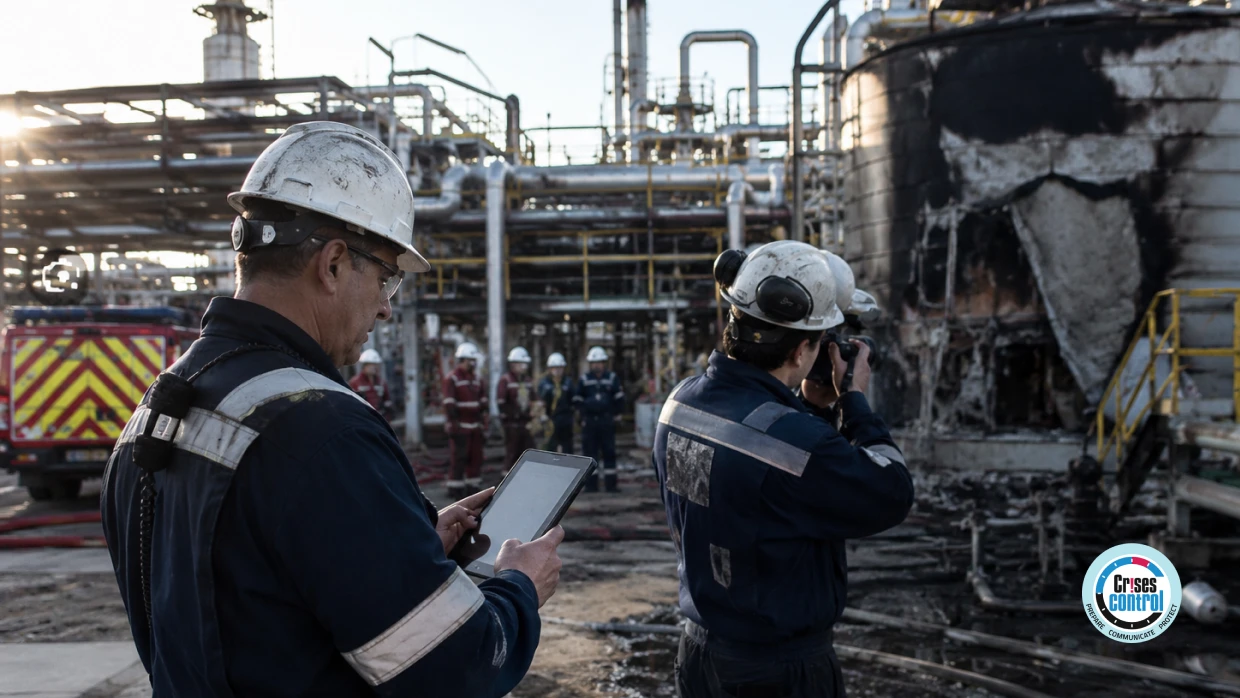
Consider a leak at an oil storage terminal.
A worker identifies an unusual smell during a routine inspection. The area is checked, the leak is confirmed and the relevant response team is notified. Access is restricted while the source is isolated. Contractors working nearby are moved away from the affected area.
Nobody is injured. The leak is contained.
From an operational point of view, there is now a strong reason to move forward. Equipment needs to be inspected, customers may need updates and normal operations need to resume.
At the same time, the investigation is beginning.
The HSE team may be collecting statements. Engineering may be reviewing maintenance records. Operations may be checking operating conditions. A Risk Manager may be looking at whether similar equipment or processes could be affected elsewhere.
Each team has part of the story.
The challenge is bringing those pieces together while the details are still available.
A useful incident record should help answer five questions:
- What happened?
- What was known at each stage?
- What did people do in response?
- Why were key decisions made?
- What needs to change?
That is much more useful than a report that simply describes the final outcome.
What Is Incident Reporting Software?
Incident Reporting Software is technology that helps organisations record, organise and review incident information, including communications, actions, decisions, timestamps and follow-up activity.
For an oil and gas operation, the record should not begin when someone opens a report template after the event.
It can start with the first notification and develop alongside the response.
Depending on the organisation’s process, the record may include:
- The initial incident alert
- When the incident was declared
- People and teams notified
- Acknowledgements and responses
- Tasks assigned during the response
- Decisions made by operational leaders
- Escalations
- Updates sent to employees or contractors
- Changes to the response plan
- Corrective actions
- Closure information
The result is a timeline of the response rather than a collection of disconnected notes.
That matters because incidents rarely unfold in a neat sequence. Information changes. Assumptions are challenged. New risks appear. Leaders make decisions based on what they know at the time.
A good investigation needs to understand that context rather than judging every decision with hindsight.
Why Reconstructing An Incident Afterwards Is Difficult
A few days after an incident, most people can remember the broad sequence.
The smaller details become harder to pin down.
One person remembers receiving a phone call at around 14:00. Another remembers the first instruction coming over the radio. A supervisor has a spreadsheet showing that a contractor was contacted, while someone else’s notes suggest the conversation happened later.
That does not necessarily mean someone is giving the wrong account.
It shows how difficult it is to reconstruct a fast-moving event from memory.
Manual records create another problem. People tend to record what they believe is important at the time.
An Incident Manager may document major decisions but not every communication. A supervisor may keep a personal list of actions. HSE may maintain a separate investigation file. Operations may have its own equipment and maintenance records.
Each record can be accurate while the overall picture remains incomplete.
Digital records can reduce this gap by capturing routine response activity as it happens. Investigators can then start with a factual timeline and add interviews, technical findings and analysis around it.
That is a better starting point than asking several people to remember exactly what happened a week later.
The Report Should Explain More Than What Failed
An equipment failure may appear to be the obvious cause of an incident.
It is often only the starting point.
Suppose a pump fails and causes a leak. The investigation may initially focus on the pump itself. A deeper review could uncover a maintenance issue, an unclear procedure, a change in operating conditions, a training gap or a decision made under production pressure.
The useful question is not only: What failed?
It is: Why was the failure possible, and what allowed the conditions for it to develop?
The Energy Institute’s 2026 guidance on reporting, investigating and learning from incidents, accidents and events specifically calls for stronger analysis of underlying causes and contributing factors. It also covers near misses, human and organisational factors, action planning and checking whether learning leads to effective change.
That matters because assigning blame to the last person involved can leave the real problem untouched.
- Was the procedure clear?
- Was it current?
- Was the equipment difficult to operate?
- Has the working conditions changed?
- Was the person properly trained?
- Were there competing operational pressures?
The answers can reveal much more than the immediate equipment fault.
Communications Are Part Of The Incident Record
Incident reporting is sometimes treated as a separate activity from emergency communication.
That separation can leave a significant gap.
Imagine an emergency notification is sent to a response team at 10:17. A supervisor acknowledges it at 10:18. Conditions change at 10:24, so a new instruction is issued. At 10:31, another team is brought into the response.
Those communications are part of the incident.
They help establish how the response developed and what information people had when decisions were made.
They can also help answer questions such as:
- Who was notified?
- When were they notified?
- Did they acknowledge the instruction?
- When did the response change?
- Who was brought into the response later?
- Which actions followed each communication?
Communication records should not replace witness interviews or technical investigation. They provide another source of evidence that can help investigators build a more reliable timeline.
For incidents involving several facilities, contractors or response teams, that timeline can become especially useful.
Corrective Actions Need More Than A Recommendation
Many organisations are good at identifying actions after an incident.
The harder part is making sure those actions are actually completed and checking whether they worked.
A report may recommend:
- Reviewing a maintenance procedure
- Inspecting similar equipment
- Updating emergency arrangements
- Retraining affected personnel
- Reviewing contractor controls
- Changing an operating instruction
- Improving escalation arrangements
Those recommendations can disappear into a spreadsheet if nobody owns them.
Each action should have:
- A named owner
- A clear description of the required change
- A target date
- A current status
- Evidence of completion
- A way to check whether the change was effective
This is where Incident Management Software can connect the investigation with operational follow-up.
Instead of copying recommendations from an incident report into another tracker, actions can remain associated with the incident that created them.
That gives HSE, Risk and Operations teams a clearer view of what is open, overdue and completed.
It also makes it easier to ask a more useful question: Did we actually fix the problem?
Compliance Is Not The Same As Learning
Compliance reporting has a legitimate role.
Depending on the location, activity and nature of an incident, organisations may have legal, regulatory, contractual or internal reporting requirements.
Meeting those requirements is necessary. It is not the same thing as learning from an incident.
A report can satisfy a reporting requirement without helping the organisation understand what needs to change.
That distinction is particularly useful for HSE and Compliance Managers.
The question should not stop at: Can we demonstrate that the incident was reported?
It should continue to: Can we demonstrate what we learned, what we changed and whether the change worked?
Our related article, Regulatory Incident Reporting After Spills, Fires And Near Misses In Oil And Gas, explores this issue in more detail, including why evidence created during the response can be more useful than a report reconstructed afterwards.
A Common Assumption Worth Challenging
A common assumption is that incident documentation should start once the immediate situation is under control.
There is a good reason for that thinking. During an emergency, responders need to focus on people, hazards, containment and operational decisions.
The problem is that the response itself contains information that may be difficult to recreate later.
People are making decisions, sending instructions, escalating issues and completing tasks while the situation develops. If routine response activity can be recorded automatically, it becomes part of the incident record without asking responders to stop and write lengthy notes.
That does not mean documenting everything.
The better approach is to capture useful operational information automatically, then allow investigators to add the context and analysis afterwards.
This creates a record based on what happened rather than relying entirely on what people remember happened.
Near Misses Can Reveal The Same Problems
Incident reporting should not only be about events that caused injury, environmental damage, equipment damage or operational disruption.
Near misses can provide valuable evidence too.
A single near miss may appear relatively minor. Several near misses involving the same equipment, procedure, contractor activity or communication failure can reveal a pattern.
That is why organisations should look across incident records rather than treating every event as an isolated case.
Ask:
- Are the same types of incidents recurring?
- Are similar corrective actions being raised repeatedly?
- Are actions remaining open for too long?
- Are particular locations or processes appearing frequently?
- Are communication failures showing up across different incidents?
- Are near misses pointing towards a problem before a more serious event occurs?
The Energy Institute’s current guidance recommends thematic analysis of learning and systematic follow-up to check whether actions are effective.
This shifts incident reporting from a record-keeping exercise towards a way of identifying patterns across the organisation.
What Should A Useful Post-Incident Review Ask?
A practical review should look at the incident from several angles.
Detection
How was the incident first identified? Was there an earlier warning that could have been acted upon?
Response
Did the right people know what was happening? Were responsibilities clear?
Decision-Making
What decisions were made, by whom and using what information? Were there points where people had to act despite uncertainty?
Communication
Were employees, contractors, responders and management given the information they needed? Did the message change as the situation developed?
Actions
Which actions were completed during the incident? Which remained outstanding afterwards?
Underlying Causes
What equipment, process, human or organisational factors contributed to the event?
Learning
What needs to change, who owns the change and how will the organisation know it has worked?
This approach helps keep the review focused on improving the organisation rather than simply finding someone to blame.
Manual Records And Digital Records Solve Different Problems
Manual records still have a place. Investigators need interviews, technical reports, photographs, maintenance records and other evidence that cannot simply be generated by software.
The problem comes when the basic timeline has to be reconstructed manually as well.
Manual Approach | Structured Digital Approach |
Notes gathered from several people | Response information captured in one incident record |
Communications reconstructed afterwards | Communications recorded as they occur |
Actions copied into separate trackers | Actions assigned and tracked against the incident |
Timestamps rely on individual records | Activity can be automatically timestamped |
Evidence is spread across systems | Core incident information is kept together |
Follow-up depends on manual checking | Outstanding actions can be monitored |
Digitalisation does not make an investigation automatically better.
Investigators still need to ask difficult questions, examine evidence and understand the operational context.
What digital tools can do is reduce the administrative work involved in rebuilding the response.
That leaves more time for HSE, Risk and Operations teams to examine what the evidence actually means.
How Crises Control Can Support Post-Incident Reporting
Crises Control can provide a digital record that connects incident response activity with the information needed for post-incident review.
The platform can record incident activity, communications, acknowledgements, tasks and status changes as the response develops. This creates a timestamped incident timeline that authorised users can review after the event.
That can be useful when several functions are involved.
An HSE Manager may need to understand the communication sequence. An Operations Director may want to see when key decisions were made. A Risk Manager may need to review corrective actions. A Compliance Manager may need evidence showing what happened and when.
Crises Control also supports digitalised response plans, role-based communication, task tracking and cloud access. The same information used to coordinate the response can therefore contribute to the review afterwards.
You can explore Crises Control’s Incident Reporting Software to see how incident activity, communications, acknowledgements and tasks can be brought together into a structured incident record.
The technology should support the investigation, not dictate its findings. The people reviewing the incident still need to challenge assumptions, speak to those involved and understand what was happening on the ground.
The Real Value Of An Incident Report Is What Changes Afterwards
An incident report has limited value if it is completed, filed and forgotten.
Its real value comes from helping the organisation understand how the incident developed, how people responded and where its controls were weaker than expected.
That requires a record that connects the sequence:
- The first alert
- The decisions
- The communications
- The actions
- Changes in circumstances
- Corrective actions
- The final review
For oil and gas organisations, a single event can involve HSE, Operations, Engineering, Risk, Compliance, contractors and senior management. Each function sees a different part of what happened.
A structured record helps bring those perspectives together.
It can also make recurring patterns easier to identify across incidents and near misses. A communication problem, equipment weakness or overdue corrective action may look insignificant when viewed once. Repeated across several events, it can point to a much bigger issue.
Crises Control can help organisations connect the operational response with the evidence needed to review what happened afterwards, giving HSE, Risk and Operations teams a clearer record to work from.
The real question after an incident is not simply whether the report was completed.
It is whether the organisation is better prepared to prevent, respond to and learn from the next one.
If your current process relies on emails, spreadsheets and individual notes to reconstruct what happened, it may be worth reviewing how much of the response could be captured automatically while the incident is still unfolding.
A better incident record will not prevent every failure. It can make it much harder for an organisation to lose the lessons that follow one.
Frequently Asked Questions
What Is Incident Reporting Software?
Incident Reporting Software is technology that helps organisations record, organise and review information about incidents. It can connect communications, actions, decisions, timestamps and follow-up activities so teams have a clearer record of what happened.
Why Is Incident Reporting Important In Oil And Gas?
Oil and gas incidents can involve multiple teams, contractors, equipment and operational decisions. A structured record helps organisations understand the sequence of events, identify underlying causes, track corrective actions and retain evidence for future review.
What Should An Oil And Gas Incident Report Include?
A useful report should normally cover the circumstances of the event, timing, people and equipment involved, actions taken, communications, decisions, causal and contributing factors, corrective actions and lessons identified. The exact requirements depend on the incident and the applicable legal or organisational requirements.
What Is The Difference Between Incident Reporting Software And Incident Management Software?
Incident Reporting Software focuses on recording and reviewing incident information. Incident Management Software covers the wider response process, including communication, task assignment, escalation, coordination and incident records. The two capabilities can work together so the final report is based on information captured during the response.
How Can Organisations Make Sure Incident Investigations Lead To Real Change?
Each finding should be translated into a clear action with an owner, target date and method for checking completion and effectiveness. Organisations should also look for repeated themes across incidents and near misses rather than treating every event as an isolated problem. The Energy Institute’s 2026 guidance supports this approach by emphasising learning, thematic analysis, action planning and follow-up to check whether changes are effective.
This article was drafted with AI assistance and reviewed by the Crises Control team. Featured image: AI-generated.