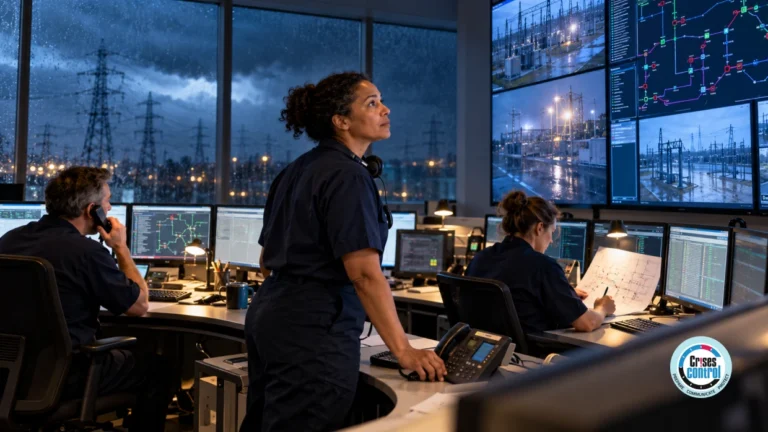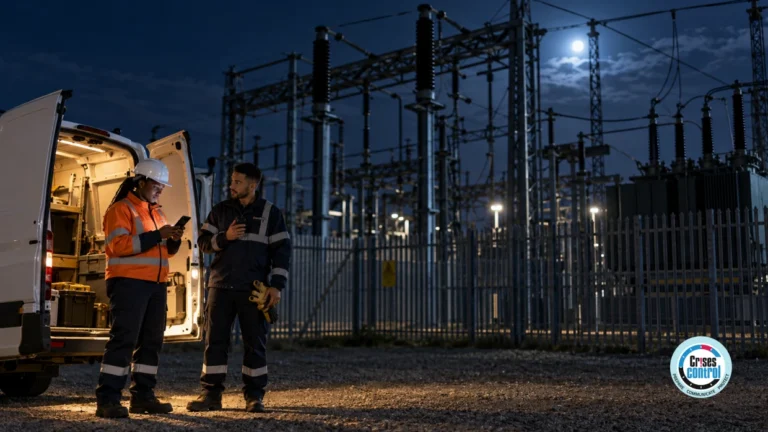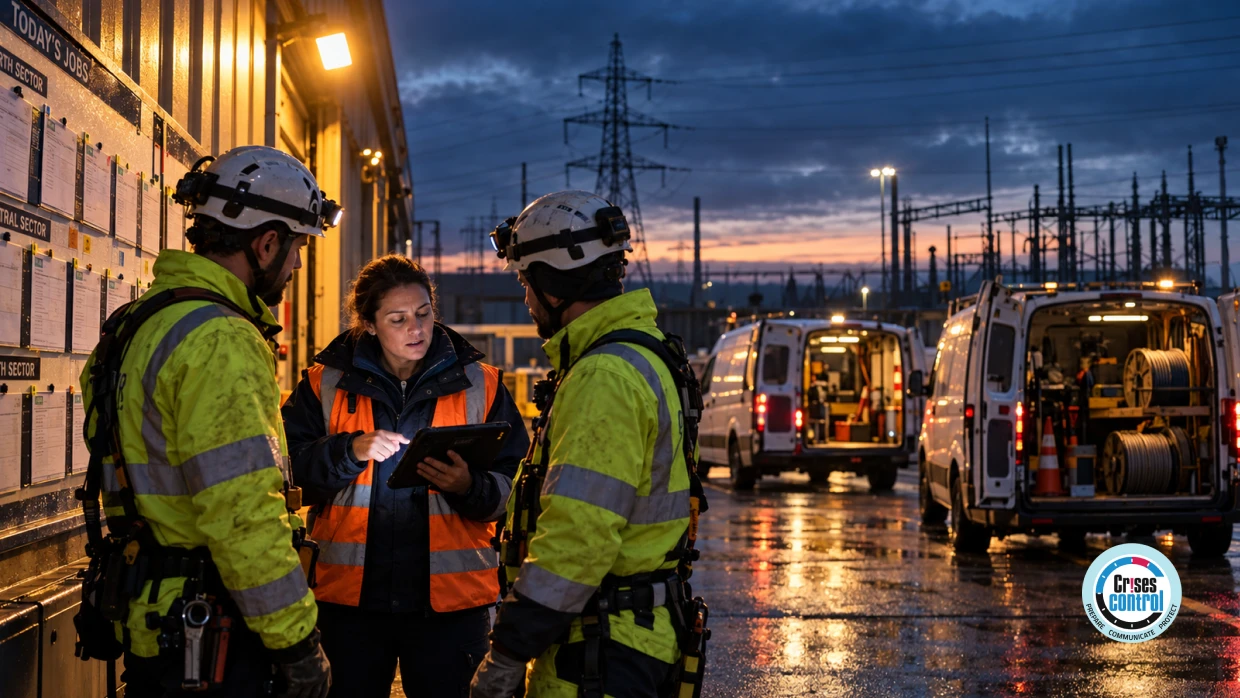
Fourteen hours into a storm restoration, a control room has twenty-three open actions on a whiteboard and three answers to one question. Has the Barnhill switchgear been isolated? The duty manager heard it on the radio at 03:40. The field supervisor thinks another crew took it. The whiteboard says in progress, in handwriting from a shift that went home at six.
Incident task management for utilities works when every response action carries one named owner, a deadline something is actively watching, and a completion record created at the moment the work is done rather than rebuilt from radio logs a fortnight later.
Incident task management for utilities is the practice of assigning every response action to one named owner, tracking its status in real time, and capturing completion as it happens. Without it a network knows what it asked for during an incident, but not what was actually done.
What Is Incident Task Management For Utilities?
Incident task management for utilities is the practice of turning response decisions into discrete, owned, time-bound actions, then tracking each one to completion across control rooms, depots and field crews. It covers five things: assignment, acceptance, status, escalation of overdue work, and the record that proves an action closed.
The difference between a task and an instruction does most of the work. An instruction is something a duty manager says. A task exists independently of whoever issued it, with a name against it, a time it was accepted, and a state anyone can read. An instruction evaporates at the end of a shift. A task doesn't.
Why Do Response Actions Go Missing During A Multi-Site Outage?
Response actions go missing because they're issued in the one medium that keeps no record: speech. A radio call. A phone handover. A shout across the control room. Each is fast, each is reasonable at the time, and none survives a shift change or produces anything an auditor can read six months later.
A utility network makes this harder than an office does. The work is physical and spread out, restorations cross shift boundaries, and operations, engineering, safety, environmental and contractors each keep records their own way.
So the gap only shows up afterwards. The incident log has the alerts and the decisions. But the layer in between, which actions were raised, who accepted them, which were still open at handover, gets rebuilt from memory. Incident task management for utilities exists to make that reconstruction unnecessary.
Who Owns A Response Action From Assignment To Sign-Off?
Four roles touch every response action, and the trouble comes from merging them rather than from any one failing. Someone raises the task. Someone accepts it and does the work. Someone confirms it's genuinely complete. Someone holds the list and chases what's overdue. Across six sites in a storm, nobody wears all four hats.
Written out, they look like this:
- The originator. Raises the task, states what done looks like, sets the deadline. A task with no definition of done can't be closed honestly
- The owner. One named person, never a team mailbox. Accepts the task, does or directs the work, updates the status
- The verifier. Confirms completion where being wrong carries safety, environmental or regulatory consequence. Isolations, permits to work and containment shouldn't be self-certified
- The task coordinator. Holds the full list, watches what's overdue or unclaimed, escalates. The role most often left vacant, and the one that keeps the other three honest
One rule earns its place. A task goes to a person, not a team. "Operations to isolate Barnhill" is an aspiration. A named engineer who accepted it at 03:42 is a task. Incident task management for utilities rests on that distinction more than on any software feature.
Which Way Of Tracking Incident Tasks Holds Up At 03:00?
Three approaches are in common use and they break in different places. Radio and a whiteboard are quick to start and leave nothing behind. A spreadsheet or group chat leaves a record, but nothing watches it, so an overdue task stays overdue quietly. A platform built for the job assigns, escalates and records.
The table compares the three on the four things that decide whether a restoration is defensible afterwards.
The third column separates them. A spreadsheet is a better record than a whiteboard, and both are equally bad at telling a duty manager that an action raised at 02:15 has had no owner for forty minutes.
What Evidence Will A Regulator Or Insurer Ask For Afterwards?
They ask what was done, by whom, and when. The specific duties depend on the asset and the jurisdiction. Two UK examples show the shape of it, and both reward a record written at the time over one assembled later.
Operators of upper tier establishments under the Control of Major Accident Hazards Regulations 2015 must prepare an internal emergency plan, and regulation 12(6) requires them to review it, revise it where necessary, and test it at suitable intervals not exceeding three years. A test only produces evidence if the actions inside it were tracked.
On the supply side, regulation 7 of the Electricity (Standards of Performance) Regulations 2015 attaches payments to category 1 and category 2 severe weather events where supply isn't restored within the relevant period, and for each succeeding six-hour period up to a cap per customer. That regulation was amended with effect from 1 September 2023 and again from 1 November 2024. When money turns on elapsed time, timestamps matter.
As at October 2026 both instruments are in force in the UK. This is orientation rather than legal advice, and an operator elsewhere should check what its own regulator expects. The point travels, though. Every regime asks the same four questions afterwards, and three are about tasks.
How Does Crises Control Support Incident Task Management For Utilities?
Crises Control supports incident task management for utilities through Task Manager, its Incident Task Management Software. Tasks are assigned automatically when a response plan is activated, using the roles defined in that plan, so the first wave of actions doesn't have to be typed out at 02:15.
From there it covers the four roles above. Owners accept tasks and update status from any device, which matters when the owner is at a substation rather than a desk. Escalation rules are configurable, so an overdue or unclaimed task notifies a supervisor, gets reassigned, or escalates to the incident manager without anyone having to spot it first.
The record builds itself. Task Manager records task ownership, acceptance times, status changes, escalation activity and completion updates against the incident, and the energy and natural resources pages describe the same audit trail across multiple facilities. Crises Control holds ISO 22301 and ISO/IEC 27001 certification, listed on the accreditation page.
Several things stay with the operator. The response plan, the task list inside it and the escalation thresholds are the operator's own work, written on a quiet afternoon. The software activates the plan. It doesn't write it. Contact and rota data has to be current, or tasks reach last month's shift. And whether an isolation is safe is a judgement for the competent person on site.
Task Manager sits between two other modules. Reaching the field comes first, covered in Monday's post on alerting field engineers during a control room outage, and Tuesday's post on multi-site incident command sets the priorities these tasks carry out.
Incident Task Management Checklist
This turns the sections above into nine things an operations or HSE director can confirm before the next storm season.
- Every response action in the plan has a definition of done
- Tasks go to named people, never to teams, functions or mailboxes
- Acceptance is explicit, and the time is recorded
- One named role holds the full task list on every shift, with a deputy
- Overdue and unclaimed tasks escalate on their own, at an interval agreed in advance
- Safety, environmental and regulatory actions are verified by someone else
- Handover transfers open tasks explicitly, with no action left ownerless
- Completion is recorded when the work finishes, not written up later
- The task record has been read back cold by someone who wasn't on the incident
Close The Action Before The Shift Ends
Twenty-three actions on a whiteboard isn't a planning failure. Somebody raised every one for a good reason, and most of them got done. The real failure is narrower than it looks: at no point could the network say which actions had an owner and which were drifting.
That gap closes with discipline more than with budget. A definition of done. A named owner instead of a team. An explicit acceptance. Something other than memory watching the clock on an overdue action. A handover that moves open tasks rather than hoping the next shift reads the board. Incident task management for utilities is the sum of those habits.
An operations director can test this quarter without touching a system. Take the last significant incident, pick five actions, and ask who owned each one, when they accepted it, and what time it closed. If the answers come from a record, the discipline is there. If they come from three people's recollection, the checklist above shows which habit is missing. To see an assigned, tracked and timestamped task list working during a live incident, request a demo.
Frequently Asked Questions
What is incident task management for utilities?
Incident task management for utilities is the practice of turning response decisions into discrete actions, each with one named owner, a deadline and a tracked status, across control rooms, depots and field crews. It covers assignment, acceptance, status updates, escalation of overdue work and the completion record. An alert tells people something. A task commits a named person to doing something.
How is task management different from incident management software?
Incident management and task management answer different questions. Incident management software coordinates the incident itself, meaning activation, roles, communication and the timeline, while task management covers the individual actions the response depends on and tracks each one to completion. Crises Control runs them as connected modules, Incident Manager and Task Manager, so a task raised during an incident sits on that incident's record.
Should a response task be assigned to a person or a team?
A response task should be assigned to one named person. A task owned by a team is owned by nobody, because no individual is accountable for accepting it or reporting it complete. Where a team has to do the work, name the person responsible and let them direct the others. Crises Control assigns tasks using the roles defined in the response plan, which is how a role on paper becomes a person at 03:00.
What should happen when a response task goes overdue?
An overdue task should escalate on its own rather than waiting to be noticed. Configurable escalation rules can notify a supervisor, reassign the task, or escalate it to the incident manager, with each step timestamped against the incident. The interval is the operator's decision and belongs in the plan, because a threshold argued over during a storm is an escalation that doesn't happen.
What task evidence do auditors and insurers expect after an incident?
They expect to see what was done, by whom and when, recorded at the time rather than written up afterwards. A defensible record names the owner of each action, the time it was accepted, every status change, any escalation and the completion time. Operators of upper tier sites under the Control of Major Accident Hazards Regulations 2015 must also test their internal emergency plan at intervals not exceeding three years. See the incident reporting pages for how that record is produced.
This article was drafted with AI assistance and reviewed by the Crises Control team. Featured image: AI-generated.