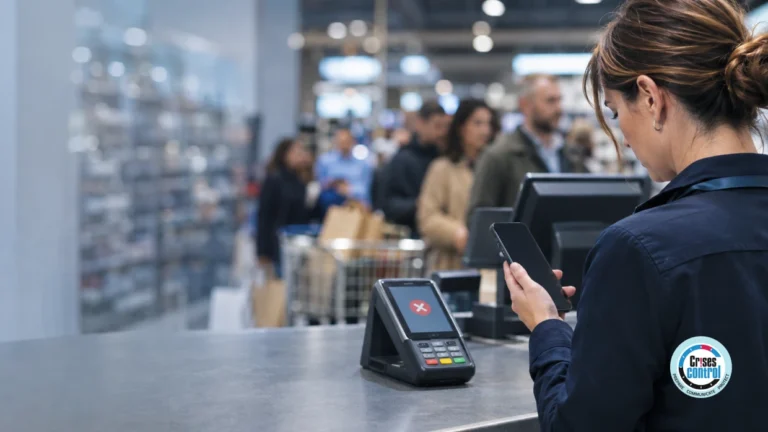
The queue is six deep and the colleague on the till started on Monday. A man at the front has stopped arguing about his refund and started on the person refusing it. The duty manager is three aisles away with a pallet. The security officer is at the entrance.
Protecting shop workers through peak trading is a question of response design. Hiring more security officers does not answer it. The colleague at the till needs a way to summon named help in seconds, without leaving the counter and without making the moment worse.
That is what Employee Safety Software is for, and it is the part most retailers have left to the floor plan. Security officers watch stock and entrances. The person being shouted at is covering themselves.
Protecting shop workers during peak trading means giving every colleague on the floor a discreet way to raise an alarm, a named responder who answers it within an agreed time, and a record of every incident so repeat offenders and repeat locations become visible to the business.
What Does Protecting Shop Workers Mean During Peak Trading?
Protecting shop workers during peak trading means a colleague can raise an alarm from wherever they are standing, and a named person is accountable for answering it. The part retailers skip is the third: recording the incident in a form the business can actually analyse. Shutters, tags and cameras protect premises and stock. This protects people.
The British Retail Consortium's Crime Report 2026, published on 24 February 2026, recorded 1,600 incidents of violence and abuse against shopworkers a day in the year to 31 August 2025. That is down a fifth on the year before, and still the second highest on record, against 455 a day in 2019-20. Of that total, 118 incidents a day involved physical violence and 36 involved a weapon.
Why Does Peak Trading Raise The Risk To Shop Floor Staff?
Peak raises the risk because it changes who is standing on the floor, not because shoppers turn aggressive in December. The least experienced colleagues work the busiest hours. Queues, stockouts and refused refunds throw up more flashpoints per hour than any other trading period. And the people who would normally step in and calm a situation are pushing cages out of the stockroom.
So protecting shop workers at peak cannot rest on experience. Rotas fill with seasonal and agency colleagues, some of whom could not tell you who the duty manager is that day. The colleague most likely to meet an aggressive customer is the one least equipped to see it coming.
Does The Law Already Protect Retail Workers From Abuse?
It depends entirely on where the store trades, and in England and Wales the standalone offence is on the statute book but not yet in force. Section 45 of the Crime and Policing Act 2026 says that "A person who assaults a retail worker at work commits an offence under this section", punishable on summary conviction by up to six months in prison, a fine, or both. As at November 2026 the legislation.gov.uk record marks that section as prospective and notes it was not in force at Royal Assent.
Scotland got there earlier. Section 1 of the Protection of Workers (Retail and Age-restricted Goods and Services) (Scotland) Act 2021 makes it an offence to assault, threaten or abuse a retail worker who is engaged in retail work at the time, with a maximum of 12 months on summary conviction. That offence is in force.
In New York State the duty is operational rather than criminal. Section 27-e of the New York Labor Law requires every employer of 500 or more retail employees statewide to give every retail employee a silent response button from 1 January 2027. The statute is specific about what the button summons: "immediate assistance from a security officer, manager, or supervisor". Not the emergency services. Someone inside the business.
Read this as orientation, not legal advice, and check the position for each territory you trade in. In all three places the operational expectation is the same. A colleague raises an alarm, and somebody answers it.
Who Answers A Retail Staff Panic Alarm, And How Fast?
Somebody specific has to answer, and in most stores nobody has been named. A retail staff panic alarm that rings into a room, a radio channel or a security desk, with no accountable responder and no agreed response time, is a record of the alarm rather than a response to it.
This is where the assumption about guards falls over. An officer on the entrance is there to deter theft and manage the door, and cannot see the customer service desk, the stockroom, the fitting rooms or the car park at trolley collection. The colleagues furthest from the door have the least cover, which is the flaw in protecting shop workers by posting someone at the front.
The table below sets out what store safety plans assume, what peak trading does to the assumption, and what closes the gap.
How Should Violence And Aggression Reporting In Retail Work?
Violence and aggression reporting in retail works when the report takes under a minute, happens on the device that raised the alarm, and lands somewhere that pulls every store together. Most retail reporting fails on the first count. A form that takes a quarter of an hour at the end of a shift does not get filled in during peak, and the incident is simply gone.
What the business loses is the pattern. The same customer every Friday is a policing matter, and a store where three colleagues have been threatened inside a fortnight has a staffing or layout problem that head office will never see unless the reports arrive in a comparable form.
The BRC found 13% of retailers rated the police response as good or excellent, up from 9% the year before, alongside more than £5 billion of retailer spending on security measures over five years. Reporting is what turns that spending into evidence the police can act on.
Three questions test whether yours works. Can a colleague file a report before they clock off? Can a regional manager see every incident across their stores this month without asking anyone? And can you show, for one store, what happened, who was told and what was done about it?
How Does Crises Control Help With Protecting Shop Workers?
Crises Control approaches protecting shop workers through the SOS Panic Button in its mobile app, the frontline escalation capability inside Employee Safety Software. A colleague presses and holds the button, a design that prevents accidental activation, and authorised responders get the alert within seconds. It carries the employee's name, their account and their GPS location where location sharing is enabled on the device.
The alert creates an incident on its own, so the response is tracked from the first second instead of being reconstructed afterwards. Incident Manager coordinates from there, and Incident Reporting Software records the activity, messages, tasks and acknowledgements as they happen. For retailers, Retail Incident Management Software brings it together across stores, warehouses and distribution centres.
Be clear about the division of labour. The platform raises the alarm, notifies the responders you nominated, captures the location and keeps the record. It does not decide who responds, set the response time, staff the rota or calm the customer down. Those stay with the retailer. A panic alarm wired to an unstaffed responder role is worse than no alarm, because it promises something the business cannot deliver.
Protecting Shop Workers At Peak: The Checklist
- Name the responder role, not the person, for every trading hour including late openings and the January sales.
- Name a deputy for each responder role and brief both at the start of the shift.
- Give every colleague on the floor, seasonal and agency staff included, a way to raise an alarm from where they stand.
- Agree the response time in minutes, and tell colleagues what it is so they know what they are waiting for.
- Cover what a door officer cannot see: customer service, fitting rooms, stockroom, car park, delivery bay.
- Make reporting take under a minute, on the device the colleague already carries.
- Review incidents weekly by store, hour and type, not quarterly by region.
- Brief seasonal colleagues on the escalation route in induction, before their first shift on the floor.
Peak Exposes The Gap, It Does Not Create It
A store that cannot answer an alarm in December could not answer one in June either. Peak trading puts your least experienced colleagues in front of the most friction, for longer hours, and takes away the slack that normally hides the gap. Protecting shop workers is an operating decision taken in September and tested in December.
The test is narrow. Can the colleague on the till raise an alarm without leaving the counter? Does a named person answer it inside an agreed number of minutes? Will the business see next month that it happened at all? A retailer who can answer all three has a response. One who cannot has a security presence and a hope.
If you are looking at frontline safety before the January sales, start with the colleagues furthest from the door and work inwards. That is where the gap sits, and it is the cheapest one to close. Book a live demo and raise an SOS from one of your own stores.
Frequently Asked Questions
What counts as abuse of a retail worker?
Abuse of a retail worker covers threats, intimidation, racial and sexual abuse, and physical assault aimed at someone because of their job. Scottish law treats assaulting, threatening or abusing a retail worker engaged in retail work as one offence, so verbal abuse counts alongside violence. The British Retail Consortium counts it all together as violence and abuse, which is how it arrived at 1,600 incidents a day in the year to 31 August 2025.
Is assaulting a retail worker a specific criminal offence?
It depends on the territory. In Scotland, yes: section 1 of the Protection of Workers (Retail and Age-restricted Goods and Services) (Scotland) Act 2021 creates a standalone offence and it is in force. In England and Wales the offence sits in section 45 of the Crime and Policing Act 2026, but that provision was still marked prospective as at November 2026, so assaults are prosecuted under general assault offences until it commences.
What is the difference between a retail staff panic alarm and a lone worker device?
A retail staff panic alarm is for a colleague surrounded by people who cannot help, while a lone worker device is for a colleague with nobody nearby at all. Operationally the difference is discretion: a shop floor alert has to be raised without the customer noticing. That is why press-and-hold activation on a phone already in the pocket suits retail better than a fixed alarm point. Crises Control's Employee Safety Software covers both from the same app.
How should a retailer record violence and aggression incidents across stores?
Record every incident where it happens, on the device that raised the alarm, in a format that aggregates across every store. The record needs the time, the store, the type of incident, who was notified and what was done, because that is what makes a pattern visible to head office and useful to the police. Our guide to retail incident response covers how that record travels from store to head office.
Do seasonal and agency staff need the same safety tools as permanent colleagues?
Yes, and sooner. Seasonal and agency colleagues work the highest-risk hours with the least knowledge of the escalation route, so they are the group least able to improvise when something goes wrong. Protecting shop workers on a December rota means handing them the alarm, the responder name and the reporting route at induction, not in week three.
This article was drafted with AI assistance and reviewed by the Crises Control team. Featured image: AI-generated.