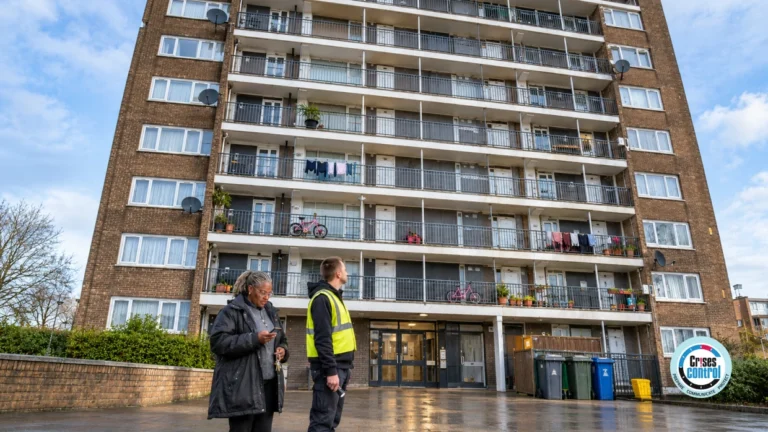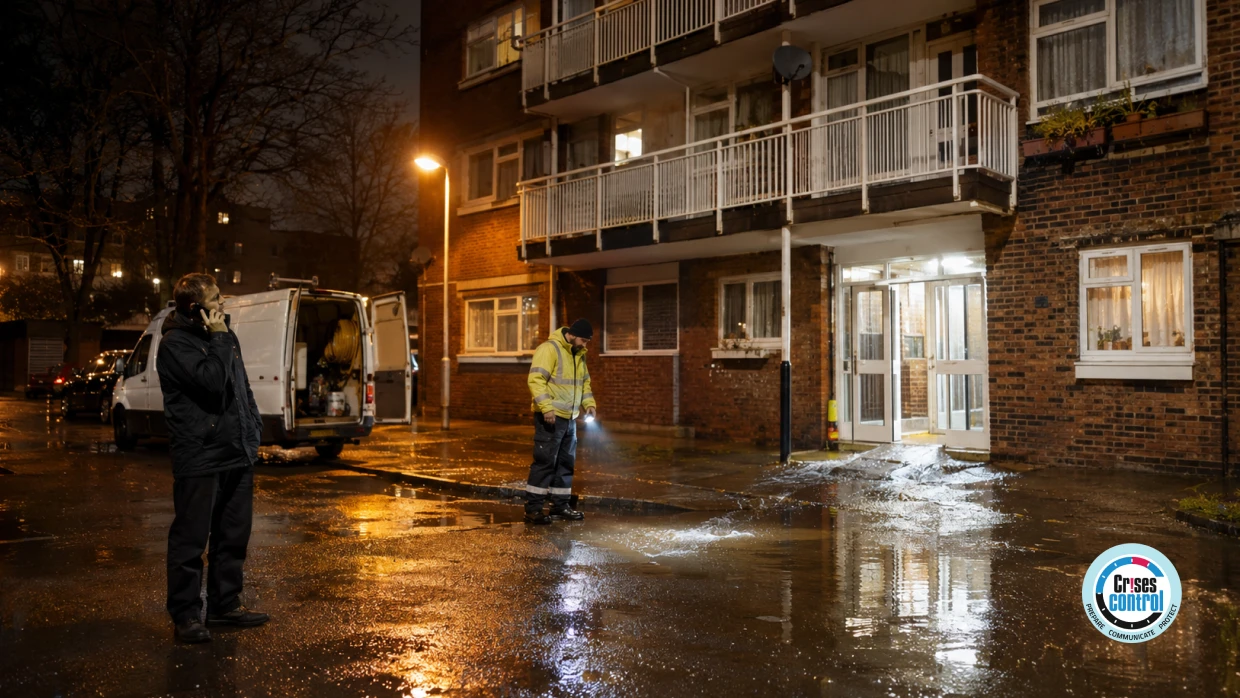
An out-of-hours contract buys attendance. It does not buy authority. A response time, a trade and a number to ring are all about getting somebody to the building, and none of them covers what happens once that person is standing in it with water coming through a ceiling.
An out-of-hours building incident has no natural owner. The landlord holds the legal duty, the managing agent holds the operational role, the contractor holds a task, and the decisions residents actually care about fall in the space between the three.
An out-of-hours building incident is any event in a managed building, outside working hours, that needs a decision nobody on site is authorised to make. The attending contractor fixes the defect. Deciding on alternative accommodation, resident communication and escalation stays with the landlord or its managing agent.
What Is An Out-Of-Hours Building Incident?
An out-of-hours building incident is any event in a managed property, outside normal working hours, where making the building safe is not the whole job. A burst main, a lift entrapment, a detection fault, a break-in: each one needs somebody to decide about people and money, and that decision sits well above the engineer in the plant room.
The useful distinction is between a callout and an incident. A callout ends when the defect is isolated and the job sheet is signed. An incident ends when every affected household knows what is happening, anybody who cannot stay at home has somewhere to go, and what was decided exists in writing in one place.
Three things separate the two on the night:
- A callout has one trade attending. An incident pulls in several, usually in an order nobody planned
- A callout needs no decision above the attending operative. An incident needs at least one that costs money
- A callout is logged by the contractor. An incident gets asked about weeks later by an insurer, a regulator or a resident's solicitor
Why Does The Out-Of-Hours Contract Not Cover It?
The out-of-hours contract does not cover it because a contract for attendance is scoped to a task. A contractor is engaged to isolate a leak, secure an entrance or release a stuck lift. Nothing in that scope lets the contractor move residents, commit the landlord to spend, or speak for the organisation to a journalist or a council.
Most nights the task is the whole job, so the gap stays invisible. It shows up on the one night a real decision is needed, which tends to be the same night the on-call manager's phone rings out. The contractor is then holding an incident nobody asked them to hold, with authority to do one thing and pressure to do five.
Outsourcing attendance does not move the accountability, and for social landlords in England that is now written down. The government's guidance on Awaab's Law for social landlords says that when engaging contractors or managing agents, landlords retain full responsibility for ensuring compliance with the regulations. It also tells landlords to check that their contractor agreements line up with those obligations. This is orientation and not legal advice, and the position is as at November 2026.
Who Owns Each Decision Between Landlord, Agent And Contractor?
Every decision in an out-of-hours building incident belongs to one of three parties. The landlord or freeholder owns the duty and the money. The managing agent owns the operational response and the communication. The contractor owns the physical task and nothing past it. Trouble starts when a decision attaches itself to whoever happens to be awake.
Writing that split down in advance is most of the work. The table sets out six decisions a building incident produces at night, and who holds each one.
The Same Three Roles, Different Names
The labels change by market. The structure does not. In Ontario, the Condominium Act 1998 gives the condominium corporation a duty to control, manage and administer the common elements, whoever is engaged to do the work day to day. Australian schemes split the same job between an owners corporation and a strata manager, and Gulf developments between an owners' association and a management company. Statutory duties differ in all of those markets, so check your own. But the three-way split of duty, operation and task holds everywhere.
Who Decides On Alternative Accommodation And Who Speaks To Residents?
Alternative accommodation is the landlord's decision and the landlord's cost, placed in practice by the managing agent. Resident communication is the managing agent's to send and the landlord's to answer for afterwards. Neither belongs to the contractor. Both are the decisions most often parked until somebody senior is reachable in the morning.
For social landlords in England the clock is explicit. Awaab's Law has applied since 27 October 2025, and a landlord must investigate a potential emergency hazard and make the property safe within 24 hours of becoming aware of it. Where that cannot be done, the landlord must offer suitable alternative accommodation, at its own expense, until the safety works are finished. Temporary measures may be used where necessary.
Twenty-four hours sounds generous until it is split three ways. The contractor attends at 02:00, the on-call manager is finally reached at 07:30, and the accommodation decision waits for an office-hours approval at 10:00. Eight of the twenty-four have gone on reaching people instead of housing them. The decision was never slow because it was difficult. It was slow because the authority to make it was not on the rota.
Who speaks to residents has a documented answer in a few regimes and no answer in most. In England and Wales, the Building Safety Act 2022 requires the principal accountable person for an occupied higher-risk building to prepare a residents' engagement strategy, and that strategy has to set out what information residents will be given about decisions relating to the management of the building. Where a managing agent does the telling, the strategy is where it gets recorded. Getting the message itself out is a separate craft, covered in this guide to resident communication when the fire alarm faults.
What Does Out-Of-Hours Escalation For Housing Associations Need?
Out-of-hours escalation for housing associations needs one named decision-maker reachable at any hour, a spending authority they can use without a second phone call, and a written path to the next person when the first does not answer. The usual failure is not a missing rota. It is a rota that names a role instead of a person.
A role cannot answer a telephone, and nothing tells the caller when to give up and try the next name. An escalation path that survives an out-of-hours building incident answers five questions before the night, not during it:
- Who is the duty decision-maker tonight, by name, and on which number
- What can that person authorise alone, in cash terms, without waking anybody else
- After how many minutes unanswered does the call move to the next name
- Who confirms residents have actually been told, as distinct from who sent the message
- Where decisions are being written down while the incident is still running
Number five is the one teams skip and the one they regret. Managing agent incident responsibilities are usually clear enough in the contract and almost invisible in the record, because the evidence of the night ends up in a call log, a contractor's job sheet and somebody's sent items. Six weeks later nobody can show who decided to decant eight flats, or at what time. Closing that gap is what Property Management Incident Management Software is for, and it only closes if the record is built while the incident is live.
How Does Crises Control Coordinate An Out-Of-Hours Building Incident?
Crises Control coordinates an out-of-hours building incident through Incident Manager, the coordination layer of its Incident Management Software. An authorised user activates the incident and launches a predefined response plan built for that incident type, so the right teams and procedures are engaged without anybody working out who to ring first at two in the morning.
Three things change on the night. Response plans are configured per incident type, so a burst main engages a different set of teams from a detection fault. Approved templates and predefined recipient groups mean the on-call manager sends a message instead of writing one. And plans, procedures and contact lists are attached to the incident as digital documents, so whoever picked up the phone is not searching a shared drive at 02:15.
The morning after is where the record earns its place. Incident Manager keeps a chronological record of communications, updates and decisions throughout the incident, and every communication, acknowledgement, update and decision is timestamped and retained as a complete incident record. Where the response throws off jobs across several contractors, Incident Task Management Software gives each task an owner and a status, so completion is tracked and not assumed. A live dashboard shows incident status and response activity while the thing is still running.
What the software does not do is decide. It will not choose to decant a block, it will not set a spending limit, and it cannot take responsibility for a building. Those stay with the landlord and its managing agent. What Property Management Incident Management Software does is get the decision to a named person fast, make sure the people affected hear it, and leave a record that nobody has to reconstruct from memory. Alert-only tools stop once the message is sent. Planning platforms hold the procedure and never run the night.
Out-Of-Hours Building Incident Checklist
Seven checks, each answerable yes or no by whoever is on call tonight:
- One named person, not a role, is the duty decision-maker tonight, on a number that has been tested this month
- That person's spending authority is written down in cash terms, and they know what it is
- The escalation path names a second and third person, with a stated time after which the call moves on
- Alternative accommodation has a standing arrangement, so the decision at 02:00 is a yes or a no
- Resident message templates exist for a decant, a loss of service and a stand-down, approved by whoever owns the building's evacuation strategy
- Every out-of-hours contractor knows which decisions are not theirs, and who to escalate to
- Decisions, times and the people who made them are recorded while the incident runs
Naming The Person Before The Night Needs Them
A building incident at two in the morning is rarely lost on the engineering. The leak gets isolated, the lift gets released, the door gets boarded. What goes wrong is the hour spent working out who is allowed to decide, while residents stand in a car park and a contractor waits for an answer nobody on the rota can give.
Fixing it is cheap next to the alternative. A named decision-maker. A written authority limit. An escalation path with a timer on it, and a record that builds itself while the incident is live. None of that needs a new contract with the out-of-hours provider, because none of it was ever the provider's job.
Property teams carry responsibility for people who do not work for them, through contractors with their own processes and residents with no interest in anybody's org chart. That is a coordination problem, not a communication one. If your escalation path currently names a role instead of a person, start there. Then see what coordinated looks like against your own portfolio on a demo.
Frequently Asked Questions
Who takes charge of an out-of-hours building incident?
The landlord or freeholder holds the legal duty and the managing agent holds the operational response, so the person taking charge should be a named duty manager acting for the managing agent, with authority delegated in advance. The attending out-of-hours contractor does not take charge, because a contract for attendance authorises a task and not an incident. Where no named decision-maker exists, the incident defaults to whoever answers the phone.
What are a managing agent's incident responsibilities at night?
A managing agent's incident responsibilities at night are to take the escalation, instruct and sequence the contractors, communicate with residents, place anybody who cannot stay at home, and record what was decided. The managing agent acts on the landlord's behalf within a delegated authority limit, so that limit has to be set in advance and not negotiated at 02:00. Spending or evacuation decisions above the limit escalate to the landlord.
Does the out-of-hours contract cover incident management?
No. An out-of-hours contract covers attendance and a defined task, such as isolating a leak or securing an entrance. Incident management is the coordination, decision-making and communication around that task, and it stays with the landlord and the managing agent. Government guidance on Awaab's Law makes the same point for social landlords in England: landlords retain full responsibility when they engage contractors or managing agents.
Who decides on alternative accommodation when a block floods?
The landlord or freeholder decides on alternative accommodation and pays for it, and the managing agent arranges it and places the household. For social landlords in England, Awaab's Law requires a landlord to offer suitable alternative accommodation at its own expense where an emergency hazard cannot be made safe within 24 hours. A standing arrangement with an accommodation provider turns that into a yes or no at two in the morning.
What is the difference between a callout and a building incident?
A callout is a single task done by one attending trade and closed on a job sheet. A building incident is an event that needs decisions about people, money and communication, so it needs a coordinator with authority and not an operative with a work order. The same burst pipe can be either, depending on how many households it affects. Holding both in Property Management Incident Management Software keeps the record of the second one consistent, and turns post-incident incident reporting into an export instead of a reconstruction.
This article was drafted with AI assistance and reviewed by the Crises Control team. Featured image: AI-generated.