A payments outage rarely announces itself. Card authorisations start failing for a handful of merchants, the dashboards look close enough to normal, and the clearest early signal is a shop assistant trying the same card three times. By then engineering is deep in diagnosis, merchant support is answering calls with nothing to say, and the board wants an update.
A payments outage response is led by a named incident lead, not by the engineer fixing the fault, and the firm should have settled that long before the authorisations start failing.
A payments outage response needs four jobs owned by name inside the first hour: incident lead, merchant communications, regulatory assessment and executive updates. Engineering owns the fault. Someone else owns the response, and that split should be agreed before an outage, not during one.
Who Owns The Payments Outage Response?
A payments outage response is owned by one named incident lead, accountable for the response as a whole and separate from the person fixing the fault. The incident lead decides what the firm does, what it says and when it escalates. The technical lead decides what is broken and how to repair it.
Those two jobs pull against each other. Diagnosis wants depth and quiet. Response wants breadth and constant updates. One person holding both will do whichever feels more urgent, and that is always the fault.
Most payment firms already run a technical on-call rota. Far fewer have a named lead for the payments outage response that reaches merchants, and that gap turns a forty minute authorisation fault into a day of merchant complaints.
Why Does The First Hour Of A Payments Outage Response Decide The Outcome?
The first hour of a payments outage response sets the record everyone else works from. Merchants decide whether to keep taking cards, support agents decide what to tell them, and the clock on regulatory reporting has already started. Decisions taken without a named owner are the ones a post-incident review comes back to.
Merchant trust is the asset a payments outage response is protecting. A merchant told at the fifteen minute mark that payments are degraded, with an update promised in half an hour, puts up a sign and takes cash. A merchant who hears nothing for two hours rings the acquirer.
Why Does Engineering Not Own The Payments Outage Response?
Engineering does not own the payments outage response because the fault is only one part of the incident. An outage reaches merchants, cardholders, settlement, support capacity and regulatory obligations at the same time. An engineer tracing a failing authorisation route cannot also assess reportability, brief the executive team and approve what merchants are told.
There is a second reason, and it is harder to say out loud. The person closest to the fault is the worst placed to judge how bad it looks from outside, and early diagnosis runs optimistic. An incident lead who is not holding a debugger asks the question engineering does not. What do we do if this lasts four hours?
So a payments outage response is led by a role, not by a person. The incident lead might be a payments operations manager one week and a service delivery lead the next. What matters is that the role is assigned, known, and held by one person at a time.
What Are The Payments Outage Response Roles In The First Hour?
Five roles cover the first hour of a payments outage response: incident lead, technical lead, merchant communications, regulatory assessment and executive sponsor. Each role owns one job and has one job it should stay out of. Naming all five in advance is what stops the work drifting to whoever is loudest on the call.
The table below sets out what each role owns in the first hour and the work it should hand to someone else. The third column is where firms come unstuck.
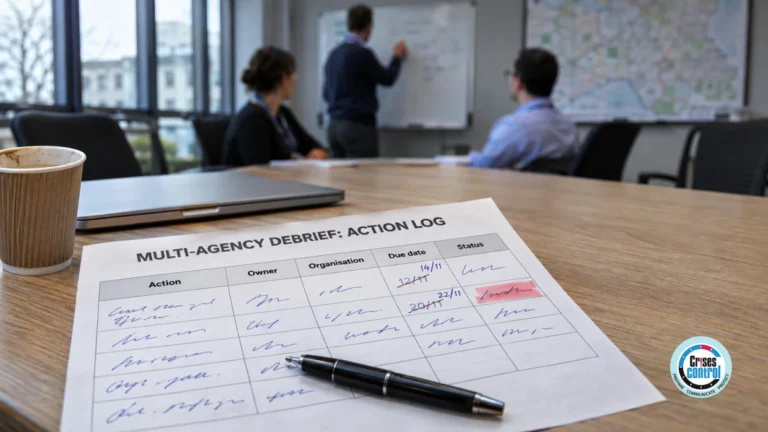
Roles on a page are only half of a payments outage response. Keeping the actions each role hands out visible, owned and closed is what incident task management is for.
Merchant Communication In A Payments Outage Response
Merchant communication runs on a cadence, not on certainty. The first message says what is failing, which merchants are affected, what to do instead, and when the next update arrives. It does not need a cause.
Knowing which merchants to contact is its own problem, and it is usually the slowest part of the first hour. Working out who is affected while the incident is still live is a different discipline from fixing it.
Where Does Regulatory Reporting Sit In A Payments Outage Response?
Regulatory reporting sits inside the payments outage response from the first minute, with a named owner and a short deadline. In the United Kingdom, the Financial Conduct Authority requires all payment service providers to report a major operational or security incident on its Major Incident Notification form within four hours of detecting it.
That window runs from detection, or from the point the regulator re-opens if it is closed. Four hours sounds generous until you split it across one outage: detection, confirmation, scoping and the threshold judgement all sit inside it, and the firm still has to agree who signs the form.
That regime is changing. The FCA published its final rules and guidance on operational incident reporting in March 2026, as Policy Statement PS26/2 and Finalised Guidance FG26/3, and they come into force on 18 March 2027. Firms follow the existing process until then. The new framework covers almost all FCA-regulated firms and payment service providers, with one report submitted through Connect.
In the European Union, the Digital Operational Resilience Act (DORA), Regulation (EU) 2022/2554, has applied since 17 January 2025. Its clock runs in three stages: an initial notification within four hours of classifying the incident as major and no later than 24 hours from becoming aware of it; an intermediate report within 72 hours of that notification; and a final report within one month afterwards. Credit institutions, e-money institutions, payment institutions and account information service providers report payment-related incidents under DORA rather than the earlier payment services regime.
One detail decides whether either clock is survivable. The European deadline starts at classification, so somebody has to classify. The United Kingdom deadline starts at detection, so somebody has to write down when detection happened. Neither does itself on a Saturday afternoon, and a firm with permissions in both places is reporting one incident to several regulators.
This is orientation rather than legal advice, and the position here is as at November 2026. Confirm what applies to your own permissions and jurisdictions with your compliance team.
How Does Crises Control Support A Payments Outage Response?
Crises Control is an Operational Incident Coordination Platform, and its Incident Manager module is built for the hour in which a payments outage response is either coordinated or improvised. Every incident runs from one structured workspace, which gives the incident lead somewhere to stand.
From there a firm can launch a predefined incident response plan instantly, so the roles above arrive already written. Structured communications let the team launch message templates and notify predefined recipient groups, which is how a first merchant update goes out in minutes. An operational timeline holds the incident from activation through to resolution, and response activity can be monitored in real time.
What comes out afterwards is the record: notification reports, an incident summary, a complete incident history, and audit and compliance reports that can be exported for governance, compliance reporting and post-incident review. A regulatory submission and a board review both draw on that material.
What the platform does not do is decide. It will not declare the incident, choose the incident lead, judge whether a reporting threshold has been met, or approve what merchants are told. Those are the firm's calls, made by the people it has named. The software reaches the right people, records every decision, and stops anything assigned from going quietly missing.
The First Hour Payments Outage Response Checklist
Work through this in order. It is the shortest working version of a payments outage response, written so a payments operations team can run it while engineering is still diagnosing.
- Declare the incident, and say out loud who the incident lead is.
- Record the detection time to the minute, and who detected it.
- Get a plain-language impact statement from the technical lead: what is failing, for whom, and what still works.
- Identify the affected merchants, and say how confident you are in that list.
- Send the first merchant update, with a workaround and the time of the next one.
- Start the regulatory threshold assessment, with a named owner, and note the time it started.
- Set the update cadence and hold it, including the updates where nothing has changed.
- Brief the executive sponsor on the commercial and reputational position, not on the fault.
- Confirm every action assigned on the call has an owner and a due time.
- Keep the timeline as you go, because it cannot be reconstructed afterwards.
Settling The Question Before The Next Outage
A payments outage response is one operational event with a technical cause, and it needs one person holding it. The firms that come through the first hour well are the ones where the incident lead, the merchant communications owner and the regulatory assessor were named weeks earlier, written into a plan, and practised on something small.
If those names do not exist in your firm today, that is the work, and it costs less than the alternative. Write the roles down. Agree the cadence. Decide who records the detection time and who signs the regulatory form. Then run a drill on a degraded authorisation route and watch which of the five roles nobody picks up.
If coordination is the part of the payments outage response that falls apart rather than diagnosis, look at how Crises Control approaches operational resilience for financial services, or ask for a walkthrough against one of your own outage scenarios.
Frequently Asked Questions
Who leads the payments outage response?
An incident lead leads it, and it is not the engineer fixing the fault. The incident lead owns the payments outage response as a whole: declaring the incident, setting the update cadence, deciding escalation and holding the roles together. The technical lead owns diagnosis, containment and recovery. Separating the two is what lets both run at full speed.
Should the incident lead and the technical lead ever be the same person?
In a small team they sometimes have to be, but treat it as a deliberate exception rather than the default. One person holding both roles will put the fault ahead of the response, because the fault feels more urgent. If the roles must be combined, hand merchant communications to someone else first, because that is the job that disappears quickest.
What should merchants be told in the first hour of a payments outage?
Tell merchants what is failing, which of them are affected, what to do instead, and when the next update will arrive. A first update does not need a root cause, and waiting for one is the most common reason merchants hear nothing at all. Three updates that land when promised build more confidence than one complete explanation that arrives late.
How quickly must a payments outage be reported to a regulator?
That depends on the jurisdiction, and the deadlines are measured in hours. In the United Kingdom, payment service providers report a major operational or security incident to the Financial Conduct Authority within four hours of detecting it, and under the European Union's Digital Operational Resilience Act (DORA) the initial notification is due within four hours of classifying the incident as major and no later than 24 hours from becoming aware of it. Confirm what applies to your own permissions, because this is orientation rather than legal advice.
What is the difference between incident coordination software and an alerting tool?
An alerting tool sends messages and tells you they were delivered. Incident coordination software adds what happens after the alert: role assignment, a shared operational picture, task ownership and a timeline that can be produced afterwards as evidence. Most organisations can send alerts, and far fewer can manage an incident end to end. A payments outage is decided in the part that comes after the alert.
This article was drafted with AI assistance and reviewed by the Crises Control team. Featured image: AI-generated.