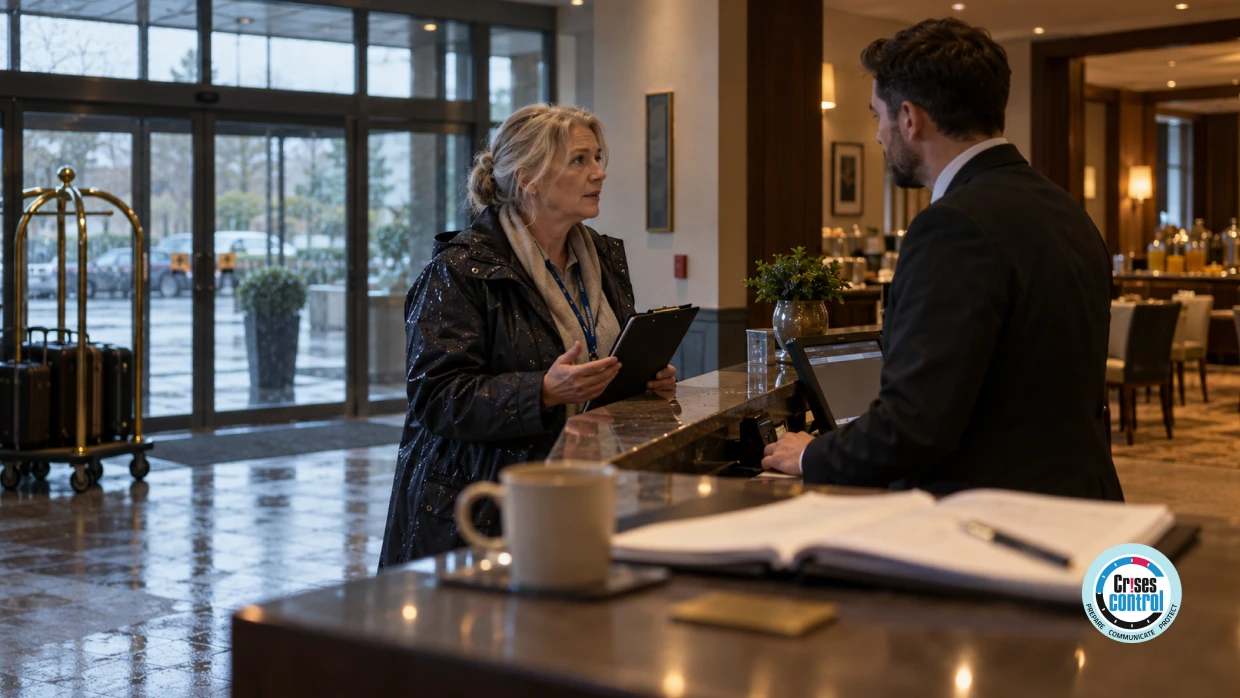
At 07:40 on a Tuesday, a woman in a damp coat walks into the lobby of a 140-room hotel, shows a lanyard and asks for the duty manager. She is not on the diary. She would like to see the fire drill records, the kitchen temperature logs and the training file for everyone on shift this morning.
Compliance in hospitality is not a folder. It is the ability to show, on any ordinary morning, who did what, when they did it, and what happened when something went wrong. Most hotels hold that evidence somewhere. The problem is that it sits in four systems, two spreadsheets and a drawer behind reception.
Compliance in hospitality means meeting fire, food, health and data protection duties and being able to evidence each one on demand. The record matters as much as the action: an inspection tests whether a hotel can prove what it did, not whether staff remember doing it.
What Is Compliance In Hospitality?
Compliance in hospitality is the set of legal and regulatory duties a hotel, resort or venue owes to its guests, its staff and its regulators, together with the records that prove those duties were met. It covers fire safety, food hygiene, health and safety, licensing and data protection, and it applies every day, not only on inspection day.
The duties themselves are rarely the hard part. A general manager can name them. What makes it difficult is that the evidence is produced by different people, in different places, at different times, and nobody owns the job of bringing it together until somebody asks.
Why Does Compliance In Hospitality Fail On An Ordinary Day?
Compliance in hospitality fails because the record breaks before the procedure does. Staff carry out the check, then log it on a sheet that stays in a department. Six weeks later nobody can say whether the check happened, and an inspector treats an unprovable check as a check that did not take place.
Four things make that more likely in a hotel than in most workplaces.
Departments keep separate records. Security logs incidents one way, housekeeping another, the kitchen a third. Each is reasonable on its own. Together they leave gaps nobody sees until an audit lines them up.
Shifts turn over constantly. Seasonal and agency staff are normal in hospitality. A worker on their second shift may not know where the logbook lives, let alone that their signature on it is the evidence.
Duties get assumed rather than assigned. The most common finding after an incident is not that someone refused a task. It is that two managers each believed the other owned it.
Incidents happen at the worst hours. A guest falls at 23:10. The person who deals with it well is often the person least equipped to write it up properly afterwards.
Which Records Does An Inspector Actually Ask For?
An inspector asks for evidence, not assurance. Four areas are examined most often in a hotel, and in each one the record either exists in a form someone else can follow, or it does not.
The table sets out where that evidence usually sits and what a satisfactory answer looks like.
In the UK the underlying duties sit in the Regulatory Reform (Fire Safety) Order 2005 and the Health and Safety at Work etc. Act 1974, and a personal data breach must be reported to the Information Commissioner's Office within 72 hours of becoming aware of it. This is orientation rather than legal advice, and it reflects the position as at October 2026. Operators in the EU, the Middle East and North America should check what their own regulator expects.
Who Is Responsible For Compliance In A Hotel?
Responsibility for compliance in a hotel sits with the general manager or the designated responsible person, but the duties are delegated down and that is where they come loose. A duty manager owns daily checks. Heads of department own their areas. Someone owns data protection, often without the title.
The practical test is simple. Pick any compliance duty and ask who would be named if it were missed tonight. If the answer is a department rather than a person, the duty is unassigned. Naming an owner costs nothing and closes most of the gap on its own.
How Does Crises Control Support Compliance In Hospitality?
Crises Control supports compliance in hospitality by holding the record in one place as the work happens, so the evidence exists before anyone asks for it. Its Compliance Management Software centralises procedures and documentation, and Incident Reporting Software timestamps each incident, the tasks assigned and who completed them.
For a hotel group, that means a duty manager logs a guest incident on a phone at 23:10, the task goes to the named owner, and the completed record is retrievable months later with the time, the actions and the people attached. Our hospitality crisis management software sets out how this works across several properties, and Hyde Park Residence, a serviced residence in Mayfair, describes in its case study how the system was shaped around its own procedures rather than the other way round.
Crises Control itself holds ISO 9001, ISO 22301, ISO 27001, ISO 14001 and Cyber Essentials Plus, listed on its accreditations page. That matters for the data protection half of the question, because a platform holding guest and staff incident records is itself part of your processing chain.
Some things stay with the operator. The platform records what was done, it does not decide what should be done. It holds the contact and rota data someone has to keep current. It will not tell a general manager that a duty has no owner. And it cannot make an agency worker on their second shift know where the kitchen log lives, which is a training question rather than a software one.
Compliance In Hospitality Checklist
- Every compliance duty has a named person, not a department
- Fire drill records show participation, timing and what failed, not only the date
- Food safety logs have no gaps, including on days the head chef was off
- Certification can be checked for anyone on shift right now, in under a minute
- Incident records capture the decision, the decider and the time
- The same procedures run at every property, not only the flagship
- Evidence for an unannounced inspection can be produced without a scramble
- One person is named to pull it all together, and knows they are
The Afternoon To Sort This Out Is A Quiet One
An unannounced inspection is not really a test of a hotel's standards. It is a test of its record keeping, carried out at a moment nobody chose. The gap it exposes is almost never a hotel that failed to act. It is a hotel that acted and cannot prove it.
Closing that gap is cheap and dull, which is why it gets postponed. Name an owner for each duty. Put the evidence somewhere a second person can find it. Run one check this month as though an inspector were standing in reception at 07:40, and see what takes longer than it should.
A general manager can test this before the next busy season. Pick a Tuesday, ask for the four records in the table above, and time it. If they arrive inside ten minutes, compliance in hospitality is working. If they do not, the checklist above shows where to start. To see how other operators handle it, book a demo.
Frequently Asked Questions
What does compliance in hospitality cover?
Compliance in hospitality covers fire safety, food hygiene, health and safety, licensing and data protection, together with the records proving each duty was met. In practice it means scheduled checks, a named owner for every duty, and an audit trail an inspector can follow without being walked through it. The duties vary by country, so a group operating in several regions carries several sets at once.
Who is responsible for compliance in a hotel?
Responsibility sits with the general manager or designated responsible person, with duties delegated to a duty manager for daily checks, heads of department for their areas, and a named owner for data protection. Compliance fails most often where a duty was assumed rather than assigned. The test is whether a person, not a department, would be named if a duty were missed tonight.
How often should a hotel run fire drills?
Frequency is set by the hotel's own fire risk assessment rather than a single fixed figure, which is why two hotels can legitimately differ. What an inspector examines is whether drills happen at the stated frequency and whether the records show who took part and what went wrong. A drill with no record is treated as a drill that did not happen.
What is the difference between a compliance checklist and compliance software?
A checklist records that a task was completed. Compliance software records who completed it, when, what they found and what happened next, and keeps that evidence retrievable afterwards. The difference matters at audit, where the question is rarely whether a procedure exists and almost always whether it can be evidenced. Hospitality compliance solutions differ mainly in how much of that evidence they capture automatically.
Do hospitality compliance requirements differ between regions?
Yes. UK operators work to the Regulatory Reform (Fire Safety) Order 2005 and the Health and Safety at Work etc. Act 1974, EU operators add GDPR and local health directives, and North America and the Middle East apply their own labour, fire and safety codes. A group operating across regions needs one process that satisfies the strictest requirement it faces, rather than a different process per country. Hotel IT compliance services are usually the hardest part to standardise, because data rules vary most.
This article was drafted with AI assistance and reviewed by the Crises Control team. Featured image: AI-generated.