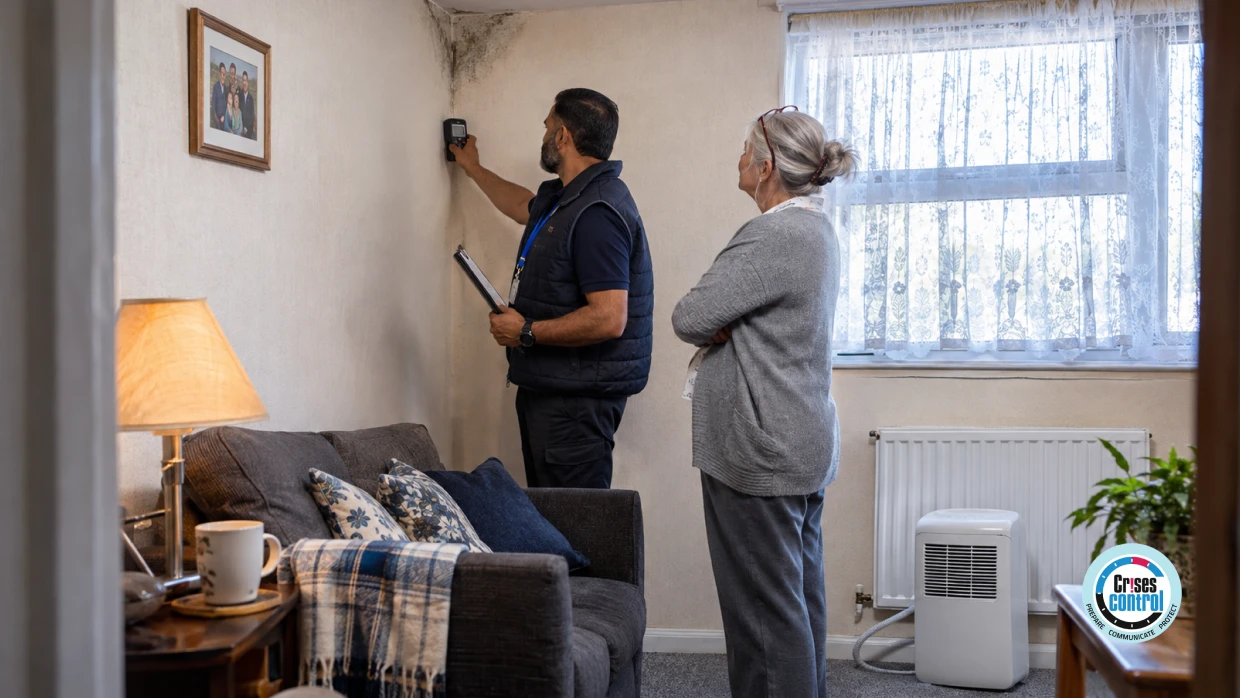
A tenant reports damp and mould in a child's bedroom. Within a week three teams hold part of the answer: a surveyor booked to inspect, a repairs planner holding the works order, and a housing officer who promised the family an update. Each team keeps its own list. The statutory clock does not wait for those lists to agree.
Evidencing hazard response times in social housing means proving, hazard by hazard, the date the landlord became aware, the date the investigation was completed, the date the written summary reached the tenant and the date the home was made safe. A repairs system records jobs. It does not record that sequence.
Evidencing hazard response times in social housing is the practice of recording, hazard by hazard, when a landlord became aware of a potential hazard, when it was investigated, when the tenant was told in writing and when the property was made safe, against the statutory deadline for each step.
What Does Evidencing Hazard Response Times In Social Housing Mean?
Evidencing hazard response times in social housing means holding a dated record for every stage the Hazards in Social Housing (Prescribed Requirements) (England) Regulations 2025 put a deadline on: awareness, investigation, the written summary to the tenant, and the safety work. The test is not whether the work happened. The test is whether the dates can be produced.
Those Regulations are the legal text behind Awaab's Law, in force since 27 October 2025. They imply a covenant into the tenancy, so a missed deadline breaches the tenancy agreement. A tenant, a solicitor or the Regulator of Social Housing can ask about one property on one date.
Why Does The Repairs System Not Prove Compliance?
A repairs system does not prove compliance because it is organised around works orders, not around hazards. One damp and mould report can produce an inspection, a mould wash and a fan replacement, each with its own reference. None of those records answers the question the Regulations ask: when did the landlord first know?
The gap is a counting problem, not a software failure. Repairs systems time from the day a job is raised. The Regulations time from the day the landlord became aware of the issue of concern, and those are rarely the same day. So evidencing hazard response times in social housing rests on three records that usually sit outside the repairs system: the written summary to the tenant, the attempts made to gain access, and anything reported through a managing agent. Closing that gap is what Compliance Management Software is for.
Which Timescales Does Awaab's Law Set For A Significant Hazard?
Awaab's Law sets four deadlines. A landlord must complete an investigation within 10 working days of becoming aware, give the tenant a written summary within 3 working days of its completion, and complete the relevant safety work within 5 working days. An emergency hazard must be investigated and made safe within 24 hours.
The 3 working day and 5 working day deadlines both run from the day after the investigation is completed, so they overlap. Where a significant hazard cannot be made safe inside those 5 working days, the landlord must provide suitable alternative accommodation at no cost to the tenant. Evidencing hazard response times in social housing means holding a date against each of those steps, separately.
The table sets each stage against its deadline and the record that has to exist for it.
The Same Clock Under Different Names
England is not the only market that puts a number on a repair, and the numbers do not transfer. In Scotland, the Scottish Secure Tenants (Right to Repair) Regulations 2002 set a maximum period for each qualifying repair, running from the day after it is notified or inspected: 1 working day for an insecure external door, 3 working days for a loose hand rail, 7 working days for a broken extractor fan.
New York City works by violation class instead, giving an owner 90 days for a Class A non-hazardous violation, 30 days for a Class B hazardous violation, 21 days where the violation is mould, and 24 hours for most other Class C violations. A mould case carrying 5 working days in England carries 21 days there. Check the regime that applies to your own stock. Only the shape of the problem travels.
What Changes On 30 November 2026?
On 30 November 2026 the Hazards in Social Housing (Prescribed Requirements) (England) (Amendment) Regulations 2026 widen Awaab's Law beyond damp and mould. The instrument was made on 13 November 2026 and brings excess cold, excess heat, domestic hygiene, falls, electrical, explosion and structural collapse hazards into the definition of a significant hazard.
It also changes the test for significance. From 30 November 2026 a significant hazard means a relevant hazard posing a risk of harm that a reasonable landlord with the relevant knowledge would make safe within 15 working days, replacing wording about acting as a matter of urgency. An emergency hazard is one such a landlord would make safe within 24 hours.
Read that carefully. The 15 working days is a classification test, not a repair deadline. A hazard that meets it is a significant hazard, and the operative deadlines stay at 10 working days to investigate, 3 working days for the written summary and 5 working days for the safety work. Treating it as a fifteen day allowance to finish a repair would put a team three times over the real limit.
Scope narrows in one direction. Fire hazards are excluded where they arise from a deficiency in a part of a building regulated under the Regulatory Reform (Fire Safety) Order 2005, covering the structure, external walls, common parts and the doors between flats and common parts. For the newly added hazards, the relevant date is 30 November 2026 instead of 27 October 2025. This is orientation and not legal advice, and the position is as at November 2026.
How Do You Track Damp And Mould Repairs Across Three Teams?
Tracking damp and mould repairs across three teams needs one record per hazard, with a named owner and a due date on every stage. One record per works order will not do it, because the hazard is the unit the Regulations care about. When three teams each hold a separate reference, nobody owns the deadline running across all three.
A works order tells a planner what to do. It does not tell a housing officer that a written summary is due to a family in two working days, and it does not escalate when that summary has not gone out. Government guidance for social landlords advises keeping clear records of all engagement, investigations and communications with tenants, including where information has been reported by a third party such as a managing agent.
That last point is where evidence trails break. A report reaching a managing agent starts the landlord's clock, not the agent's, and outsourcing the work does not move the duty. The same split of duty, operation and task appears out of hours, covered in this guide to who takes charge of an out-of-hours building incident. Four dates carry the obligation, and each one usually sits with a different team:
- The day the landlord became aware, captured by a contact centre or a housing officer
- The day a competent investigation was completed, owned by surveying or asset management
- The day the written summary reached the tenant, owned by housing or customer services
- The day the relevant safety work was completed, owned by repairs or a contractor
How Does Crises Control Track Hazard Repair Timescales?
Crises Control tracks hazard repair timescales through Task Manager, its execution layer. Each stage becomes a task with an owner and a deadline, so the investigation, the written summary and the safety work are tracked separately, not buried in one works order. Task Manager assigns response tasks to the right people or teams and maintains clear ownership.
Three capabilities matter for a statutory clock. Deadline monitoring shows due dates against each task. Escalation rules can be configured for overdue or unclaimed tasks, so a written summary that has not gone out raises itself instead of waiting to be noticed. Task progress is tracked from assignment through completion, with ownership and status visible in real time.
The record builds itself as the work happens, which is the practical form evidencing hazard response times in social housing takes. Task Manager records task ownership, acceptance times, status changes, escalation activity and completion updates, and those records support post-incident review, governance and audit. Incident Task Management Software is the part of the platform holding that task layer, and Compliance Management Software is how Crises Control frames the record it leaves. Property teams coordinating across buildings and contractors get the same approach through Property Management Incident Management Software.
What the software does not do is decide. It will not judge whether a hazard is significant, choose between a mould wash and a ventilation upgrade, or make a surveyor available. Those stay with the landlord's own people. Alert-only tools stop once a message is sent. Repairs and asset platforms hold the works order, and were never built to run a statutory clock.
Hazard Response Evidence Checklist
Seven checks on evidencing hazard response times in social housing, each answerable yes or no for one named property:
- The date and time the landlord became aware is recorded, with the channel and the person who took the report
- Reports arriving through a managing agent or contractor are timestamped in the landlord's own record the day they arrive
- Each hazard has one record, and every stage of it has a named owner, not a team
- The 10 working day investigation, the 3 working day summary and the 5 working day safety work are tracked as separate deadlines
- Overdue stages escalate to a named person before the deadline, not after it
- Attempts to gain access are recorded, including missed and refused appointments
- The written summary issued to the tenant is retained with its date and the timeframes it gave
Proving It, Not Just Doing It
Most social landlords are already doing the work. Surveyors inspect, contractors attend, mould gets treated and families get called back. What tends to be missing is the thing a regulator, a solicitor or an ombudsman actually asks for: a dated sequence for one property showing each statutory step and when it happened.
That sequence cannot be assembled afterwards from a repairs system, a call log and somebody's sent items. Evidencing hazard response times in social housing is an operational habit first and a reporting exercise second. It gets built while the clock runs, by the people doing each stage.
From 30 November 2026 the number of hazards running on a statutory clock grows, and so does the number of teams touching any one of them. If your answer to when did we first know lives in three systems, start there. See how the task and evidence layer works against your own stock on a demo.
Frequently Asked Questions
What is Awaab's Law?
Awaab's Law is the set of requirements in the Hazards in Social Housing (Prescribed Requirements) (England) Regulations 2025, which came into force on 27 October 2025 and apply to social landlords in England. It works by implying a covenant into the tenancy, so a missed deadline breaches the tenancy agreement. Phase 1 covered emergency hazards and significant damp and mould hazards.
What are the Awaab's Law timescales for a significant hazard?
A landlord must complete an investigation within 10 working days of becoming aware of the issue of concern, give the tenant a written summary within 3 working days of the investigation being completed, and complete the relevant safety work within 5 working days of that point. An emergency hazard must be investigated and made safe within 24 hours. Where a hazard cannot be made safe in time, the landlord must provide suitable alternative accommodation at no cost to the tenant.
What changes under Awaab's Law Phase 2 on 30 November 2026?
From 30 November 2026, excess cold, excess heat, domestic hygiene, falls, electrical, explosion and structural collapse hazards join damp and mould in the definition of a significant hazard. The amending regulations also redefine a significant hazard as one a reasonable landlord with the relevant knowledge would make safe within 15 working days, which is a classification test and not a repair deadline. Fire hazards arising from parts of a building regulated under fire safety law are excluded.
Does a repairs system prove Awaab's Law compliance?
No. A repairs system records works orders and times them from the day a job is raised, while the Regulations time from the day the landlord became aware of the issue of concern. The written summary, attempts to gain access and reports arriving through a managing agent usually sit outside it. Evidencing hazard response times in social housing needs a dated sequence per hazard, which is what Compliance Management Software and incident reporting hold.
What records should landlords keep for emergency hazard repairs?
Recording emergency hazard repairs for landlords means keeping the date and time the landlord became aware, the time the investigation was completed, the time the safety work was finished and, where 24 hours could not be achieved, the offer of suitable alternative accommodation. Government guidance advises landlords to keep clear records of all engagement, investigations and communications with tenants. Records of attempted access matter as much as records of completed work.
This article was drafted with AI assistance and reviewed by the Crises Control team. Featured image: AI-generated.