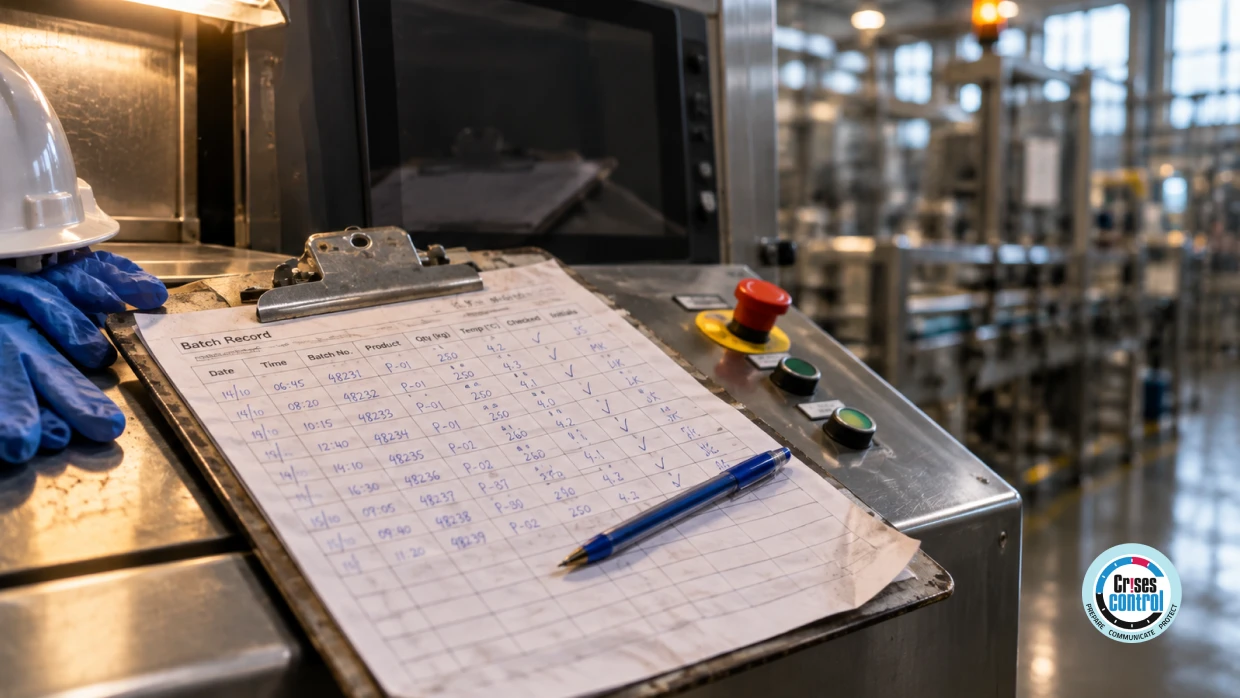
A manual workaround is not one decision. It is the set of jobs that leave your systems the moment those systems stop, and land on people instead: entering, counting, signing, checking, writing up. Switching to paper takes a minute. Working out who holds each of the dozen jobs that follow is the part most plans never cover.
Incident task management for manufacturing is the practice of putting a named person and a due time against every action an incident creates, the manual ones included, and capturing the record while the work happens instead of rebuilding it afterwards.
Incident task management for manufacturing means assigning every action an incident creates to a named person with a due time, tracking it to completion, and recording ownership and timing as the work happens. During a manual workaround those actions include the paperwork the systems used to do.
What Is Incident Task Management For Manufacturing?
Incident task management for manufacturing turns an incident response plan into assigned work. Each action gets one owner, one due time and a state you can see, from assignment to completion. It covers the technical recovery tasks, and during an outage it covers the manual jobs that keep production and its paperwork going.
Two things separate it from a task list in a project tool. The work is created under pressure, by people who did not plan their day around it. And it has to be provable later. A shift handover applies both tests at once: whoever takes over needs to know what is outstanding, who held it, and what state it was left in.
Why Do Manual Workarounds Fail On The Record Rather Than On The Line?
Manual workarounds usually keep production moving, because operators are good at improvising. What fails is the record. Physical work has an obvious prompt, so somebody does it. The jobs that exist only to create a record have no prompt at all once the system that used to demand them is gone.
A pallet that needs moving gets moved. A batch record that needs transcribing once the system returns has no queue, no reminder and often no owner, so it waits. The same goes for the stock count nobody reconciles, the deviation raised verbally at handover, and the check signed on a sheet now sitting in a different office. By the time your systems are restored, the gap is not on the floor. It is in the paperwork, and a quality lead, an auditor or an insurer finds it weeks later.
Which Manual Tasks Appear When Plant Systems Go Down?
The manual tasks that appear are transcription, counting, signing, raising and reporting. Each was enforced by a system that would not let a step be skipped. On paper nothing enforces it except a person who knows the job is theirs, and that is what incident task management for manufacturing has to supply while the system is unavailable. Telling people the outage has started is a separate problem, and one we covered in a piece on alerting the plant floor when the network is down.
The table below sets out four jobs that most often lose their owner during a plant outage, where each one normally lives, and what goes missing when nobody is named against it.
Four jobs, four owners, four due times. Most sites have a longer list. The point is that every job on it needs a name against it before the outage, because an incident is a poor moment to be deciding who transcribes the batch records.
How Do You Keep The Record While The Line Runs On Paper?
You keep the record by treating each manual job as an assigned task with an owner, a due time and a completion state, and by capturing it as the shift runs. A record written at the time is evidence. The same record assembled from memory three weeks later is a reconstruction, and it reads like one.
Manufacturing already has a working model for this. A permit to work is what process industries use when normal controls are set aside for non-routine work. HSE's guidance on permit to work systems expects that "the work is properly authorised by a responsible person", that permits are kept on file, and that there is a formal procedure for handing the plant back to operation. A manual workaround is the same shape of problem. Normal controls are suspended, so the authorisation, the record and the formal handback all have to come from people.
The duty to write the arrangements down is already there too. In the United Kingdom, regulation 5 of the Management of Health and Safety at Work Regulations 1999 requires every employer to "make and give effect to such arrangements as are appropriate" for the planning, organisation, control, monitoring and review of preventive and protective measures, and, where five or more employees are employed, to record those arrangements. An agreed list of who owns each manual task is that kind of arrangement. As at October 2026 the regulation is in force in this form. Treat this as orientation and not legal advice: duties differ by sector and by country, so confirm your own with your regulator and your advisers.
Three rules make the difference on the day:
- Name the owner, not the team, because a task assigned to maintenance is assigned to nobody
- Give every manual task a due time, so an overdue one becomes visible instead of forgotten
- Capture the completion where the incident record lives, not on a sheet somebody has to find again
How Does Crises Control Support Incident Task Management For Manufacturing?
Crises Control holds the ownership and the record around a manual workaround, so every job has a named person, a due time and a state you can see while the systems that normally enforce them are down. Crises Control is an Operational Incident Coordination Platform. It coordinates the response. It does not run the plant.
Task Manager is the module that does this, described on the Incident Task Management Software page. It assigns response tasks to the right people or teams and keeps clear ownership for every one of them. It monitors deadlines and tracks progress from assignment to completion on a live dashboard showing total, completed, in progress and overdue tasks. Escalation rules can be configured for overdue or unclaimed tasks, and escalations are timestamped against the incident.
Ownership, acceptance times, status changes and completion updates are all recorded, which is what supports a post-incident review or an audit later. Workflow dependencies can be set so tasks follow the right sequence, which matters when a reconciliation cannot start until a count is closed.
In a plant this sits alongside the rest of the response. The manufacturing incident management software pages describe operations, maintenance, engineering, HSE and leadership working from one shared picture, with every alert, acknowledgement, task and decision recorded automatically for the incident timeline. Where the outage is a cyber event, the restart question runs in parallel, and we looked at that separately in who decides when to restart production. The record itself comes out of Incident Reporting Software as a by-product of the response instead of a write-up afterwards.
What the platform does not do is the manual work. It will not transcribe a batch record, count a pallet or sign a check sheet, and it does not stand in for the manufacturing execution system that is unavailable. Which jobs must continue on paper, and which can safely wait for the systems to return, stays with the plant's own people. Incident task management for manufacturing is still run by named humans. What changes is that the naming happens in advance, the due times are visible, and the record exists by the end of the shift instead of being owed.
Manual Workaround Ownership Checklist
Use this as the test of whether your site could run incident task management for manufacturing tomorrow, with no meeting to work out who does what.
- A written list of the manual jobs each critical system creates when it stops
- One named owner, plus a deputy, against every job on that list
- A due time for each job, so an overdue one is visible and not assumed
- Deputies tested against a night shift and a weekend, not only the day team
- A defined place the record goes, agreed before the outage and not during it
- An owner for the catch up work: transcribing, reconciling and filing once systems return
- A rule that a deviation raised verbally is written up before the shift ends
- One rehearsal, so the first time your site runs on paper is not a live event
Decide The Owners Before The Systems Stop
A manual workaround is rarely where a site comes unstuck. Operators keep the line moving, the shift gets through, and the product goes out. The damage shows up later, in the batches nobody transcribed, the count nobody closed, and the deviation that exists only in somebody's memory of a handover conversation.
Sites that come out of an outage clean have not found a faster way to do paperwork. They agreed, on an ordinary week, which manual jobs each system creates, who owns each one, when each is due and where the record goes. That costs an afternoon, and it is the whole of incident task management for manufacturing. Skip it, and the account you give a quality lead or an auditor months later is assembled from memory. To see what assigned ownership and a defensible record look like against your own continuity plan, request a demo and bring the plan with you.
Frequently Asked Questions
What is incident task management for manufacturing?
Incident task management for manufacturing is the practice of assigning every action an incident creates to a named person with a due time, then tracking it to completion and recording what happened. It covers the manual jobs an outage creates, such as transcribing batch records and reconciling stock counts, not only the technical recovery work. The record it produces is what supports a review or an audit afterwards.
Who should own manual tasks during a production outage?
Each manual task should have one named individual and one named deputy, agreed before the outage. A task assigned to a department is assigned to nobody, because every member of that department assumes a colleague has it. Deputies matter more than primary names, since a night shift or a weekend crew rarely holds the people a plan assumes.
How do manufacturers keep records when systems are down?
Manufacturers keep records by writing manual work down as it happens, against a named owner and a time, in a place agreed in advance. A record written during the shift is evidence, while one assembled from memory weeks later is a reconstruction. Permit to work systems in process industries run on the same principle: authorisation by a responsible person, a permit kept on file, and a formal handback.
What is the difference between incident task management and a project task tool?
A project task tool assumes planned work, a known team and no time pressure. Incident task management assumes the opposite. Tasks are created during the incident, assigned to whoever is actually on shift, escalated when they go overdue, and recorded for accountability. What comes out of it is an operational record, described on the Incident Task Management Software page, and not a burndown chart.
Does incident task management software replace a manufacturing execution system?
No. Incident task management software coordinates the people and the actions around an incident. It does not run or replace a manufacturing execution system, an ERP or a control system. It holds who owns each manual job, when it is due and what state it is in while those systems are unavailable. Restoring the systems themselves stays with the information technology and engineering teams.
This article was drafted with AI assistance and reviewed by the Crises Control team. Featured image: AI-generated.