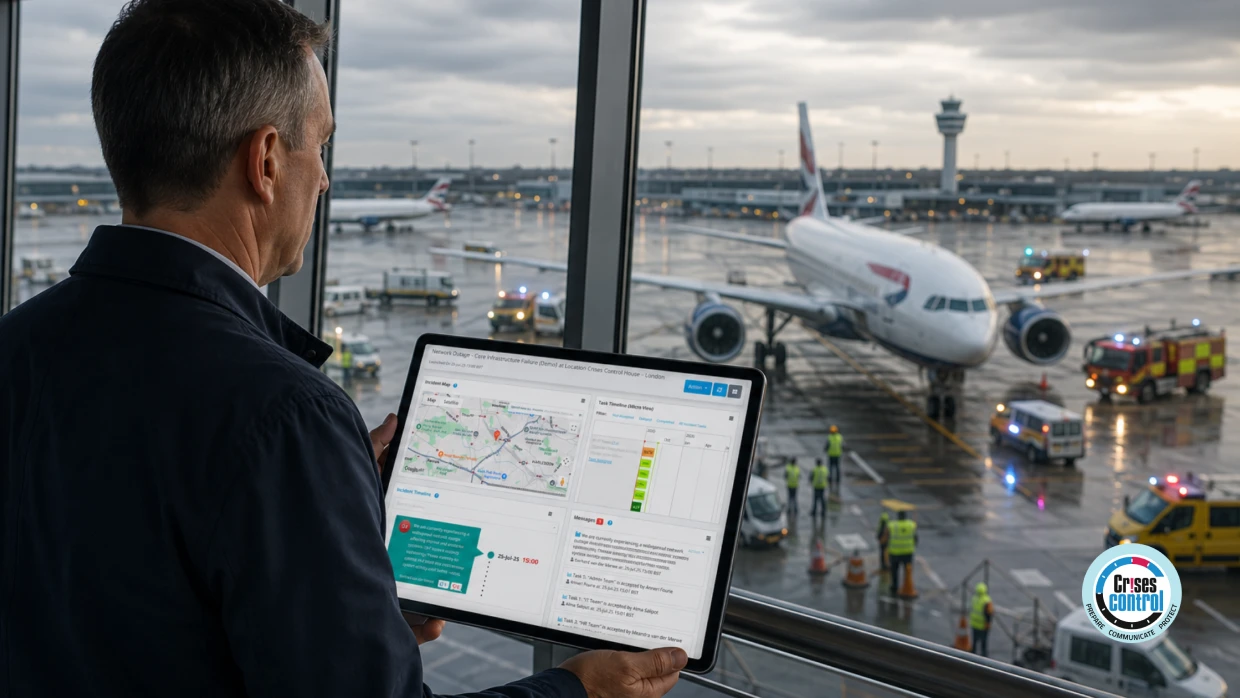
Operational visibility during incidents is the ability of every decision-maker in an organisation to see the same real-time picture of what is happening, who is responding, and what still needs to be done. In aviation and transport, this shared view is not a luxury or a technical enhancement. It is the operational baseline that determines whether a team contains an incident or loses control of it.
Consider a flight delay caused by a technical fault. At the same moment, the airline operations team believes the aircraft will be ready in twenty minutes. The ground handling team has already begun reassigning the stand. The gate team has advised passengers of a ninety-minute delay. And the captain has received no update at all. Four separate versions of the same incident are being managed simultaneously by teams that believe they are working from the same information. They are not.
This is not a communication failure. It is a visibility failure. And it is the most common reason that manageable incidents in aviation and transport escalate beyond their initial scope.
Why Operational Visibility Breaks Down During Incidents in Aviation and Transport
In stable operations, the lack of a shared operational picture is tolerable. Each team manages its function. Information flows at the pace of routine communication. The gaps between what one team knows and what another knows are narrow enough not to cause problems.
During an incident, those gaps widen instantly. The pace of events outstrips the pace of routine communication. Decisions need to be made in seconds rather than minutes. Teams that operated independently in stable conditions suddenly need to coordinate in real time, often without the tools or structures to do so.
Three structural factors make operational visibility during incidents particularly difficult in aviation and transport.
First, the scale of the operational environment. A large international airport can involve dozens of separate organisations: airlines, handling agents, ground services, fuel suppliers, security contractors, border agencies, medical services, and emergency responders. A major logistics network can span hundreds of drivers, multiple depots, and a customer base across several countries. When an incident occurs, getting every relevant party onto the same operational picture is a coordination challenge of significant complexity.
Second, the speed at which incidents evolve. A runway incursion at a busy airport can go from isolated event to multi-agency emergency in under two minutes. A vehicle collision involving hazardous materials can trigger simultaneous actions across emergency services, operations, environmental teams, and regulatory authorities within minutes. The information needed to make good decisions is changing faster than manual communication systems can distribute it.
Third, the fragmentation of communication channels. During an incident, information travels across radio, phone, group chat, email, public address system, and face-to-face briefings simultaneously. Each channel carries a different version of the operational picture. The team relying on radio knows something different from the team relying on email. No one has the full picture. Everyone believes they do.
Visibility Is Not the Same as Communication
One of the biggest misconceptions during a major incident is that fast communication automatically creates operational visibility.
It doesn’t.
Communication tells people what has happened. Operational visibility allows everyone responsible for the response to understand what is happening right now.
A shared operational picture should enable decision-makers to see:
- The current status of the incident
- Which teams are actively responding
- Which tasks have been completed
- What actions remain outstanding
- How the situation is evolving in real time
Without that visibility, organisations often have plenty of communication but very little situational awareness. Teams receive updates, yet leaders still struggle to understand the overall state of the response.
Operational visibility turns information into shared understanding, allowing decisions to be made quickly, consistently and with confidence as the incident develops.
The Four Most Costly Visibility Failures in Aviation and Transport Incidents
1. Blind escalation
When the team managing the initial incident does not have visibility of the wider operational picture, escalation decisions are made without the context needed to make them correctly. A duty manager who does not know that three other incidents are being managed simultaneously may escalate one event in a way that diverts resources from a higher-priority situation. Without operational visibility, escalation is not a rational decision. It is a guess under pressure.
2. Siloed updates creating contradictory public communications
In aviation, contradictory information delivered to passengers by different teams is both a reputational risk and a safety concern. In transport, contradictory information delivered to customers, drivers, and regulators simultaneously creates legal and operational exposures. When each team draws its operational picture from a different source, contradictory communications are not a management failure. They are an inevitable structural outcome.
3. Reactive rather than predictive response
Without operational visibility during incidents, teams respond to what they know rather than what is happening. By the time information has travelled through manual relay channels, the situation on the ground has already changed. Response actions are targeting a version of the incident that no longer exists. This reactive posture is the primary reason that managed incidents become prolonged incidents.
4. No confirmation that response actions have been completed
Visibility of the incident itself is only half the picture. The other half is visibility of the response. Who has done what? Which tasks are complete? Which teams are still engaged? Which action items are overdue? Without a real-time view of response activity, the incident commander is managing the situation without knowing whether the response is working. Identifying gaps requires phone calls rather than a dashboard. By the time a gap is identified, the window for action may have closed.
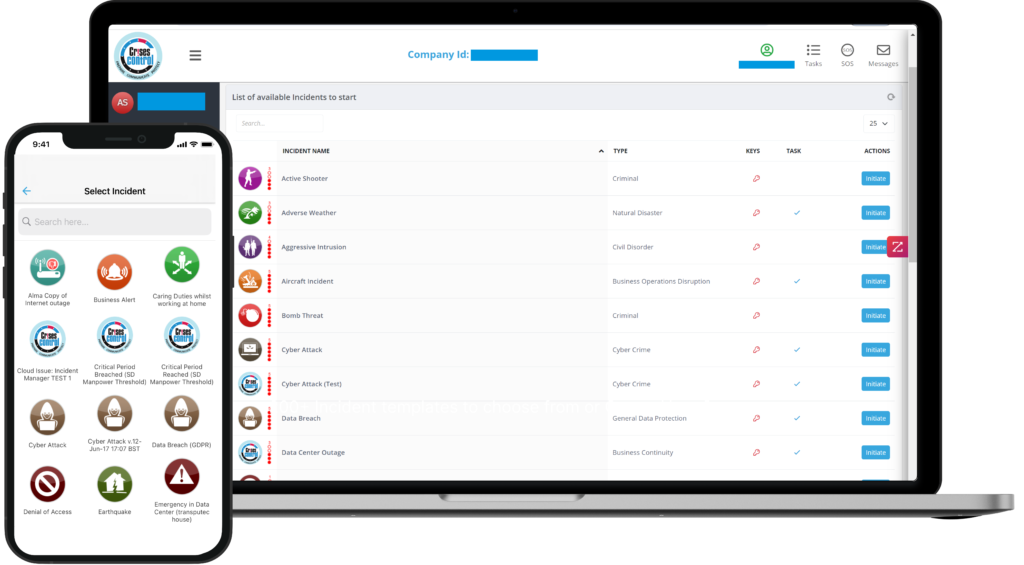
Interested in our Incident Management Software?
Flexible Incident Management Software to keep you connected and in control.
What Operational Visibility During an Incident Actually Requires
Operational visibility during incidents is not achieved by having more communication tools. It is achieved by having the right communication architecture: one that collects information from all response teams, consolidates it into a single shared picture, and distributes updates to all decision-makers simultaneously.
The requirements for true operational visibility during an incident include a single source of truth for the incident status, updated in real time as the situation evolves. Every team needs access to the same version of events, not the version delivered to them through their specific communication channel. Alerts need to reach all relevant parties simultaneously, with confirmation that they have been received and understood.
Response actions need to be visible to the incident commander, not just the team carrying them out. And the entire sequence of events, from first alert to resolution, needs to be captured automatically, not assembled from notes after the fact.
Operational visibility during incidents is not a reporting function. It is a coordination function. The value is not in knowing what happened. It is in knowing what is happening now, and using that knowledge to direct the response before the situation deteriorates further.
Why Standard Tools Cannot Deliver Operational Visibility in a Crisis
Microsoft Teams, Slack, and radio communication networks are capable of moving information quickly. They are not capable of providing operational visibility during incidents. The distinction is important.
A group chat shows messages, not status. It shows what has been said, not what has been done. It shows who sent a message, not who has acknowledged an instruction and confirmed it. When twenty people are contributing to a chat simultaneously, the operational picture fragments into a stream of unstructured information that requires human synthesis to interpret. Under pressure, that synthesis is slow, error-prone, and inconsistent.
Radio communication in aviation and transport is fast and direct. It is also one-to-one, unlogged, and unverified. There is no automatic record of what was said, no confirmation of receipt beyond the acknowledgement in the moment, and no mechanism for tracking whether the action requested has been completed.
The gap is execution.
Operational visibility requires more than communication alone. Organisations need a platform that combines alerts, acknowledgements, task management, operational updates and reporting into a single, continuously updated operational picture. Crises Control is designed to provide that shared view throughout the lifecycle of an incident.
How Crises Control Provides Operational Visibility During Aviation and Transport Incidents
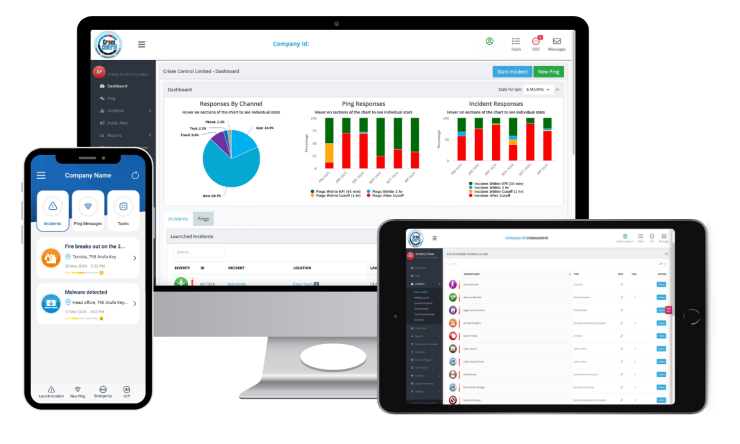
Crises Control helps aviation and transport organisations maintain a shared operational picture throughout the lifecycle of an incident. Rather than relying on fragmented communication channels and manual updates, the platform brings alerts, task management, two-way communication, escalation and reporting together in a single operational workflow.
When an incident is declared, response teams are notified simultaneously across multiple communication channels, ensuring everyone starts from the same information. Two-way acknowledgement tracking provides immediate visibility into who has received critical instructions, while automated escalation helps keep the response moving if actions are delayed.
As the situation develops, the operational picture updates continuously. Teams can report progress, complete assigned tasks and share field updates in real time, allowing incident commanders to monitor the response as it happens rather than piecing together information from multiple sources.
Every alert, acknowledgement, task update and operational decision is recorded automatically throughout the incident. This creates a complete audit trail and enables structured post-incident reporting without relying on manual reconstruction, helping organisations strengthen operational oversight and meet regulatory reporting requirements.
Whether responding to an aircraft emergency, a cyberattack, severe weather disruption or a large-scale transport incident, Crises Control provides the operational visibility needed to help teams make faster, more informed decisions under pressure.
Building Operational Visibility Into Every Incident Response
Operational visibility isn’t created by sending more messages. It’s created by ensuring every decision-maker can see the same live operational picture as an incident unfolds.
For aviation and transport organisations, that means replacing fragmented communication with coordinated execution. Teams need shared situational awareness, real-time task tracking, automated escalation and a single source of truth that keeps everyone aligned as conditions change.
Operational visibility doesn’t prevent disruption. It enables organisations to respond with greater speed, confidence and consistency before disruption spreads.
If you’re looking to strengthen operational visibility across your incident response process, book a personalised Crises Control demo and see how the platform helps aviation and transport organisations maintain a shared operational picture from the first alert through to recovery.
FAQs
1. What is operational visibility during incidents in aviation and transport?
Operational visibility during incidents is the ability of all decision-makers in an organisation to see the same real-time picture of an unfolding event: who is responding, what actions have been taken, what still needs to be done, and how the situation is evolving. In aviation and transport, this shared view is the operational foundation for effective incident coordination. Without it, teams respond to different versions of the same situation, which increases the risk of contradictory actions, missed escalations, and prolonged incidents.
2. Why does operational visibility break down so quickly during aviation incidents?
Operational visibility breaks down during aviation incidents because the pace of events outstrips the pace of manual communication. Information that takes minutes to relay through phone chains and radio communications is already outdated by the time it reaches decision-makers. In complex multi-organisational environments like airports, where airlines, ground handlers, security, and emergency services all need to coordinate simultaneously, no single manual communication channel can keep all parties updated in real time.
3. What tools support operational visibility during transport incidents?
Dedicated incident management platforms that deliver simultaneous multi-channel alerts, two-way confirmation, real-time task tracking, and automated escalation are the primary tools for operational visibility during transport incidents. These platforms provide a single source of truth for the incident status, accessible to all response teams simultaneously. General communication tools such as group chats and email chains cannot provide this level of visibility because they cannot confirm receipt, track task completion, or escalate automatically.
4. How does operational visibility support regulatory compliance in aviation?
Regulators from EASA, the CAA, and the FAA require aviation operators to demonstrate that their incident responses were proportionate, timely, and properly documented. Operational visibility during an incident creates this documentation automatically: every alert, acknowledgement, task completion, and communication is timestamped and stored. When a regulatory inquiry follows an incident, the operator has a complete, consistent, and legally defensible record rather than a reconstructed account.
5. How quickly can operational visibility tools activate in an aviation incident?
Platforms designed for aviation and transport incident management can achieve full team notification within seconds of an incident being declared. The key capability is simultaneous multi-channel distribution: SMS, voice, push notification, email, and app all activated at the same moment rather than sequentially. This eliminates the delays inherent in manual notification chains and gives every team the same information at the same time.