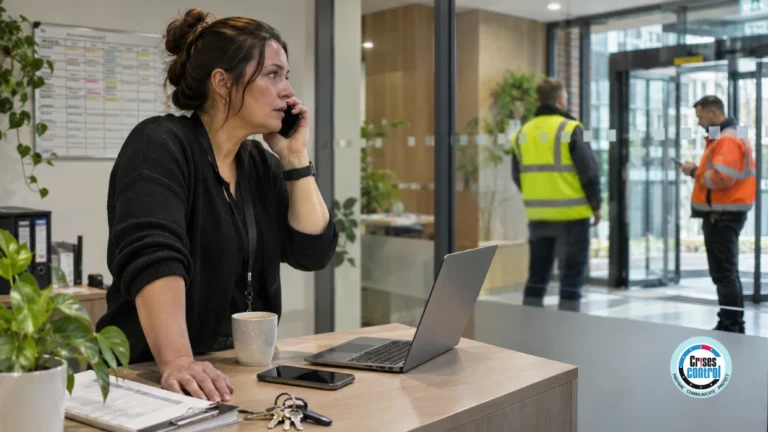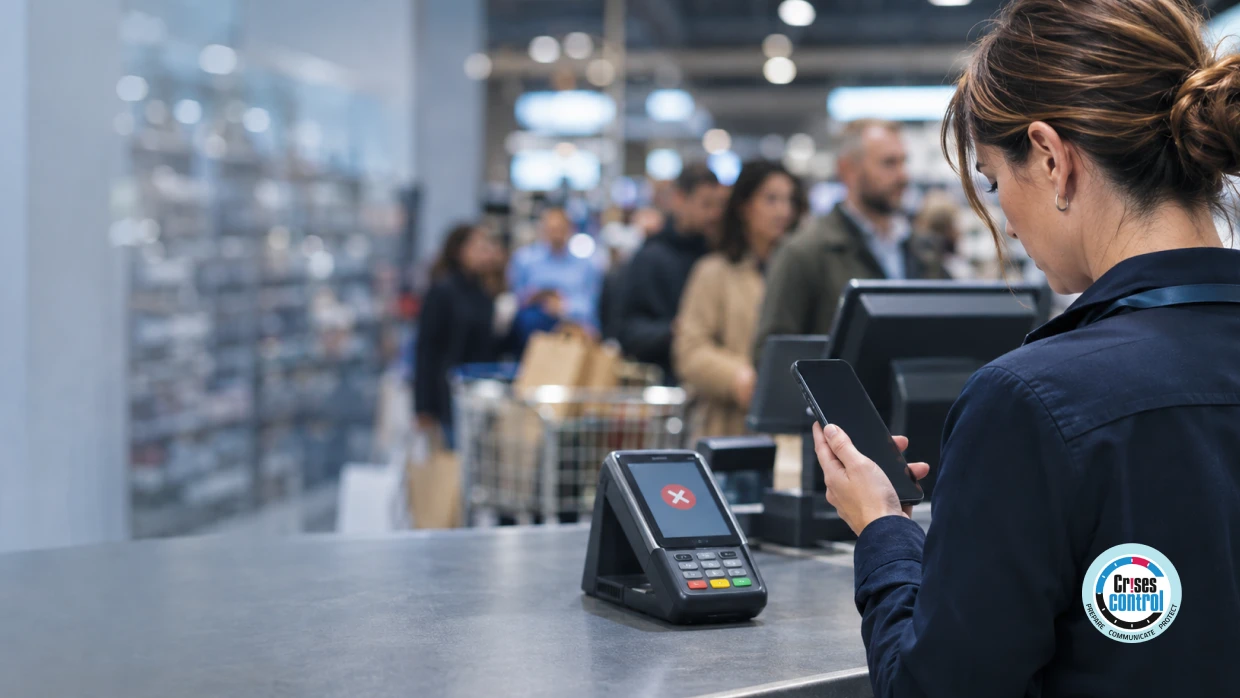
Card payments stop authorising in a third of a retail group's stores on the busiest Friday of the year. Head office sees it in four minutes. The store managers do not, because they are on the shop floor with a queue in front of them and no reason to open email.
Alerting store managers during a peak trading outage works when the alert goes only to the affected stores, carries one instruction a manager can act on at the till, and collects an acknowledgement from each store so head office knows which locations have switched over.
Alerting store managers during a peak trading outage means sending a targeted, multi-channel alert to the stores actually affected, giving each manager one instruction they can follow at the till, and collecting an acknowledgement per store so head office can see which locations have acted.
What Does Alerting Store Managers During A Peak Trading Outage Mean?
Alerting store managers during a peak trading outage is the practice of notifying a defined set of store locations that a system they trade on has failed, telling each manager what to do instead, and recording which stores have confirmed. It is store-level operational communication, not a company-wide announcement.
The two look identical on a screen and behave nothing alike in a shop. A company-wide announcement tells 600 stores that card authorisation is degraded. An operational alert tells the 190 stores behind the affected acquirer to take contactless only and reply once the change is made. One of those changes behaviour at the till. The other generates 600 phone calls to head office.
Why Does The Retail Operations WhatsApp Group Fail At Peak?
The retail operations WhatsApp group fails at peak because it has no targeting, no delivery evidence and no acknowledgement. Every store reads a message meant for a third of them, nobody can tell which managers saw it, and the instruction is pushed off the screen by replies within a minute of being sent.
- No targeting. A regional group reaches every store in the region, so managers act on an instruction never meant for their store.
- No read evidence. A group chat shows a message reached devices, not that a named manager at a named store did anything.
- No acknowledgement. Thirty replies saying "ok" are not a store-by-store record, and nobody can tell which eight stores never answered.
- No record afterwards. A chat export is not an incident timeline, and the timeline is the first thing leadership asks for.
Peak trading turns those four gaps into money. Non-seasonally adjusted retail sales volumes in Great Britain rose 11.9% over the month to November 2025, the month Black Friday fell in, on Office for National Statistics figures. Trade that concentrated makes twenty minutes expensive, and it is the point where alerting on its own stops being enough.
Which Channel Reaches A Store Manager On A Busy Shop Floor?
A push notification or an SMS to the manager's own mobile reaches a store manager on a busy shop floor. Email and head office group chats do not. The test is not whether a channel can carry the message but whether it interrupts somebody standing at a till, and whether it can prove that person responded.
Payment failure is the sharpest version of this because so little trading survives it. Card payments were 57% of the number of non-cash payments in the euro area in the second half of 2025, on European Central Bank payments statistics, and 81% of them by number started at a terminal rather than remotely. When the terminals stop, most of the queue stops with them.
This table scores the channels most retailers already have against the two things that matter when alerting store managers at peak: reaching a manager mid-shift, and proving each store acted.
Most retail groups use several at once, in a deliberate order. The alert goes out on push and SMS together, a voice call follows for any store silent after a set interval, and a regional manager phones the handful left. That cascade is the difference between a channel list and a working plan for alerting stores during Black Friday.
What Should Retail Payment Outage Communication To Stores Contain?
Retail payment outage communication to stores should contain five things: what has failed, which stores it affects, the one action to take now, what not to do, and when the next update arrives. Anything beyond those five reads as noise on a shop floor and slows the change down.
- What has failed, in shop language. "Card payments are declining at the till" lands. "Degraded authorisation at the acquirer" does not.
- Which stores. Name the group the alert went to, so a manager knows the message is for their store.
- One action. A single instruction, such as the offline process or cash only, written as the step a till operator follows.
- One prohibition. Usually retrying a declined card or rebooting the terminal, because both make the backlog worse.
- The next update time. A stated time stops managers ringing head office, which is what jams the line everyone needs.
Writing that under pressure is where the first ten minutes go. Write it before peak season instead, as a template per failure type, with the store group and the channels attached. Alerting store managers then becomes a choice between templates rather than a drafting job mid-incident.
How Do You Confirm Every Store Has Acted And Keep Them Updated?
Confirming every store has acted means asking for a per-store acknowledgement, escalating automatically to a second channel for the stores that stay silent, and keeping every update on the same thread as the first alert. The output is a live list of which stores have switched over and which have not.
Acknowledgement is the part most plans leave out, and the part that makes alerting store managers measurable. A send report says 190 alerts went out. An acknowledgement report says 174 stores confirmed, 16 did not, and here they are. Only the second one is worth anything at peak, because those 16 are still declining cards while head office believes the problem is handled.
Updates follow the same rule. Each goes to the same store group on the same channels, says what has changed and what the store does now, and ends with the next update time. The close-out message that releases the fallback matters as much as the first alert, because a store left on cash only after the fix is in is losing sales nobody is counting. Where the response needs more than messages, assigned tasks with completion tracking carry the work running alongside.
How Does Crises Control Help With Alerting Store Managers?
Crises Control helps with alerting store managers through Ping, its alerting and activation module. Ping sends one message across SMS, push notification, voice call, email, Microsoft Teams and web alert to a targeted group such as a single site, cascading until somebody acknowledges, and timestamps every delivery and response.
In retail terms that covers the four jobs this article has set out. Store groups are built in advance, so an alert reaches the affected stores and not the estate. Acknowledgements are recorded per recipient, so the silent stores are a list and not a guess. Every send and response is timestamped into an exportable record. Crises Control sets out the wider picture across stores, warehouses and distribution centres on its Retail Incident Management Software page, and the alerting module on its Mass Notification Software page.
The judgement stays with the retailer. Crises Control does not decide that contactless only is the right fallback, which stores sit behind which acquirer, or who may declare an outage. The software is only as good as the store groups, templates and escalation rules loaded into it beforehand. Multi-site organisations outside retail hit the same shape of problem, as this rail and infrastructure services case study shows.
The Peak Trading Outage Alerting Checklist
Run this before peak season, not during it. Each line is something a Head of Retail Operations can test in an hour.
- Store groups exist per failure pattern, including per acquirer and per region, checked against the store list this quarter.
- Every store manager and duty manager has a current mobile number and sits in at least two channels, so a silent device is not a silent store.
- A message template exists for payment failure, naming the fallback, the prohibition and the next update time.
- Alerts request an acknowledgement, and escalation to a voice call runs automatically for stores that have not responded.
- A named role owns the chase list and may phone the stores that stay silent.
- Updates and a close-out message are in the plan, so no store trades on a fallback longer than it has to.
- Every alert, acknowledgement and escalation is timestamped and exportable for the post-incident review.
Keeping Control When The Tills Stop
A payment outage at peak is a coordination problem that arrives dressed as a communication problem, which is why better messaging rarely fixes it. The retailers who handle it well can name the affected stores in seconds, send those stores one instruction, watch store by store who has acted, and show all of it afterwards.
That capability gets built in the quiet weeks. Store groups, templates, channels and escalation rules take an afternoon to set up, and they decide whether you lose twenty minutes of peak trading or an hour of it. Alerting store managers is the first move. The acknowledgement that follows is what turns it into control.
If peak season is the test your current process has not passed, walk a payment outage through targeted alerting and per-store acknowledgement against your own estate. Book a live demo and bring your own regions and store groups.
Frequently Asked Questions
What is the fastest way of alerting store managers during an outage?
The fastest way is a pre-built store group alerted on push notification and SMS at the same time, with an acknowledgement request attached. Speed only counts when the alert is targeted and acknowledged, because an untargeted alert produces calls to head office instead of action at the till. Pre-built groups and templates remove the drafting time that usually costs the first ten minutes.
Is a WhatsApp group good enough for retail payment outage communication to stores?
A WhatsApp group is not good enough for retail payment outage communication to stores, because it cannot target a subset of stores, confirm that a named manager acted, or produce a per-store record afterwards. Group chat proves a message reached devices, not that a store changed what it was doing at the till. It works as a supporting channel alongside a system that tracks acknowledgement.
What is Retail Incident Management Software?
Retail Incident Management Software is software that helps a retail group alert the right stores, coordinate the response across stores, warehouses and distribution centres, assign and track recovery tasks, and keep a record of what happened. It covers the whole incident, not only the first message. Crises Control sets out what this involves for retailers on its retail page.
How do you know which stores have acted on an alert?
You know which stores have acted when the alert requests an acknowledgement and the platform logs each response against a named recipient and store. The useful output is the list of stores that have not responded, because those are the locations still trading the wrong way. Automatic escalation to a second channel, such as a voice call, closes most of that gap without manual chasing.
How should retailers prepare for alerting stores during Black Friday?
Retailers should prepare by building store groups per failure pattern, writing a message template for each one, checking contact data for every store and duty manager, and rehearsing the escalation path once at realistic volume. Anything that can be decided in advance should be, because peak trading leaves no time for drafting.
This article was drafted with AI assistance and reviewed by the Crises Control team. Featured image: AI-generated.