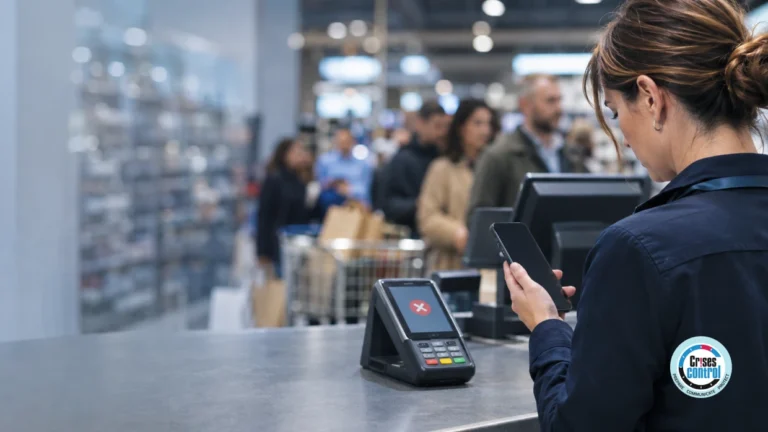
A payment processor fails across a retail group's southern region on a Saturday afternoon. Thirty minutes later four stores have shut, eleven are taking cash only, nine are still trying cards, and one has a handwritten sign that a customer photographs and shares. Nobody broke a rule, because there was no rule.
Every store closure decision belongs to one of three levels, and the level is set by the decision type rather than by job title: head office owns anything that changes trading terms across the estate, the region owns resourcing across its stores, and the store owns anything that cannot wait for a phone call, each with one named owner and a short list of pre-agreed options.
A store closure decision depends on the decision type, not the job title. Trading and brand decisions sit with head office, resourcing sits with the region, and immediate safety sits with the store, each with one named owner and a short list of pre-agreed options.
Who Owns The Store Closure Decision In A Retail Group?
The store closure decision is owned by whoever the decision type points to. A store manager closes the doors immediately for a safety threat. A regional manager ranks stores when security or staffing cover runs short. Head office decides anything that changes trading terms, because those choices are visible to every customer at once.
The three decisions run on different clocks, which is why they cannot share an owner. A safety closure is measured in seconds. A resourcing call across fifteen stores needs someone who can see all fifteen. Cash only or a shortened day changes what customers meet in every affected store, so it belongs to whoever answers for the brand.
Most retail groups have never written this down. Ask who decides to close a store during an incident and you get an escalation list, which is a different thing, because a list of who to ring is not a list of who may decide. Confuse the two and the store rings the region, the region rings head office, and twenty minutes go while three people each wait for someone else to take the decision.
Why Do Two Stores In The Same Outage Make Opposite Calls?
Two stores in the same outage make opposite calls because the store closure decision was never allocated. Each manager reads the same failure, applies their own judgement about queues, staffing and takings, and lands somewhere different. That is a design fault in the process. More training will not fix it.
- No owner per decision. The plan names an incident lead but never says which decisions that person holds.
- No pre-agreed options. Managers invent a response under pressure, so it varies by manager.
- No threshold. Nothing states how long an outage must run before the answer changes.
- No single channel. One store hears from its regional manager, another from a group chat, a third from a customer.
Customers close that gap for you. A shopper turned away at one branch and served at the next one two miles away notices, and says so publicly. The damage rarely comes from the outage. It comes from the group looking as though nobody is in charge, which makes this a brand question as much as an operational one.
Which Decisions Belong To Head Office, The Region And The Store?
Trading and brand decisions belong to head office, resourcing across a group of stores belongs to the region, and any decision affecting immediate safety belongs to the store. The test is simple: whoever cannot be reached in the time the decision allows should not be the one holding it.
This table allocates the five decisions a retail group actually faces in an outage, the options that should be agreed before the day, and the point at which the decision moves up.
The first row is the one retail groups get wrong in the other direction, by routing a safety call upwards. It is the one decision that must never need permission, and the one now attracting a legal expectation. In the United Kingdom, the Terrorism (Protection of Premises) Act 2025, known as Martyn's Law, will require those responsible for standard tier premises to have appropriate public protection procedures in place so far as is reasonably practicable. Standard tier covers premises where 200 to 799 people, staff included, may reasonably be expected, which takes in a great many shops. The Act received Royal Assent on 3 April 2025, and the Home Office's overarching factsheet states that its requirements have not yet been commenced, with an implementation period expected to be at least 24 months and enforcement by the Security Industry Authority. Treat this as orientation rather than legal advice, and check the status before relying on it.
Settling the owner is half the work. Agreeing what they may choose from is the other half, and the half that makes the answer repeatable across hundreds of sites. Four named options turn a judgement call into a selection. They also give head office a vocabulary: "option three, close the tills but stay open" is unambiguous across 300 stores in a way that "use your discretion" never is.
When Should A Store Manager Escalate Instead Of Deciding?
A store manager should escalate the moment a decision would set the store apart from the rest of the estate, and decide alone only where safety or a pre-agreed option already covers it. The assumption that managers know where that line falls is the weakest part of most retail plans, because the line has never been written down.
Ask ten store managers in the same group when they would ring head office and you will get ten answers. That is predictable. It is also not their failing. Who decides to close a store during an incident is usually answered somewhere in the plan, while the point at which a manager stops deciding is left to instinct. Retail incident escalation from store to head office works when the trigger is observable rather than felt: an outage past a stated number of minutes, a queue at a stated length, any press or social media enquiry, any injury, or any option the manager cannot find on the list.
Regulators in several markets already expect the named-owner part to be written down rather than assumed. In the United States, the Occupational Safety and Health Administration standard 29 CFR 1910.38 requires an emergency action plan to include "the name or job title of every employee who may be contacted" by staff needing an explanation of their duties under it, in writing for any employer with more than ten employees, and reviewed with each employee whenever their responsibilities change. A retail group that cannot name the owner of a closure decision sits some way behind that baseline.
Once the store closure decision is made, the next problem is getting it to the right stores and knowing they acted on it, which is a separate discipline from deciding. Our guide to alerting every affected store manager covers the targeting, channel and acknowledgement side of the same incident, and who runs the response in the first hour sets out the same problem in financial services.
How Does Crises Control Support The Store Closure Decision Process?
Crises Control supports this through Incident Manager, its coordination module. Incident Manager launches a predefined response plan, assigns roles to named people, keeps communication on one controlled thread, and records every update and decision on a single incident timeline from activation through to resolution.
Against the four jobs this creates, that covers all of them. The response plan carries the decision table, so owners and options are loaded before the incident rather than recalled during it. Role assignment fills the trading lead and regional seats with named people for that incident. Nobody has to work out who holds what. Communication control keeps one instruction going to the affected stores instead of three regional managers improvising, and the incident timeline timestamps each decision and the person who made it, which is what produces a decision log that survives later scrutiny.
The judgement stays with the retailer, and that limit is worth stating plainly. Crises Control does not decide that cash only is the right fallback, how long an outage must run before a store closes early, or who holds the trading lead. The software is only as useful as the decision table, roles and thresholds loaded into it beforehand. What it does is carry the agreed decision to the right stores, keep one person accountable for it, and leave a record. Crises Control describes this coordination layer on its Operational Incident Management Software page, the actions that follow on its Incident Task Management Software page, and the multi-site retail picture on its Retail Incident Management Software page.
The Store Closure Decision Checklist
Work through this before the next peak, not during it. By the end of it, the owner of each decision should be nameable by any regional manager in the group without making a phone call. Each line is something a Head of Retail Operations can settle in a meeting rather than an incident.
- Every decision in the table has one named owner by role, and a deputy for when that role is unreachable.
- Each decision has three or four pre-agreed options, written as the step a store actually takes.
- Safety decisions are explicitly delegated to the store duty manager and require no approval.
- Escalation triggers are stated as observable facts: minutes elapsed, queue length, any media enquiry, any injury.
- Store managers have been told which decisions are not theirs, as clearly as which are.
- One channel carries the decision to the affected stores, and each store confirms it has acted.
- Every decision, its owner and its time are captured automatically, so the post-incident review is a record rather than a reconstruction.
Consistency Is What Customers Actually See
An outage across 300 stores is not really a test of the stores. It tests whether the group decided in advance who holds each decision and which options they may pick from. The retailers who come out of it well are rarely the ones with the fastest engineers. They are the ones where a regional manager knew within a minute that the trading call was not theirs, and head office could name the affected stores and send all of them one instruction. Manufacturers meet the same question when they ask who makes the call to restart production.
That work costs a meeting and a one-page table. It pays back the first time an outage lands on a Saturday and all 300 stores do the same thing. A store closure decision is not something to settle on the day. A group still arguing about it mid-outage has already lost the twenty minutes that mattered most.
If your own answer to that question would differ depending on which regional manager you asked, the fix is a short exercise rather than a project. Book a live demo and walk a payment outage through your own regions, stores and decision owners.
Frequently Asked Questions
Who owns the store closure decision in a retail group?
It depends on the decision type, not the job title. Immediate safety closures sit with the store duty manager and need no approval, resourcing across several stores sits with the regional manager, and anything that changes trading terms sits with head office. Nobody who cannot be reached inside the time the decision allows should be the one holding it. Each decision should name one owner and one deputy.
What is a store closure decision process?
A store closure decision process is a written allocation of who may decide what during an incident, with pre-agreed options for each decision and stated triggers for moving it up. It replaces individual judgement under pressure with a selection from options agreed in advance. In practice it is a one-page table covering safety, payment method, trading hours, online fulfilment and staff movement.
When should a store manager escalate to head office?
A store manager should escalate as soon as a decision would make their store behave differently from the rest of the estate, or when the situation is not covered by an agreed option. Escalation triggers work only when they are observable, such as minutes elapsed, queue length, any media enquiry or any injury, rather than left to judgement. Safety action is the exception and is taken first, then reported.
How do retailers keep 300 stores consistent during the same outage?
Retailers keep stores consistent by deciding centrally, sending one instruction to the affected stores only, and confirming store by store that it was acted on. Consistency comes from a single decision owner and a single channel, not from asking every manager to reason their way to the same answer independently. Targeting matters too, because an instruction sent to the whole estate produces action in stores that were never affected.
What is Operational Incident Management Software?
Operational Incident Management Software is software that activates an incident, assigns roles to named people, controls communication to the people affected, tracks the actions that follow and records the whole sequence as a timeline. It covers the coordination and accountability of an incident, not only the first alert. Crises Control describes this layer on its incident management page.
This article was drafted with AI assistance and reviewed by the Crises Control team. Featured image: AI-generated.