
Incident Management Software is a category of technology designed to structure how organisations detect, manage, and document operational events, from minor disruptions to serious crises. Within that category, two capabilities are frequently conflated but serve different purposes: the audit trail and the incident report. Understanding the distinction, and ensuring your platform delivers both, is central to building a defensible compliance position.
Picture a bank operating across dozens of branches. During a quarterly regulatory review, the compliance team is asked to provide evidence of the organisation’s incident response capability. They produce a log of notification events: timestamps, delivery receipts, response records from a mass notification test. The auditor nods, then asks a second question: can you show the incident reports from the last three significant events, including the decision log, the escalation sequence, and the actions taken?
The compliance team pauses. The notification log exists. The incident reports, however, were compiled manually after each event from whatever notes individuals happened to keep. They exist as documents, but they do not match the notification log precisely. The timelines are slightly different. The names of the decision-makers are not consistent. There is no clear record of when the incident was formally declared closed.
This is not a failure of effort. It is a failure of system design. The organisation had Mass Notification Software. It did not have incident management that unified the audit trail and the reporting function into a single, coherent record.
Defining the Audit Trail
An audit trail is an automatic, continuous log of every action taken within a system during an incident. It records what happened, in what order, at what time, and who performed each action. It is not curated or assembled after the fact. It is generated in real time, automatically, as a byproduct of using the platform.
In a well-designed Incident Management Software platform, the audit trail captures:
- The exact time the incident was activated and by whom
- Every alert sent, including the channel used, the time of delivery, and the recipient group
- Every response received, including the content, the respondent identity, and the time of receipt
- Every task assigned, including the assignee, the instructions, the time assigned, and the completion status
- Every escalation triggered, with the reason and the time
- Every status update posted by incident managers or role holders
- The time the incident was formally closed and by whom
The audit trail is not edited. It is not summarised. It is the raw, timestamped log of everything the system recorded during the event. Its value for compliance lies precisely in that objectivity: it reflects what actually happened, not what people remember or choose to report.
An audit trail is only as reliable as the system that generates it. A platform that allows manual amendment of audit records does not produce a defensible audit trail. It produces a document that can be challenged.
Defining the Incident Report
An incident report is a structured summary of an event, typically produced after the incident is closed. It draws on the audit trail as its primary source but presents that information in a form that is useful for review, reporting, and learning. A good incident report includes the nature of the incident, the timeline of key actions, the decisions made and by whom, the outcomes achieved, and the lessons identified.
In contrast to the audit trail, the incident report is intended to be read and understood by people who were not involved in the response: senior leadership, auditors, regulators, and board-level governance functions. It translates the raw log into a narrative that supports decision-making and accountability.
The problem arises when the incident report is created entirely separately from the audit trail, assembled by hand from notes and recollections after the event. When this happens, the two records are rarely identical. Dates may differ by minutes or hours. The sequence of events may be slightly different from what the system log shows. Decision-makers may be named differently or inconsistently.
For a regulated organisation, that discrepancy is a risk. Auditors and regulators who see inconsistency between a notification log and a manually compiled incident report will ask which one is correct. There is no good answer to that question if the two documents were produced independently.
When the audit trail and the incident report are produced by different systems, or one is generated manually, inconsistencies between them become a compliance liability rather than a compliance asset.
Audit Trail vs Incident Report: What’s the Difference?
Although the terms are often used interchangeably, an audit trail and an incident report serve different purposes. An effective Incident Management Software platform should provide both from the same source of truth.
Audit Trail | Incident Report |
Generated automatically in real time | Produced after the incident has closed |
Raw, timestamped system record | Structured summary of the incident |
Records every action as it happens | Explains what happened and why |
Objective evidence | Executive and governance document |
Supports compliance, audits and investigations | Supports reviews, reporting and lessons learned |
Cannot be reconstructed reliably afterwards | Draws directly from the audit trail |
Why Organisations Often Have One but Not the Other
The pattern of having notification logs without structured incident reports, or incident reports without reliable underlying audit trails, is common across regulated sectors. It arises from how organisations typically acquire their crisis communication tools.
Many organisations begin with Mass Notification Software because the need for rapid, multi-channel alerting is visible and immediate. The platform sends alerts, collects responses, and generates delivery logs. That is useful. But it does not constitute an incident management system. The structured response, the task assignment, the decision log, and the formal close of the incident all happen outside the platform, in whichever informal tools the team reaches for.
Other organisations begin with a Crisis Management Software solution focused on planning: storing business continuity plans, running exercises, and maintaining contact directories. These tools support preparation but are not designed to manage a live incident in real time. When the event happens, the team reverts to email and phone calls, and the incident record is whatever survives in inboxes after the event.
The gap between notification tools and planning tools is where incident accountability lives. Filling that gap requires Incident Reporting Software that sits between the two, capturing the live response and generating both the audit trail and the structured report from a single source of truth.
The Compliance Case for Unifying Audit Trails and Incident Reports
For financial services organisations, the case for unifying audit trails and incident reports in a single platform is not just operationally sensible. It is increasingly a regulatory expectation.
The FCA’s operational resilience framework requires firms to demonstrate, with evidence, that they can respond to disruptions within their defined impact tolerances. That demonstration is built on records that show the actual response, not the intended response. If the records used to build that demonstration come from two different systems, one automatic and one manually compiled, the demonstration is weakened by the inconsistency.
Similarly, the Digital Operational Resilience Act (DORA), which applies to financial entities operating within the European Union and has implications for UK firms with EU operations, requires documented evidence of incident classification, escalation, and resolution. That evidence needs to be consistent, complete, and produced from a reliable source. Organisations relying on manual incident reports compiled after the fact are in a structurally weaker position than those whose reports are generated directly from the system audit trail.
Some organisations conduct quarterly compliance tests, sending mass notifications to thousands of employees and collecting response data. The value of those tests as compliance evidence depends entirely on the quality of the documentation they produce. If the notification log and the incident report are generated from the same platform and cross-referenced automatically, the evidence is robust. If they are produced separately, the evidence is vulnerable to the question of whether the two records agree.
How to create an incident audit trail for compliance: use a platform that logs every action automatically in real time, and generates incident reports directly from that log. The two records should share the same timestamps, the same event sequence, and the same participant data.
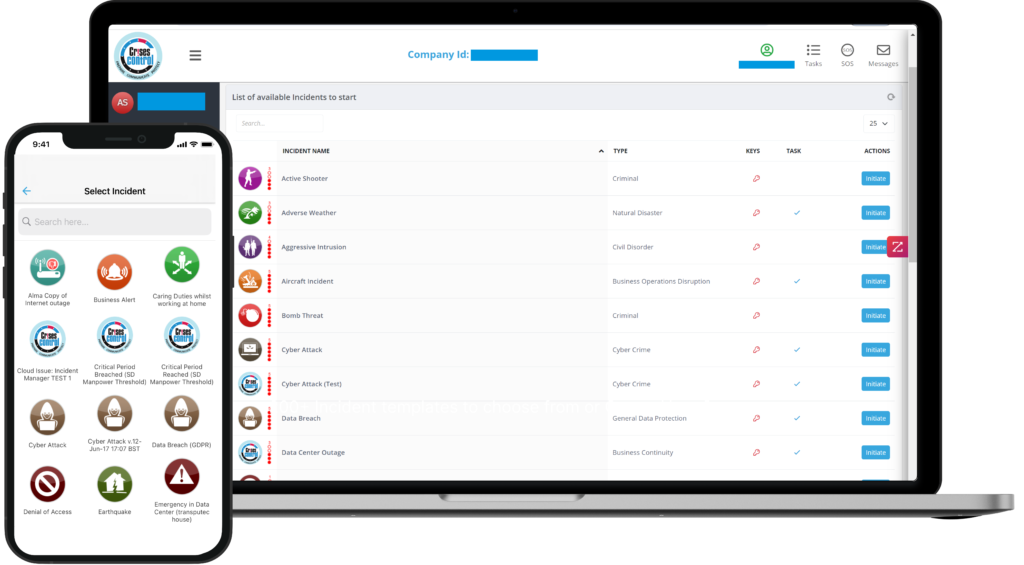
Interested in our Incident Management Software?
Flexible Incident Management Software to keep you connected and in control.
Common Mistakes Organisations Make
The most common mistake is treating notification logs as incident records. A delivery confirmation from a mass notification system tells you that an alert was sent and that a certain number of people received and acknowledged it. It does not tell you who made the decision to send it, what escalation protocol was followed, or what happened between the alert and the resolution. Notification logs are a component of an incident record, not a substitute for one.
The second mistake is compiling incident reports from memory rather than from system data. Memory is unreliable, especially in the hours and days following a significant incident when the team is focused on recovery. Reports compiled from memory introduce inaccuracies that, when discovered by an auditor, raise questions about the integrity of the record as a whole.
The third mistake is maintaining the audit trail and the incident report as separate documents with no systematic link between them. When a regulator asks a question about a specific event, the ability to point to the audit trail entry that corresponds to the relevant section of the incident report is a significant advantage. When the two documents cannot be reconciled, the organisation is in a weaker position.
What Incident Management Software Should Deliver
An effective Incident Management Software platform should do more than send notifications or store response plans. It should become the operational record of the incident itself.
Every alert, acknowledgement, decision, task assignment, escalation and status update should be captured automatically as the response unfolds. When the incident is closed, the platform should generate both the audit trail and the incident report from the same underlying data. This ensures that operational records, compliance evidence and post-incident reporting remain accurate, consistent and fully aligned.
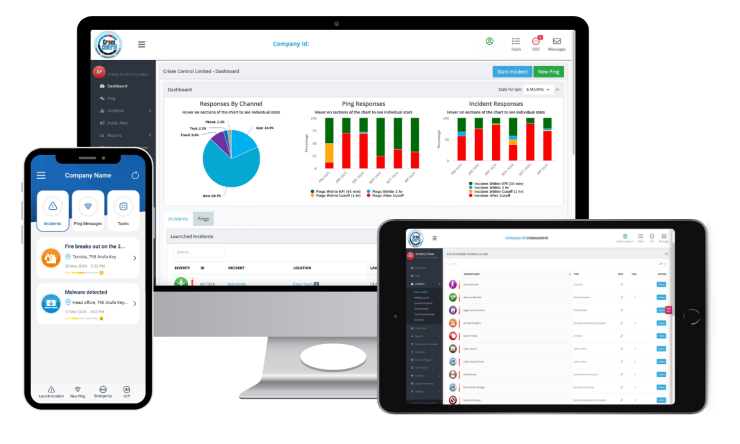
Crises Control follows this approach by combining emergency communications, incident coordination, task management and reporting within a single platform. When an incident is activated, every action taken during the response is recorded automatically, creating a live audit trail that reflects exactly what happened and when. Once the incident has been resolved, the platform can generate a structured incident report directly from that same record, eliminating the need to manually reconcile multiple documents or systems.
For a bank managing incidents across multiple branches and required to present audit evidence to regulators each quarter, this means the incident audit trail and the incident report are always consistent, because they come from the same platform and the same data. There is no manual reconciliation, no risk of discrepancy, and no ambiguity about which record is authoritative.
For an insurance organisation managing a major event across several locations, the same system that sends the mass notification, tracks the responses, assigns the tasks, and monitors the escalation also produces the post-incident report. The timeline in the report is the same timeline that appears in the audit log. The decision-makers named in the report are the same individuals whose actions appear in the system record.
For organisations with specific requirements around GDPR compliance or integration with existing systems such as Azure Active Directory or Workday, Crises Control supports those requirements without requiring parallel manual record-keeping processes.
Conclusion
The distinction between an audit trail and an incident report is not technical detail for IT teams to manage. It is a governance question with direct implications for compliance, regulatory exposure, and the credibility of the organisation’s incident management capability. Incident Management Software that generates both from a single source of truth is not a premium feature. It is the baseline standard for regulated organisations.
If your current approach produces notification logs that cannot be directly reconciled with your incident reports, that is the gap most likely to create problems in a regulatory review. The solution is not to invest more effort in compiling better manual reports. It is to use a platform that makes both records automatic, consistent, and reliable.
To see how unified audit trails and incident reporting work in practice, get a free personalised demo.
FAQs
1. What is Incident Management Software and what is its role in producing audit trails?
Incident Management Software is a platform that manages the full lifecycle of an incident, from detection through to resolution and review. Its role in producing audit trails is fundamental: a well-designed system logs every action automatically in real time, creating an objective, timestamped record that can be used as compliance evidence. This is different from notification systems, which log delivery but not the structured management of the response.
2. What is the difference between an audit trail and an incident report?
An audit trail is an automatic, real-time log of every action taken during an incident, generated by the system as the event unfolds. An incident report is a structured summary of the event, produced after the incident closes, drawing on the audit trail as its source. The key distinction is that the audit trail is objective and automatic, while the incident report is interpreted and structured for a specific audience, typically leadership, auditors, or regulators.
3. Why do organisations in financial services need both an audit trail and an Incident Reporting Software output?
Regulated financial services organisations face requirements that demand both types of record. The audit trail demonstrates what actually happened, in sequence, in real time. The incident report presents that information in a form that governance and oversight functions can review and act on. Incident Reporting Software that generates structured reports directly from the audit trail ensures the two records are consistent, which is what regulators need to see to have confidence in the organisation’s response capability.
4. How does Crisis Management Software support the production of defensible incident records?
Crisis Management Software supports defensible incident records by ensuring that the response is managed within a structured platform that logs every action automatically. When the incident record is produced by the system rather than compiled by hand, it is significantly harder to challenge because it reflects what the platform recorded in real time, not what individuals recall after the fact. This is a material advantage in any regulatory or legal review of the organisation’s response.
5. How do you create an incident audit trail for compliance as Incident Management Software for Finance?
To create a defensible incident audit trail for compliance, financial services organisations need a platform that logs every communication, task, escalation, and decision automatically with timestamps and user attribution. The best Incident Management Software for Finance generates incident reports directly from that audit log, ensuring the two records are always consistent. Organisations should also ensure the platform supports their specific regulatory requirements, including DORA, FCA operational resilience rules, and any sector-specific reporting obligations.