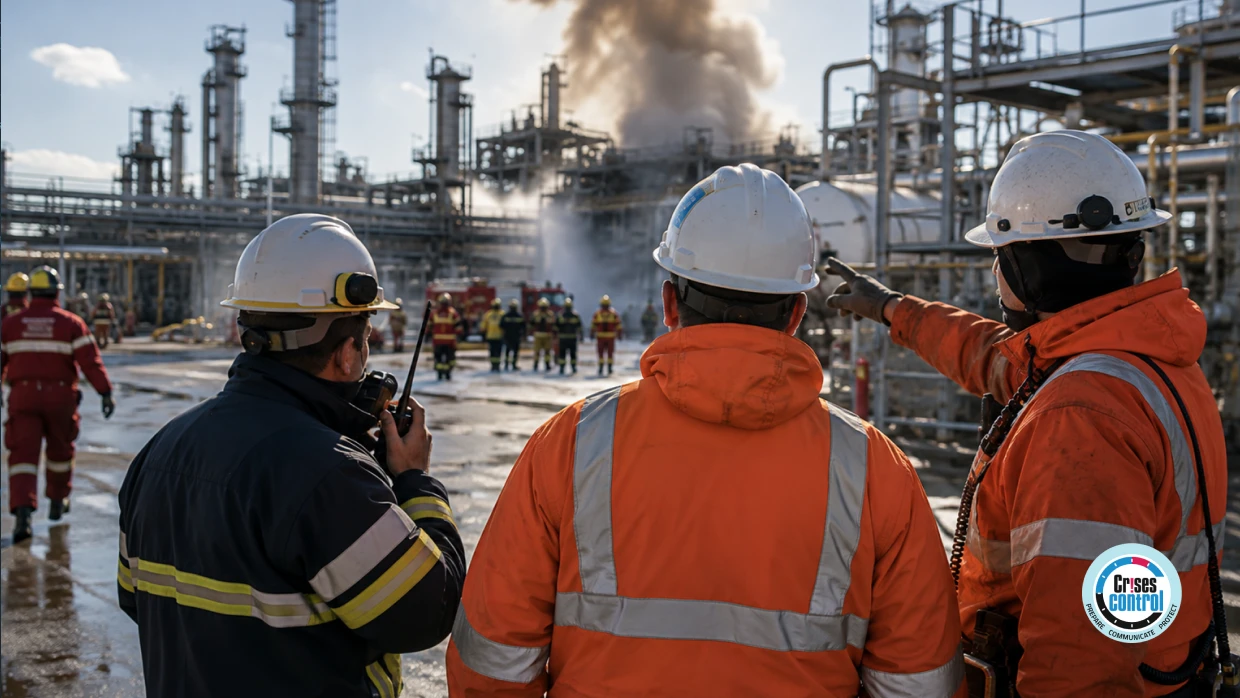
A serious incident at an oil and gas facility can change the priorities of an entire site within minutes. A fire, explosion, hazardous release or major equipment failure may require Operations to shut down part of a plant while HSE manages the safety response, Security controls access, emergency teams assess the situation and senior leaders decide whether the incident needs to be escalated.
The problem is not usually a lack of emergency procedures. Most major facilities have detailed plans, trained personnel and established chains of command. The difficulty comes when several teams need to use those procedures at the same time, while the situation is changing and information is arriving from different sources.
Incident Management Software can help by bringing communication, response tasks, responsibilities and incident information into one coordinated process. The technology does not replace the site’s emergency arrangements. It helps people put those arrangements into action without losing track of who needs to know, who needs to act and what has already happened.
Consider a realistic situation. A loss of containment occurs around a processing area. An alarm is raised and the affected section is isolated. Workers begin moving towards designated muster points, while the control room assesses whether other parts of the facility could be affected.
HSE is assessing the potential consequences. Operations needs to understand which equipment can remain in service. Security is managing access. The Emergency Response Manager is coordinating the wider response. Contractors may be working elsewhere on the site, while senior management is asking for an initial assessment.
The first alert is only the beginning.
The real test is what happens afterwards.
What Is Incident Management Software?
Incident Management Software provides a structured environment for coordinating people, communications, response tasks, decisions and incident records during an operational emergency.
Instead of relying on separate phone calls, emails, spreadsheets and messaging channels, teams can work from a shared incident record. Response plans can be activated, relevant people can be notified according to their roles, actions can be assigned and progress can be tracked as the situation develops.
For an oil and gas organisation, this can connect Operations, HSE, Security, Engineering, Emergency Response, Communications and senior leadership without requiring one person to manually coordinate every part of the response.
The purpose is not to create another system for people to monitor. It is to make established emergency procedures easier to activate and manage when people are working under pressure.
The First Challenge Is Establishing What Is Happening
During a plant emergency, information does not arrive in a neat sequence.
The control room may know that a process has been isolated. A supervisor may report that workers are moving towards a muster point. HSE may be assessing whether there is a risk of further release. Security may be controlling access to the affected area. An emergency response team may have information that has not yet reached the incident lead.
All of this information can be useful. The challenge is bringing it together without treating unconfirmed information as fact.
The Incident Manager needs a basic operational picture that answers questions such as:
- What happened?
- Where did it happen?
- Which areas or processes are affected?
- Are people at immediate risk?
- What has already been isolated or shut down?
- Which emergency teams have been activated?
- Who has been notified?
- What information has been confirmed?
- What remains uncertain?
- Which decisions need to be made?
That distinction between confirmed and unconfirmed information matters.
During a developing incident, an assumption can quickly become an instruction. A mistaken assessment could lead to unnecessary disruption, conflicting evacuation messages or an important action being missed.
A structured incident record gives teams somewhere to capture information as it is confirmed and updated. It also gives people a common reference point when different teams are reporting different parts of the situation.
Why An Emergency Alert Is Not The Same As An Emergency Response
Many oil and gas organisations already have systems that can send urgent messages to employees. That is an important part of emergency communication, but it is only one part of the response.
Suppose an evacuation instruction is sent across a facility.
What happens next?
The Emergency Response Manager may need to know whether key response teams have acknowledged the instruction. HSE may need to confirm that personnel are moving towards the appropriate muster areas. Security may need to restrict access. Operations may need to confirm shutdown actions. Leadership may need an update on the scale and potential consequences.
An emergency notification system can deliver the initial instruction. Incident Response Software can support the wider process that follows.
This distinction is easy to overlook because sending the first message feels like a significant milestone. In reality, it creates a series of questions that need to be answered.
A structured response should connect:
Alert → Assessment → Action → Escalation → Recovery → Review
Each stage depends on information from the previous stage. If the organisation cannot see what has been communicated, what has been completed and what remains outstanding, coordination becomes harder as the incident develops.
Where Traditional Approaches Start To Struggle
Phone calls and radio communications remain valuable in oil and gas operations, particularly for personnel working directly in the field. The problem comes when informal communication becomes the main method for coordinating a complex response.
During a serious incident, one person may receive an instruction by telephone and write it down. Another may receive a different update over radio. Someone else may be working from an email sent several minutes earlier.
As more people become involved, it becomes difficult to establish which information is current.
Common problems include:
- An action is agreed verbally but nobody has clear ownership.
- A critical update reaches one team but not another.
- Leadership receives an outdated assessment.
- Employees receive different instructions from different departments.
- A completed task has no clear record of when or by whom it was completed.
- The Incident Manager spends time requesting updates rather than directing the response.
- The organisation has to reconstruct the incident afterwards from individual notes and messages.
The issue is not that these communication methods are inherently wrong. They are useful tools, but they were not designed to provide one shared operational record across a large, multi-team emergency.
This becomes even harder when contractors, remote teams, multiple sites or external responders are involved.
The Human Factor Cannot Be Removed From Emergency Response
Emergency procedures are written for people, and people behave differently when they are dealing with uncertainty.
During a serious incident, people ask questions. Supervisors escalate concerns. Teams create temporary communication channels because they cannot immediately find the information they need. Additional people may be copied into messages simply because nobody is sure who already knows what.
These reactions are understandable.
They can also create more information without creating more clarity.
The role of technology should not be to force people into a rigid process. It should remove avoidable uncertainty around the process.
A response team member should be able to see the current instruction without asking several colleagues. A task owner should know what they have been assigned. An Incident Manager should be able to see which teams have acknowledged an alert and which actions remain outstanding.
That does not remove the pressure of an emergency. It removes some of the administrative work that makes the pressure harder to manage.
Coordinating Evacuation, Containment And Escalation
A major plant emergency can involve several activities at the same time.
HSE may be coordinating evacuation arrangements while Operations manages a controlled shutdown. Engineering may be assessing equipment condition. Security may be controlling access. Emergency responders may be preparing specialist intervention, while Communications manages updates for employees and other stakeholders.
These activities cannot always happen in a fixed sequence.
The response needs clear ownership while allowing information to move between teams.
Who Needs To Be Notified?
Not every incident requires the same response group.
A local equipment failure may involve Maintenance and Operations. A hazardous release may require HSE, emergency response teams, site leadership and potentially external authorities. A major fire or explosion may activate a much wider response.
Predefined response groups reduce the risk of relying on someone to remember every contact during a stressful situation.
Who Needs To Act?
Notifications need to connect with responsibilities.
If a site evacuation is initiated, the organisation needs to know who is responsible for specific areas, who is coordinating muster activities and who is escalating information about people who have not been accounted for.
If containment is required, there should be clear ownership of the relevant actions rather than a general instruction for someone to deal with it.
When Should The Incident Escalate?
Escalation should follow the organisation’s emergency procedures and defined criteria rather than relying entirely on someone deciding that a situation “feels serious enough”.
Triggers may relate to the potential impact on people, the environment, critical operations, surrounding communities or the need for external assistance.
Digital workflows can help make those procedures easier to activate consistently.
A Common Assumption Worth Challenging
A common assumption is that having a well-written emergency plan means an organisation is prepared.
The plan matters, but a document cannot coordinate a response by itself.
The real test comes when several teams need to use that plan simultaneously while the situation is changing.
- Can the right people access it?
- Can actions be assigned?
- Can updates be shared without creating competing versions of the situation?
- Can leadership understand what has happened without repeatedly interrupting the people dealing with the emergency?
For sites covered by the UK’s Control of Major Accident Hazards Regulations, HSE guidance requires upper-tier operators to prepare and test internal emergency plans covering the on-site consequences of major accidents. The arrangements also need to connect with wider emergency planning.
That means testing should examine more than whether personnel know the procedure.
It should test whether the organisation can actually coordinate that procedure when multiple activities are happening at once.
What A Structured Digital Response Looks Like
A useful digital response process should make an existing emergency procedure easier to manage, not add unnecessary complexity.
Before an incident, organisations can prepare response plans around realistic scenarios such as:
- Plant fire or explosion
- Loss of containment
- Hazardous substance release
- Major equipment failure
- Security breach
- Severe weather affecting a facility
- Power or utility failure
- Cyberattack affecting operational technology
When an incident occurs, authorised personnel can activate the relevant response plan and notify the appropriate groups.
The response should then provide visibility of:
- People and teams notified
- Alert acknowledgements
- Current incident status
- Assigned response actions
- Outstanding tasks
- Escalations
- Key decisions
- Communications issued
- Recovery activities
This also makes exercises more useful.
A fire drill, evacuation exercise or hazardous release exercise can test more than whether the alarm works. It can test whether people receive the correct information, whether responsibilities are clear, whether escalation works and whether the organisation can reconstruct what happened afterwards.
Five Questions To Test Your Emergency Response
The next emergency exercise is an opportunity to test the information flow as well as the procedure.
Ask:
- Can you notify the right people without manually working through contact lists?
- Can the Incident Manager see who has acknowledged the initial instruction?
- Does every important response action have a named owner?
- Can leadership see the current situation without repeatedly requesting updates?
- Can you reconstruct the major decisions, communications and actions after the incident?
If the answer to several of these questions is no, the weakness may not be the emergency procedure itself.
It may be the way the procedure is coordinated when the incident is actually happening.
How Crises Control Can Support The Response
Crises Control provides a practical example of how emergency procedures can be moved from static documents into a structured digital response.
Response plans can be digitalised and activated by authorised users, while role-based communication can direct information to the relevant teams. The platform supports notifications across multiple channels and acknowledgement tracking, giving response leaders visibility of who has received and responded to communications.
Its Incident Manager and Task Manager capabilities can also connect communications with assigned response actions. Tasks can be given to individuals or teams, tracked through completion and escalated when required.
Cloud access is useful when response personnel are working across different parts of a facility or organisation. The purpose is not to replace specialist control room, safety or emergency response systems. It is to give the people coordinating the wider response a shared place to manage communication, actions and incident information.
For a related perspective on the oil and gas sector, see the Crises Control article Oil And Gas Emergency Response: Why The First 10 Minutes Determine Everything. It looks at how communication gaps, unclear ownership and fragmented information can affect the early stages of an emergency.stages of an emergency.
The Goal Is Control, Not More Technology
An oil and gas emergency will always involve uncertainty. No software can remove the judgement required from experienced Operations, HSE, Emergency Response and leadership teams.
The value of a structured digital response is more practical. It can reduce the avoidable confusion around that judgement.
When people know who has been notified, what has been confirmed, which actions are underway and where responsibility sits, leaders have a better basis for making decisions. Response teams can concentrate on their roles rather than repeatedly searching for information or asking colleagues for updates.
For oil and gas organisations, this matters because a major plant emergency can affect people, assets, production, the environment and surrounding communities at the same time. The response therefore needs to coordinate more than the initial alarm.
The strongest emergency response is not simply one that tells people there is a problem. It gives the people responsible for managing that problem a clear view of what is happening, what needs to happen next and who is responsible for each action.
If you are reviewing how your organisation manages major plant emergencies, ask whether your current process gives response teams that shared operational picture.
If you would like to see how Crises Control can support structured incident coordination, emergency communication, response tasks and incident reporting, Get a free personalised demo.
Frequently Asked Questions
What Is Incident Management Software For Oil And Gas?
Incident Management Software helps oil and gas organisations coordinate communications, response actions, responsibilities and incident information during operational emergencies. It can support scenarios such as fires, hazardous releases, equipment failures, security incidents and other major disruptions.
How Does Incident Response Software Help During A Plant Emergency?
Incident Response Software can help activate predefined response procedures, notify relevant teams, assign actions and maintain visibility of the incident as it develops. This connects the initial emergency notification with the wider response.
What Is The Difference Between Emergency Notification Software And Incident Management Software?
Emergency Notification Software primarily focuses on communicating urgent information to the right people. Incident Management Software supports the wider response by connecting notifications with tasks, responsibilities, updates, decisions and incident records.
Why Is Incident Coordination Important In Oil And Gas Facilities?
Oil and gas emergencies can involve Operations, HSE, Security, Engineering, Emergency Response, leadership and external responders at the same time. Coordinated incident management helps these groups work from consistent information and reduces the risk of duplicated actions, conflicting instructions or missed responsibilities.
How Should Oil And Gas Companies Test Their Emergency Response?
Testing should go beyond checking whether an alarm works. Exercises should assess whether the organisation can notify the right people, assign responsibilities, share verified information, coordinate evacuation or containment, escalate appropriately and maintain a clear record of decisions and actions. HSE guidance for major hazard sites also emphasises preparing and testing internal emergency plans and coordinating with external emergency planning arrangements.
This article was drafted with AI assistance and reviewed by the Crises Control team. Featured image: AI-generated.