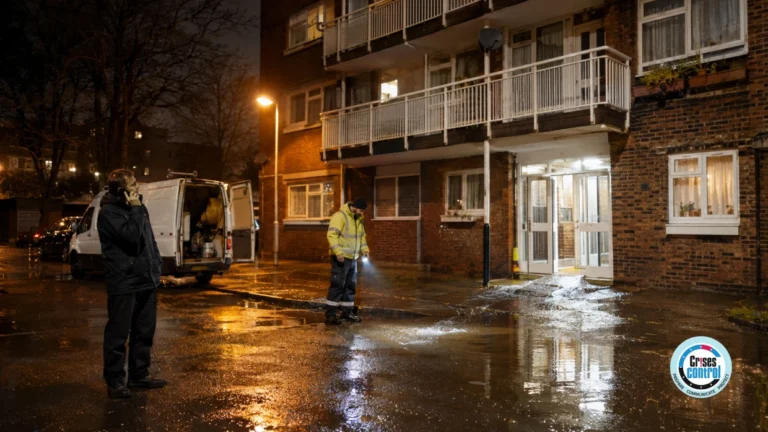
A burst riser cuts water to ninety flats. The ticket is raised in four minutes and the plumber is on the way, so the helpdesk has done its job. Eleven calls later, nobody can say which contractor is on site, whether both affected cores have been told, or who agreed to pay for hotel rooms.
A property incident platform earns its place on what happens after the ticket: whether a response can be activated out of hours, whether contractors and occupiers can be reached without a phone tree, and whether the record builds itself while the incident runs.
A property incident platform is software that coordinates one incident across several buildings at once: activation, role assignment, contractor and occupier messaging, task tracking and a single timeline. A helpdesk or CAFM system logs and schedules the work. The platform runs the response around it.
What Is A Property Incident Platform?
A property incident platform is the system a property or facilities team uses to run an incident that crosses buildings, contractors and occupiers. It activates a response, assigns roles, sends and records communication, tracks tasks to completion and holds one timeline across the portfolio, instead of one ticket per site.
The distinction that decides the purchase is between a fault and an incident. A fault has an asset, a trade and a completion date, and a computer-aided facility management (CAFM) system handles that well. An incident has people in it.
Three things turn a fault into an incident:
- More than one trade attends, usually in an order nobody planned
- Somebody has to decide about people: evacuation, accommodation, what the occupiers are told
- Somebody asks about it weeks later, with an insurer or a regulator behind the question
Why Does A CAFM Or Helpdesk System Not Run A Portfolio Incident?
A CAFM or helpdesk system does not run a portfolio incident because it models work orders. It schedules a job against an asset at one site, with one trade and one service level. A portfolio incident arrives with none of those. Four buildings, six contractors, no single clock.
None of that is a criticism of the category. A CAFM system is the right home for planned maintenance, asset history and statutory inspection schedules, and a property incident platform that tries to replace it only creates a second source of truth. The helpdesk answers what work is outstanding on an asset. Incident Management Software answers who is handling this event, right now, across these four buildings.
Which Requirements Matter When Choosing Incident Software For Facilities Management?
Choosing incident software for facilities management comes down to five jobs a helpdesk was never built to do: activate a response out of hours, bring contractors into that response, message occupiers and capture who acknowledged, hold one view across every building, and produce a record an insurer will accept.
Seven questions separate a platform that survives a bad night from one that looks good in a demonstration:
- Out-of-hours activation. Can a named duty manager open an incident from a phone, at any hour, without waking an administrator to grant them the right? If your rota names roles instead of people, read this on who takes charge of an out-of-hours building incident first
- Contractor participation. Can an external contractor receive the incident, acknowledge it and update a task, and what does that cost per contractor?
- Occupier and resident messaging. Can one incident reach residents, commercial tenants and on-site staff on different channels, and does the platform record who acknowledged rather than who was sent to?
- Role assignment. Does an incident have a named lead and named roles, or does it have a distribution list? A distribution list is not a command structure
- Multi-site view. Can one screen show every open incident across forty buildings with its status, and can a regional manager be shown only their own patch?
- Task completion. Are response actions tracked to completion with an owner and a due time, or does the product stop once the message is sent?
- The record. Does the timeline export, with timestamps, acknowledgements and decisions, into something an insurer, a regulator or a board accepts without a covering email?
Part of this is already written down. In England, the Fire Safety (England) Regulations 2022, in force since 23 January 2023, require the responsible person for a high-rise residential building to carry out monthly routine checks of firefighters' lifts, evacuation lifts and essential fire-fighting equipment, and to report any fault that cannot be rectified within 24 hours to the local fire and rescue authority by electronic means. The record of those checks must be accessible to residents. A fault, an escalation, an external notification and a published record, all on one clock. This is orientation rather than legal advice, and the position is as at November 2026.
How Do The Main Categories Of Tool Compare On Portfolio Incidents?
Five categories of tool turn up in a property portfolio evaluation. Each is genuinely good at the job it was built for. The useful question is which part of a portfolio incident each category hands back to the telephone. Incident Management Software is the category that sets out to cover the whole event.
The table sets out what each category is built for and the part of a portfolio incident it leaves open.
What Should Contractor Access And Occupier Messaging Look Like?
Contractor access should let an external engineer receive an incident, acknowledge it and update their own task without a procurement cycle. Occupier messaging should record who acknowledged, not who it was sent to. Both are where portfolio incidents actually fail, because both involve people who do not work for you.
Accounting for people is a written duty in some markets. In the United States, the emergency action plan standard 29 CFR 1910.38, enforced by the Occupational Safety and Health Administration (OSHA), requires a written plan kept in the workplace, procedures for reporting an emergency, procedures to account for all employees after evacuation, and the name or job title of everyone who may be contacted about the plan. A plan that names a person implies a system that can reach them.
Occupier messaging has the same shape. In England, the 2022 regulations also require fire safety instructions to be displayed in any building with two or more sets of domestic premises and shared escape routes, and to be given to every new resident and to all residents each year. Standing information is not incident communication, but it sets the expectation residents already hold. The craft of the message itself is covered in this guide to resident communication when the fire alarm faults.
How Does Crises Control Fit A Multi-Site Property Incident Platform Evaluation?
Crises Control sits at the coordination layer of a multi-site property incident platform evaluation. Incident Manager, the coordination module of its Incident Management Software, activates an incident, launches a predefined response plan, assigns teams, sends approved messages to predefined recipient groups and keeps one chronological record of communications, updates and decisions.
Against the seven questions, that covers activation, role assignment, communication control and the timeline. Response plans are configured per incident type, so a detection fault engages different teams from a burst main. Templates and recipient groups mean a duty manager sends a message instead of writing one. Plans, procedures and site drawings attach to the incident as documents. Where a response throws off work across several contractors, Incident Task Management Software gives each task an owner and a status.
Procurement asks a different set of questions, and those have public answers. Crises Control lists its certifications on its accreditation page, including ISO 22301 for business continuity management and ISO/IEC 27001 for information security.
What the software does not do is decide. It will not choose to evacuate a block, set a spending limit or carry responsibility for a building, and those stay with the landlord, the freeholder or the managing agent. It does not replace the helpdesk either. What Property Management Incident Management Software adds is one activation route, one recipient structure and one timeline across every building.
Property Incident Platform Evaluation Checklist
Eight checks to run before signing anything, each answerable yes or no:
- A named duty manager can activate an incident from a phone, out of hours, without help
- Response plans exist per incident type, not one generic plan for the portfolio
- External contractors can receive, acknowledge and update without a full user licence each
- Residents, commercial tenants and staff can be reached from the same incident on different channels
- Acknowledgement is recorded, so you know who read the message
- One screen shows every open incident across the portfolio, with regional visibility controlled
- Every response action carries an owner, a due time and a completion status
- The timeline exports with timestamps and decisions, in a form an insurer accepts
Buying For The Night, Not The Ticket Queue
Forty buildings and six contractors is not a bigger version of one building and one contractor. It is a different problem, and the tool that is excellent at the first is usually silent on the second. The helpdesk will carry on doing what it does well: work orders, asset history, the statutory schedule. What it cannot do is open an event, give that event a named lead, reach people who do not work for you, and leave behind a record that still stands up a year later.
So test for the night rather than the ticket queue. Take your last genuinely bad incident, the one that ran across three buildings at an awkward hour, and walk every shortlisted product through it exactly as it happened: who activates, who gets told, what the contractor sees, what a regional manager sees on the portfolio view, and what the export looks like in the morning. A product that handles that night handles the quiet weeks.
Walk your own portfolio through that night with us on a free personalised demo.
Frequently Asked Questions
What is a property incident platform?
A property incident platform is software that coordinates an incident across several buildings at once, rather than logging a fault at one. It activates a response, assigns named roles, messages contractors and occupiers, tracks response tasks to completion and keeps a single timeline for the whole portfolio. A computer-aided facility management (CAFM) system sits alongside it and keeps the asset and work-order record.
Is a CAFM system enough for incident management across a property portfolio?
No. A computer-aided facility management (CAFM) system is built around the work order, so it schedules a job against an asset at one site, with one trade and one service level. An incident that crosses buildings and contractors has no single asset, no single trade and no single clock, so the coordination falls back to phone calls. Keep the CAFM system for planned and reactive maintenance and add a coordination layer, such as property management incident management software, for incidents.
How should contractors be given access during a building incident?
Contractors should be able to receive the incident, acknowledge it and update their own task without a procurement cycle or a full user licence each. Ask any vendor what a contractor actually sees, what it costs per contractor, and what happens when the contract changes hands next year. A product that only works for permanent employees leaves the people doing the physical work outside the record.
What records should a property incident platform produce?
It should produce one exportable timeline per incident, carrying timestamps, the messages sent, who acknowledged them, the tasks assigned and completed, and the decisions taken and by whom. Insurers, regulators and boards ask who was informed, what was done and what was decided, so a record that cannot answer those three questions is not finished. Crises Control holds that side of it in incident reporting software.
How many buildings do you need before a property incident platform is worth it?
The trigger is the number of organisations in a response rather than the number of buildings. One building with an in-house team can run an incident on a group chat, while two buildings, a managing agent and three contractors cannot, because nobody in that chat has authority over everybody in it. Most property teams cross the line well before they notice it.
This article was drafted with AI assistance and reviewed by the Crises Control team. Featured image: AI-generated.