A panic button is a promise. The promise is not the button, it is that somebody is on the other end of it, awake, and able to do something. In a managed building after midnight that somebody is often a control room that has shut for the night, or an on-call number nobody has rung since the spring.
Duty of care to lone building staff is not discharged by issuing a device. It is discharged by naming who watches the alert at the hour it will actually be pressed, deciding what happens when that person does not answer, and telling the member of staff that help is coming.
Lone building staff are the concierge, security and caretaking staff who work alone in a managed building, often overnight. Protecting them takes a monitored way to raise the alarm, a named person watching it out of hours, a timed escalation when nobody answers, and confirmation back to the member of staff.
What Does Duty Of Care Mean For Lone Building Staff?
Duty of care to lone building staff means managing the risk of working alone before the shift starts, not reacting to it afterwards. In Great Britain the Health and Safety Executive says employers must manage the risk to lone workers, train, supervise and monitor them, and keep in touch and respond to any incident.
That duty sits under the Management of Health and Safety at Work Regulations, and most of it describes the shift itself rather than the paperwork before it. HSE is direct about what monitoring means in practice: you must monitor your lone workers and keep in touch with them. Its own list of arrangements includes pre-agreed intervals of regular contact, other devices for raising the alarm, operated manually or automatically, and a reliable system to ensure a lone worker has returned to their base once they have completed their task. It also says to regularly test these systems and all emergency procedures.
This is not a British peculiarity. In the United States, the OSHA shipyard standard on working alone, 29 CFR 1915.84, tells an employer to account for each employee working alone throughout each workshift at regular intervals appropriate to the job assignment, and again at the end of the job assignment or the end of the workshift, whichever comes first, by sight or verbal communication. Different country, different industry, same idea underneath. Somebody has to be counting. Statutory wording varies by market, so check the duty that applies to your own buildings. This is orientation and not legal advice, and the position is as at November 2026.
Why Is A Panic Button Not Enough On A Night Shift?
A panic button is not enough on a night shift because it moves the problem one step and stops. Pressing it creates an alert. It does not create a listener. Employee Safety Software starts to matter at the point where that alert reaches a named person who is awake, and where something else happens automatically if nobody does.
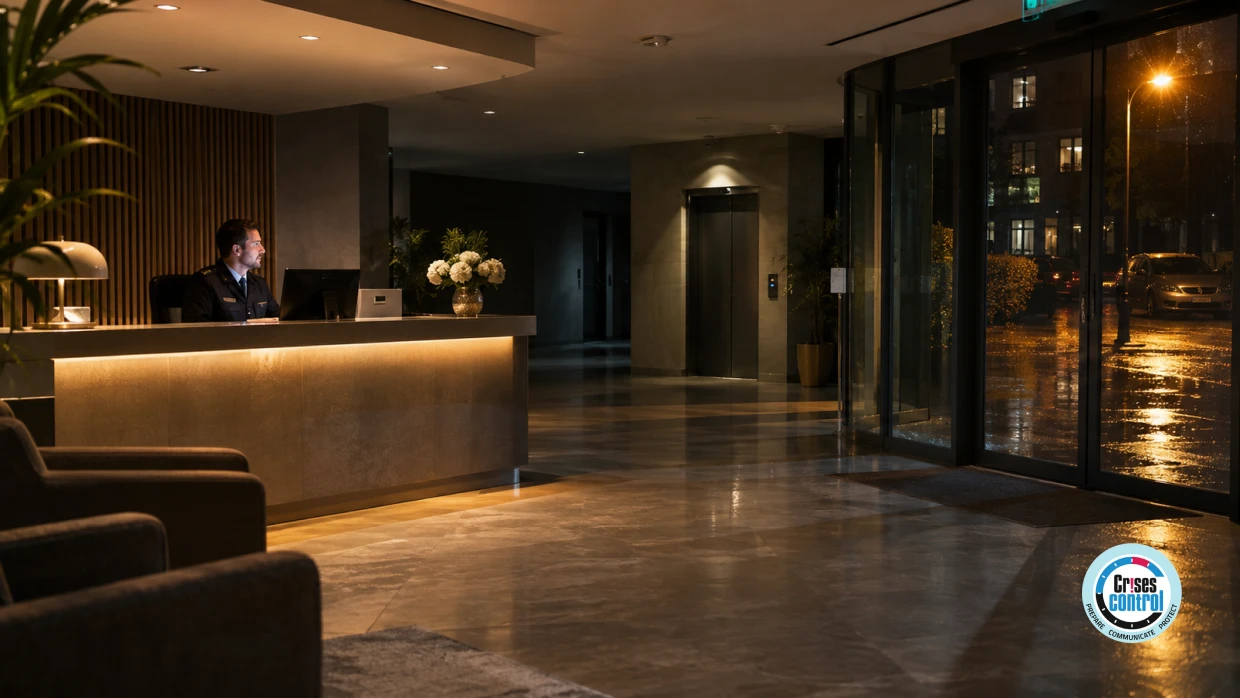
The daytime arrangement hides the gap. At eleven in the morning a concierge has a radio, a staffed reception, a facilities office two floors up and people crossing the lobby every minute. The alert is close to redundant, because the building is full of colleagues who would hear a raised voice. By three in the morning all of that has gone home and the device is the whole arrangement.
HSE's guidance on violence names this exposure directly. It lists working late in the evening or early in the morning, when fewer colleagues are present, and lone security staff who have authority over customers and are enforcing rules. A night concierge refusing entry to a visitor who has been drinking is doing both of those at once, with nobody in sight.
Assault is not the only risk. A caretaker who falls on a stairwell, a security officer who has a cardiac event on a patrol round, a receptionist taken ill at a desk: none of them can explain themselves on a radio. That is why HSE's list covers devices that raise the alarm automatically as well as manually, and a reliable way of knowing somebody came back.
Who Monitors Panic Alerts For Building Security Staff Out Of Hours?
Panic alerts for building security staff should go to a named destination on a rota, with a stated response time. The usual candidates are an in-house control room, a contracted alarm receiving centre, an on-call manager's mobile, or an app-based responder rota. What cannot work is an alert routed somewhere shut, unstaffed or untested at the hour the shift runs.
Any of those destinations can be made to work. The question worth asking of any arrangement is not whether it works but who it wakes. A radio that reaches a console nobody is sitting at is a dead channel, and it fails silently, which is the worst property an alarm can have. The member of staff believes they have called for help. Nothing in the system tells them otherwise.
The table sets out four routes an alert from lone building staff can take in the middle of the night, against the three things that decide whether help arrives.
What Happens When Nobody Answers The Alert?
When nobody answers, a well-built arrangement moves on by itself. The alert passes to a second name after a set time, then to a third, then to somewhere staffed every hour of every night. A badly built one does nothing, because it treated the first notification as the plan and left the rest to whoever was holding a phone.
An escalation path that survives a night shift answers five things before the shift, not during it:
- Who receives an alert from lone building staff tonight, by name, on a device tested this month
- After how many unanswered minutes the alert moves to the next name
- Which destination is the last resort, and is genuinely staffed at every hour
- Who confirms the member of staff has been reached, as distinct from who received the alert
- Where the activation, the escalation and the outcome are written down while the shift is still running
Closing The Loop With The Member Of Staff
Point four is the one most arrangements leave out, and it is the one the member of staff cares about. Somebody has pressed a button and is now standing in a lobby with an aggressive visitor, holding a device that gave no sign of being heard. Silence after an activation is indistinguishable from failure. A member of staff who has once been met with silence will hesitate the next time. One acknowledgement naming who is coming, and when, is worth more than any amount of alerting capacity sitting behind it.
Closing the loop afterwards counts too. Reaching the member of staff is where the incident stops being dangerous. Debriefing them, writing down what happened and acting on it is where the next one gets prevented. HSE asks employers to put measures in place to support any worker who has experienced violence, and that work only gets done if the activation left a record somebody reads.
How Does Crises Control Support Lone Building Staff?
Crises Control supports lone building staff through the SOS Panic Button, the frontline escalation capability of its Employee Safety Software. Staff raise an SOS from the Crises Control mobile app, authorised responders get the alert with the GPS location where available and the incident details, and an incident is created automatically instead of waiting for somebody to open one.
Three details matter at a concierge desk. The button is activated by press and hold, which the product page says prevents accidental triggers. Location is shared only when an SOS is activated or location sharing is enabled on the device, and the page states that employees are not tracked continuously in the background, which is the line between a safety tool and a surveillance one. And the alert goes to authorised responders by role, so one activation can notify security, a first aider and a supervisor at the same time rather than a single mobile that may be face down on a bedside table.
After that the escalation belongs to the platform rather than the individual. Incident Manager coordinates the communications, the response activities and the incident record. Response tasks are assigned and tracked in Incident Task Management Software, so checking on the member of staff is a task with an owner and a status rather than something everyone assumes happened. Across a portfolio the activation then sits in the same record as everything else the night produced, which is the job of Property Management Incident Management Software.
What the software does not do is watch. It will not staff a rota, decide that an aggressive visitor warrants the police, or form a view on whether one person should be alone in that lobby at all. Those judgements stay with the employer. Alert-only tools stop once the message has left the building. The minutes after it leaves are the ones that decide how the shift ends.
Lone Building Staff Duty Of Care Checklist
Seven checks, each answerable yes or no by whoever sets tonight's rota:
- Everybody working alone tonight can raise the alarm without having to speak or be seen doing it
- The alert has a named human destination for this shift, not a role and not a shared inbox
- That destination has been tested on a live activation in the last month, at the hour the shift runs
- The escalation path names a second and third destination, with a stated time after which the alert moves on
- One destination in the chain is staffed at every hour of every night, under contract if not in house
- Somebody confirms the member of staff has been reached, and that confirmation goes back to them
- The activation, the escalation, the outcome and the debrief are recorded in one place while the shift is live
The Button Is The Easy Part
Issuing a device is the cheapest part of protecting somebody who works alone, which is why it is so often the only part anybody does. The hard work is the rota behind it. A name for tonight. A timer that moves the alert on when that name does not answer. A destination that is awake at four in the morning, and a message back to the person who pressed the button telling them somebody heard.
Lone worker safety in property management has one wrinkle a single site does not. The person at risk, the manager who can authorise a response and the contractor who will attend are rarely in the same building, and often not in the same organisation. That makes it a coordination problem rather than a communication one, and it is close kin to deciding who takes charge of an out-of-hours building incident at all.
If the honest answer to any of those seven checks is no, the device on the desk is a promise nobody has agreed to keep. Start with the destination, because every other check depends on it. Then see what a monitored activation looks like against your own portfolio and your own night rota on a demo.
Frequently Asked Questions
What does duty of care mean for lone building staff?
Duty of care to lone building staff means assessing and managing the risks of working alone before the shift begins. In Great Britain, HSE says employers must manage the risk to lone workers, train, supervise and monitor them, and keep in touch and respond to any incident. In practice that means a monitored way to raise the alarm, a named person watching it, and a tested escalation route. Issuing a device on its own does not meet it.
Who should monitor panic alerts for building security staff at night?
A named destination that is awake and staffed at the hour the shift runs, with a stated response time. That can be an in-house control room, a contracted alarm receiving centre, an on-call rota reached through a mobile app, or a combination of them. An alert routed to a control room that closes at midnight is not monitored, whatever the written procedure says. The destination has to sit on this shift's rota and have been tested recently.
Is a panic button enough for a lone night concierge?
No. A panic button creates an alert, not a response. Without a named person monitoring it out of hours, a timed escalation when that person does not answer, and a confirmation back to the concierge, the device transfers risk instead of reducing it. HSE's monitoring guidance pairs devices for raising the alarm with regular contact at pre-agreed intervals and regular testing of the system.
What is the difference between a lone worker device and safety software?
A lone worker device raises an alarm. Employee Safety Software decides what happens next. The difference shows up in escalation when the first responder does not answer, in whether an incident record is created automatically, and in whether the response tasks that follow have owners. A device answers how somebody calls for help. Software answers who hears it, who acts, and what is left on record afterwards.
How does lone worker safety in property management differ from a single site?
The person at risk, the manager who can authorise a response and the contractor who will attend are usually spread across different buildings and different organisations. That turns an alert into a coordination task across a portfolio rather than a call down the corridor. Holding activations in one place alongside the night's other incidents is what makes patterns visible, and it turns post-incident incident reporting into an export rather than a reconstruction.
This article was drafted with AI assistance and reviewed by the Crises Control team. Featured image: AI-generated.