A county council, a fire service and an ambulance trust debrief a flood six weeks on. Everyone agrees the rest centre opened too slowly, and twenty-two recommendations go into the report. Eighteen months later, the next flood finds it opening at the same speed.
Tracking actions from a multi-agency debrief means giving every agreed recommendation one named owner in one named organisation, a date, a visible status and a standing forum that reviews it. A numbered list at the back of a debrief report is none of those things.
Tracking actions from a multi-agency debrief is the discipline of turning agreed recommendations into owned, dated and monitored work across organisational boundaries. A debrief identifies the lesson. Only an owner, a deadline and a standing review turn a lesson identified into a lesson learned.
What Is A Multi-Agency Debrief Action?
A multi-agency debrief action is one piece of work agreed at a joint debrief, assigned to a named person in a named organisation, with a date by which it will be finished. A recommendation is not an action. An action is something a person can be asked about by name.
Observations describe what happened. Recommendations describe what should change. Actions name who will change it, and by when. The United Kingdom's Joint Emergency Services Interoperability Principles programme draws the same line: its Joint Organisational Learning strategy exists to move responder organisations from lessons identified to lessons learned, and calls itself a consistent and accountable mechanism for making sure lessons identified are acted upon. Identification was never the hard part.
Why Do Debrief Recommendations Stall In Local Government?
Debrief recommendations stall because the structure that produced them dissolves the moment the debrief ends. The facilitator goes back to a day job and the report goes to a shared drive. Each organisation assumes another partner is carrying the shared items, so nobody refuses the work and nobody owns it.
Implementing debrief recommendations in local government fails in four predictable ways, and not one of them involves bad faith.
- The action has an organisation but no person. "The council will review its rest centre arrangements" names a body, and a body cannot be chased.
- The action has a direction but no date. Work without a deadline loses to work that has one.
- The owner has the action but not the authority. Work needing a service director's budget lands on an emergency planning officer, who carries it quietly.
- The register exists and nothing asks about it. Without a standing item on an agenda somebody chairs, the list gets read after the next incident.
Who Owns A Debrief Action That Crosses Organisational Boundaries?
One organisation owns every action, shared ones included. An action with three owners has none, because each partner can reasonably wait to see what the others do. The body that convened the debrief should assign a single accountable organisation to each action, and that organisation should name an individual inside it.
This is the step that gets skipped in the room, and it is usually the shared actions that suffer. Agreeing that interoperability needs to improve is comfortable. Agreeing that the fire service owns action nine and will report on it in March is not. The discomfort is the signal: an action nobody wanted to accept in the debrief is an action nobody will do afterwards.
Where the action list lives decides what it can prove. The table compares four common homes for debrief actions against the questions a scrutiny committee, an auditor or a public inquiry asks.
What Does Tracking Actions From A Multi-Agency Debrief Look Like In Practice?
In practice, tracking actions from a multi-agency debrief is a routine, not a project. Every action carries an owner, an organisation, a deadline and a status. One register holds all of them. One forum reviews that register on a fixed cycle, and overdue items escalate to somebody senior enough to unblock them.
Other jurisdictions have already formalised the routine. The United States Department of Homeland Security's Homeland Security Exercise and Evaluation Program gives improvement planning a chapter of its own, defining it as the process by which areas for improvement are turned into concrete, measurable corrective actions, then tracked to resolution. Its after-action meeting exists to reach consensus on draft corrective actions, concrete deadlines and owners or assignees. The World Health Organization's Guidance for after action review, published in 2019, builds follow-up into each of its four review formats.
What A Good Action Looks Like
The Homeland Security Exercise and Evaluation Program asks for corrective actions that are specific, measurable, achievable, relevant and time-bound. Applied to a debrief, it means rewriting each recommendation until it names something deliverable. "Improve rest centre activation" is a theme. "Agree and publish a rest centre call-out list with named deputies, owned by the council's emergency planning manager, by 31 March" is an action.
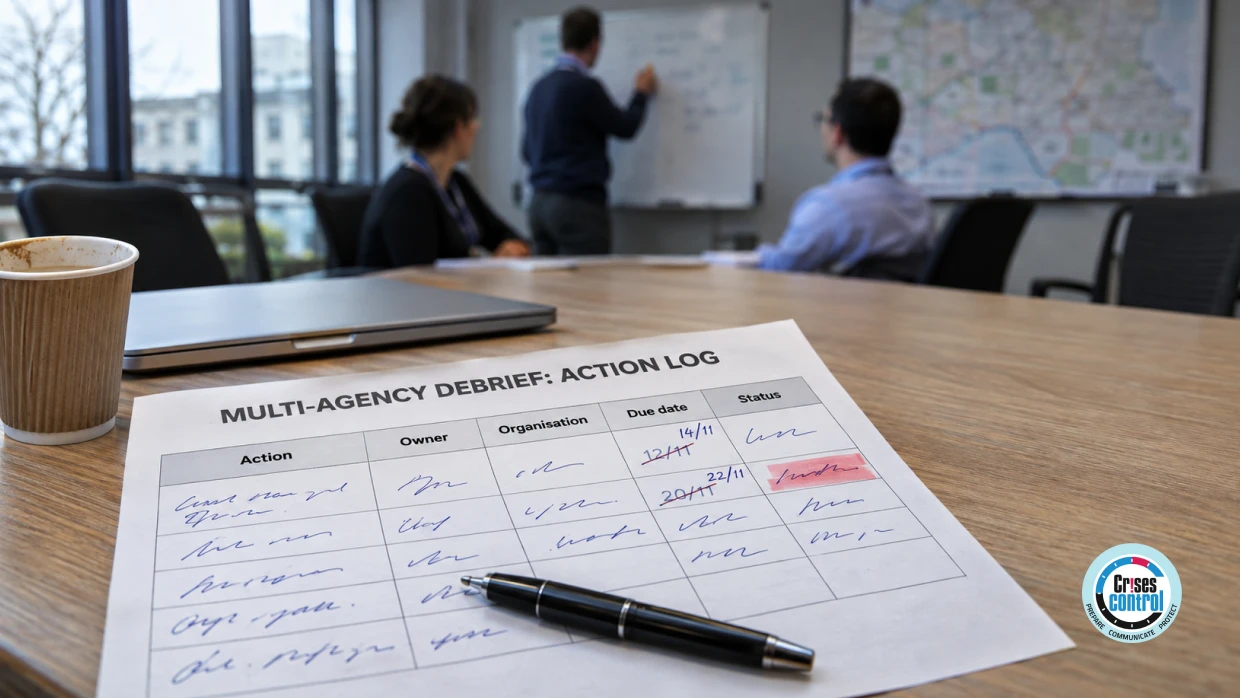
- Owner: a named individual, not a team or a job family
- Organisation: which partner is accountable, even when several will contribute
- Deadline: a date, plus a flag on any action whose date has already moved
- Status: what is true now, with the date somebody last confirmed it
- Evidence: what will exist when the action is done, so completion is something to look at
That is the whole of lessons learned action tracking. A register, an owner, a date, and somebody whose job it is to read the list.
How Does Crises Control Help With Tracking Actions From A Multi-Agency Debrief?
Crises Control handles the mechanical half of tracking actions from a multi-agency debrief: assignment, ownership, deadlines, status and escalation. It does not decide which recommendations are right, and it cannot give a partner organisation authority it does not already have. Those parts stay with the people in the room.
Incident Task Management Software is the module that carries this work. Its Task Assignment puts response tasks with named people or teams, Task Ownership maintains clear ownership for every task, and the Live Task Dashboard shows task ownership, progress and completion status in real time. Automatic Escalations let you configure escalation rules for overdue or unclaimed tasks. That is the one thing a spreadsheet can never do. A cell that has been red for four months tells nobody.
Public Sector Incident Management Software brings departments, responders and partner agencies into one shared workspace, and its Operational Audit Trail keeps an incident timeline for reporting, compliance and post-incident reviews. Incident Reporting Software turns the same activity into an Executive Summary Report, a Detailed Incident Report or an Audit Trail Report, exportable as PDF or CSV, which is what a scrutiny committee can actually be handed.
Two limits worth stating plainly. The module is built for tasks inside a live incident, where the clock runs in minutes, and a debrief register runs on months: the same mechanics at a different tempo. And no platform settles the argument about which organisation owns a cross-boundary action. That belongs in the debrief itself, alongside the joint decision log. The software holds the commitment. The partnership has to make it.
Multi-Agency Debrief Action Checklist
Work through this once before the next debrief rather than after it. It is the short version of tracking actions from a multi-agency debrief in a way that still stands up two years later.
- Decide before the debrief who will hold the joint action register, and say so in the room.
- Convert every agreed recommendation into an action with a named individual, an accountable organisation and a date, or record that it was rejected and why.
- Rewrite any action that cannot be finished, measured or shown to somebody. Vague actions are the ones that survive to the next debrief.
- Check on the day of assignment that each owner holds the authority the action needs, and escalate the ones who do not.
- Put the register on a standing agenda with a named chair, at a frequency the actions can realistically move between.
- Record every change of date and the reason for it. A deadline that has slipped three times is the finding, not the footnote.
- Close actions against evidence rather than against an assurance, and keep the evidence with the action.
- Open the previous debrief's register at the start of the next debrief, and read it out.
The Flood That Comes Back
The awkward thing about debrief actions is that the second incident tests them in public. The first flood is a flood. The second one, with the same rest centre opening at the same speed, becomes a question about the eighteen months in between, and the people answering it will be asked what happened to recommendation nine.
That question is nearly always answerable. It had no owner, or it had an owner without the authority to act, or it had both and nobody looked at it. None of those failures is dramatic. They happen in the gap between a well-run debrief and a busy quarter, which is exactly where tracking actions from a multi-agency debrief belongs.
Give every action a name, a date and somewhere visible to sit, and most of the problem goes away. The rest is the ordinary discipline of reading the list often enough that an overdue item is embarrassing while there is still time to fix it. To see what a joint action register would look like against your own multi-agency arrangements, book a demo and bring the last debrief report you wrote.
Frequently Asked Questions
What is a multi-agency debrief action?
A multi-agency debrief action is one piece of work agreed at a joint debrief, assigned to a named individual in a named organisation, with a date for completion. It is different from a recommendation, which says what should change without saying who will change it. A debrief report can hold dozens of recommendations and very few actions.
Who is responsible for tracking actions from a multi-agency debrief?
The organisation that convened the debrief holds the joint register, and each partner organisation owns the actions assigned to it. Shared ownership of a single action means nobody owns it, so every action needs one accountable organisation even when several partners contribute. Tracking actions from a multi-agency debrief also needs a named chair with the standing to ask why an item is overdue.
What is the difference between a lesson identified and a lesson learned?
A lesson identified is an observation that has been written down. A lesson learned is a change that has been made and will hold next time. The United Kingdom's Joint Organisational Learning strategy exists specifically to move responder organisations from the first to the second. A national strategy would not be needed if identification were the hard part.
How is a joint action register different from each agency's own improvement plan?
An agency improvement plan tracks what that agency will change on its own. A joint action register tracks the actions that sit between organisations, which are the ones most often dropped. Both are needed: a joint register is no substitute for internal plans, and internal plans cannot see the gaps between partners.
What should every debrief action record contain?
Five fields: the action itself, the accountable organisation, the named owner, the deadline, and the current status with the date somebody last confirmed it. Adding the evidence that will prove completion is what stops an action being closed on an assurance. Incident task management software that assigns owners, monitors deadlines and escalates overdue items removes the step where a person has to remember to look.
This article was drafted with AI assistance and reviewed by the Crises Control team. Featured image: AI-generated.