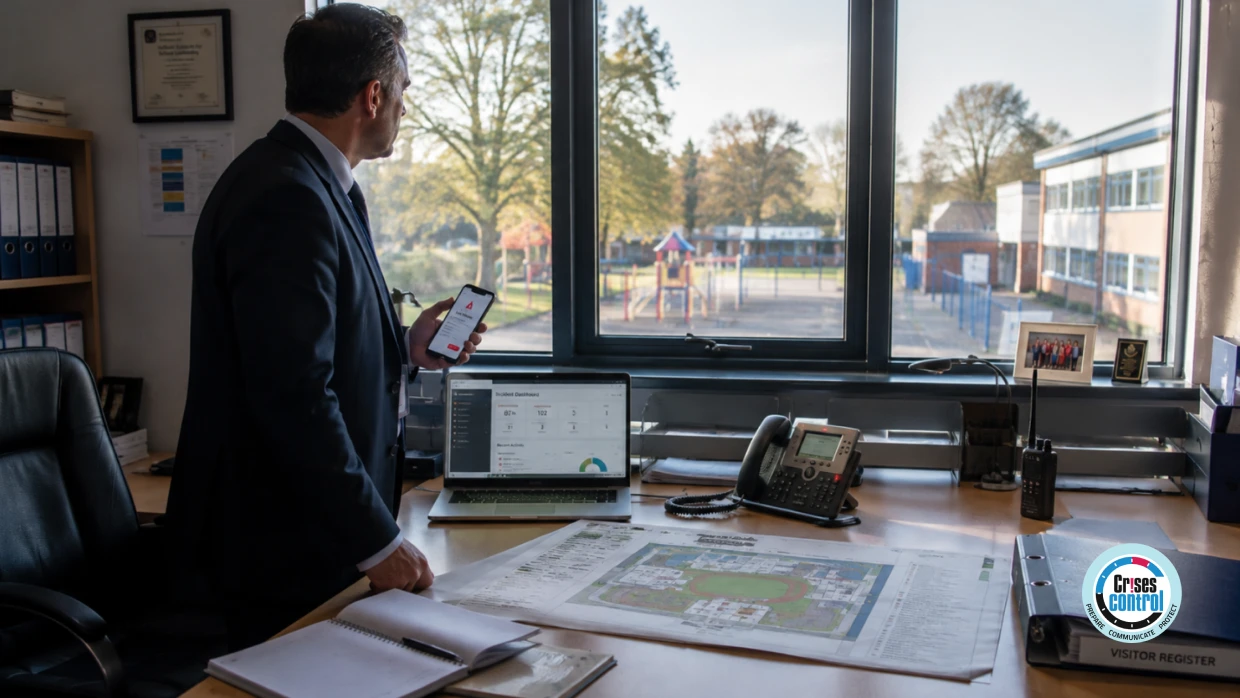
It’s 10:18 on a Tuesday morning.
A secondary school office receives a call from local police. Officers are responding to reports of a potentially dangerous individual seen a few streets away. There is no confirmed threat to the school, but the advice is immediate: begin lockdown procedures while the situation is assessed.
Within seconds, the Headteacher is making decisions that affect hundreds of pupils, staff and visitors. Has every classroom received the instruction? Have pupils on the sports field been brought inside? Are contractors still working near the science block? Do substitute teachers understand the lockdown procedure? Who is responsible for communicating with parents?
Twenty minutes later, police confirm there is no threat to the school. The lockdown ends, lessons resume and the exercise is considered a success.
Or is it?
Incident Management Software helps schools activate emergency plans, coordinate response teams and maintain visibility throughout an incident. During a lockdown exercise, its greatest value is not proving that a procedure exists. It is helping school leaders understand whether that procedure will still work when information is incomplete, decisions must be made quickly and multiple teams are responding at the same time.
A lockdown drill should never exist simply to satisfy a policy requirement or complete an annual exercise. Its purpose is to expose weaknesses while the consequences are still simulated. The most valuable exercises rarely run perfectly. They reveal communication gaps, unclear responsibilities and hidden risks before a real emergency exposes them instead.
For Headteachers, School Safety Leads, Facilities Managers and School Governors, the goal is not to leave the exercise feeling reassured. It is to leave with a clearer understanding of what needs improving.
What Makes A School Lockdown Exercise Valuable?
A school lockdown exercise is a controlled test of how people, processes and technology work together when normal school operations suddenly change. Unlike a fire evacuation, where the objective is to leave the building safely, a lockdown requires staff and pupils to remain in place while the situation continues to develop. Decisions often need to be made with incomplete information, changing circumstances and limited time.
A well-designed exercise should measure far more than whether classroom doors were locked. It should answer practical operational questions that help school leaders evaluate their emergency capability, including:
- Did every member of staff receive the lockdown instruction?
- Were substitute teachers and temporary staff included?
- Could the school confirm who acknowledged the alert?
- Were visitors and contractors accounted for?
- Did senior leaders receive accurate updates throughout the exercise?
- Could the response be reconstructed afterwards?
These questions sit at the centre of effective school lockdown drill best practices because they measure operational readiness rather than procedural compliance. A valuable exercise is not one where nothing goes wrong. It is one that identifies weaknesses before they affect pupils, staff or visitors during a genuine emergency.
The Biggest Misconception About School Lockdown Drills
Many schools judge a lockdown exercise by one outcome: everyone stayed inside their classroom.
While that is important, it represents only one part of the response. A successful lockdown does not automatically mean communication was effective, responsibilities were understood or leadership had the information needed to make confident decisions. In reality, many exercises appear successful while hiding weaknesses that only become visible once the situation becomes more complex.
Perhaps one classroom never received the original instruction. Perhaps visitors were overlooked. Perhaps several senior staff assumed somebody else was responsible for communicating with parents. None of these issues prevents the exercise from finishing successfully, but each one could become a serious problem during a real incident.
The purpose of a school lockdown drill checklist is not to prove that procedures work. It is to identify where they need to work better.
Problem 1: Some Staff Never Receive The Lockdown Alert
Imagine the lockdown begins during morning lessons. The alert is issued immediately, and most teachers receive it within seconds before securing their classrooms.
One substitute teacher does not.
She is covering a Year 8 class for the first time and has not yet been added to the school’s communication system. She only realises something is happening after seeing neighbouring classrooms locking their doors.
The exercise is still recorded as successful.
Yet one of the most important objectives of the drill has already failed.
Emergency communication only protects people if it reaches every person responsible for safeguarding pupils. Schools are constantly changing environments. Substitute teachers arrive at short notice, contractors move between buildings, visitors attend meetings and external specialists may only be on site for a few hours. If any of these groups fall outside the communication process, the lockdown plan contains a weakness that deserves immediate attention.
This is where Mass Notification Software for Schools add value. By delivering alerts across multiple communication channels and confirming who received them, school leaders gain confidence that critical instructions are reaching the people who need them.
The measure of success is not how quickly the notification was sent.
It is whether everyone who needed to act actually received it.
Problem 2: Nobody Knows Who Has Acknowledged The Lockdown
Sending an alert is only the beginning of the response.
Knowing whether people have acted on it is equally important.
During the exercise, the Senior Leadership Team assumes every classroom has entered lockdown because the notification was successfully delivered. Afterwards, one teacher explains she only saw the message after another member of staff knocked on her classroom door.
That raises an uncomfortable question.
Would anyone have known this during a genuine emergency?
A delivery report confirms that a message reached a device. It does not confirm that the recipient saw it, understood it or acted on it.
Acknowledgement tracking provides a much clearer operational picture by showing who has confirmed the instruction, who has not responded and where follow-up may be needed. On larger school sites with multiple buildings, sports facilities or sixth form centres, that visibility can make the difference between assuming people are safe and actually knowing they are.
Every lockdown exercise should answer two separate questions:
- Did people receive the alert?
- Did they acknowledge it?
Those answers are not the same.
Problem 3: Visitors And Temporary Staff Fall Outside The Process
Many schools believe they are testing their lockdown procedures.
In reality, they are only testing permanent members of staff.
Visitors experience the school very differently. Parents attending meetings, governors, agency staff, peripatetic music teachers, contractors and maintenance engineers may all be unfamiliar with local emergency procedures. They are also unlikely to know where to go or who to report to if a lockdown is declared.
When these groups are excluded from an exercise, schools often leave with a false sense of confidence. The procedure worked for employees who already understood the process, but the exercise never tested the people who needed the clearest guidance.
A realistic lockdown exercise should reflect a normal school day. That means considering everyone who could reasonably be on site, not just those employed by the school.
A lockdown procedure should work just as effectively for someone visiting the school for the first time as it does for someone who has worked there for twenty years.
Problem 4: Responsibilities Become Unclear As The Situation Changes
Fifteen minutes into the exercise, the scenario changes.
Police continue investigating nearby, parents begin calling reception and local media start asking questions. The immediate task of securing classrooms has been completed, but a different challenge has now emerged.
- Who updates parents?
- Who informs governors or the academy trust?
- Who decides whether after-school activities should continue?
- Who records key decisions?
At this point, uncertainty often shifts from the classroom to the leadership team.
The Headteacher may assume the School Business Manager is coordinating parent communication. The School Safety Lead believes that responsibility sits elsewhere. Reception staff continue answering calls while someone else drafts an update that has not yet been approved.
Nobody is avoiding responsibility.
Each person simply believes someone else owns the next decision.
This is one of the most valuable weaknesses a lockdown exercise can expose because unclear ownership rarely appears in written procedures. It only becomes visible when several decisions need to be made at the same time.
If different members of the leadership team give different answers about who owns a critical task, the exercise has identified an issue worth fixing.
Interested in our Incident Management Software?
Flexible Incident Management Software to keep you connected and in control.
Problem 5: Parent Communication Quickly Becomes The Biggest Challenge
The pupils are safe.
The classrooms are secure.
Yet outside the school gates, a different incident is beginning to unfold.
Parents are sharing messages in WhatsApp groups. Local community Facebook pages report police activity nearby. Some parents decide to drive to the school before receiving any official information.
This is often the point where lockdown exercises stop being operational and become reputational.
Schools usually spend significant time practising internal communication, but far less time testing how they will communicate with hundreds or even thousands of anxious parents looking for immediate reassurance.
Questions worth testing include:
- How quickly can parents receive an official update?
- Who approves external communications?
- Which communication channels will be used?
- How often will updates be issued?
- How will rumours and misinformation be addressed?
Emergency Notification Software helps schools distribute consistent updates across multiple communication channels while maintaining a clear record of what has been communicated and when.
Good parent communication is not about providing constant updates.
It is about providing trusted updates that reduce uncertainty.
Problem 6: Escalation Depends On Individual Phone Calls
Every emergency plan includes escalation procedures.
The real question is whether they continue working once the situation becomes more complicated.
Police advise that the lockdown will continue longer than expected. Additional support is required, so the Headteacher begins contacting senior staff individually.
One person is already dealing with another issue.
Another does not answer immediately.
Someone else is unsure whether they have already been informed.
The delay lasts only a few minutes, but the exercise has exposed another weakness.
Manual escalation becomes harder as more people, more decisions and more information enter the response. Leadership teams spend increasing amounts of time coordinating communication instead of managing the incident itself.
Incident Management Software reduces that burden by allowing predefined escalation workflows to notify the next responsible person automatically when acknowledgements are not received or critical tasks remain incomplete.
The goal is not to replace leadership.
It is to allow leaders to spend more time making decisions and less time chasing updates.
Problem 7: Nobody Can Reconstruct What Happened Afterwards
The lockdown exercise ends and lessons resume.
The debrief begins with what should be straightforward questions.
- When was the lockdown declared?
- How long did each classroom take to acknowledge the alert?
- When were parents first informed?
- Who authorised extending the lockdown?
- When was every visitor accounted for?
The answers should be simple.
Instead, people remember events differently.
Some decisions were recorded in notebooks. Others happened during telephone calls or informal conversations in corridors. Without a reliable incident record, much of the exercise depends on memory rather than evidence.
That matters because the purpose of the debrief is not simply to discuss what happened. It is to understand why decisions were made, identify where communication slowed down and determine what should change before the next exercise.
A structured incident timeline allows leadership teams to review:
- When the lockdown was activated
- Who acknowledged the alert
- Which tasks were completed and when
- Where communication slowed
- Which escalation steps worked as expected
- Which decisions created unnecessary delays
The greatest value of a lockdown exercise is not the exercise itself.
It is the evidence it generates to strengthen the school’s next response.
Manual Exercises Versus Digitally Supported Exercises
Schools have been running lockdown exercises long before digital incident management platforms existed. Strong leadership, well-rehearsed procedures and confident staff remain the foundation of every effective emergency response.
Technology does not replace those fundamentals.
What it changes is how information is shared, tracked and acted upon once the exercise begins.
During a manual exercise, leaders often rely on phone calls, radio messages, paper registers and verbal updates to understand what is happening across the school. Those methods can work, particularly during smaller exercises, but they become harder to manage as more information, more people and more decisions need to be coordinated at the same time.
A digitally supported exercise creates a different experience. Instead of piecing together updates from multiple conversations, leadership teams can work from a shared operational picture that shows what has happened, what still requires attention and where support may be needed.
Manual Exercise | Digitally Supported Exercise |
Phone calls and verbal instructions | Role-based notifications sent simultaneously |
Paper registers and attendance lists | Digital acknowledgement tracking |
Separate updates from different teams | Shared operational picture |
Manual escalation through phone calls | Automated escalation workflows |
Notes recorded by different individuals | Centralised incident timeline |
Debrief based largely on memory | Complete record of decisions, actions and communications |
Neither approach guarantees a successful lockdown exercise. An experienced leadership team can still manage an incident effectively using manual processes, while technology cannot compensate for unclear procedures or poor decision-making.
The real advantage of digital support is that it reduces the amount of information that depends on memory, handwritten notes or individual conversations. That allows schools to spend less time coordinating information and more time evaluating how well their emergency procedures actually performed.
The objective is not to digitise a lockdown exercise.
It is to make every exercise a better learning opportunity.
How Incident Management Software Strengthens School Lockdown Exercises
By the time a lockdown exercise reaches its most challenging stage, the questions facing school leaders are rarely technical.
- Who has acknowledged the instruction?
- Which visitors have not yet been accounted for?
- Has every department received the latest update?
- Who is responsible for the next decision?
These are coordination challenges rather than communication challenges, and they become more difficult as the situation develops.
This is where Incident Management Software supports the wider response. Rather than acting as another messaging tool, it provides a structured framework that helps schools coordinate people, information and decisions throughout the exercise.
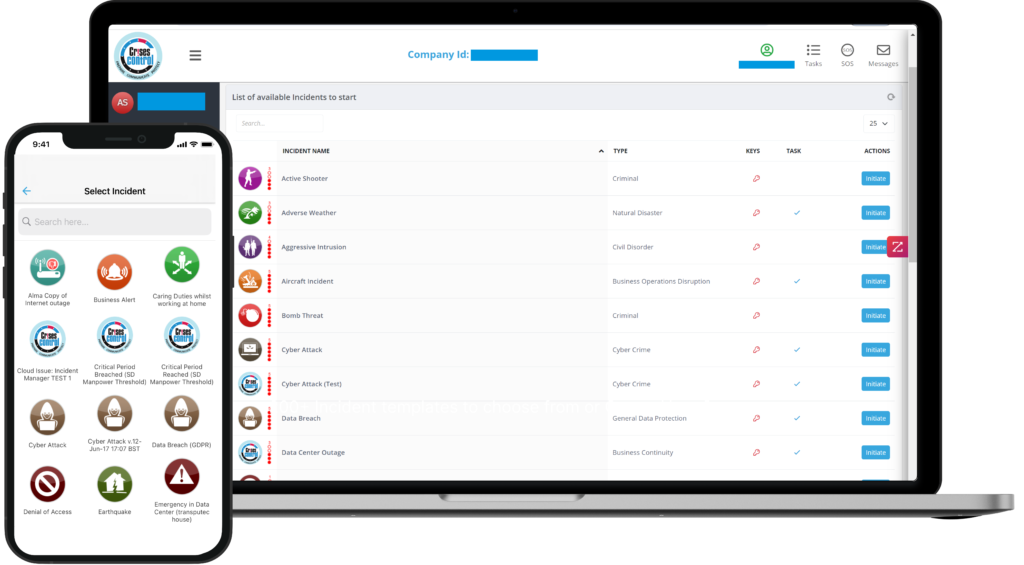
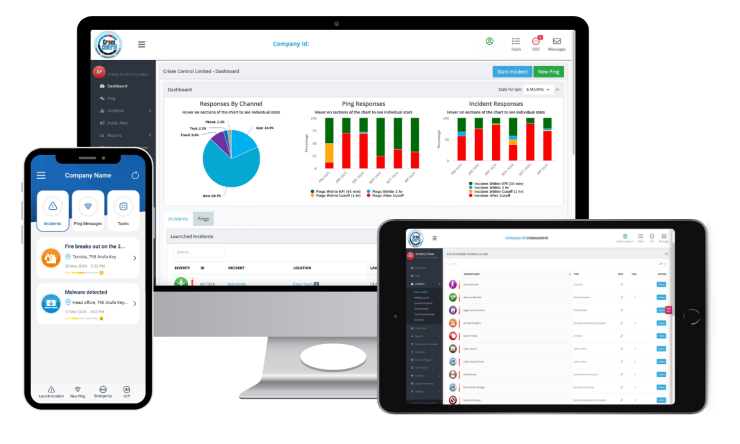
Schools can activate predefined lockdown procedures, notify staff according to their roles, monitor acknowledgements, assign tasks and maintain a shared operational picture as events unfold. Leadership teams can see which actions have been completed, which remain outstanding and where additional support may be required without relying on a series of separate phone calls or fragmented updates.
Once the exercise has finished, the same information becomes one of the most valuable parts of the debrief. Instead of relying on individual recollections, schools can review exactly when alerts were issued, acknowledgements were received, key decisions were made and actions were completed.
Solutions such as Crises Control support this approach by helping schools digitalise emergency plans while continuing to follow their existing safeguarding procedures and emergency policies. Combined with Emergency Notification Software and Mass Notification Software for Schools, they give leadership teams greater visibility, stronger accountability and a clearer understanding of how the exercise actually unfolded.
Technology cannot make emergency decisions.
Its value lies in helping the people responsible for those decisions work from the same information.
The Most Valuable School Lockdown Drill Is The One That Reveals Weaknesses
It is easy to finish a lockdown exercise feeling reassured because every classroom followed the procedure and lessons resumed without incident.
That feeling can be misleading.
A successful exercise is not one where nothing goes wrong. It is one that exposes weaknesses while the consequences are still simulated.
Perhaps a substitute teacher never received the lockdown alert. Perhaps visitors were overlooked during accountability checks. Perhaps two members of the leadership team assumed someone else was responsible for updating parents. Perhaps escalation depended on a series of unanswered phone calls. Perhaps nobody could accurately reconstruct the response during the debrief.
None of these findings should be viewed as failures.
They are evidence that the exercise achieved exactly what it was designed to do.
Every weakness identified during a lockdown drill is an opportunity to improve the school’s emergency procedures before a real incident places pupils, staff and visitors under genuine pressure.
For schools reviewing their school lockdown drill best practices, the most valuable question is not: “Did the exercise go well?”
It is: “What did the exercise teach us that we did not know before?”
That change in mindset transforms lockdown exercises from routine compliance activities into one of the most effective ways to strengthen safeguarding, improve operational resilience and build greater confidence across the entire school community.
If your school is reviewing how it plans, coordinates and evaluates lockdown exercises, Crises Control can help support structured incident activation, reliable communication, acknowledgement tracking, role-based task management and comprehensive post-exercise reporting.
FAQs
1. What Should A School Lockdown Drill Test?
A school lockdown drill should test far more than whether classrooms can be secured. It should assess whether staff receive emergency notifications, acknowledgements can be confirmed, visitors and contractors are included, responsibilities are clearly assigned and leadership can coordinate decisions as the situation develops. A successful lockdown exercise identifies weaknesses in communication, accountability and decision-making before a real emergency exposes them.
2. How Does Incident Management Software Improve School Lockdown Drills?
Incident Management Software helps schools activate lockdown procedures, notify staff according to predefined roles, assign tasks, monitor acknowledgements and maintain a shared operational picture throughout an exercise. It also creates a complete incident timeline, allowing leadership teams to review decisions, identify communication gaps and improve future lockdown drills using evidence rather than memory.
3. What Is The Difference Between A Successful Lockdown Drill And An Effective One?
A successful lockdown drill follows the planned procedure and reaches its intended outcome. An effective lockdown drill goes further by exposing weaknesses that could affect a real emergency. These may include missed notifications, unclear responsibilities, communication gaps, delayed escalation or difficulties accounting for visitors. The purpose of the exercise is not simply to demonstrate compliance but to improve the school’s emergency preparedness.
Why this change? This question is far more likely to appear in AI search results because it directly reflects the central argument of your article.
4. How Does Emergency Notification Software Support School Emergency Response?
Emergency Notification Software enables schools to send critical alerts through multiple communication channels, including SMS, voice calls, email and mobile push notifications. It also provides acknowledgement tracking so leadership teams can confirm who has received and acted on emergency instructions. This improves communication, accountability and coordination during both lockdown exercises and real incidents.
5. Why Do Some School Lockdown Drills Fail To Identify Real Weaknesses?
Many lockdown drills focus on whether classrooms were secured rather than how the entire response was managed. If an exercise does not test communication, accountability, parent updates, visitor management, escalation and decision-making under realistic conditions, important weaknesses can remain hidden. The most valuable lockdown drills are those that identify opportunities for improvement before a genuine emergency occurs.