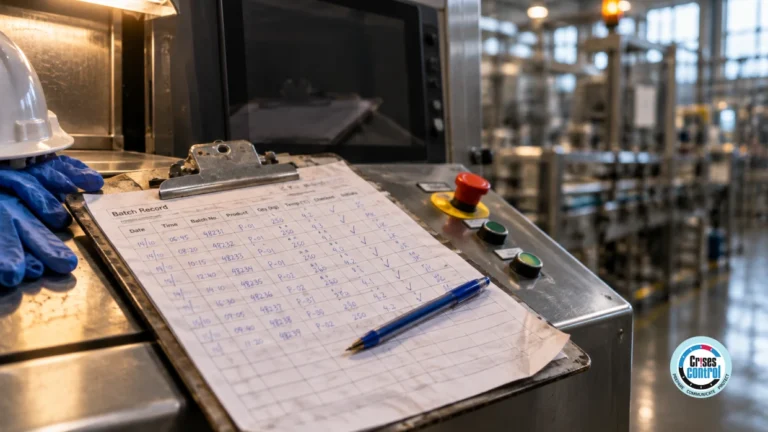
A single event on a production line rarely produces a single report. Depending on where the plant sits, it can trigger a notification measured in hours, a formal report measured in days, and a record that has to survive for years. None of those clocks waits for the others.
Incident reporting for manufacturers is a recording job before it is a reporting job. The account has to be built while the response is still running, because every deadline that follows draws on the same facts: who was told, what was done, and when.
Incident reporting for manufacturers means notifying the relevant authority inside a fixed window, filing a formal report inside a longer one, and keeping the record for years afterwards. The deadlines differ by jurisdiction and by incident type, but all three draw on one operational account of the response.
What Does Incident Reporting For Manufacturers Actually Require?
Incident reporting for manufacturers requires three separate things from one event: an immediate notification to a regulator, a formal written report inside a statutory deadline, and a retained internal record. Safety regulators set the first two deadlines. The third is what an investigator, an insurer or an auditor actually reads, sometimes years later.
Three obligations, usually three different people. A shift manager or HSE lead calls the regulator. A compliance team writes the formal submission days later. The internal record gets assembled from whatever the plant happened to capture at the time, and that last part is where it goes wrong.
- The regulator wants a few facts fast, before anyone knows the full picture
- The formal report wants a considered account, with a cause and a corrective action
- The retained record wants everything, including what was never submitted anywhere
A manufacturer with sites in Britain, the United States and the European Union answers to three different authorities, on three different clocks, about the same twenty minutes of the same shift.
Why Does Reconstructing The Record Afterwards Fail?
Reconstructing the record afterwards fails because the detail regulators ask about is the detail nobody writes down during a response. Who was told, at what minute, and whether they confirmed it. Who took the isolation task, and who finished it. Which call escalated, and to whom.
None of that is hard to capture as it happens. All of it is hard to recover a week later from phone logs, a group chat, a maintenance ticket and four people's memories.
The problem shows up in one specific place. A plant can nearly always prove it sent a message. It is much less likely to prove somebody received one, acted on it and closed the action out. That distinction is what a formal submission turns on, and it is the first thing an inspector tests.
Retention periods make this harder rather than easier. Records are read months or years later, by someone who was not there, once everybody who could have filled in a gap has moved on. A record is only reliable if it was written while it was still accurate.
Which Authorities Want What, And By When?
The authorities want different things on different clocks, and the fastest deadline is counted in hours rather than days. Under United States federal rules, a work-related death goes to the Occupational Safety and Health Administration within eight hours. In Great Britain the first duty is to notify without delay, with the written report following inside ten days.
The shortest clock sets the real operating requirement. Incident reporting for manufacturers has to be designed around the clock that reaches the site first, not the one that gives the most room. Three sets of rules, all current as at October 2026, show the range a multinational plant works inside.
Under the United Kingdom's RIDDOR 2013 reporting procedure, a responsible person must notify the enforcing authority of a reportable incident by the quickest practicable means without delay, then send the report within ten days. An injury that keeps someone off routine work for more than seven consecutive days is reported within fifteen days of the accident. Records of reportable incidents, and of injuries causing more than three days of incapacity, are kept for at least three years.
In the United States, 29 CFR 1904.39 sets eight hours for a work-related fatality and twenty-four hours for an in-patient hospitalisation, an amputation or the loss of an eye. A recordable injury or illness is a separate duty: it goes on the OSHA 300 Log and the 301 Incident Report within seven calendar days of receiving the information, and those forms are kept for five years after the calendar year they cover.
In the European Union, the NIS2 Directive puts a cyber clock on top of the safety ones. Article 23(4) of Directive (EU) 2022/2555 requires an early warning within twenty-four hours of becoming aware of a significant incident, an incident notification within seventy-two hours, and a final report within a month. Annex II names manufacturers of medical devices, computers and electronics, electrical equipment, machinery, motor vehicles and other transport equipment as important entities. Member States have applied the measures since 18 October 2024.
The table below sets the same comparison out by obligation, so a site can work out which clock reaches it first.
This is orientation, not legal advice. Which rules bind a given site depends on the jurisdiction, the sector and the nature of the event, and a compliance team should confirm the position for each location.
What Has To Be In The Record Before The Deadline?
The record has to carry four things before any deadline arrives: what happened, who was informed, what actions were taken, and what decisions were made. Leadership, regulators, insurers and auditors all ask those four questions afterwards. They are what incident reporting for manufacturers has to produce.
A submission is only as good as the answers it can evidence. Each of the four fails in a different way.
Who Was Informed, And Did They Confirm It
A delivery report proves a message left a system. An acknowledgement proves a named person read it, and names the minute they did. For a manufacturer the second one is what counts: the duty manager, the HSE lead, the contractor supervisor on the affected line. A record listing recipients without acknowledgements has a hole in it, and that hole is where the inspector looks.
What Actions Were Taken, And By Whom
An incident creates work, and the work needs owners. Isolation. Evacuation checks and head counts. Customer notification, environmental containment, preservation of the scene. Incident Task Management Software holds each one as a named task with an owner, a status and a completion time, which is the difference between saying the plant responded and showing how. We looked at what happens when that tracking drops back to paper in incident task management for manufacturing.
What Decisions Were Made, And On What Basis
Decisions are the hardest part to reconstruct, and the part reviews concentrate on. Whether to evacuate a building or a zone. Whether to stop one line or the whole site. Whether to restart. Logging the decision, the person who made it and the information in front of them at the time turns a contested judgement into a documented one.
How Does Crises Control Support Incident Reporting For Manufacturers?
Crises Control supports incident reporting for manufacturers by recording the response as it happens, so nobody has to write it up afterwards. Every incident action is captured automatically into a single incident timeline, and Incident Reporting Software turns that timeline into reports for leadership, regulators and post-incident reviews.
Three of the things a submission needs are therefore already in place when the deadline arrives. Alerts carry acknowledgements, so the record shows who confirmed and when. Response work sits as named tasks with owners and completion times. The timeline holds updates, acknowledgements and tasks together, and exports as an Executive Summary, a Detailed Incident Report or an Audit Trail Report in PDF or CSV.
The manufacturing incident management software page makes the same point for plant operations: incident coordination across departments, alerting through text, voice, email, push notification and Microsoft Teams, task management with clear accountability, and a complete operational audit trail for compliance, investigations and reviews.
What stays with the organisation is everything that calls for judgement. Crises Control does not decide whether an event is reportable, which regulator receives it, how the submission is worded, or what the corrective action should be. Those are decisions for the HSE, compliance and operations teams. What the platform takes away is the week spent assembling evidence before any of those decisions can be made. Crises Control holds ISO 22301, ISO 9001, ISO/IEC 27001, ISO 14001 and Cyber Essentials Plus certification, which matters to a procurement team deciding where that record is going to live.
The Incident Reporting Readiness Checklist
Run a plant against this list. It tests incident reporting for manufacturers as an operational capability rather than as a policy. Each item is something a compliance team should be able to demonstrate from a closed incident, rather than describe from a policy document.
- Every jurisdiction a site operates in is mapped to its reporting authority and its shortest deadline
- One named role owns the decision to notify, and a deputy covers every shift
- Alerts record acknowledgements, not just delivery, with a timestamp against each name
- Response actions exist as assigned tasks with owners, statuses and completion times
- Decisions are logged with the person who made them and the information available at the time
- The incident timeline exports in a format a regulator or an insurer will accept
- Retention meets the longest applicable period, which may be years rather than months
- A closed incident from the last quarter can be reconstructed in under an hour, start to finish
Proof Is Built During The Incident, Not After It
Reporting deadlines are not deadlines for writing. They are deadlines for knowing. A plant either knows who was told and what was done, or it spends the window finding out. Eight hours is not long enough to investigate. It is long enough to read a record that already exists.
So the operational record belongs inside the response, not in the paperwork that follows it. Alerting that captures acknowledgements, response work held as owned tasks, decisions logged as they are made: each one is useful during the incident and each one is evidence afterwards. The same timeline serves the shift manager at hour one and the inspector at month nine.
If a site cannot currently reconstruct a closed incident in an hour, that is the gap to close first. Book a demo and bring a real incident from the last quarter. The useful test is not whether the platform looks capable. It is whether it would have captured what that specific event failed to leave behind.
Frequently Asked Questions
What is incident reporting for manufacturers?
Incident reporting for manufacturers is the duty to notify a safety or cyber authority about a qualifying incident, file a formal report inside a statutory deadline, and keep the underlying record. It is three obligations from one event, each with its own clock. The Health and Safety Executive, the Occupational Safety and Health Administration (OSHA) and European Union national authorities each set their own thresholds and timescales.
How quickly must a manufacturer report a workplace death?
In the United States a work-related death goes to the Occupational Safety and Health Administration (OSHA) within eight hours, under 29 CFR 1904.39. In Great Britain the duty under RIDDOR 2013 is to notify the enforcing authority without delay by the quickest practicable means, with the written report following within ten days. Both are current as at October 2026.
How long do manufacturers have to keep incident records?
Retention runs to years, not months. Under RIDDOR 2013 a record of a reportable incident is kept for at least three years from the date the entry was made, and United States OSHA injury and illness forms are kept for five years following the calendar year they cover. A manufacturer operating in both places works to the longer of the two.
Does incident reporting software replace a compliance team?
No. Incident reporting software supplies the operational record; the compliance team still decides what is reportable, to whom, and how the submission is worded. Crises Control captures incident actions, acknowledgements and tasks into a timeline that exports as an Executive Summary, a Detailed Incident Report or an Audit Trail Report. The regulatory judgement stays with the organisation.
What is the difference between a delivery report and an audit trail?
A delivery report shows that a message left the system. An audit trail shows who acknowledged it, what task they were given, whether they completed it, and what was decided along the way. Safety investigations and insurance reviews turn on the second one. The incident reporting module records both while the incident is still running.
This article was drafted with AI assistance and reviewed by the Crises Control team. Featured image: AI-generated.