
Written by Dr Shalen Sehgal | Crises Control
At 8:47pm on 29 January 2025, American Airlines Flight 5342 collided with a US Army Black Hawk helicopter over the Potomac River on approach to Ronald Reagan Washington National Airport. All 67 people aboard both aircraft were killed. It was the deadliest aviation accident on US soil in more than two decades.
What the subsequent investigation revealed was not just a story about how the collision happened. It was a story about what was missing in the systems around it. A hotline between the Pentagon and Reagan National was offline that night, preventing direct communication between the two organisations whose aircraft were sharing the same airspace. The helicopter’s ADS-B transponder, which would have broadcast its precise location to other aircraft and air traffic control, had been switched off. An air traffic controller was managing two positions simultaneously. And the NTSB later confirmed there had been at least 85 near-miss events in the same airspace in the three years before the crash, none of which had triggered structural change.
The alert, when it came, came too late. But the deeper failure was not the alert. It was the coordination, communication, and visibility infrastructure that should have been operating long before the emergency declared itself.
Aviation emergency response does not begin when the mayday call goes out. It is built, tested, and embedded in operational systems before any aircraft ever leaves the ground. When those systems fail, no alert can compensate for them.
What Is Aviation Emergency Response?
Aviation emergency response is how airlines, airports, air traffic services, and partner agencies manage incidents that threaten safety or disrupt operations. It is about responding quickly, coordinating across multiple organisations, and maintaining control when situations escalate.
It typically includes:
- Detecting and reporting the incident
- Alerting the right teams and stakeholders
- Coordinating actions across agencies
- Managing communication internally and externally
- Supporting recovery and returning operations to normal
At its core, aviation emergency response is not just about sending alerts. It is about ensuring every action that follows is coordinated, visible, and executed under pressure.
What Happens After an Aviation Emergency Alert
This is where most aviation emergency response plans are weakest, and where the consequences of weakness are most visible.
An aviation emergency alert, whether a pilot declaring MAYDAY or a ground team activating an Aerodrome Emergency Plan, triggers a cascade of actions across multiple organisations simultaneously. Understanding that cascade is the starting point for understanding where it breaks down.
- Immediate actions
Within minutes, air traffic control acknowledges the emergency, assesses the problem, resolves separation conflicts, and alerts the Rescue Coordination Centre. The airport activates its emergency plan, deploying fire, medical, and security teams. The airline’s operations centre begins its own response. These steps, outlined in ICAO’s checklists, are rehearsed regularly and executed quickly in prepared organisations.
- Coordination phase
After the initial alarm, coordination across organisations becomes the challenge. At Reagan National (29 Jan 2025), failures included an offline Pentagon hotline, missing ADS-B data, and a controller unable to resolve conflicts. Post-crash demands multiply: airlines manage families, media, insurers, and investigators; airports balance continuity with crisis response; emergency services and government agencies must align despite differing systems and priorities.
- Communication collapse
Crises often expose weak cross-agency communication. Structured alerts give way to phone calls and email chains, leaving each organisation with only part of the picture. ICAO’s 2025 Assembly noted persistent gaps in multi-agency emergency plan testing and coordination even at major airports. The alert triggers the plan, but only effective coordination prevents an emergency from becoming a crisis.
The alert activates the plan. The plan does not guarantee the coordination. That gap is where aviation emergencies become aviation crises.
Lessons from Reagan National for Aviation Emergency Response Plans
The Reagan National crash did not reveal new failure modes. It confirmed ones that had been documented and ignored. The NTSB’s investigation identified four pre-existing system gaps — each of which had been flagged, none of which had been remediated before the collision.
When aviation organisations review their own emergency response plans, the Reagan National findings translate into four direct audit questions:
- Are all inter-agency communication lines, including backup channels, verified as active and tested before each operational period?
- Are ADS-B and other location transponders subject to pre-flight compliance checks with a logged record?
- Is controller workload actively monitored and capped at defined thresholds, with documented escalation if exceeded?
- Is near-miss data from safety management systems reviewed against a defined threshold that triggers structural review?
An aviation emergency response plan that cannot answer yes to all four of these questions has identified gaps. The question is whether those gaps are addressed before the next event or after it.
What an Aviation Emergency Response Plan Must Cover
An effective aviation emergency response plan is not a document that describes what should happen. It is an operational system that makes what should happen happen, at speed, under pressure, across the full range of organisations involved.
ICAO and IATA guidance identifies the following as the essential components of an effective ERP in aviation:
- Clearly defined roles and responsibilities for every stakeholder involved in the response, including airline operations, airport authority, ATC, emergency services, regulators, and government agencies
- Pre-established communication protocols between all parties, including primary and backup channels that do not depend on the systems most likely to be affected by the incident
- Predefined escalation paths that activate automatically at defined thresholds, rather than relying on individuals to judge when escalation is appropriate
- Tested notification procedures that reach all relevant parties within defined timeframes, with confirmation of receipt required
- A family assistance and stakeholder communication programme for incidents involving passenger casualties
- Regular full-scale exercises, with ICAO recommending comprehensive drills at least every two years, supported by tabletop exercises more frequently
- Post-incident review processes that feed lessons learned back into the plan before the next event
The specific gaps that ICAO identified in 2025 across its member states, including inadequate multi-agency coordination, key agencies uninformed of their roles, and plans poorly linked to realistic emergency scenarios, are precisely the gaps that structured aviation emergency management technology is designed to close.

Interested in our Incident Management Software?
Flexible Incident Management Software to keep you connected and in control.
Aviation Crisis Response Communication Challenges
Aviation crisis communication presents challenges that are distinct from most other industries for three key reasons.
First, the scale of stakeholder coordination. A single incident can involve airlines, airports, air traffic control, emergency services, regulators, government bodies, and, in many cases, international stakeholders. Each operates within different systems, regulations, and communication protocols.
Second, the speed at which information evolves. In the early stages of an incident, details change rapidly. Passenger data, locations, and operational decisions are continuously updated, requiring timely and accurate communication across multiple parties.
Third, the regulatory and legal sensitivity of communication. Aviation organisations must follow strict rules on what information can be shared, when, and with whom. Missteps can lead to legal consequences or compromise ongoing investigations.
This is why generic crisis communication tools consistently fall short in aviation environments. Aviation crisis communication requires role-specific alerts that deliver the right information to the right person in the right sequence, with confirmation tracking at each step, and a complete audit trail that can withstand regulatory and legal scrutiny. That combination is not achievable through email, messaging apps, or basic notification platforms.
What Is Airport Emergency Response?
Airport emergency response sits at the centre of the multi-agency coordination challenge. The airport authority is responsible for activating and managing the Aerodrome Emergency Plan, but it does not control most of the organisations that plan requires to act.
Fire services, police, medical responders, the airline operations team, air traffic control, and the airport’s own operational teams all need to receive accurate, timely information and act on it in a coordinated sequence. The airport authority’s role is to maintain that coordination, not to conduct the response itself.
That coordination role is where airport emergency response consistently struggles under real incident conditions. The 2024 taxiway collision at a Canadian airport, cited in ICAO guidance, resulted in notification to Transport Canada being delayed partly because of outdated regulator contact details in the emergency plan. A 2024 drill at a regional Australian airline revealed delays in notifying the Civil Aviation Safety Authority because the notification procedure had not been updated to reflect current contact information.
These are not failures of intention or effort. They are failures of the systems that keep emergency plans current, connected, and actionable.
Airport emergency response requires a platform that maintains contact data in real time, triggers notifications automatically without depending on individuals to initiate each step, tracks confirmation from every stakeholder, and gives the airport authority a live view of who has been reached and what actions are underway. Without that infrastructure, coordination depends on individuals making phone calls in the right sequence at the right time, which is precisely the failure mode that real incidents consistently expose.
What Is an Aviation Incident Response Workflow?
An aviation incident response workflow is the structured sequence of actions, notifications, and decisions that an organisation executes when an emergency occurs. A well-designed workflow ensures that the right actions happen in the right order, that responsibilities are clear, and that nothing is missed under pressure.
ICAO’s ATS Emergency Response Checklists set out the immediate actions for air traffic control: acknowledge the emergency, assess the nature of the problem, resolve immediate separation conflicts, declare the appropriate emergency phase, notify the supervisor, and alert the Rescue Coordination Centre. Each step is codified and sequenced. That structure is what makes ATC emergency response reliable even under extreme pressure.
The same level of structure is required across the full response, including the airline operations centre, the airport authority, emergency services, family assistance teams, communications teams, and senior leadership. But outside of the cockpit and the tower, that structure is rarely codified to the same standard.
The result is that aviation incident response workflows are often stronger at the front end, where regulatory requirements are clearest, and weaker at the coordination and communication stages, where the regulatory framework is less prescriptive and the number of stakeholders involved is highest.
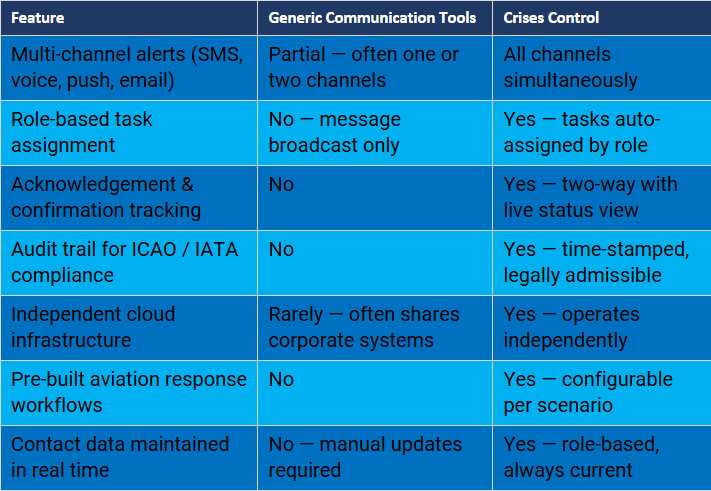
A structured incident response workflow platform brings the same codified, sequenced approach to the full response lifecycle. When an incident is logged, tasks are automatically assigned to the right teams in the right order. Alerts go out across multiple channels simultaneously. Each action is time-stamped and logged. Escalation happens automatically at defined thresholds rather than depending on individual judgment. Leadership sees a live status view rather than waiting for phone updates.
How Crises Control Supports Aviation Emergency Management
Crises Control supports aviation emergency response by bringing structure, speed, and visibility to how incidents are managed across multiple organisations. It ensures that communication is not just fast, but coordinated and actionable under pressure.
It does this through:
- Predefined workflows that activate once an incident is launched, guiding the response from the start
- Ping mass notification across SMS, push, voice, and email to reach all relevant teams instantly
- Role-based task assignment so actions are owned, even if individuals are unavailable
- Two-way communication to track acknowledgement and real-time status updates
- Live dashboards giving leadership visibility into what is happening and what is pending
- Independent cloud infrastructure that remains operational even if internal systems are down
- Automatic audit trails logging every action for compliance and post-incident review
At its core, Crises Control ensures that aviation response is not just about sending alerts, but about coordinating every action that follows in a way that holds under pressure.
Generic tools vs Crises Control
The Takeaway
The collision at Reagan National on 29 January 2025 killed 67 people and triggered one of the most significant investigations in US aviation history. The congressional report, the NTSB findings, and the government’s own admission of fault all pointed to the same underlying failures: communication systems that were offline, coordination processes that had not been maintained, and near-miss data that had not been acted on.
None of those failures were invisible before the crash. The NTSB later confirmed that the FAA had been on notice of at least 85 near-miss events between helicopters and commercial aircraft in the same airspace in the three years prior. The hotline being offline was a known operational gap. These were no surprises. They were failures of the systems that should have prevented the incident, not just of the response that followed it.
Aviation emergency response does not begin with the mayday call. It is built into the operational infrastructure before any flight departs. The alert is only as effective as the coordination system behind it. And coordination systems only hold under pressure when they have been designed, tested, and embedded into real operations before an emergency occurs.
For aviation organisations reviewing their aviation emergency response plan or evaluating how their current systems would perform in a real incident, the starting point is the same question: what happens after the alert goes out? Read more about how Crises Control supports aviation incident management from the first notification through to post-incident review.
Aviation emergencies do not give organisations time to build coordination on the fly. Book a free personalised demo.
See how Crises Control supports aviation emergency management before an incident occurs!

FAQs
1. What is aviation emergency response?
Aviation emergency response is how airlines, airports, and air traffic services manage incidents that affect safety or operations, from the first alert through to recovery.
2. What is an aviation emergency response plan?
It is a structured plan that outlines roles, communication steps, and procedures to follow during an emergency, ensuring everyone knows what to do.
3. What are the main communication challenges during an aviation incident?
The biggest challenges are coordinating multiple teams, handling fast changing information, and following strict rules on what can be communicated and when.
4. How often should emergency response plans be tested?
Full scale exercises should happen at least every two years, with smaller drills and reviews done more frequently.
5. What role does technology play in aviation emergency response?
Technology helps send alerts quickly, assign tasks, track responses, and keep a full record of actions during an incident.