Written by Anneri Fourie | Crises Control Executive
Crisis management software for construction is a digital system that helps construction organisations prepare for, communicate during, and manage serious incidents across sites, offices, and contractor teams. It brings together emergency communication, incident response tasks, and recorded actions so teams can respond in a controlled way when situations escalate.
The problem it addresses is simple and familiar to anyone working in construction. Things go wrong. Power fails. Weather turns. Someone gets hurt. A site becomes unsafe. When this happens, plans are only useful if people can act on them quickly and consistently.
Many organisations still rely on printed documents, shared folders, phone trees, or personal judgement during these moments. These methods can work in calm conditions. Under pressure, they often fall apart. Messages do not reach the right people. Responsibilities become unclear. Actions are taken but not recorded. The result is confusion at the point when clarity is most needed.
The solution is not more paperwork. It is the ability to turn plans into action while the incident is unfolding.
Why crisis management is harder in construction than most sectors
Construction has unique operational pressures that make crisis response more difficult than in many other industries.
A distributed and changing workforce
Construction projects involve multiple sites, temporary teams, and a mix of employees and contractors. People move on and off projects frequently. Contact lists change. Roles vary from site to site. During an incident, assumptions about who is present or who is responsible are often wrong.
Unreliable infrastructure on sites
Sites do not always have stable power or connectivity. Office-based systems may be unavailable when they are needed most. Relying on email or desktop tools during an incident is risky, particularly when teams are spread across locations.
Strong safety and compliance expectations
Construction organisations are expected to show that they took reasonable steps to protect workers. After an incident, what matters is not intention but evidence. Being unable to show who was contacted, what instructions were given, and how quickly actions were taken creates real exposure.
High pressure and limited thinking time
When something goes wrong on a site, people are dealing with physical risk, injured colleagues, and operational disruption at the same time. Expecting anyone to recall detailed procedures from memory or search through documents is unrealistic.
These factors explain why incidents escalate even in organisations with solid safety policies. The issue is rarely a lack of planning. It is the gap between planning and execution.
The limits of traditional approaches
Many construction firms believe they are prepared because they have an emergency binder, a safety manual, or a documented construction site emergency response plan. These are necessary, but they are not sufficient.
Common weaknesses in manual approaches
- Emergency plans are generic and not adapted to specific sites
- Contact information is outdated or incomplete
- Responsibility depends on individual judgement rather than defined roles
- Communication relies on one channel such as phone or email
- There is no reliable record of alerts, responses, or decisions
When an incident occurs, these weaknesses show quickly. Messages are delayed or missed. People assume someone else is dealing with the problem. Decisions are made without a shared view of what is happening. After the event, teams struggle to piece together what actually occurred.
This is not a failure of effort. It is a failure of tools.
Why emergency communication fails first
Communication is usually the first capability to break during construction incidents.
Power outages can disable office systems. Telecom failures can isolate sites. Messaging tools used for day-to-day work may not be approved or reliable for emergency use. Calling individuals one by one does not scale when dozens or hundreds of people need instructions at the same time.
This is why emergency communication solutions for construction sites must assume that something will fail.
Effective systems tend to share a few practical features:
- Multiple delivery channels such as mobile app, SMS, and voice
- Targeting by site, role, or contractor group
- Confirmation that messages were received and acknowledged
- Access that does not depend on a single location or system
When communication breaks down, coordination follows. Safety risks increase. Work stops longer than necessary. Trust in leadership is damaged.
What effective crisis response actually requires
Across construction environments, effective crisis response usually depends on four basic capabilities.
Reach
The ability to contact everyone who needs instructions, including contractors, even if one channel is unavailable.
Role clarity
Clear understanding of who is responsible for what, based on role rather than individual memory.
Response tracking
Visibility of who has received instructions, who has responded, and which actions are complete.
Evidence
A clear record of alerts, acknowledgements, and decisions that can be reviewed later.
Many organisations assume they have these capabilities because they have plans. In reality, they often only have intent.
How crisis management software changes response dynamics
Digital crisis management platforms exist to close the execution gap between plans and action.
Instead of relying on memory or improvisation, response steps are structured and visible. This matters in construction, where teams are distributed and turnover is high.
From static plans to live response actions
Digital platforms break emergency plans into practical steps that can be followed in real time:
- Who needs to be alerted first
- What actions site leads must take
- Which decisions require escalation
- What information must be recorded
This turns a plan from a reference document into an operational guide.
From broadcast messages to targeted alerts
Rather than sending the same message to everyone, teams can issue real-time incident alerts for contractors and site workers during construction emergencies based on location and role. This reduces confusion and avoids unnecessary disruption.
From assumptions to evidence
Time-stamped alerts, acknowledgements, and task completion records create a clear account of what happened. This supports internal reviews, regulatory enquiries, and insurance discussions without relying on memory.
Incident management in real construction scenarios
The value of incident management software for construction industry use becomes clearer when applied to everyday scenarios.
Power outage at head office
Without digital tools, coordination slows or stops. With a cloud-based system, response teams can still communicate, assign tasks, and maintain oversight through mobile access.
Injury on site
Alerts reach site managers, safety officers, and first aiders at the same time. Tasks such as securing the area, contacting emergency services, and documenting actions are assigned and tracked in one place.
Severe weather warning
Only affected sites receive alerts. Site-specific actions are activated. Senior leaders can see what is happening without interfering with local response.
In each case, the benefit is not technology for its own sake. It is speed, clarity, and shared understanding.
Compliance, evidence, and scrutiny after incidents
Construction firms operate under health and safety legislation across regions such as the UK, Europe, the Middle East, and North America. While the rules vary, expectations are consistent.
Organisations are expected to show that:
- Emergency procedures were in place
- Workers and contractors were informed
- Actions were taken in a reasonable timeframe
- Decisions were documented
Manual systems struggle to meet these expectations. Evidence ends up scattered across emails, call logs, and handwritten notes.
Digital crisis platforms centralise this information. Alerts, responses, and decisions are recorded automatically. Reports can be produced without reconstructing events weeks later.
This is not about bureaucracy. It is about credibility when questions are asked.
A common assumption that causes problems
A widely held belief in construction is that experienced site managers can handle incidents without structured digital support. Experience is valuable. It is not enough on its own.
Experience does not solve these issues:
- Missing or outdated contact details
- Multiple incidents across different sites
- Contractor communication gaps
- The need for consistent records
As organisations grow, reliance on individuals increases risk. Systems reduce that dependency.
Human behaviour under pressure
Crisis response is shaped by human behaviour. Stress narrows attention. Memory becomes unreliable. People fall back on habit.
Good crisis management systems are designed with this in mind. They reduce the number of decisions people need to make in the moment. They provide prompts, structure, and visibility.
This is why digital platforms outperform paper-based plans in real incidents. They support people rather than expecting perfect recall.
Digital and manual approaches compared
Manual approaches feel familiar and flexible. Digital systems introduce structure and consistency.
Manual approaches offer:
- Low upfront cost
- Familiar processes
- Flexibility for very small teams
Digital approaches provide:
- Speed across multiple sites
- Consistent response even with staff changes
- Clear records of actions taken
- Reduced reliance on individual judgement
For multi-site construction organisations, scale exposes the limits of manual methods very quickly.
Where Crises Control fits into real construction operations
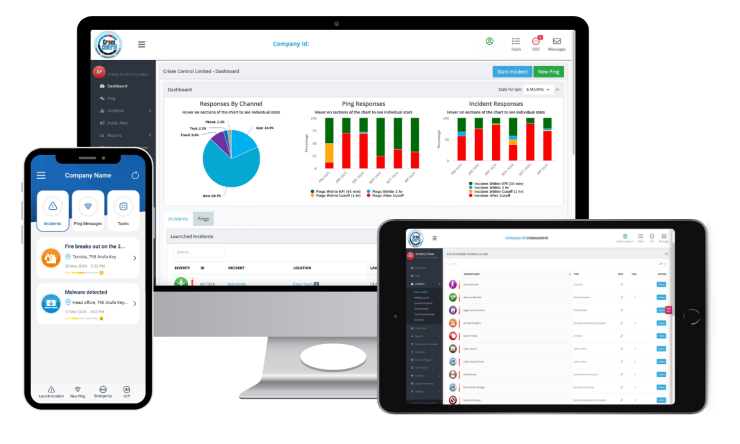
Crises Control supports construction organisations by turning crisis and continuity plans into live, usable workflows. Plans are digitised, roles are defined, and actions are assigned based on actual responsibilities.
Emergency communication is delivered through multiple channels so messages can still reach people when primary systems fail. Cloud-based access allows response teams to operate during power or infrastructure disruptions.
The platform is designed to support experienced teams, not replace them. It provides structure, visibility, and reliability when conditions are difficult.
Making better decisions as a leader
Professionals responsible for crisis management in construction often ask the same questions:
- Can we reach everyone who needs instructions quickly
- Do we know who has acknowledged critical messages
- Can we show what actions were taken during an incident
- Are our plans usable when pressure is high
Crisis management software exists to answer these questions honestly.
Preparing for what really happens on sites
Construction incidents rarely follow neat scenarios. Systems that assume ideal conditions fail first.
Practical preparation accepts uncertainty. It focuses on communication, coordination, and clear responsibility. It removes friction when teams are under pressure.
That is the role of crisis management software in construction environments.
Next steps
Crisis readiness on construction sites is defined by how well teams respond during disruption, not by how well plans read on paper.
If your organisation is reviewing its approach to emergency response, incident coordination, or compliance evidence, it may be time to assess whether current tools reflect how construction actually operates.
Request a FREE Demo