

Written by Paul Malinda | Crises Control Marketing Assistant
Crisis management tools are tested in the first 10 minutes of an incident, not in a demo. During the NHS IT disruptions in 2024, alerts were sent quickly. Staff were informed across multiple sites within minutes.
And then the response slowed down.
Not because people did not act, but because there was no clear structure guiding what happened next. Teams were working, but not always in sync. Leadership had visibility on communication, but not on execution.
This is the gap most organisations do not see until it is too late.
This article breaks down why most crisis management tools fail in the first 10 minutes, where the gaps appear under pressure, and what a structured response actually looks like in practice.
Most crisis management tools focus on getting the message out. The harder problem, and the more consequential one, is everything that happens after the message lands.
What Most Platforms Are Built For
The mass notification market was built around one core problem: how do you reach a large number of people quickly during an emergency?
That problem is real and the solutions for it are technically impressive. Platforms like Everbridge can send alerts across SMS, email, voice, and push notification simultaneously, with geographic targeting, contact list segmentation, and delivery confirmation built in. For large-scale public safety alerts, government agencies, and organisations that primarily need to broadcast information at volume, these capabilities are genuinely strong.
The limitation is not that these platforms do not work. It is that they were built for a specific kind of incident: one where the primary challenge is getting a message to a large group fast. A tornado warning. A building evacuation. A major service outage notification. In those scenarios, a mass notification system is the right tool. The alert goes out, people receive it, and the immediate communication objective is met.
But most real incidents are not that simple. They involve multiple teams, evolving information, competing priorities, and decisions that need to be made and documented in real time. And in those incidents, the alert is the beginning, not the solution.
Where the Gaps Appear in Real Incidents
Three gaps show consistently when notification-first platforms are tested against complex incidents. Understanding them is the most useful starting point for any evaluation.
Gap 1: No coordination layer
Sending an alert tells people something is happening. It does not tell them what to do about it, who is responsible for which part of the response, or how their actions connect to everyone else’s.
In a real incident, the response involves multiple teams acting simultaneously: IT, communications, operations, HR, and senior leadership. Each team needs to know what it is responsible for and what others are doing. Without a coordination layer that assigns tasks, tracks completion, and surfaces of blockers in real time, teams default to informal channels. They call each other. They start separate WhatsApp groups. Information fragments. And the response that looked coordinated in the notification log becomes improvised on the ground.
This is consistently what organisations report when they reflect on incidents managed through notification-only platforms. The alerts reached everyone. The response did not hold together.
Gap 2: No task ownership
An alert without a task assignment is an announcement, not a response. Someone has to own the next action, and that ownership needs to be visible to the whole team.
When task ownership is not built into the platform, it gets managed through side conversations: a phone call to confirm who is doing what, a follow-up email to check on progress, a message to leadership to explain why something is delayed. Each of those conversations takes time and creates a parallel record that is impossible to reconcile later. One user review on Software Reviews noted that keeping contact data synchronised with directory changes was a persistent manual burden, meaning that task assignments based on outdated roles could reach the wrong people entirely.
What organisations need is a platform where tasks are assigned within the incident to record itself, where completion is logged automatically, and where anyone with oversight access can see what is done and what is not without making a single phone call.
Gap 3: No real-time visibility for leadership
Senior leaders during a crisis do not need to know that an alert was sent. They need to know whether the response is on track, where it is stalling, and what decisions they need to make right now.
Most notification platforms offer dashboards that show message delivery statistics. That is useful data. It is not an incident status. Knowing that 847 out of 900 employees received a notification does not tell a Chief Operating Officer whether the IT team is managing the outage, whether the customer communications team has issued a statement, or whether the organisation is on track to restore service within its committed window.
The visibility gap is what turns a manageable incident into a reputational one. Without real-time status information, leadership makes decisions based on estimates. Those estimates are often wrong. The decisions that follow are often the ones that attract scrutiny afterwards. Read more about why post-incident accountability depends on what was visible during the response.
The Assumption Worth Examining Before You Switch
If you are evaluating an Everbridge alternative, it is worth being clear about why you are looking. The answer shapes what you should be looking for.
Organisations looking to switch for cost reasons alone often discover that the cheaper platform has the same notification-first architecture and the same gaps. The price is lower because the scope is narrower, not because the approach is fundamentally different.
Organisations looking to switch because they found the platform difficult to use under real incident conditions are identifying a more structural problem. Complexity that creates barriers in training creates larger barriers in the first minutes of an actual crisis, when cognitive load is highest and there is no time to look things up.
The right question is not which platform sends alerts faster. It is which platform supports the full response lifecycle, from first alert through to post-incident review, in a way your team can operate under pressure.
That distinction matters because the market is full of platforms that compete on notification of speed and delivery rates. Fewer compete on what happens after the notification lands. And that is precisely where most crisis management strategies succeed or fail.
Interested in our Ping Mass Notification Software?
Efficiently alert everyone in seconds at scale with our Mass Notification Software.
Explore Now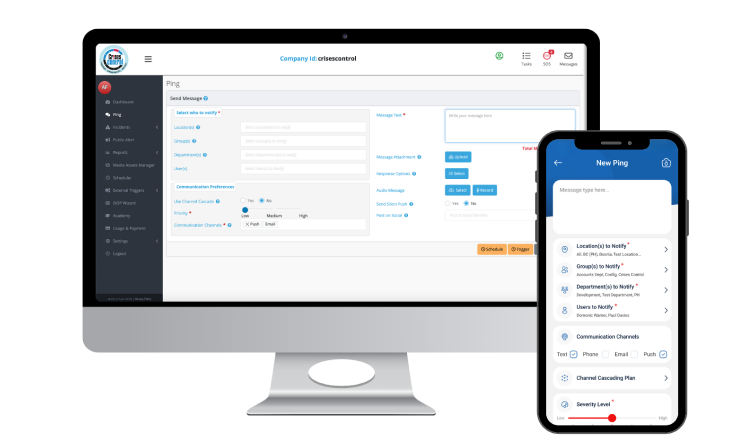
What to Evaluate When Comparing Platforms
Any platform you evaluate seriously should be assessed against these criteria. They are the ones that separate tools that work in a demo from tools that hold up in a real incident.
- Activation speed is under pressure. How long does it take, from the moment an incident is identified, to have an active response underway? This includes logging the incident, triggering workflows, and sending the first alerts. If the answer involves multiple screens, manual configuration steps, or training to navigate, that time extends significantly when pressure is real.
- Task assignment and tracking. Can tasks be assigned to specific individuals or roles directly within the incident record? Can completion be tracked and surfaced to leadership without requiring a separate conversation? If task management lives outside the platform, the coordination gap is still open.
- Two-way communication with confirmation. Sending an alert is not the same as knowing it was received and acted on. Two-way communication that tracks acknowledgement and status responses gives organisations a real picture of their people during an incident, not just a delivery log.
- Leadership visibility in real time. Does the platform give senior leaders a live status view of the incident, covering who has been reached, which tasks are in progress, and where the gaps are? Or does it show system activity rather than response activity?
- Automatic audit trail. Every action, alert, task, and decision should be logged automatically as the incident unfolds, creating a complete record without anyone having to maintain it manually. This is what makes a response defensible after the fact.
- Usability without training. Can someone activate the platform and run a response without having used it recently? This is the test that most platforms fail. Familiarity built in training degrades quickly. The platform needs to be operable by someone who has not touched it in three months, at 2am, under pressure.
- Infrastructure resilience. If the incident involves a cloud outage, network disruption, or regional infrastructure problems, can the platform still reach your people? A platform dependent on the same infrastructure that may be affected by the incident is a significant vulnerability.
- Where Crises Control Is Different
Where Crises Control Is Different
Crises Control was built around the insight that notification is the start of crisis management, not the whole of it. The platform brings mass notification, task management, two-way communication, leadership visibility, and automatic audit trail together in a single environment, so that the response does not have to be assembled from separate tools when an incident is already underway.
When an incident is logged, predefined response workflows activate immediately. The Ping mass notification system reach employees across SMS, push notification, voice, and email simultaneously. Tasks are assigned to the right teams automatically, without anyone needing to coordinate that step manually. Two-way messaging opens so that employees can confirm their status or flag that they need support. Leadership sees a live dashboard showing exactly where the response stands at any moment.
Every action is logged automatically. By the time the incident is over, a complete, time-stamped audit trail exists without anyone having to create it. That record supports post-incident review, regulatory compliance, and the kind of accountability that regulators under frameworks like the UK Senior Managers Regime and the EU’s DORA are increasingly expecting organisations to demonstrate. Read more about how audit trails support defensibility after incidents.
Crises Control is ISO 27001 certified and GDPR compliant, with data center options across the UK, Europe, North America, and the Middle East, including local hosting in Saudi Arabia for regional data sovereignty requirements. It runs its own cloud infrastructure, meaning the platform stays operational even when corporate systems are under strain.
On Capterra, Crises Control holds a rating of 4.8 out of 5, compared to 4.3 for Everbridge. On SoftwareReviews, the scores are 8.5 and 6.6 respectively. Independent reviews on Capterra and G2 consistently highlight ease of use under real conditions, speed of onboarding, and the quality of account management and support as the factors that matter most to users who have switched.
Who Should Be Looking at This
Crises Control is the right fit for organisations that need a serious, end-to-end response capability without the implementation complexity or cost structure of enterprise-tier platforms built for government-scale operations.
It works well for:
- Organisations with staff across multiple sites, countries, or time zones who need targeted, role-specific communication alongside task coordination
- Regulated industries including financial services, healthcare, energy, and logistics, where post-incident accountability and audit trail are as important as response speed
- Organisations that have experienced a real incident and found that their notification platform left them without coordination or visibility when it mattered most
- Leadership teams that need real-time status of an active incident, not a notification delivery report
- Businesses building or reviewing their emergency response plan and want a platform that makes the plan operational rather than documentary
If your primary need is large-scale public alert broadcasting for government emergency services, or deep geopolitical threat intelligence for security operations teams, there are specialist platforms better suited to those specific requirements, and Crises Control is transparent about where those boundaries sit.
For most organisations managing operational incidents, IT failures, safety events, environmental disruptions, or the kind of multi-layer crises that have become more common in the past two years, Crises Control closes the gaps that notification-first platforms leave open.
The Takeaway
If you are looking for an Everbridge alternative, the most important question to ask is not which platform sends faster alerts. It is which platform supports everything that happens after the alert lands.
The coordination layer. The task ownership. The leadership visibility. The audit trail. These are the capabilities that determine whether an organisation manages an incident or is managed by it.
Notification-first platforms solve one part of that problem and leave the rest to be assembled from informal channels under pressure. A full response platform solves the whole thing, from the moment an incident is identified through to the post-incident review that improves the next response.
That is the difference worth evaluating. And it is the difference that shows up most clearly not in a sales demonstration, but in the first 10 minutes of a real incident. See how Crises Control approaches the full response lifecycle and what that looks like in practice for an organisation like yours.
If you are evaluating Everbridge alternatives, the best way to understand the difference is to see it in a scenario that reflects your actual operations. Book a free personalised demo and bring your own incident types.
Request a FREE Demo
Request Demo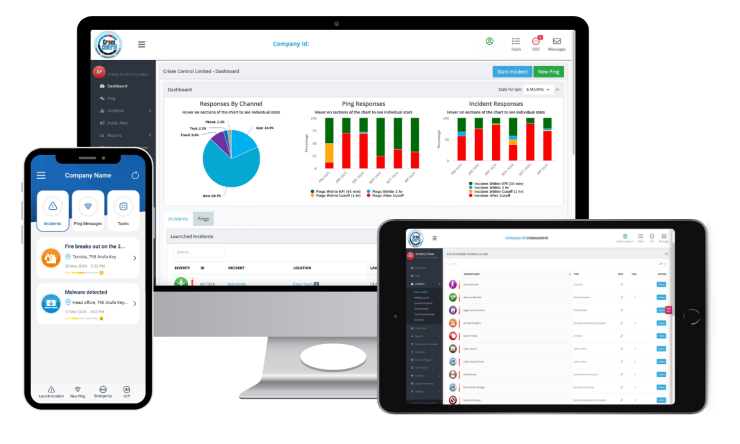
FAQs
1. What are the main limitations of notification-first platforms like Everbridge?
Notification-first platforms excel at sending alerts quickly to large groups. Where they fall short is in what comes next: coordinating the response, assigning and tracking tasks, giving leadership real-time visibility of incident status, and creating an automatic audit trail.
These gaps only become visible during real incidents, not in demonstrations. Read more about what breaks in real incident responses.
2. What should I look for in an Everbridge alternative?
Look for a platform that covers the full response lifecycle: fast multi-channel notification, automated task assignment, two-way communication with acknowledgement tracking, real-time leadership visibility, and automatic audit trail creation.
Evaluate each of these under pressure conditions, not just in a structured demonstration. Ask the vendor to show you what happens 10 minutes into a real incident, not 10 minutes into an onboarding session.
3. How does Crises Control compare to Everbridge ratings?
On Capterra, Crises Control holds a rating of 4.8 out of 5 compared to 4.3 for Everbridge. On SoftwareReviews, the scores are 8.5 and 6.6 respectively.
Independent reviews on Capterra and G2 consistently highlight ease of use under real conditions, quality of support, and the completeness of the response workflow as the features users value most after switching.
4. Is Crises Control suitable for regulated industries?
Yes. Crises Control is ISO 27001 certified and GDPR compliant. It supports the audit trail and accountability requirements expected under frameworks including the UK Senior Managers Regime and the EU Digital Operational Resilience Act DORA.
It also offers data centre options in the UK, Europe, North America, and the Middle East, including local hosting in Saudi Arabia for regional data sovereignty.
More on business continuity and compliance requirements here.
5. How long does Crises Control take to implement?
Implementation is significantly faster than enterprise-tier platforms. Most organisations are operational within days rather than months, and the platform is designed to be usable without specialist administration.
Dedicated account management and 24 7 technical support are included, meaning teams are not on their own if questions arise during or after setup.