Written by Anneri Fourie | Crises Control Executive
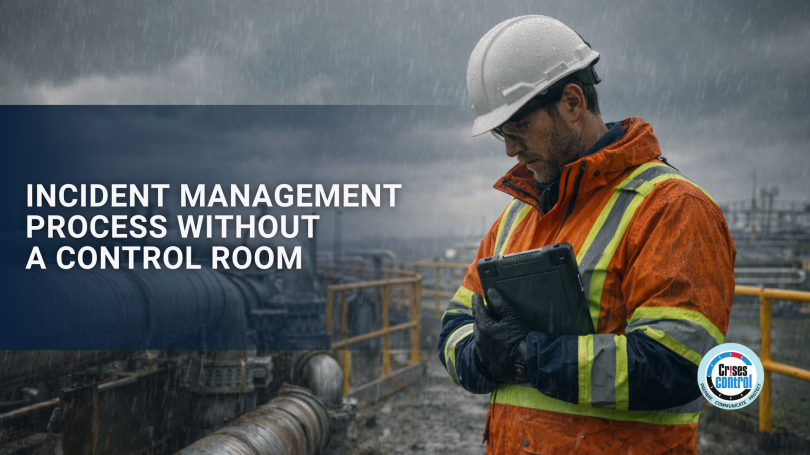
In oil and gas, incident command is often imagined as a room.
Screens on the wall. Maps. Status boards. Senior leaders gathered around a table. A physical space where decisions are made and direction is clear.
The problem is simple.
That room often does not exist when you need it most.
A gas leak occurs offshore. A refinery loses power during a storm. A cyber incident restricts access to headquarters while half the leadership team is travelling. A pipeline issue spans multiple sites across regions.
Your incident management process must work even when no one can gather in one place.
If emergency coordination depends on physical presence, response slows the moment reality interferes. Modern incident command in oil and gas is distributed by default. The solution is not a bigger control room. The solution is a structured process that functions without one.
This article explains why the central control room assumption fails, how distributed incident command actually works, and what a resilient incident management process looks like in practice.
A Clear Definition Of An Incident Management Process
An incident management process is the structured framework an organisation uses to detect, escalate, coordinate, and resolve incidents while maintaining accountability and traceable communication.
It defines:
- Who can declare an incident
- Who owns the response
- How roles are assigned
- How decisions are recorded
- How communication flows
- How evidence is captured
It is not a physical space.
It is not a meeting.
It is not a whiteboard.
It is a system of ownership, escalation, visibility, and documentation.
When that system depends on co-location, it becomes fragile.
The Myth Of The Central Control Room
Many oil and gas organisations still design their incident command around the idea that people will assemble when something serious happens.
That assumption breaks down quickly.
Consider common operational realities:
- Offshore teams operating independently
- Multi-site operations across countries
- Hybrid leadership teams working remotely
- Severe weather disrupting travel
- Cyber incidents restricting building access
Waiting to assemble leadership wastes time. In distributed operations, delay is often not caused by lack of skill or effort. It is caused by structural dependency on physical coordination.
Benefit
A distributed incident management process allows response to begin immediately, regardless of location.
Example
A refinery experiences an unplanned shutdown. Operations are onsite. IT is remote. Compliance is travelling. Rather than waiting to convene physically, the incident is declared digitally. Ownership is assigned. Tasks activate automatically based on role. Leadership joins from wherever they are.
Evidence
Post-incident reviews in industrial environments frequently show that delays occur between detection and structured response, not between response and resolution. Distributed activation shortens that gap.
A Real Failure Scenario
A site in a coastal region receives warnings of severe weather. Forecasts suggest rainfall will exceed normal limits. No one declares an incident. The plan assumes leadership will gather if escalation becomes necessary.
Overnight, roads flood. Access routes become restricted. A shift change overlaps with deteriorating conditions. The operations lead cannot reach the site. The safety manager is on leave. Communication begins through personal phones and informal messages.
By morning, the situation requires full coordination. There is no single record of decisions made overnight. Ownership is unclear. Escalation feels reactive.
The issue was not detection.
The issue was reliance on a room that no one could access.
Why Distributed Incident Command Feels Uncomfortable
Leaders often equate visibility with physical presence. A room provides psychological reassurance. When everyone is seated together, authority appears tangible.
Distributed incident command removes that visual anchor.
Common concerns include:
- Loss of oversight
- Fragmented communication
- Confusion over authority
- Reduced decision quality
These concerns are valid when coordination is informal.
The problem is not distribution. The problem is lack of structure.
When a clear incident management process exists, control does not depend on walls.
Ownership Is More Important Than Location
In a physical control room, hierarchy is visible. Authority is implied.
In distributed incident coordination, authority must be explicit.
A resilient incident management process ensures:
- A named incident owner
- Clearly defined functional leads
- Structured escalation triggers
- Documented decision points
- Transparent task assignment
Without explicit ownership, distributed command becomes parallel conversation rather than coordinated action.
Benefit
Clear ownership reduces hesitation and duplication.
Example
During a pipeline disruption affecting multiple regions, engineering, operations, and communications teams may begin acting independently. A structured process designates one incident owner responsible for cross-functional alignment and escalation.
Evidence
Many escalation failures stem from diffused responsibility rather than technical limitations. Explicit ownership consistently improves response coherence.
Remote Incident Response Under Operational Pressure
Oil and gas incidents rarely occur under ideal conditions.
They overlap with:
- Shift changes
- Reduced staffing
- Severe weather
- Cyber system limitations
- Regulatory reporting deadlines
Manual coordination struggles in these circumstances.
Phone calls create information silos.
Email chains bury decisions.
Messaging platforms lack structured escalation.
Whiteboards are inaccessible remotely.
Digital coordination changes the dynamic.
Incident management software for oil and gas provides:
- A shared live incident record
- Role-based task allocation
- Time-stamped decisions
- Multi-channel communication
- Cloud-based access
Benefit
Continuity of command even during evacuation or restricted access.
Example
A facility evacuation prevents access to the operations centre. The incident record remains accessible via secure mobile devices. Tasks continue to update. Leadership maintains visibility without physical presence.
Evidence
Business continuity frameworks emphasise resilience of governance structures. Digital accessibility strengthens operational and regulatory defensibility.
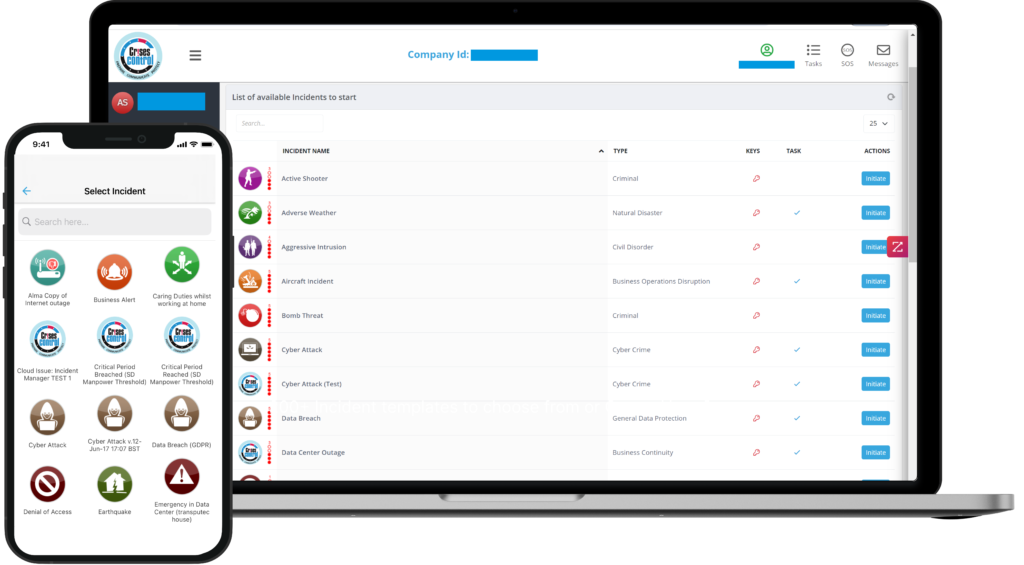
Interested in our Incident Management Software?
Flexible Incident Management Software to keep you connected and in control.
Challenging A Comfortable Assumption
There is a persistent belief that face-to-face coordination improves decision quality.
Physical discussion can accelerate alignment. It is not a prerequisite for effective incident command.
Decision quality improves when there is:
- Structured information
- Clear ownership
- Defined escalation logic
- Transparent documentation
These are attributes of a disciplined incident management process, not of a room.
An organisation that cannot coordinate without physical co-location is not resilient. It is dependent.
Incident Coordination Without A Control Room In Multi-Site Operations
Large operators manage assets across regions and jurisdictions. Distributed command is not optional. It is daily reality.
Effective emergency coordination in this environment requires layered visibility.
Local site teams respond immediately.
Regional leadership monitors escalation.
Corporate compliance ensures regulatory obligations are met.
Communications prepares stakeholder messaging.
Without structured coordination, these layers fragment.
A well-designed process supports:
- Real-time local action logging
- Automatic regional escalation
- Corporate oversight without interference
- Clear documentation for regulatory review
This is what defines the best incident management platform in practice. Not screens. Not dashboards. Structure.
Manual Versus Digital Incident Command
Manual incident coordination relies heavily on memory and discipline.
Digital coordination embeds discipline into workflow.
Manual coordination often results in:
- Informal role allocation
- Delayed escalation
- Incomplete records
- Weak audit traceability
Digital coordination enables:
- Role-based incident activation
- Structured task tracking
- Live shared visibility
- Automatic event logging
The benefit is reduced ambiguity. The process guides behaviour rather than relying solely on individual judgement.
How Crises Control Supports Distributed Incident Command
Crises Control supports a structured incident management process by turning documented crisis and continuity plans into executable digital workflows.
This includes:
- Role-based incident activation
- Defined task allocation
- Reliable multi-channel emergency communication
- Cloud-based accessibility
- Automatic event logs and reporting
The platform does not replace leadership. It reinforces ownership and visibility when teams are geographically dispersed.
By embedding escalation logic into the workflow, it allows distributed incident command without loss of control.
Questions Leaders Should Ask Themselves
If you are responsible for operational resilience, consider:
- Does your incident management process rely on physical co-location?
- Can ownership be assigned instantly if leadership is remote?
- Can coordination continue during evacuation or system restriction?
- Is emergency coordination traceable in real time?
- Would a regulator understand your decision path without reconstruction?
If any answer depends on informal communication, your process remains exposed.
The Modern Reality Of Incident Command
Oil and gas operations are increasingly distributed. Leadership is hybrid. Regulatory expectations continue to rise. Incidents span physical and digital domains simultaneously.
Incident command without a control room is not a contingency scenario. It is normal operating reality.
The strength of your response depends on the clarity of your incident management process, not on the size of your meeting space.
A resilient approach ensures:
- Ownership is immediate
- Escalation is structured
- Coordination is visible
- Evidence is automatic
If your current model assumes everyone will gather in one room before action begins, it may already be outdated.
If you are reviewing your distributed incident coordination capability, examine whether your structure holds without walls.
Request a FREE Demo