
Written by Dr Shalen Sehgal| Crises Control CEO
Incident management software for manufacturing is a platform that automates the first steps of emergency response: reaching the right people, assigning tasks by role, and logging every action as it happens. It is the difference between a coordinated response and nine minutes of nobody moving.
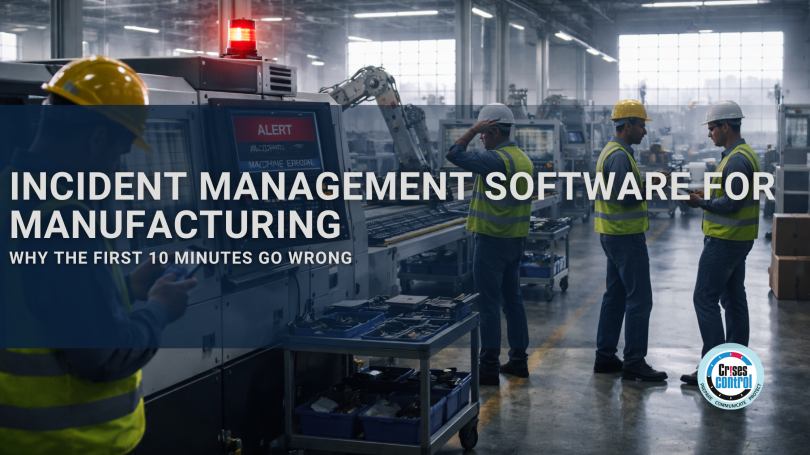
The machine stopped at 6:47 AM. The sensor logged it. The SCADA alert fired. Nobody moved for nine minutes.
Three people assumed someone else had it. The shift lead who should have owned the response had handed over eleven minutes earlier. The emergency plan on the wall named a supervisor who transferred to another site in February. The WhatsApp group the team actually used did not include the maintenance manager.
By the time anyone with authority to act had been reached and issued the first instruction, the incident had spread to two adjacent lines. A planned production run was eight units behind.
That is a Tuesday. And the cost of that Tuesday is measurable.
Why Manufacturing Incident Response Fails in the First 10 Minutes
Most manufacturing facilities have response plans. What they often lack is the infrastructure to execute those plans under real pressure, with the right people unavailable, shift patterns in flux, and communication fragmented across five different channels.
The breakdown follows a consistent pattern. Understanding it is the starting point for fixing it. Here is what goes wrong and why, based on the recurring failure modes observed across manufacturing incident responses.
Contact data that has not been updated
Emergency plans list names. Names leave, transfer, or go on leave. When the named contact is unavailable and nobody has updated the plan, the first three minutes of the response are spent discovering that fact.
Shift handover gaps
Siemens’ True Cost of Downtime 2024 report found that major manufacturers average 25 unplanned downtime incidents per month. The HSE has tied handover failures directly to major industrial incidents, noting that when permit status and equipment conditions are not clearly transferred, the incoming shift acts on outdated assumptions. The ten minutes after a shift ends are statistically the riskiest of the working day.
No clear task ownership
When an alert reaches six devices simultaneously, the most common outcome is the assumption that someone else is handling it. Without automatic role-based task assignment, the response depends on someone volunteering to own the problem. Under pressure, that takes time the incident is already consuming.
Fragmented communication channels
Incident information typically travels across email, WhatsApp, radio, phone calls, and verbal updates at the same time, through different combinations of people. No one has a complete picture. Leadership is piecing together a situation from three partial conversations, each a few minutes behind.
Paper plans under real conditions
A 2023 ARC Advisory Group study found that human error from manual processes contributes to 30 percent of manufacturing downtime. Plans in binders or laminated folders require someone to physically locate and read them while also managing a live incident. Under pressure, that rarely works as intended.
These failure points exist in facilities with experienced teams and documented procedures. They are structural, not personal. Better-written plans do not fix them. A platform that assigns ownership automatically and activates workflows on declaration does.
What That Delay Actually Costs
Siemens’ True Cost of Downtime 2024 report puts unscheduled downtime costs at $1.4 trillion annually across the world’s 500 largest manufacturers, up from $864 billion in 2019. In the automotive sector, a single hour of unplanned downtime now costs $2.3 million. The increase is not driven by more incidents. It is driven by the fact that each incident takes longer to contain once it starts.
That delay has a direct cause. The nine minutes before a coordinated response begins are not a fixed cost — they are determined by the infrastructure in place. Facilities with structured, automated response systems contain incidents faster. Those without them spend those first minutes establishing what should already be established: who is responding, what they need to do, and who is accountable.
Manufacturing recorded 220,000 workplace injuries in 2024 (OSHA/BLS data), with an injury rate of 2.8 per 100 full-time equivalent workers. The interval between detection and coordinated response is a factor in how many of those injuries escalate beyond the initial event.
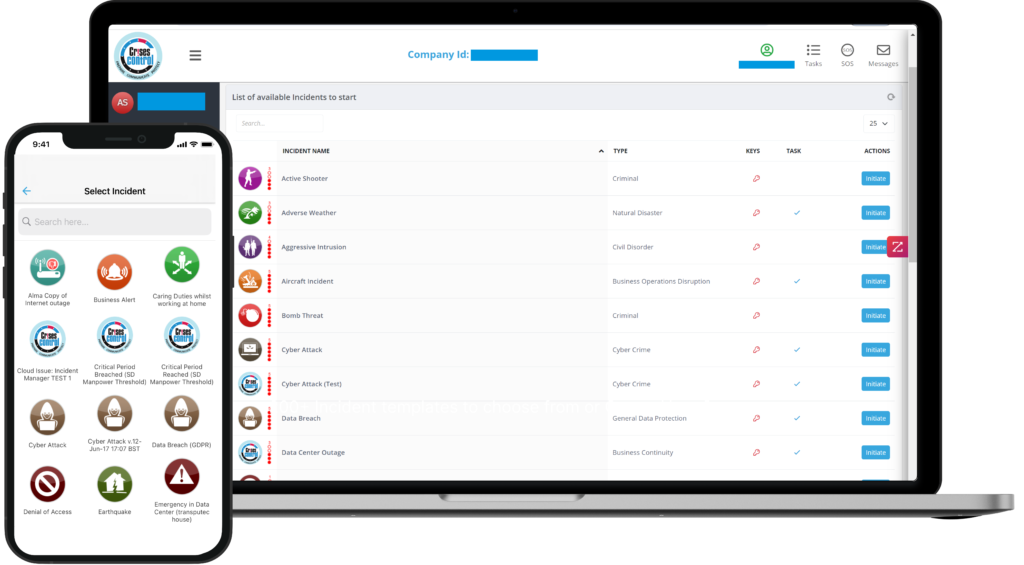
Interested in our Incident Management Software?
Flexible Incident Management Software to keep you connected and in control.
What Good Response Infrastructure Looks Like
Incident management software for manufacturing that closes the gap does five specific things from the moment an incident is declared.
Tasks go to roles, not names
The software carries current roster data. When the named contact is unavailable, the task goes to whoever holds that role on the active shift. No manual checking. No phone calls to establish availability. The first action begins immediately.
Alerts reach people simultaneously, not sequentially
SMS, voice call, push notification, email, and in-app message at the same time. The mass notification system sends across all channels simultaneously. On a noisy manufacturing floor or in a zone with limited connectivity, the channel that works is the one that drives the response.
Workflows activate on declaration
Incident response automation means that when the incident is declared, each step in the response sequence activates automatically. The right people get the right tasks in the right order. Nobody has to locate a plan and work through it manually while managing a live situation.
Decision-makers have a live view
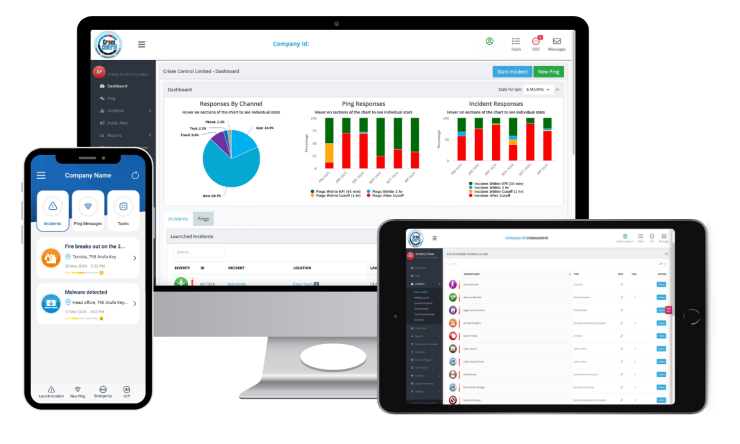
The site manager and safety lead can see which tasks are complete, which are in progress, and which have not been acknowledged, on a single dashboard, on any device. Not through a chain of phone calls arriving fifteen minutes after each development.
The audit trail builds itself
Every alert sent, every task assigned, every acknowledgement and escalation is logged automatically with a timestamp. Response workflows produce the OSHA and RIDDOR compliance record as a byproduct of the response, without additional administrative effort.
The pattern across all five points is the same: the platform removes the decisions that slow people down when pressure is high. Who owns this? Has anyone acknowledged? What happened and when? Those answers should exist automatically, not depend on someone remembering to create them.
The Shift Handover Problem
Shift handover is the single highest-risk point in most manufacturing operations. The incoming shift inherits whatever context the outgoing shift managed to pass on in a five-minute briefing: equipment in an unknown state, incomplete maintenance tasks, safety conditions that were flagged verbally but not logged.
The right platform makes any active incident, open task, or unresolved safety condition automatically visible to the incoming shift the moment they log on. They do not need to be told. The system shows them. When an incident occurs in the first minutes of a new shift, the response starts with full context, not a reconstruction effort.
Poor shift handovers cost operations between $18,000 and $45,000 per incident when critical equipment issues or safety conditions go undocumented between crews. Operations that implement digital shift handover systems reduce miscommunication incidents by 76 percent and equipment downtime by 40 percent. (Heavy Vehicle Inspection, 2025)
Compliance Requirements That Cannot Be Met by a WhatsApp Thread
Manufacturing operations face specific documentation obligations after incidents.
In the UK, RIDDOR (Reporting of Injuries, Diseases and Dangerous Occurrences Regulations 2013) requires specific incidents to be reported to the HSE within defined timeframes. The Health and Safety at Work Act 1974 and the Management of Health and Safety at Work Regulations 1999 require documented emergency procedures and evidence they were followed. ISO 45001 requires recorded evidence of how incidents were identified, investigated, and responded to.
In the United States, OSHA’s recordkeeping requirements under 29 CFR 1904 mandate accurate records of work-related injuries and illnesses, including the timeline of the response.
A verbal response, a WhatsApp thread, or a handwritten note made from memory two hours after the incident does not satisfy these requirements. Incident management software that automatically logs the full response timeline produces that record without anyone having to build it.
How Crises Control Supports Manufacturing Operations
Crises Control is an incident management platform built for multi-site manufacturing environments where shift patterns rotate and named individuals are regularly unavailable. It reaches teams via SMS, voice, push, email, and Microsoft Teams simultaneously. Tasks are role-based. Workflows activate on declaration. Every action is logged automatically.
The platform runs on its own cloud infrastructure, separate from corporate IT and production systems. If internal networks go down, the response platform stays up.
To see how it works against the specific failure modes in your operation, request a personalised demo.
FAQs
1. What is incident management software for manufacturing?
Incident management software for manufacturing is a platform that automates the initial steps of emergency response in production environments. When an incident is declared, it sends multi-channel alerts to the right people, assigns tasks by role rather than by name, activates predefined response workflows, and logs every action with a timestamp. It is designed for manufacturing-specific constraints: rotating shifts, multi-site operations, noisy or remote environments, and regulatory documentation requirements under OSHA, RIDDOR, and ISO 45001.
2.Why does manufacturing incident response fail in the first 10 minutes?
The most common causes are: contact data that has not been updated when staff change, shift handover gaps where incoming teams lack context on active incidents, no automatic task ownership so everyone assumes someone else is responding, communication fragmented across email, WhatsApp, radio, and verbal updates, and paper plans that are too slow to access under real pressure. These are infrastructure problems. A more detailed plan does not fix them.
3. How does incident management software help with RIDDOR and OSHA compliance?
Both RIDDOR and OSHA’s recordkeeping requirements under 29 CFR 1904 require a contemporaneous record of what happened, who was notified, what actions were taken, and in what sequence. Incident management software logs every alert, task assignment, acknowledgement, and escalation automatically with timestamps. The audit trail is complete by the time the incident closes, without any additional effort from the response team.
4. What does slow incident response cost in manufacturing?
Siemens’ True Cost of Downtime 2024 report found that unscheduled downtime costs the world’s 500 largest manufacturers $1.4 trillion annually. In the automotive sector, one hour costs $2.3 million. The average large plant loses 27 hours per month to unplanned downtime. A 2023 ARC Advisory Group study found that manual process errors account for 30 percent of that downtime.
5.How does role-based task assignment work?
Rather than assigning tasks to named individuals, the platform assigns them to whoever currently holds a given role on the active shift. When the primary contact is unavailable, the task routes automatically to the backup role holder. There is no manual checking, no phone call to establish who is on, and no delay. The first step in the response begins the moment the incident is declared.