Written by Anneri Fourie | Crises Control Executive
Running a large-scale event involves juggling multiple teams, managing complex systems, and keeping thousands of attendees safe. When something goes wrong, whether a ticketing system fails, a cybersecurity incident occurs, or an unexpected hazard arises on-site, confusion spreads quickly. Staff can be unsure of what to do, attendees may panic, and response efforts can be delayed.
A Mass Notification System provides a practical solution. It allows organisations to send clear, real-time alerts to the right people at the right time, track acknowledgements, and ensure actions are taken quickly. By connecting with incident management systems and linking to crisis or emergency plans, these platforms help teams respond with speed and clarity, reducing risk and keeping operations on track.
Why Mass Notification Matters for Entertainment Venues
Entertainment venues face pressures that most workplaces do not. They need to manage events that attract large crowds, often across multiple sites, while dealing with high public visibility and regulatory obligations.
Some of the key challenges include:
Multi-site coordination
Many events involve multiple locations, satellite stages, or temporary venues. Communicating alerts consistently across these sites is difficult if teams rely on phone calls, emails, or manual messages.
High public exposure
Attendees expect smooth experiences. Even minor technical glitches, like a ticketing platform going down, can create frustration, confusion, and reputational risk.
Regulatory compliance
Venues must meet data protection, health and safety, and event-specific regulations. Delayed or undocumented communication can lead to fines or legal issues.
Rapid incident escalation
Delays in notifying the right teams can increase risks to staff and attendees. When information is slow or inconsistent, the chance of accidents or mismanaged responses rises.
Traditional methods of communication often fail in these conditions. Email chains, phone calls, and walkie-talkies can be slow, prone to errors, or limited in reach. A digital Mass Notification System ensures everyone receives accurate instructions immediately, supports coordination across multiple sites, and creates records for accountability.
Core Features of an Effective Mass Notification System
An effective Mass Notification System addresses three main needs: speed, accuracy, and confirmation that alerts are received and acted upon.
Real-Time Alerts for Staff and Attendees
- Messages are sent instantly via SMS, email, app push notifications, or on-site display screens.
- Alerts can be tailored to roles, ensuring security staff, operations teams, and attendees receive relevant instructions.
- Integration with Incident Management Software allows automated alerts when specific incidents are detected, reducing delays caused by manual messaging.
Multi-Site and Cross-Channel Communication
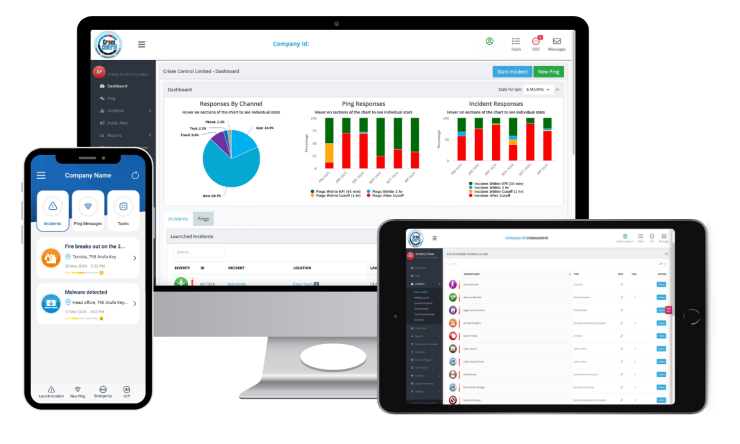
- Central dashboards provide a complete view of all active alerts across venues.
- Notifications can be sent in multiple languages for international audiences.
- Consolidated reporting helps with compliance, demonstrating timely and auditable communication under GDPR, NIS2, or local safety regulations.
Automated Acknowledgment and Incident Tracking
- The system tracks who has received and acknowledged alerts in real-time.
- Escalation workflows automatically notify alternate staff if initial recipients do not respond.
- Audit logs simplify post-incident reviews and regulatory reporting.
Integration with Crisis and Business Continuity Plans
- Alerts can be linked to an organisation’s Crisis Management Plan or Emergency Response Plan.
- Digital workflows give staff clear instructions, reducing confusion about roles and next steps.
- Cloud-based platforms maintain operation during network failures or partial system outages.
Interested in our Ping Mass Notification Software?
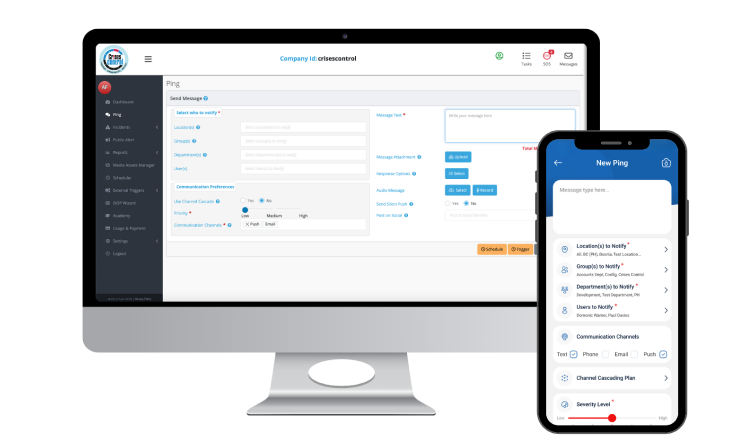
Efficiently alert everyone in seconds at scale with our Mass Notification Software.
Common Challenges and Mistakes
Even with technology available, organisations often struggle to implement mass notification systems effectively. Common pitfalls include:
Relying on manual processes
- Email chains and call trees take time and depend on human accuracy.
- Staff may miss critical alerts, or messages may be inconsistent.
Fragmented systems
- Separate platforms for messaging, incident tracking, and compliance reporting create delays and make coordination difficult.
- Integration gaps reduce visibility and accountability.
Assuming visibility equals action
- Sending a message does not guarantee it is read or acted upon.
- Without automated acknowledgment, managers cannot confirm staff have received instructions, increasing the chance of errors.
Ignoring regulatory requirements
- Laws around data protection and workplace safety require secure communication and audit trails.
- Failing to comply can result in fines, legal complications, or reputational damage.
Best Practices for Live Events
Implementing a Mass Notification System requires planning and attention to operational realities.
Define Clear Alert Scenarios
- Identify likely incidents such as system outages, cybersecurity events, medical emergencies, or evacuations.
- Decide who receives each type of alert, their priority, and the most effective channels.
Test Alerts Regularly
- Run simulations and tabletop exercises.
- Use Ping messages to validate acknowledgement workflows without affecting live operations.
Use Role-Based Messaging
- Staff receive information relevant to their duties.
- Attendees get concise, actionable guidance without technical jargon.
Automate Escalation and Tracking
- Alerts automatically escalate if they are not acknowledged.
- Incident logs provide a single source of truth for audits and post-event reviews.
Integrate with Incident Management Software
- Combining mass notifications with incident management platforms ensures coordinated response across teams.
- Reporting tools help analyse incidents and identify opportunities for improvement.
Plan for Multi-Site Operations
- Use central dashboards to deliver alerts across multiple locations.
- Standardised procedures ensure consistency and reduce errors in large-scale events.
Challenging Common Assumptions
A frequent misconception is that sending a message is enough. Real-world experience shows this is not true:
- Alerts must be acknowledged and acted upon to reduce risk.
- Sending too many notifications can overwhelm staff, causing alert fatigue.
- Manual systems are often unreliable under pressure; automated workflows and cloud redundancy reduce the chance of missed alerts.
Practical Benefits of a Digital Mass Notification System
Using a structured system provides tangible benefits:
| Benefit | Practical Impact | Example in Entertainment Context |
| Faster response times | Staff act immediately on verified information | Security team responds to a system outage within minutes |
| Regulatory compliance | Audit trails and reporting simplify obligations | Demonstrates GDPR and safety compliance for international events |
| Reduced human error | Automated workflows minimise mistakes | Multiple teams receive consistent instructions simultaneously |
| Improved stakeholder confidence | Staff and attendees feel informed | Public screens display updates on delays or minor incidents |
Integrating Mass Notification with Crisis Management
Mass notifications are most effective when linked to broader crisis and business continuity frameworks:
- Align alerts with the Crisis Management Plan to ensure responses follow tested procedures.
- Integrate with an Employee Mass Notification System to keep staff informed across teams.
- Cloud-based platforms maintain communication even if local networks fail.
- Centralised reporting supports post-incident reviews, lessons learned, and continuous improvement.
A platform that combines real-time alerting with incident management reduces confusion during emergencies, improves decision-making, and supports regulatory compliance without adding unnecessary complexity.
Closing Thoughts
For entertainment venues, speed, accuracy, and clarity are essential. A Mass Notification System ensures staff and attendees receive critical information quickly and that actions are tracked and accountable. By integrating with incident management tools and linking to crisis and continuity plans, venues can respond more effectively, reduce human error, and maintain compliance.
Digital alerting does not replace careful planning or trained staff, but it gives teams the tools to act swiftly and confidently when incidents occur.
Request a FREE Demo