Written by Anneri Fourie | Crises Control Executive
The communication problem construction teams rarely talk about
Construction sites are unpredictable, which is why business continuity software for construction is becoming a practical necessity rather than a nice-to-have. Access routes close, equipment fails, weather shifts, and people move between locations constantly. When something goes wrong, the challenge is not only dealing with the issue itself, but making sure the right people know what is happening and what they need to do.
Many construction firms believe they are prepared because they can send a message. A text goes out, an email follows, and someone ticks a box to confirm it was sent.
The problem is that no one really knows if the message was received, understood, or acted on. This uncertainty is one of the biggest risks in large construction projects. It can compromise safety, slow down response, and create serious issues later when teams are asked to prove what happened during audits or investigations.
Business continuity software for construction closes this gap. It helps teams confirm delivery, track responses, and understand who has acted and who still needs support. This turns communication into something reliable, visible, and accountable across every site.
Why construction sites are harder to communicate with than offices
Unlike office environments, construction teams are rarely sitting in front of screens with notifications switched on. Messages can be missed because people are:
- Working in noisy environments
- Wearing protective equipment
- Moving between zones and sites
- Using personal phones with poor signal
- Relying on supervisors for updates
This makes mass notification software for construction sites different from generic messaging tools. One channel alone rarely works.
Sending an email to a project team does not help a subcontractor on a scaffold. A push notification may never be seen by someone underground. A noticeboard update is useless if people are already out on site.
Construction teams need messages to reach them wherever they are, using whatever channel works at that moment.
Interested in our Ping Mass Notification Software?
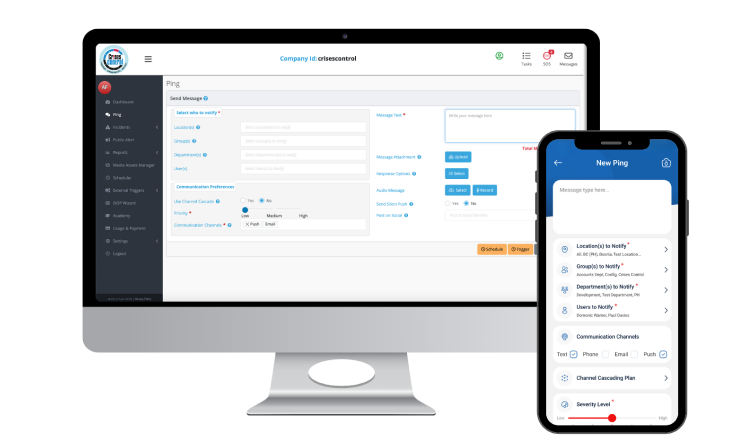
Efficiently alert everyone in seconds at scale with our Mass Notification Software.
The risk of assuming messages are received
One of the most common failures during incidents is assumption. Leaders often assume:
- The alert was seen
- The site manager passed it on
- Everyone understood the instruction
- Someone would speak up if they did not
In practice, none of this is guaranteed.
This becomes especially risky during emergency response planning for large construction projects. Evacuations, severe weather, structural issues, or security incidents all require fast, confirmed communication.
If even a small group does not receive the message, the consequences can be serious. Missed messages can slow response, increase hazards, and leave gaps in compliance records.
Why acknowledgement tracking changes everything
Acknowledgement tracking replaces guesswork with clarity. Teams can see exactly who has acknowledged a message and who has not.
For construction projects, this matters because:
- Teams are spread across multiple sites
- Responsibilities are shared between companies
- Accountability is often questioned after incidents
Acknowledgements provide a clear record of who was informed and when. This is a key way business continuity software supports construction compliance and audits.
It also helps during the incident itself. Managers can focus on those who have not responded rather than sending repeated messages to everyone.
What acknowledgement really means on a construction site
Acknowledgement is not just “message received”. On construction projects, it often confirms something specific, such as:
- I am safe
- I am on site
- I have completed the task
- I need assistance
- I have passed the message on to my team
Clear acknowledgements turn alerts into two-way communication. This is central to effective incident management software for construction projects.
When acknowledgements are vague, people hesitate. When they are clear, response becomes faster and more consistent.
Channel cascading and reaching distributed workforces
Channel cascading is one of the most effective ways to reach workers across multiple construction sites.
It works by sending the same message across different channels in a set order until the person responds, such as:
- Push notification
- SMS
- Voice call
People on construction sites communicate differently. A supervisor may respond to a mobile app, a contractor may only see SMS, and a night shift worker may need a phone call.
Mass notification and incident response for distributed construction workforces only works when communication adapts to real conditions, not ideal ones.
Why repeating messages is not the answer
Resending missed messages seems logical but often causes more problems.
People who already responded receive duplicates and stop paying attention. Those who missed the first message often miss the second one too.
Channel cascading solves this by changing the method, not the message. Alerts escalate automatically, without adding extra pressure to the response team.
Reducing alert fatigue on busy sites
Construction teams are bombarded with updates. Safety notices, toolbox talks, daily briefings, and operational instructions all compete for attention.
If emergency communication is treated the same way as routine messaging, alerts are ignored.
Well-designed emergency communication solutions for multi-site organisations reduce noise by:
- Stopping messages once acknowledged
- Targeting alerts by role and location
- Following up only with non-responders
- Keeping instructions clear and specific
Over time, workers learn that alerts matter and that responding is expected.
Supporting compliance and audits
After an incident, organisations are asked:
- Who was informed?
- When were they informed?
- What instructions were given?
- Who confirmed the receipt?
Without clear records, answers are often incomplete or rely on memory. This can be risky in regulated environments.
Business continuity software for construction automatically records alerts, acknowledgements, and responses. This supports internal reviews, client reporting, and regulatory audits.
For organisations managing multiple sites, consistency is essential.
Coordinating response across multiple construction sites
Construction projects often span regions or countries. Teams need to act locally but remain coordinated centrally.
Emergency communication solutions for multi-site organisations allow:
- Head office to see response status across sites
- Site managers to focus on action rather than reporting
- Communications to remain consistent across locations
This supports both routine disruptions and serious incidents without adding unnecessary complexity.
Interested in our Incident Management Software?
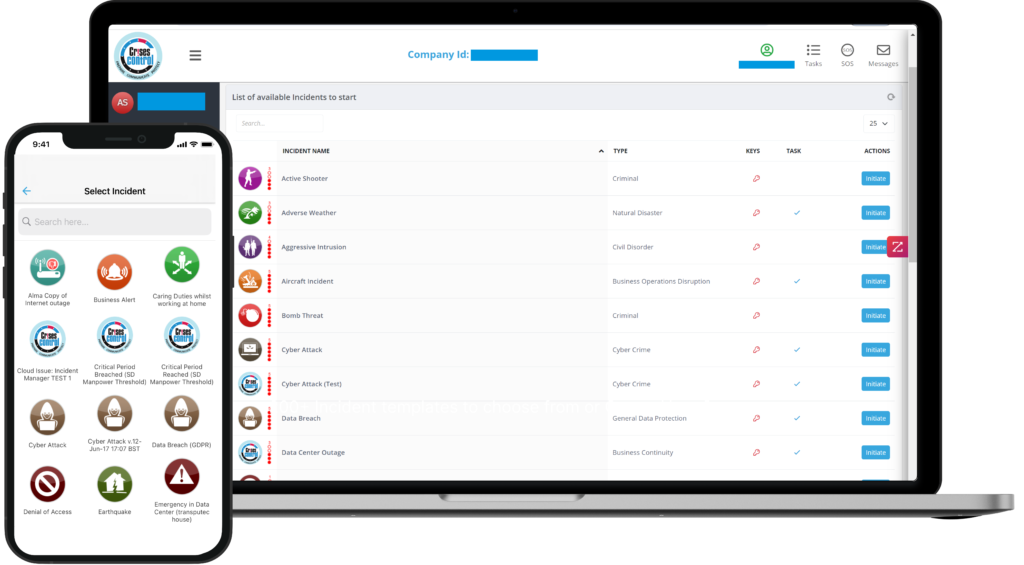
Flexible Incident Management Software to keep you connected and in control.
Why construction teams need more than alerts
Alerts alone do not create control. Effective incident management software for construction projects guides teams through the full response, from notification to task completion and review.
This includes:
- Assigning actions to the right roles
- Tracking progress in real time
- Sharing updates across teams
- Reviewing response after the event
Disconnection between these steps leads to lost information and repeated mistakes. Integrated systems keep everyone working from the same picture.
Where Crises Control fits into construction response
Crises Control helps construction organisations focus on action, not just alerts. Its platform brings together:
- Mass notification software for construction sites
- Acknowledgement tracking across roles and locations
- Channel cascading to reach people wherever they are
- Clear records to support compliance and audits
These capabilities are applied across safety incidents, operational disruptions, and planned events requiring coordination. The goal is to support teams under pressure, not overwhelm them with technology.
Making emergency communication work in practice
Projects succeed or fail based on coordination. When communication breaks down, risks rise quickly.
Business continuity software for construction closes the gap between sending a message and knowing what actually happened. It gives teams confidence that:
- Messages are received
- Responses are tracked
- Actions are clear
Most importantly, it supports the people on site who need information to stay safe and keep work moving.
For construction organisations managing complex projects and distributed teams, that clarity is essential.
Get a free personalised demo
For construction organisations looking to improve communication, manage incidents, and maintain compliance across large projects, seeing the system in action can make a real difference.
Request a FREE Demo