
Written by Paul Malinda | Crises Control Marketing Assistant
Between late February and late March 2026, organisations across the UAE and wider Middle East were tested in real time.
Not by a single major incident, but by multiple disruptions unfolding at once. Airspace closures, port delays, cloud outages, and urgent staff evacuation decisions all placed pressure on operations simultaneously.
Each issue, in isolation, was manageable. Together, they exposed a far more critical challenge.
The problem was not disruption. Disruption is expected in complex operating environments. When response depends on emails, calls, and manual coordination, control is lost long before the incident is understood.
Some had the structure to coordinate effectively. Others were forced to build that structure in real time, under pressure. The difference between the two became immediately visible.
This article draws on those events across incident management, crisis management, and emergency communication to examine where organisations were exposed, what failed under pressure, and what needs to change for businesses operating in the region going forward.
Three Disruptions. One Response Failure.
The events of March 2026 were not a single incident. They were a sequence of disruptions that converged into something far more complex than any one of them alone.
Dubai International Airport, which handled a record 95.2 million passengers in 2025, began operating at reduced capacity. Multiple nations suspended flights following aerial interception events over the city. A fire at Jebel Ali Port, linked to debris from those events, disrupted cargo operations. At the same time, an AWS data centre in the UAE experienced a fire, triggering outages that affected businesses across the region. On the night of 16 to 17 March, the UAE temporarily closed its entire airspace.
For organisations, this created three immediate and simultaneous challenges.
The first was communication. Who knew what was happening, when, and through which channel? Were employees notified, and had they confirmed they were safe? Was the guidance clear, accurate, and consistent across locations?
The second was coordination. Who was responsible for decisions? Were the right teams activated, or was response happening in silos? Were actions being tracked, or managed informally through scattered messages?
The third was continuity. Which operations could continue, and which could not? What happened when cloud systems failed? How were supply chains and service delivery maintained when the infrastructure connecting them was under pressure?
Each of these is a known problem. What March 2026 revealed is what happens when all three arrive at the same time, without warning, and without the structure to manage them.
What the Events Revealed About Incident Management
In the early hours of the disruption, the organisations that maintained control were not necessarily the largest or best resourced. They were the ones with an incident management structure already in place.
Incident management is the operational layer of crisis response. It provides the structure to log events, assign responsibility, track progress in real time, and give leadership a clear, accurate view as the situation develops.
Where that structure was missing, the pattern was consistent. Teams were notified through multiple channels, often receiving conflicting information. Decisions were made on incomplete data. By the time leadership had a reliable picture of what was happening, the window for fast, effective action had already closed.
The failure points were not dramatic. They were structural.
- No centralised logging of incidents
- No predefined workflows to guide response
- Task assignment handled through calls and messages instead of a system
- Escalation dependent on individuals being available, not processes being triggered
Under pressure, these gaps compound quickly. What starts as a delay becomes a breakdown in coordination.
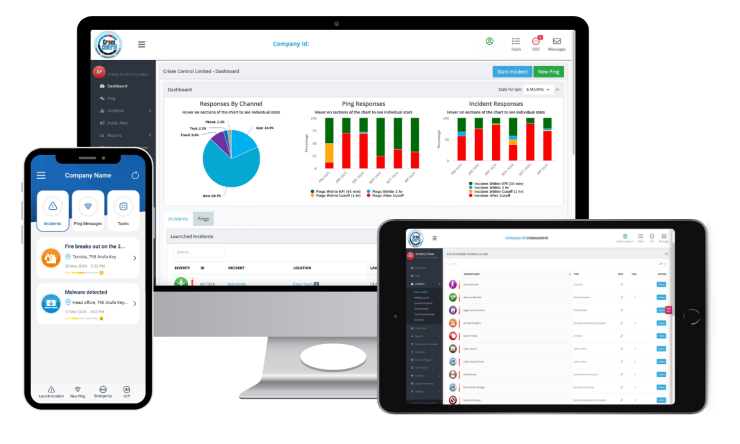
Platforms like Crises Control address these failure points directly. When an incident is logged, predefined workflows activate automatically. Tasks go to the right teams without manual coordination. Leaders get real-time visibility from a single dashboard. The structure that took months to build is activated in seconds. What would otherwise take hours to organise is executed in seconds.
The organisations that struggled in March 2026 were not lacking effort. They were operating without structure. And structure, unlike effort, cannot be built in the middle of an incident. It has to exist before it begins.
What the Events Revealed About Emergency Communication
At 12:30am on 1 March 2026, mobile phones across Dubai lit up with an emergency alert from the UAE Ministry of Interior. Seek shelter. Stay away from windows. Wait for the all-clear.
For organisations, what followed was not just an alert. It was a real-time test of their internal communication structure. For many, it exposed a gap they had not planned for.
The UAE’s national alert system worked as intended. It delivered fast, geo-targeted warnings to the public. But it was never designed to manage internal organisational response. It could not tell an HR manager which employees had received the alert, who had acknowledged it, or who remained unaccounted for.
That gap became critical within minutes.
The organisations that managed this effectively had a single, structured communication platform already in place. They could reach their entire workforce simultaneously across SMS, push notifications, email, and voice. They could track acknowledgement in real time and identify who still needed to be reached.
As guidance evolved, they could issue updated instructions instantly, targeted by location, role, or team, without rebuilding communication chains under pressure.
Others were left relying on fragmented channels, manual follow-ups, and incomplete visibility. By the time they established control, valuable time had already been lost.
Speed without structure still fails. The March 2026 events made that visible at scale.
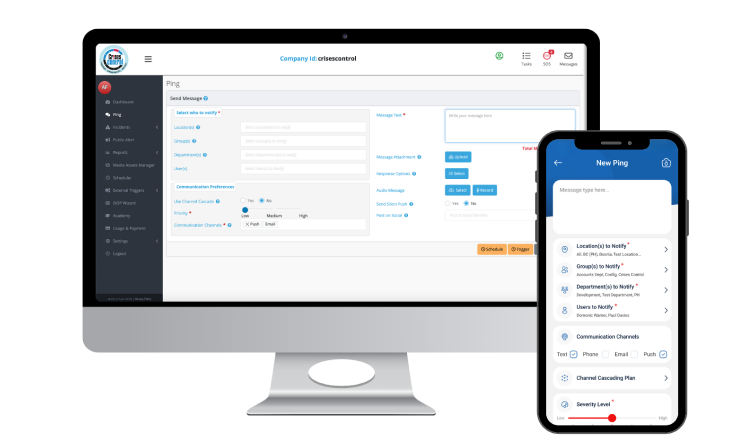
This is the core function of emergency communication software UAE organisations rely on: not just the ability to broadcast, but the ability to target, confirm, and adapt. Crises Control’s Ping module delivers this in a single, trackable operation.
What the Events Revealed About Crisis Management
If incident management is the operational layer, crisis management is the strategic one. It is what enables leadership to make decisions under pressure, maintain control as situations evolve, and ensure the organisation protects its people, reputation, and operations.
The events of March 2026 tested crisis management at a level few organisations in the UAE were designed to handle. Airspace closures, port disruptions, cloud outages, and staff evacuation decisions unfolded simultaneously. This was not a scenario most continuity plans had accounted for.
The organisations that held together shared a clear advantage. They were not relying on static plans. They were operating with systems.
Response plans were accessible in the cloud from any device, even when office infrastructure was unavailable. Workflows activated automatically, reducing reliance on individuals who were already managing competing priorities. Communication was centralised, ensuring decisions were based on a single, consistent view of the situation.
The organisations that struggled also had plans. In many cases, detailed ones. But plans stored in documents cannot be executed at 2am when the situation is changing faster than teams can interpret it.
The gap is not between having a plan and not having one. It is between having a plan and being able to act on it instantly.
March 2026 made that distinction clear, crisis management software closes. It turns a static document into a live process.
Interested in our Ping Mass Notification Software?
Efficiently alert everyone in seconds at scale with our Mass Notification Software.
Why the UAE and Middle East Context Makes This Harder
Organisations operating in the UAE and across the Middle East face a set of conditions that make response inherently more complex than in most regions.
The first is the speed at which disruptions converge. The same infrastructure that makes the UAE one of the world’s most connected hubs, including its airports, ports, and digital backbone, becomes a pressure point under strain. A port closure reduces cargo capacity. Airspace restrictions strand staff. A cloud outage disrupts coordination systems. Each is manageable in isolation. Together, they create a level of complexity that manual processes cannot handle.
The second is workforce diversity. Across industries such as finance, logistics, and hospitality, organisations manage teams that are multilingual, culturally diverse, and distributed across multiple emirates. Emergency instructions that appear clear to one group may be misunderstood by another, especially when delivered under pressure or outside normal working hours.
The third is regulatory and operational complexity. Organisations often operate across multiple jurisdictions at the same time, each with different guidance, infrastructure conditions, and communication requirements. Aligning response across these environments in real time becomes a challenge in itself.
This is why incident management software Middle East organisations choose needs to go beyond simple alerting. It needs to handle targeting by location, support multiple languages, track delivery and acknowledgement at an individual level, and give leadership a single, real-time view. That is what Crises Control is built to do.
The Three Lessons That Will Define Response in 2026 and Beyond
The events of March 2026 were not a warning of what might happen. They were a demonstration of what does happen. And they produced three lessons that organisations across the region now need to act on.
Lesson one: a plan is not a response structure.
Written plans do not activate themselves. They do not assign tasks, track progress, or give leadership a real time view. Organisations that responded effectively had their response structure built into the systems they use, not stored in documents that must be located and interpreted under pressure.
Lesson two: communication cannot be retrofitted.
The organisations that reached their people quickly had already built and tested that capability. Those that could not were not short of intent. They were short of infrastructure. A mass notification system that has never been tested is not a response asset. It is a risk.
Lesson three: compound disruptions require integration.
When incident management, crisis communication, and business continuity are managed through separate tools, they create fragmented visibility. Leaders cannot make fast decisions while waiting for updates from multiple systems. Platforms such as Crises Control bring these capabilities together into a single environment with one activation and one real time view.
The question is not whether organisations in the region face complex risk. They clearly do. The question is whether their response structure was built for it.
How Crises Control Brings This Together
Crises Control is designed as an integrated crisis response platform for organisations managing real operational complexity. It brings together Crises Control platform capabilities including incident management, mass notification, task assignment, business continuity, and real time leadership visibility within a single system.
When an incident is triggered, predefined response workflows activate immediately through the Incident Manager. Tasks are assigned to the right people without delay. Alerts reach employees across multiple channels at the same time using the Mass Notification System.
Leadership has a live dashboard showing what is happening, what actions have been completed, and where decisions are still required. Updated instructions can be issued to any location or team within seconds. Every communication, action, and acknowledgement is logged automatically through the Reporting and Audit Trail, creating a complete record for post incident review.
The platform operates on dedicated cloud infrastructure, with data centres across the UK, Europe, North America, and the Middle East. When regional systems are under pressure, as seen during the AWS disruption in the UAE in March 2026, Crises Control continues to function without interruption. That level of resilience is not an added benefit. It is fundamental to how the platform is built.
For organisations that faced the events of early 2026 with fragmented tools and manual processes, the question is now straightforward: what would the outcome have been with a platform that had the whole response built in before the incident started?
The Takeaway
March 2026 compressed years of discussion about resilience into a few weeks of operational reality. Organisations across the UAE and the wider Middle East discovered whether their response structure worked, not in controlled exercises, but in live conditions they had not anticipated and could not control.
The organisations that maintained control were not those with the most detailed plans. They were the ones whose response structure could activate immediately, at scale, across multiple locations, under real pressure.
The difference between those outcomes is not about resources or intent. It is about readiness. Specifically, whether the right structure and systems were already in place before the disruption began.
In the current operating environment, that gap is no longer theoretical. It is operational.
The next event will not wait for preparation that has not yet started.
If your response structure was tested by events like March 2026, you already know where the gaps are.If it wasn’t, it’s worth understanding how it would perform under real pressure.See how Crises Control works in your environment. Book a personalised demo to see the platform in the context of your own operations.
Request a FREE Demo
FAQs
1. What did the March 2026 Middle East events teach organisations about crisis response?
Written plans do not hold under fast-moving, compound disruption. Organisations that responded effectively had their response structure built into a live platform, not stored in a document. The gap between planning and execution became clear at scale.
2. What is the difference between incident management and crisis management?
Incident management is the operational layer, focused on logging events, assigning tasks, and tracking progress. Crisis management is the strategic layer, focused on decision-making, stakeholder communication, and maintaining control as situations evolve. Both must work together within a single system.
3. Why is emergency communication harder in the UAE than in other regions?
Workforce diversity, multi-location operations, and fast-moving disruptions increase complexity. Organisations need systems that support multiple languages, target by location, track individual responses, and adapt communication in real time.
4. How does Crises Control support organisations during compound disruptions?
Crises Control integrates incident management, mass notification, task assignment, and business continuity into one platform. Workflows activate automatically, communication reaches all employees simultaneously, and leadership gains a real-time operational view. All actions are logged for review.
5. What should organisations in the UAE do to prepare for future disruptions?
Build the response structure before the incident. This includes implementing a single platform, testing it regularly, creating message templates, and ensuring systems can operate independently of regional infrastructure.