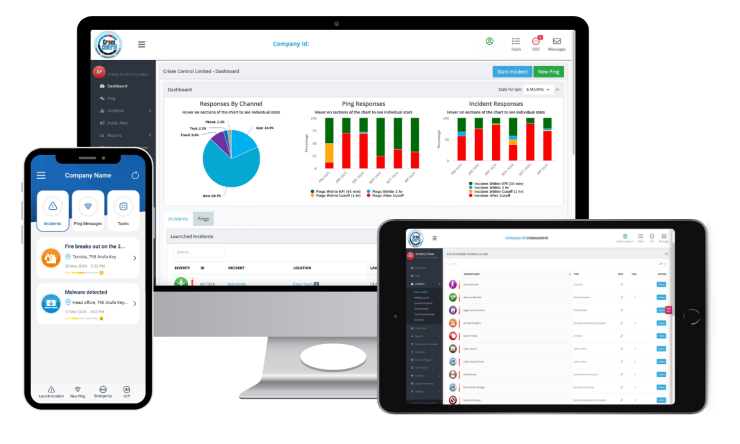
Written by Anneri Fourie | Crises Control Executive
Design agencies are built for creativity, not disruption. When systems go down, offices close, or staff are spread across locations, communication often becomes the weakest link. Messages get missed. Decisions are delayed. Teams lose time trying to work out what is happening instead of responding.
The problem is not a lack of effort or commitment. It is that most agencies rely on tools and habits that are designed for everyday collaboration, not urgent situations.
Crisis Communication Software provides a practical solution. It enables agencies to send clear, reliable messages through multiple channels, confirm who has received them, and coordinate actions when normal working conditions break down.
This article explains why crisis communication remains difficult for many design agencies, how distributed working makes the issue harder, and what a more reliable approach looks like in practice.
Why crisis communication is a persistent challenge in design agencies
Design agencies work differently from many other organisations. Teams form around projects, then move on. Freelancers and contractors are common. Work often depends on specialist software and shared digital assets.
This creates several challenges during disruption:
- Responsibility for crisis response is often informal
- Communication tools are chosen for collaboration, not urgency
- Teams are spread across offices, homes, and client sites
- Client deadlines discourage stopping to coordinate properly
When something goes wrong, agencies usually fall back on email, chat platforms, or quick phone calls. These tools are familiar and convenient, but they do not perform well when speed and certainty are required.
The result is confusion at the exact moment when clarity matters most.
Crisis scenarios that expose communication gaps
Most disruptions faced by design agencies are not headline events. They are operational problems that interrupt delivery and put pressure on client relationships.
Common examples include:
- Loss of access to design tools or asset libraries
- Cyber incidents affecting files or client data
- Office closures caused by weather, alarms, or access issues
- Power or connectivity failures during delivery deadlines
- Safety incidents during travel or site visits
In each case, leaders need quick answers to basic questions:
- Who needs to know?
- How quickly must they be informed?
- Which channel will reach them right now?
- How do we know they have seen the message?
Without a structured system, these questions are handled manually. Messages are sent in different ways, to different groups, with no clear confirmation that anyone has received them.
Why collaboration tools fail during crises
Many agencies assume that modern collaboration tools are enough for emergency communication. This assumption usually fails under pressure.
Typical problems include:
- Messages missed outside working hours
- No guarantee that messages are delivered or read
- No escalation if someone does not respond
- Channels flooded with unrelated messages
- No reliable record of who was informed
An Emergency Communication System for Remote Teams is built for urgency and accountability. It focuses on delivery, confirmation, and coordination rather than discussion.
Using the wrong tools during a crisis slows response, creates duplicated effort, and increases stress across the team.
The role of multi-channel communication for distributed teams
Distributed working gives agencies flexibility and access to wider talent. It also means no single communication channel can be relied upon.
Multi-channel crisis notifications solve this by sending the same message through several routes at once, such as:
- Mobile app notifications
- SMS when data access is limited
- Email for detailed follow-up
- Voice calls for escalation
- Microsoft Teams notifications for visibility
This approach reduces the risk of messages being missed. Staff do not need to monitor multiple systems because the system reaches them where they already are.
Mass notification as a coordination tool, not just an alert
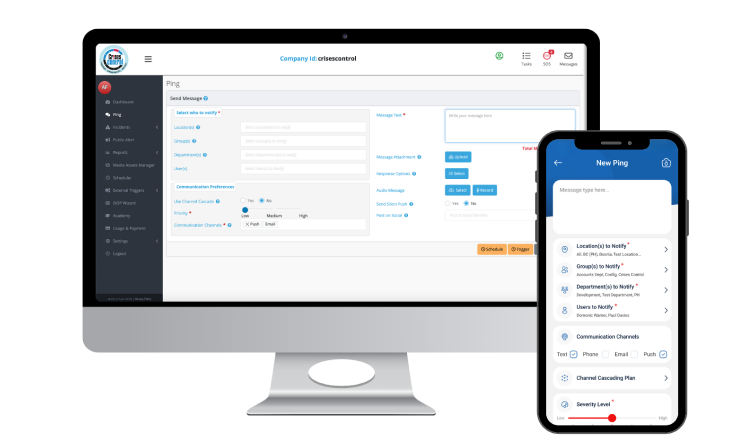
Mass Notification Software for Design Agencies is often misunderstood as a simple broadcast tool. In practice, its real value lies in coordination.
Effective systems allow agencies to:
- Target messages by role, location, or project
- Track who has acknowledged instructions
- Escalate automatically if responses are missing
- Control messaging from a single source
This turns communication into a managed process. Leaders can see in real time who is informed and who still needs attention.
Interested in our Ping Mass Notification Software?
Efficiently alert everyone in seconds at scale with our Mass Notification Software.
Internal alignment before external communication
Client communication during disruption is sensitive. Rushed or inconsistent messages damage trust and create unnecessary follow-up.
A structured Incident Communication Platform for Creative Agencies supports internal alignment by:
- Alerting leadership and delivery teams at the same time
- Clarifying who is responsible for decisions
- Coordinating actions before clients are updated
Once internal actions are clear, client-facing teams can communicate with confidence and consistency.
Safety communication for offices and site visits
Design agencies sometimes underestimate safety risks because incidents are rare. When they occur, the impact on people is serious.
Situations that require fast safety communication include:
- Fire alarms or building evacuations
- Severe weather affecting office access
- Incidents during site visits or travel
- Lone working scenarios
An effective system allows staff to raise alerts themselves through an SOS function and receive immediate instructions. Location-based messaging ensures only relevant teams are notified.
Manual plans versus digital response
Many agencies still rely on static documents for crisis and continuity planning. These documents are hard to access during disruption and often outdated.
Digital platforms improve response by:
- Turning plans into clear, actionable steps
- Assigning actions to named roles
- Providing cloud access during outages
- Recording actions for review and learning
Crises Control supports this approach by digitising plans and linking them directly to communication and response workflows. The focus is on usability under pressure.
A common assumption that often fails
A frequent belief is that smaller or mid-sized agencies do not need formal crisis communication because teams are close-knit.
This belief breaks down when:
- Teams grow quickly
- Remote working becomes standard
- Clients operate across regions
- Compliance expectations increase
Informal communication works until it does not. Structured systems do not remove flexibility. They provide clarity when informal networks fail.
Compliance, accountability, and audit readiness
Design agencies operating across regions face growing expectations around safety, data protection, and operational resilience.
While regulations differ by region, common expectations include:
- Proof that staff were informed
- Records of response actions
- Protection of personal data
Digital crisis communication platforms generate audit trails automatically. This supports accountability without adding work during incidents.
How design agencies improve crisis communication in practice
Agencies that improve communication during disruption usually follow a clear set of steps:
- Identify scenarios that require urgent communication
- Define who needs to be notified and how quickly
- Choose channels that work during disruption
- Enable acknowledgement and escalation
- Test and refine the process regularly
Crises Control supports these steps through cloud-based access, role-based response, and reliable emergency communication.
Practical benefits for decision-makers
When crisis communication improves, agencies see clear operational benefits:
- Faster, more consistent response
- Less confusion during incidents
- Improved staff confidence
- Clearer client communication
- Better oversight and accountability
These outcomes directly affect delivery, reputation, and wellbeing.
Closing perspective
Crisis communication is not about planning for every possible problem. It is about making sure people know what is happening and what to do when plans are tested.
For distributed design agencies, reliable multi-channel communication is a core capability rather than a nice-to-have.
To explore how this can work in practice within your organisation, speak with Crises Control.
Request a FREE Demo