Written by Anneri Fourie | Crises Control Executive
When something goes wrong inside an organisation, the first reaction is often to send a message. An email, a text, a Teams post, or a call-out alert. That instinct makes sense. People need to know what is happening.
The problem is that alerts on their own do not manage a crisis.
Many organisations have discovered this the hard way. Messages go out quickly, yet confusion follows. Teams wait for direction. Leaders chase updates. Decisions are made based on partial information. Meanwhile, the situation keeps changing.
This is why crisis management software has changed so much in recent years. What used to be simple alerting tools are now expected to support coordination, decision-making, and business continuity across the organisation. Emergency notification is still essential, but it is only the starting point.
This article explains why alerting alone falls short, how modern platforms are evolving into operational hubs, and how Crises Control supports organisations through structured response and continuity workflows.
Crisis management software and the limits of traditional alerting
Early emergency notification tools were built for speed. Their purpose was clear. Send a message to as many people as possible, as quickly as possible.
Speed still matters, yet it does not solve the wider challenge of managing an incident from start to finish.
Traditional alerting tools struggle when incidents become complex or last longer than expected. Common limitations include:
- One-way communication with no clear view of staff safety or response status
- No structured steps to guide teams after the alert is sent
- Heavy reliance on manual decision-making during stressful situations
- Limited connection to operational systems or continuity plans
- Little or no audit trail for review, reporting, or compliance
During a serious incident, these weaknesses add up quickly. Alerts are delivered, yet no one is sure who is responsible for the next action. Teams look for instructions that do not exist. Leaders rely on phone calls and spreadsheets to piece together what is happening.
This is where frustration turns into risk.
Modern incident management software addresses this gap by placing alerting inside a wider response framework. Notifications trigger action rather than marking the end of the process.
Why emergency notification fails during complex incidents
Complex incidents share familiar patterns. They affect more than one location. They involve multiple teams. They evolve quickly and rarely follow a neat sequence.
Examples include:
- A cyber incident disrupting systems across regions
- Severe weather affecting several sites at once
- A safety incident requiring coordination with external responders
In these situations, basic alerting fails for three clear reasons.
Alerts do not create coordination
Sending a message does not assign ownership or confirm that tasks are being completed. Without predefined workflows, teams improvise under pressure, often duplicating effort or missing key steps.
Information flows in one direction
If people can only receive messages and not respond in a structured way, leadership has no reliable view of what is happening. Decisions are based on guesswork rather than live data.
Alerting sits outside continuity planning
When alerts are disconnected from business continuity plans, teams are left searching for documents instead of acting. Plans exist, but they are not usable in the moment.
This is why critical event management software has emerged as a broader category. It treats notification as the trigger for coordinated response, supported by structure, visibility, and accountability.
Crisis management software as an operational hub
Modern platforms now act as central operating hubs during disruption. They bring together communication, response workflows, decision support, and reporting in one place.
This shift reflects how organisations actually manage incidents, not how tools were originally designed.
Key characteristics of this evolution include:
Integrated response workflows
Incidents activate predefined actions linked to roles and responsibilities. Tasks are assigned, escalated, and tracked in real time, reducing uncertainty.
Live situational awareness
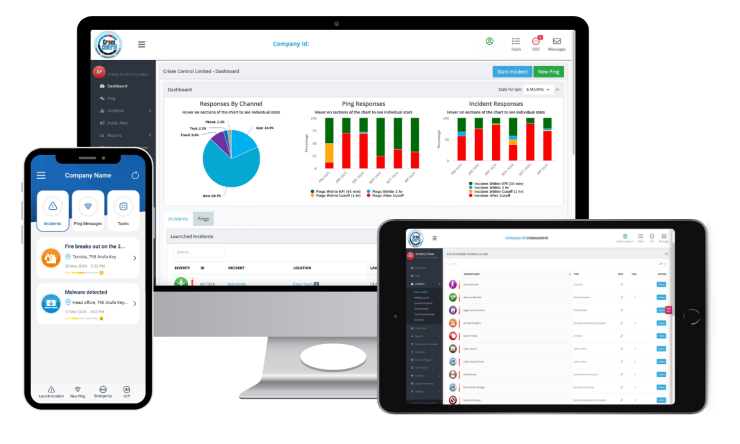
Dashboards show alert delivery, staff responses, incident status, and outstanding actions. Leaders no longer need to chase updates through calls and emails.
Multi-channel communication by design
An emergency mass notification system must reach people across devices, networks, and regions, with built-in redundancy to cope with outages.
Direct connection to continuity planning
Response actions reflect approved continuity strategies rather than ad hoc decisions made under pressure.
By bringing these elements together, crisis response becomes repeatable and measurable rather than improvised. This consistency matters most for organisations managing multiple sites or distributed teams.
The role of mass notification software in a wider response strategy
Alerting remains a foundation of crisis response, yet its role has changed.
Mass notification software works best when it initiates structured action rather than acting as a standalone broadcast tool.
Within an enterprise platform, notification:
- Triggers relevant workflows based on the type of incident
- Requests specific responses rather than simple acknowledgements
- Feeds real-time data into dashboards for leadership
- Supports escalation when responses are delayed or missing
This approach ensures alerts lead somewhere. People know what is expected of them, and leaders can see progress as it happens.
For organisations operating internationally, a mass notification system for global teams must also support localisation, time zones, and targeted messaging. The right people receive the right information, while leadership maintains a single view of the situation.
Crises Control supports this by allowing organisations to define who receives which messages, when they receive them, and through which channels, all within one controlled environment.
Crisis management software and business continuity alignment
One of the most important changes in the market is the closer link between alerting and business continuity software.
In many organisations, continuity plans exist as documents that are reviewed once a year. During a real incident, these plans are often hard to find, outdated, or too generic to follow.
Modern platforms embed continuity directly into response workflows. This changes how plans are used in practice.
Key benefits include:
- Plans become actionable steps rather than static documents
- Teams follow approved processes without searching for guidance
- Decision-making aligns with organisational priorities
- Recovery actions begin alongside response, not after the incident ends
Crises Control allows organisations to digitise continuity plans and break them into structured, role-based actions. When an incident occurs, the platform activates the relevant steps automatically. This reduces reliance on memory and experience at the most stressful moments.
Why enterprises are moving beyond basic alert tools
Large organisations face challenges that simple tools cannot address.
Scale and complexity
Enterprises operate across regions, industries, and regulatory environments. Response needs to be consistent without ignoring local realities.
Governance and accountability
Senior leaders need assurance that incidents are managed according to policy, with clear records of decisions and actions.
Regulatory pressure
Regulations such as GDPR and DORA raise expectations around incident communication, reporting, and oversight.
Operational resilience
Disruption affects revenue, safety, and reputation. Crisis response becomes a strategic capability, not a technical add-on.
These pressures drive demand for the best crisis management software for enterprises, defined not by how fast alerts are sent, but by how effectively people, processes, and information are coordinated.
How Crises Control supports modern crisis response
Crises Control is built around this shift from alerting to coordinated response. The platform combines notification, incident management, and continuity execution in a modular structure.
Key capabilities include:
- Structured incident workflows: Incidents trigger predefined actions aligned to organisational roles. This reduces confusion and speeds up response.
- Multi-channel alerting with redundancy: Messages reach people through mobile apps, SMS, voice, and email, supporting delivery even during network disruption.
- Two-way communication and status tracking: Teams confirm safety, complete tasks, and provide updates that feed into live dashboards.
- Integrated continuity execution: Business continuity plans are activated during incidents, guiding teams through response and recovery.
- Audit and reporting readiness: Every action, message, and response is recorded, supporting governance and regulatory requirements.
This approach helps organisations move from reactive alerting to managed response, supported by clear data rather than assumption.
Supporting global and multi-site organisations
Distributed organisations face extra challenges during incidents. Information needs to move quickly without overwhelming teams or creating conflicting instructions.
A centralised platform supports this by:
- Targeting alerts by role, location, or exposure
- Maintaining consistent messaging across regions
- Giving leadership a single operational view
Crises Control is used by organisations with global footprints to coordinate response across time zones and jurisdictions. This reduces fragmentation and supports consistent standards of response.
AI and the future of crisis response platforms
AI is increasingly shaping how platforms support crisis response. Its role is to assist decision-making, not replace it.
Practical uses include:
- Analysing response data to highlight delays or gaps
- Supporting prioritisation when multiple incidents occur
- Improving post-incident learning through pattern analysis
As platforms evolve, AI will continue to enhance situational awareness and organisational learning. Crises Control applies this carefully, ensuring automation supports governance and accountability rather than bypassing them.
Choosing crisis management software that scales with risk
When reviewing platforms, organisations should look beyond alerting features and consider how the system supports the full lifecycle of an incident.
Useful questions include:
- Does the platform guide teams through response, not just notification?
- Can it connect with existing continuity plans and operational systems?
- Does it provide real-time visibility for leadership?
- Can it support regulatory reporting and audit needs?
- Will it scale across regions and business units?
Clear answers to these questions help organisations move away from fragmented tools and towards a unified approach to resilience.
From alerting to organisational resilience
Emergency notification remains essential, yet it is no longer enough on its own. Organisations now need platforms that support structured response, continuity execution, and informed decision-making during disruption.
Crisis management software has become a core capability for enterprises that want to protect people, operations, and reputation in an unpredictable world. By bringing together notification, incident management, and continuity workflows, platforms such as Crises Control help organisations respond with clarity rather than confusion.
Ready to see how this works in practice?
For organisations reviewing whether their current tools can support coordinated response during complex incidents, seeing this approach in action can be valuable.
Crises Control can show how modular crisis management and business continuity workflows support faster, more coordinated response when it matters most.
Request a FREE Demo