
Written by Paul Malinda | Crises Control Marketing Assistant
Introduction
In March 2026, organisations operating in Dubai faced a level of disruption that few continuity plans had anticipated. Airspace closures, port disruptions, cloud infrastructure outages, and staff evacuation decisions arrived simultaneously, compressing weeks of risk into hours. For many teams, the gap between a managed incident and an uncontrolled one came down to a single question: did they have the right structure in place before things went wrong?
The difference between a response that held and one that collapsed was rarely about effort. It was about structure. This article draws on the events of early 2026 to explain what that structure looks like, why Dubai organisations need it now, and what happens when it’s missing. This is no longer a planning exercise for future risk. It is an immediate operational requirement
What Is Crisis Management Software?
Crisis management software is a digital platform that helps organisations coordinate their response to incidents in real time. It replaces fragmented communication and manual processes with a single structured environment where teams can log incidents, notify the right people immediately, assign actions, and track progress as a situation develops.
Platforms like Crises Control cover three stages: preparation before an incident, coordination during one, and structured review afterwards. The platform gives organisations a real-time operational picture so that when multiple disruptions arrive at once, teams are not choosing between speed and clarity. They have both.
The core capabilities include:
- Real-time alerts sent to the right people by role, location, or team
- Predefined workflows that activate automatically when an incident is logged
- Task assignment and tracking so nothing falls through the gaps
- A shared dashboard giving leadership visibility of the full situation as it develops
- Integrated communication across mobile, SMS, email, and voice simultaneously
For organisations evaluating options, verified user reviews on Capterra consistently highlight speed of deployment and ease of use under pressure as the capabilities that matter most when an incident is already developing.
What Is Happening in Dubai Right Now
Dubai International Airport, which handled a record 95.2 million passengers in 2025, has been operating at significantly reduced capacity since early March 2026. Multiple nations suspended flights following aerial interception events over the city. A fire at Jebel Ali Port, one of the world’s busiest, was attributed to debris from those events. An AWS data centre in the UAE was struck and took on fire, causing cloud outages that disrupted businesses across the region. The UAE temporarily closed its entire airspace overnight on 16 to 17 March as a precautionary measure.
Organisations have been managing staff evacuation decisions, remote working transitions at short notice, and customer communication under conditions that changed hour by hour. The US State Department classified the UAE at Level 3, recommending organisations reconsider operations in the country.
These are not theoretical risks. They are live operational conditions. And they are exactly the environment that crisis management software like Crises Control is built for. The organisations that have responded well are not the ones that started planning when the disruption began. They are the ones that had their response structure already in place.
The question is not whether Dubai organisations face complex risk. They clearly do. The question is whether their response structure was built for it.
Why Dubai’s Risk Profile is Unique?
Dubai’s global connectivity is also its greatest vulnerability. The same infrastructure that made it one of the world’s most connected hubs, its airports, ports, and digital backbone, is the infrastructure that becomes a pressure point when the region around it is under strain.
What makes this operating environment genuinely distinct is the speed at which separate disruptions converge. A port closure reduces cargo capacity. Airspace restrictions strand staff and break supply chains. A cloud outage takes down the coordination systems teams rely on. Each event is serious on its own. Together, they create a level of operational pressure that no manual process can manage.
Organisations that built their resilience plans around isolated, predictable incidents are finding those plans do not hold. The events of March 2026 confirm what resilience professionals in the region already understood: investing in business continuity software Dubai organisations can depend on is not a future priority. It is an immediate one.
Platforms like Crises Control are already supporting companies in the UAE and across the Middle East by integrating crisis communication, incident tracking, and automated response workflows into a single, dependable system, ensuring continuity even when multiple disruptions collide.
Interested in our Ping Mass Notification Software?
Efficiently alert everyone in seconds at scale with our Mass Notification Software.
Where Crisis Response Actually Breaks Down
Most organisations do not fail in a crisis because they lacked a plan. They fail because the plan could not keep up with what was actually happening.
Here is what that looks like in practice.
An incident starts. Teams are notified through different channels, some by email, some by phone, some through a group chat. Updates arrive from multiple directions, but they do not match. One site manager has information another does not. A decision is made at the centre based on an incomplete picture. By the time the full situation is understood, the window for fast action has already closed.
The failure points are consistent across organisations:
- Communication is scattered across email, calls, and messaging apps with no single source of truth
- Leaders are asking for status updates rather than seeing them in real time
- Response actions are tracked in spreadsheets or not tracked at all
- Employees in different offices or countries receive inconsistent instructions
- The post-incident review is based on memory rather than a documented record
The problem is rarely effort. It is structure. Organisations work hard but coordinate poorly, and in a fast-moving crisis, poor coordination costs more than anything else. Basic alerting tools expose this gap most clearly. A mass notification system that fires a message to everyone but does not activate predefined workflows, track task completion, or give leadership a real-time operational view leaves teams informed but uncoordinated. In a compound disruption like those facing Dubai in March 2026, that gap becomes critical.
The problem is rarely effort. It is structure. Organisations work hard but coordinate poorly, and in a fast-moving crisis, poor coordination costs more than anything else.
What Effective Crisis Response Looks Like
Effective crisis response is not about reacting faster. It is about having a structure that holds when pressure is highest.
In practice, four things need to be in place before an incident starts.
-
Roles are defined
Everyone knows what they are responsible for when something goes wrong, without needing to be told in the moment. The incident management software assigns tasks automatically based on role and incident type the moment a situation is logged.
-
Communication paths are tested
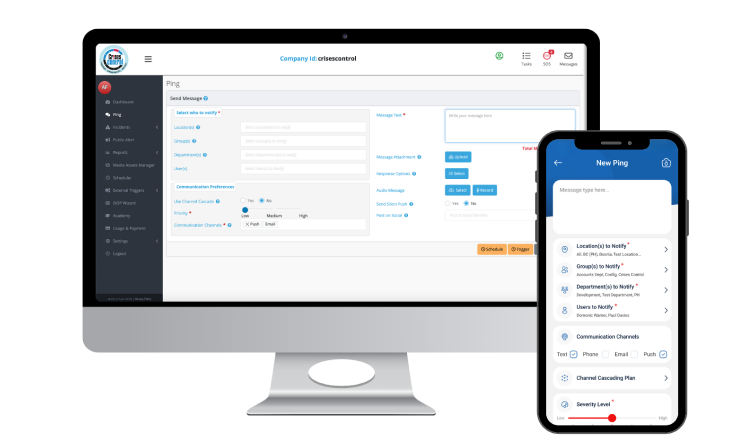
The emergency communication software UAE organisations depend on works because it has been used before, not just configured and forgotten. Crises Control’s Ping mass notification, reaches teams across mobile app, SMS, email, and voice simultaneously and tracks acknowledgement in real time, so you know immediately who has received critical instructions and who has not.
-
Escalation logic is clear
When an incident grows beyond the initial response team, the right people are brought in automatically, not after a phone chain has worked its way up the organisation.
-
Visibility is centralised
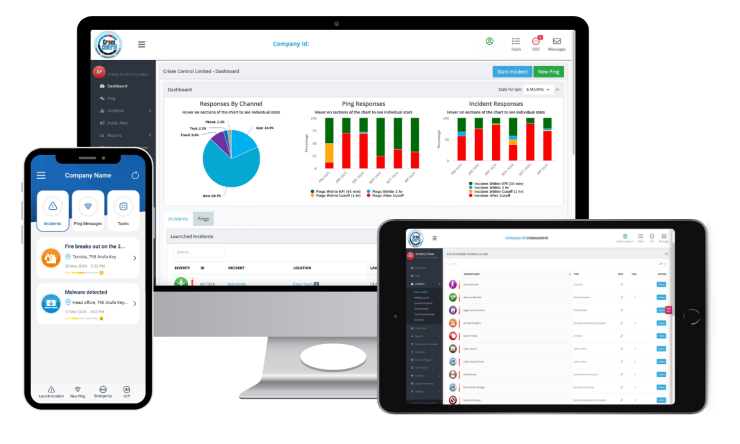
Leadership can see what is happening and where the response stands without chasing individual updates. Crises Control’s Incident Manager provides exactly that: a real-time command-and-control dashboard showing the full operational picture, live task progress, and employee status across every location.
When these four things are in place, organisations move from reacting to managing. That shift is what determines whether an incident stays contained or escalates into something wider.
How Crisis Management Software Helps Organisations in Dubai Respond to Disruptions
Effective crisis response is not about reacting faster. It is about having a structure that holds when pressure is highest. Crisis management software creates that structure across four areas that matter most in Dubai’s operating environment.
First, it centralises communication. Instead of updates spreading across email, WhatsApp, and phone calls, every message, alert, and acknowledgement runs through one platform. Teams in different offices and countries are working from the same information at the same time.
Second, it activates response plans automatically. When an incident is logged, Crises Control triggers predefined workflows immediately. The right tasks go to the right teams without anyone needing to coordinate that manually. This is what the emergency communication software UAE organisations need when events move faster than phone trees can keep up.
Third, it gives leadership real-time visibility. Rather than asking for updates and waiting, senior teams can see which actions are complete, where the gaps are, and what decisions still need to be made. That visibility is what allows faster, better-informed choices under pressure.
Fourth, it supports business continuity. Crises Control’s business continuity platform stores response plans securely in the cloud, accessible from any device, ensuring that teams can act on the latest version of the plan even if office systems are unavailable. For organisations managing the events of March 2026, that cloud independence has been critical.
Why Isn’t Having an Emergency Response Plan Enough?
A documented emergency response plan is a starting point, not a solution.
Static documents do not hold up under real pressure. When an incident is developing fast, people do not have time to locate the right document, find the relevant section, and interpret what to do next. The plan gets bypassed, and teams default to improvisation.
An emergency response plan in safety for Middle East organisations needs to be built into the systems teams actually use during a crisis. Activating the plan should be as simple as logging an incident and following the workflow that appears automatically.
The organisations that responded effectively to the events of early March 2026 were not the ones with the most detailed written procedures. They were the ones whose response structure could be activated immediately, at scale, across multiple locations, under genuine pressure.
How Crises Control Works as a Crisis Response Platform
Crises Control helps organisations in Dubai and across the UAE turn their crisis management approach into something that works when they need it most, not just when conditions are stable.
The platform brings together everything needed for a coordinated response in a single environment:
- Ping, Crises Control’s mass notification system, reaches employees across all channels simultaneously, whether they are in an office in Dubai, working remotely across the UAE, or based in another country. Messages reach the right people in under one minute, with real-time acknowledgement tracking, so there is no uncertainty about who has been reached.
- The Incident Manager digitalises response workflows so that when an incident is logged, the right tasks are assigned to the right people automatically. Teams do not need to work out what to do next. They need to do it. The platform’s command-and-control dashboard gives leadership a full real-time view of the developing situation: who has been notified, which tasks are complete, and where the gaps are.
- For organisations managing incident management software Middle East requirements across multiple sites and jurisdictions, Crises Control provides the structure to maintain central oversight while allowing local teams to act within their own operational context.
- Every action, message, and response is recorded automatically, creating a complete audit trail for post-incident review, regulatory reporting, and continuous improvement.
The Takeaway
The events of March 2026 in Dubai are not a warning of what might happen. They are a demonstration of what operational disruption at scale looks like when it arrives without warning.
Airspace closures, port disruptions, cloud outages, and staff evacuation decisions are not separate problems to manage through separate channels. They are interconnected pressures that require a coordinated response from a single operational structure.
Organisations that had that structure in place responded faster, communicated more clearly, and maintained control through events that overwhelmed those relying on manual processes.
That is the gap that emergency communication software UAE and crisis management software closes. In Dubai right now, closing that gap is not a future priority. It is an operational decision that needs to be made before the next incident starts. Read more about how crisis management strategies for the Middle East are evolving in response to the current environment.
If the events of early 2026 have raised questions about whether your response structure would hold under similar pressure, Crises Control can help you find out. Book a personalised demo to see the platform in the context of your own operations.
Request a FREE Demo
FAQs
1. What is the purpose of an emergency response plan?
An emergency response plan defines how an organisation responds to incidents, including roles, communication, escalation steps, and recovery actions. Its purpose is to ensure that when pressure is highest, teams can act immediately without needing to work things out in real time.
2. What are the key elements of an effective emergency response plan?
An effective plan includes clearly defined roles and responsibilities, tested communication procedures, predefined escalation paths, specific response actions for likely incident types, and a structured process for review and continuous improvement after each event.
3. What is the difference between risk management and crisis management?
Risk management focuses on identifying and reducing potential threats before they occur. Crisis management focuses on responding when a threat materialises, ensuring coordination, clear communication, and control during the incident.
4. What is the first step in response planning?
The first step is understanding your risk landscape. This includes identifying the most likely incidents, those with the greatest impact, and areas where the organisation is least prepared. All response planning should be built on this foundation.
5. How can crisis management software help organisations in Dubai?
Crisis management software replaces fragmented, manual coordination with a structured, real-time response environment. Teams receive targeted alerts, follow predefined workflows, and leadership maintains full visibility of the situation, enabling faster decisions and a more controlled response.