Written by Anneri Fourie | Crises Control Executive
In oil and gas operations, incident detection usually works.
Sensors pick up anomalies. Fire alarms activate. Weather warnings arrive. Cyber alerts are triggered. Messages are sent. Screens light up. Logs start filling.
And yet, incidents still escalate. Response slows. Confusion spreads. Audits raise uncomfortable questions.
The problem is rarely that organisations did not know something was wrong.
The problem is that no one clearly owned what happened next.
Many operators invest heavily in monitoring and alerting. There is an assumption that once an alert goes out, response will follow. In practice, that assumption is one of the most common reasons incidents drift, stall, or spiral.
This article looks at why incident detection fails without response ownership, why this gap keeps appearing in oil and gas environments, and how crisis management software for oil & gas operations can help close the space between awareness and action.
A clear definition before we go further
Incident detection tells you that something is wrong. Response ownership defines who is responsible for fixing it, coordinating it, and proving it was handled properly.
Detection answers one question: Is there an issue?
Ownership answers the harder ones:
- Who is in charge right now?
- What actions must happen first?
- Who needs to be informed and who does not?
- When does this escalate?
- How do we show what decisions were made?
Without ownership, alerts remain information. Information alone does not resolve incidents.
Why detection without ownership is so common in oil and gas
Oil and gas organisations are complex by nature. Operations span regions. Teams work on site, offshore, remotely, and across time zones. Responsibility is split between operations, engineering, IT, safety, security, and senior leadership.
When something goes wrong, this shared responsibility often turns into diluted responsibility.
What tends to happen looks familiar:
- Alerts are sent to large distribution lists rather than named owners
- SMS or email confirms delivery, but no one confirms action
- Teams assume another function is leading the response
- Escalation happens late, under pressure
- Reporting is rebuilt after the event, from memory
These patterns are not caused by lack of care or competence. They exist because many emergency response plan frameworks focus on detection and communication, not execution.
Plans describe what should happen, but rarely enforce who must act.
Alerts create awareness, not accountability
There is a deeply rooted belief that fast alerts equal effective response.
Dashboards reinforce this belief. Delivery rates look reassuring. Read receipts provide comfort. A message was sent, therefore the job feels done.
In reality, acknowledgement does not equal action.
A person can read an alert, assume someone else is dealing with it, and move on. At organisational level, this creates a dangerous situation where everyone knows and no one leads.
This is where an incident management platform becomes essential. It introduces structure where alerts alone fall short.
The quiet danger of small incidents
Many major oil and gas incidents start quietly.
A small leak. Heavy rainfall. An unusual pressure reading. A local fire alarm. A system fault that looks minor.
These are often treated as issues to watch rather than events to manage. Escalation is delayed because no one has clear authority to declare an incident.
In safety-critical environments, escalation thresholds must be operational, not theoretical. An emergency response plan in safety-critical environments must answer practical questions:
- Who can declare an incident without waiting for consensus?
- When does monitoring become action?
- What actions are mandatory at each stage?
- How does ownership shift as severity changes?
When these answers are unclear, early opportunities to contain impact are lost.
Fire alarms and cyber alerts reveal the same weakness
Fire alarms and cyber incidents seem unrelated. Operationally, they expose the same flaw.
Fire alarms activate automatically, but coordination between on-site teams, safety leads, and emergency services is often manual. Cyber alerts may be detected by IT teams, while operations and leadership remain unaware of potential knock-on effects.
In both cases, detection works. Ownership across functions does not.
This is where the difference between risk management and crisis management becomes clear. Risk management focuses on what could happen. Crisis management focuses on coordinated action when it does.
Manual coordination under pressure does not scale
When ownership is unclear, teams fall back on manual coordination. Phone calls, emails, messaging apps, hurried meetings.
Manual approaches struggle because they rely on memory, availability, and judgement under stress. They also scale poorly during multi-site or prolonged incidents.
From a governance point of view, manual response creates another issue. It leaves weak evidence.
Regulatory reporting for incident management requires organisations to show who was informed, what decisions were made, when actions were taken, and how outcomes were tracked. Reconstructing this after the event is unreliable and often incomplete.
Why basic SMS reaches people but not outcomes
SMS remains essential in oil and gas operations, especially for remote or offshore teams. It is reliable for immediate awareness.
Its limitation is simple. It stops at delivery.
SMS cannot assign tasks. It cannot enforce escalation. It cannot show progress. It cannot provide a shared view of what is happening.
This is why many organisations now separate alerting from incident management. Alerting creates awareness. Incident management creates ownership.
What response ownership looks like in real organisations
Response ownership is not about adding process for its own sake. It is about removing uncertainty.
In organisations that handle incidents well:
- Every declared incident has a named owner
- Responsibilities are role-based, not dependent on who is available
- Tasks are explicit, time-bound, and visible
- Escalation follows defined rules
- Leadership can see progress without disrupting execution
- Actions are recorded as they happen
This structure reduces hesitation, prevents duplication, and supports consistent response across sites and teams.
Challenging a comfortable assumption
A common assumption in emergency planning is that more training or more detailed plans will solve response failures.
In practice, this often fails.
Detailed plans sit in documents. Under pressure, people do not read documents. They act on instinct and habit.
Training measures attendance and completion, not decision quality in real conditions.
Digital crisis management platforms challenge this assumption by turning plans into live workflows. Actions surface when they are needed. Ownership is clear. Progress is visible. Decisions leave a trace.
This shift from documentation to execution is where many traditional approaches fall down.
Evidence matters more than intention
Regulators and auditors focus on evidence. Intentions carry little weight after an incident.
Across regions, expectations are consistent:
- Clear emergency response plans
- Timely and appropriate communication
- Assigned responsibilities
- Verifiable records
Crisis management software for oil & gas operations supports this by making evidence a natural outcome of good response, not an extra task.
Where Crises Control fits
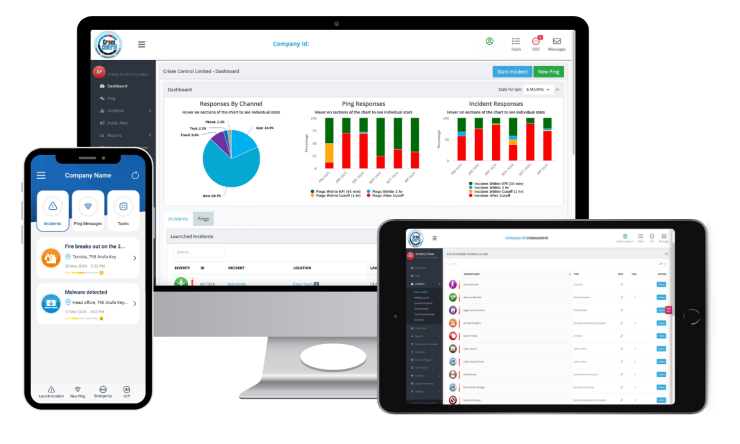
Crises Control supports response ownership by digitalising crisis and business continuity plans and embedding them into live incident workflows.
This includes:
- Role-based incident activation
- Task assignment and tracking
- Reliable emergency communication across channels
- Cloud-based access during disruption
- Automatic event logs and reports
The platform sits between detection systems and human response. It does not replace alarms or sensors. It ensures that once detection happens, ownership is established and maintained.
Why this matters to senior leaders
For Heads of Business Continuity, IT Risk, Compliance, and Operations, the real question is not whether alerts are sent.
The question is whether response is controlled, repeatable, and defensible.
Ownership reduces uncertainty. It shortens response times. It strengthens audit outcomes. It supports safer operations.
Closing thoughts
Incident detection will continue to improve. Alerts will become faster and more precise.
Response will not improve unless ownership is designed into the process.
Crisis management software for oil & gas operations exists to close that gap. It turns awareness into action and information into accountability.
If you are reviewing your current approach, focus less on how quickly incidents are detected and more on who takes control once an incident is declared.
Request a FREE Demo