
Written by Paul Malinda | Crises Control Marketing Assistant
At 12:30am on Sunday, 1 March 2026, mobile phones across Dubai lit up with an emergency alert. The message from the Ministry of Interior was direct: potential missile threat. Seek immediate shelter. Stay away from windows and doors. Wait for the all-clear. For thousands of employees who had been working late, staying in hotels, or living in high-rises across the city, that alert arrived with no warning and no context. Some received it. Others, in the same buildings and streets, did not. And in offices and operations centres across the UAE, HR teams, security managers, and senior leaders faced the same urgent problem at the same moment: they had no fast, reliable way to reach their people.
Who was in the office? Who was working remotely? Who was travelling? Who had seen the alert and who had not? In a city of over three million people managing one of the most connected business environments in the world, the communication gap between government alert and organisational response was immediate and real.
This is exactly the gap that emergency communication software UAE organisations rely on is built to close.
What Is Emergency Communication Software?
Emergency communication software is a platform that enables organisations to send fast, targeted alerts to employees and stakeholders during a crisis. It ensures that the right message reaches the right people, across the right channels, at the moment it matters most. Crises Control delivers this through a single platform that combines mass notification, two-way communication, and real-time tracking.
In the events of late February and early March 2026 in the UAE, the distinction between organisations that had this capability and those that did not became visible almost immediately. Some could reach their entire workforce within minutes. Others were still working through phone lists hours later.
The core capabilities include:
- Instant multi-channel alerts across SMS, mobile push notifications, email, and voice calls simultaneously
- Two-way messaging so employees can confirm safety or report their status
- Targeted communication by location, role, building, or team
- Real-time delivery tracking showing who has received and acknowledged each message
- Predefined message templates that can be activated without delay
Speed matters in a crisis. But speed without reach and confirmation is not enough. Organisations need to know not just that a message was sent, but that it was received.
What UAE Organisations Actually Faced in March 2026
The alerts began on 28 February 2026 and continued through March. They were issued using the UAE’s National Early Warning System, a cellular broadcast technology managed by the National Emergency Crisis and Disasters Management Authority (NCEMA) and the Ministry of Interior. Alerts were geo-targeted, meaning they reached phones in specific locations rather than across the entire country.
This created an immediate problem for organisations with distributed teams. An employee in Deira might receive an alert that their colleague in Business Bay did not. A manager sheltering in their apartment in Dubai Marina had no way of knowing whether their team in an office in Abu Dhabi had been notified at all.
The instructions themselves changed over time. In early March, the guidance was to shelter in place and wait for an all-clear. By mid-March, updated guidance allowed limited movement within cities while still requiring people to take cover when incoming drone or missile reports were received. As late as 23 March, shelter-in-place protocols remained active.
For organisations, each update meant a fresh communication challenge. New instructions needed to reach everyone, fast, across multiple locations, in multiple languages, through whatever channels were still available. Organisations that relied on email chains, WhatsApp groups, or manual phone trees found that those methods could not keep pace with how quickly the situation was changing.
The UAE’s public alert system did its job. But it was never designed to replace the internal communication structures that organisations are responsible for themselves. That gap is where businesses were exposed.
Why Emergency Communication Is Harder in the UAE
Emergency communication in the UAE is more complex than in most regions. The challenge goes beyond geography. It comes down to how organisations operate and how people receive information under pressure.
-
Diverse, multilingual workforces
Workforces across industries such as finance, logistics, hospitality, and construction are highly diverse. Employees often speak multiple languages and come from different cultural and professional backgrounds.
This creates a communication gap during incidents:
- Instructions may be interpreted differently
- Language barriers can delay understanding
- Urgent alerts may not be clear to everyone
A shelter-in-place message that seems straightforward to one person may not land the same way for another, especially if it is received late at night or through an automated alert.
-
Operations across multiple locations
Organisations in the UAE often operate across several emirates at the same time.
A single company may have teams in:
- Dubai
- Abu Dhabi
- Sharjah
- Ras Al Khaimah
During an incident, each location may:
- receive different alerts
- experience different levels of disruption
- follow different local guidance
Coordinating a consistent response across all locations, in real time, is extremely difficult without structure.
-
Speed without alignment creates risk
In fast-moving environments, information spreads quickly. But speed alone does not guarantee clarity.
When updates come from multiple sources:
- Teams act on different information
- Decisions become inconsistent
- Leadership loses visibility
This is where communication begins to break down.
What this means for organisations
A crisis communication platform Middle East solution must do more than send messages.
It needs to provide structure and control by:
- Targeting messages by location and role
- Supporting multiple languages
- Tracking delivery and acknowledgement
- Giving leadership a single, real-time view
This is why a crisis communication platform Middle East solution needs to do more than send a message. It needs to handle targeting by location, track confirmation by individual, support multiple languages, and give leadership a single view of who has been reached and who has not.
Interested in our Ping Mass Notification Software?
Efficiently alert everyone in seconds at scale with our Mass Notification Software.
Where Emergency Communication Breaks Down
Communication breaks down in a crisis for consistent and predictable reasons. Understanding them is the first step to fixing them.
The first failure point is channel fragmentation. When an incident starts, messages go out across email, WhatsApp, phone calls, and building PA systems simultaneously. Some employees get four messages. Others get none. There is no single record of who was told what, and no way to track whether the information was received.
The second failure point is speed. In the March 2026 events, the situation changed multiple times in a single night. An organisation that could only communicate through email or sequential phone calls could not keep pace with how quickly instructions were being updated.
The third failure point is confirmation. Sending a message is not the same as knowing it was received. In a shelter-in-place scenario, an HR team needs to know which employees are accounted for and which are not. Without a system that tracks acknowledgement, that information simply does not exist.
The fourth failure point is leadership visibility. During the events of early March, senior leaders across the UAE needed to make fast decisions: which staff to contact first, whether to close offices, how to support employees in different locations. Those decisions depend entirely on having a real-time picture of the situation. A mass notification system Dubai organisations use should give leaders that picture as the incident develops, not hours later.
How to Improve Emergency Communication During a Crisis in the UAE
Improving emergency communication starts before the crisis, not during it. Organisations that responded well in March 2026 had built and tested their communication structure in advance. Those that struggled were building it in real time.
There are four practical areas where the difference shows up most clearly.
First, have a single platform for all emergency communication. When a crisis starts, teams should not be deciding which channel to use. One platform, activated immediately, reaching everyone simultaneously.
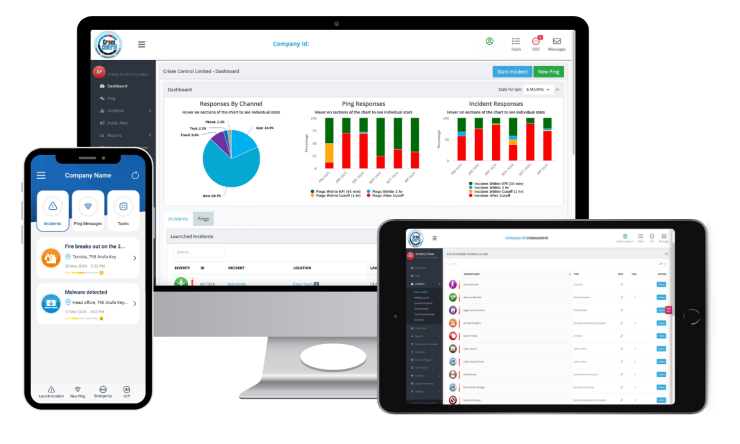
Second, use a mass notification system that tracks delivery and acknowledgement. Sending an alert is the beginning, not the end. Knowing that 94 of your 100 employees have confirmed safe is what allows you to focus on the six who have not responded.
Third, pre-build message templates for the scenarios most likely to affect your operations. Shelter-in-place instructions. All-clear notifications. Remote working activations. Office closure notices. In a crisis, the time spent drafting these from scratch is time your employees are waiting for guidance.
Fourth, test the system regularly. The March 2026 events showed that the UAE’s national alert system did not reach everyone in every location consistently. Your internal communication system needs to be the reliable layer underneath it. That reliability only comes from regular testing and updating of contact information.
How Crises Control Supports Emergency Communication in the UAE
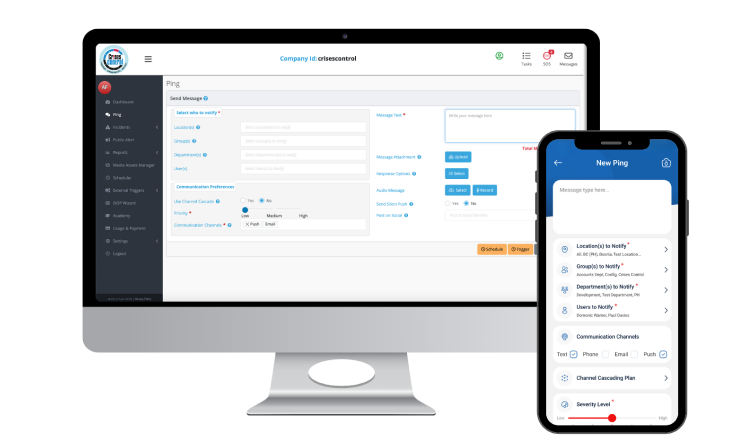
Crises Control is built specifically for the kind of multi-location, fast-moving, high-stakes communication that organisations in the UAE faced in March 2026. Its mass notification capability reaches employees across SMS, push notification, email, and voice simultaneously, without requiring anyone to manually work through a contact list.
The platform’s two-way communication lets employees confirm their safety status directly, giving HR and security teams a live picture of who is accounted for. As the situation changes, updated instructions can be sent to everyone, or to a specific subset of employees by location, role, or building, within seconds. This is the core of what emergency communication software UAE organisations need: not just the ability to broadcast, but the ability to target, track, and adapt.
Crises Control’s infrastructure is cloud-hosted with data centre locations in the UK, Europe, North America, and the Middle East. When regional digital infrastructure is under strain, as it was during the AWS outage in the UAE in early March 2026, the platform continues to operate. That resilience is not an optional feature. It is the point.
For organisations evaluating options, independent reviews on Capterra and the Crises Control LinkedIn page consistently highlight deployment speed and ease of use under pressure as the capabilities that separate crisis-ready platforms from those that fall short when it matters.
A Common Assumption That the March 2026 Events Disproved
The assumption is that government alert systems are sufficient for organisational emergency communication.
The UAE’s National Early Warning System performed well in March 2026. NCEMA issued alerts quickly, updated guidance regularly, and used cellular broadcast technology to reach phones across specific geographic areas.
But as official guidance from the UAE’s own authorities made clear, the system does not reach everyone in every location consistently. Alerts are geo-targeted, meaning employees in different parts of the same city may receive different notifications. The system is designed for public safety at a national level. It is not designed to manage the internal communication needs of individual organisations.
An organisation’s emergency communication system for employee safety in Dubai needs to sit underneath the national system, not rely on it. When NCEMA issues an alert, that is the signal for an organisation’s own communication process to activate. Not the end of it.
The Takeaway
The 12:30am alert on 1 March 2026 was the moment that tested every organisation’s emergency communication structure in real time. Not in a drill. Not in a planning session. In the middle of the night, with no warning, against a situation that had not been anticipated.
Some organisations reached their employees within minutes. They knew who was safe, who was unaccounted for, and what instructions had been received. They could update their teams as guidance changed, and they had a record of every communication for review afterwards.
Others were still building their response hours later.
The gap between those two outcomes is not a matter of resources or effort. It is a matter of whether the right emergency communication software was in place before the alert arrived. In the UAE’s current operating environment, that preparation is no longer something organisations can defer. The next alert could arrive any night. The question is whether your response will be ready when it does. The next alert will not wait for you to be ready.
See how Crises Control helps UAE organisations reach their people instantly and stay in control when it matters most. Book a free personalised demo.
Request a FREE Demo
FAQs
1. What is emergency communication software?
Emergency communication software is a platform that enables organisations to send fast, targeted alerts to employees and stakeholders during a crisis. It delivers messages across multiple channels simultaneously, tracks delivery and acknowledgement, and gives leadership real-time visibility of who has been reached.
2. How does a mass notification system work in Dubai?
A mass notification system allows organisations to send a single alert to all employees, or a targeted group, across SMS, push notification, email, and voice at the same time. In Dubai, where workforces are spread across multiple locations and languages, this capability ensures consistent communication regardless of where employees are or which channel they are most likely to see.
3. What is the purpose of an emergency response plan?
An emergency response plan defines how an organisation responds to incidents, covering roles, communication procedures, escalation paths, and recovery actions. Its purpose is to ensure that when pressure is highest, teams know what to do without having to work it out from scratch.
4. What is the difference between crisis management and emergency management?
Crisis management focuses on strategic coordination and decision making at an organisational level. Emergency management focuses on immediate actions to protect people and assets during an active incident. Both require fast, reliable communication to be effective.
5. How can organisations improve emergency communication in the UAE?
Organisations can improve emergency communication by:
- Implementing a single platform for all emergency alerts.
- Using a mass notification system that tracks delivery and confirmation.
- Building message templates in advance for likely scenarios.
- Testing the system regularly.
Those that had these elements in place before March 2026 responded significantly faster than those that did not.