Written by Anneri Fourie | Crises Control Executive
Environmental alerts in oil and gas operations are rarely missed.
Weather warnings arrive early. Sensors flag pressure changes. Small leaks are detected. Flood risk notifications are issued. Safety teams are informed. Logs begin to fill.
Yet the same pattern repeats itself across organisations. What starts as a manageable environmental event grows into operational disruption, regulatory attention, and long recovery periods.
The problem is not awareness.
The problem is what happens after the alert appears.
An emergency response plan is meant to bring structure to uncertainty. In real operating conditions, many plans struggle to do that. Environmental alerts expose gaps in ownership, escalation, and decision-making that only become visible once pressure builds.
This article looks at why environmental alerts so often turn into operational chaos, how escalation fails in practice, and how crisis management software helps organisations move from awareness to controlled response.
A simple definition to set context
An emergency response plan describes how an organisation should identify, escalate, and respond to incidents that threaten people, operations, or the environment.
On paper, the plan defines roles, actions, and escalation paths.
In reality, environmental response breaks down when alerts remain disconnected from ownership and decision-making.
Alerts create information.
Crisis response requires action, coordination, and accountability.
When those are missing, even well-documented plans struggle to hold.
Why environmental alerts are harder than they look
Environmental incidents rarely arrive as clear emergencies.
They develop slowly.
Rainfall exceeds forecasts but not by much.
A leak persists but stays within tolerance.
Pressure readings drift but do not spike.
Flood risk fluctuates hour by hour.
These situations sit in an uncomfortable middle ground. They are serious enough to monitor, yet not serious enough to trigger full mobilisation at first glance.
This grey area is where escalation failures in emergencies begin.
Teams watch conditions closely. Updates are shared. Everyone stays informed. What is missing is a clear decision that monitoring is no longer enough.
Where escalation breaks down in real conditions
Most organisations have strong detection capabilities. Environmental monitoring systems, weather services, and safety sensors generally perform as expected.
The breakdown happens between detection and coordinated response.
In practice, this often looks like:
- Alerts sent to broad groups rather than named owners
- Environmental events treated as background noise rather than incidents
- Delays while teams wait for confirmation or senior approval
- Parallel actions with no shared view of progress
- Decisions made verbally with no record
Conditions continue to evolve while escalation lags behind.
By the time response gathers momentum, the situation has changed.
A familiar moment many organisations recognise
Consider a common scenario.
A weather alert arrives late in the afternoon. Rainfall is expected to exceed forecasts overnight. The site is staffed, but a shift change is approaching. Operations flag the risk. Safety teams are aware. No formal incident is declared.
The decision is to monitor.
Overnight, conditions worsen. Access routes are affected. Equipment checks are delayed. By morning, the situation demands action, but the handover is messy. Ownership is unclear. Decisions made overnight are not documented. Response starts behind the curve.
No one ignored the alert.
No one acted with bad intent.
The gap was ownership.
Why emergency response plans struggle with uncertainty
Many emergency response plans rely on thresholds.
If X happens, escalate.
If Y occurs, mobilise.
Environmental conditions rarely behave so neatly.
Rainfall increases gradually. Leaks worsen slowly. Flood risk changes by the hour. Pressure readings hover just below limits.
When escalation depends on clean categories, teams hesitate. No one wants to overreact. No one wants to trigger disruption prematurely.
An emergency response plan in safety-critical environments must account for this reality. It must support escalation decisions when conditions are ambiguous, not just when they are obvious.
When manual coordination becomes the default
As uncertainty grows, manual coordination fills the gap.
Phone calls, emails, instant messages, and informal meetings become the primary response tools.
This creates predictable problems:
- Information fragments across channels
- Decisions are hard to trace
- Ownership shifts informally
- Actions are repeated or missed
- Evidence is weak afterwards
Environmental incidents do not pause while coordination catches up. Conditions continue to change while teams piece together what is happening.
The assumptions that quietly fail under pressure
Many organisations rely on assumptions that hold in calm conditions but collapse under stress.
Common assumptions include:
- Someone will naturally take charge
- Teams will know when to escalate
- Information will reach the right people
- Actions can be documented later
Environmental incidents challenge all of these.
They require judgement calls rather than checklist responses. They demand someone decide that monitoring is no longer acceptable.
Without clear ownership, those decisions drift.
Risk management and crisis response are not the same
Environmental alerts often sit at the boundary between risk management and crisis response.
Risk management focuses on identifying and tracking potential threats. It supports planning and prevention.
Crisis response governs coordinated action when those threats begin to materialise.
Problems arise when organisations treat evolving environmental incidents purely as risks to monitor rather than situations that require response ownership.
The shift from risk to response is where many escalation failures occur.
How crisis management software changes escalation behaviour
Crisis management software does not replace environmental monitoring systems. It changes how alerts turn into action.
Instead of relying on informal judgement, escalation becomes structured.
In practice, this means:
- Alerts can trigger incidents, not just notifications
- Ownership is assigned explicitly
- Tasks are created, tracked, and time-bound
- Progress is visible across teams
- Decisions are recorded as they happen
For organisations, like oil and gas operations, this structure matters when conditions evolve slowly but unpredictably.
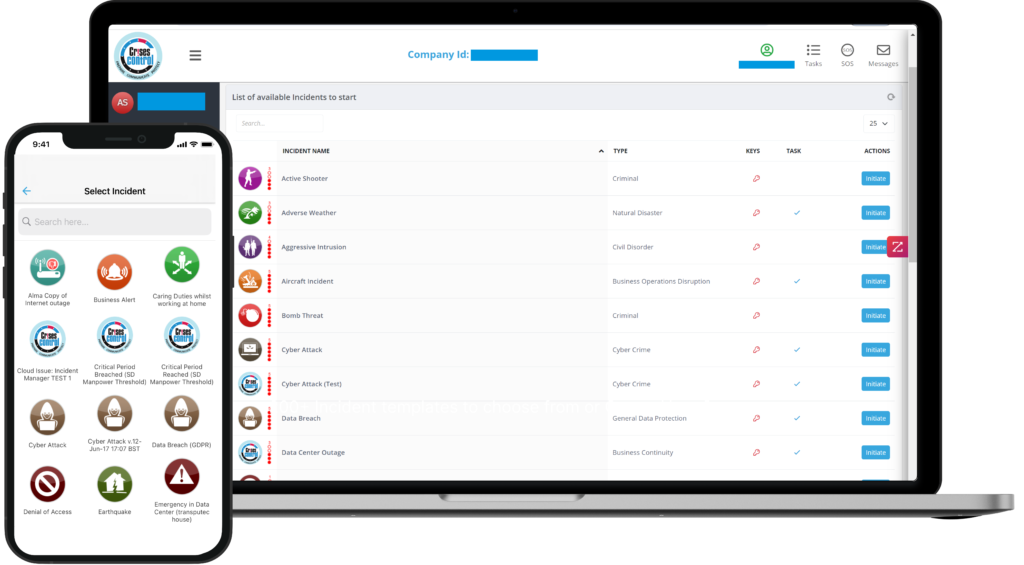
Interested in our Incident Management Software?
Flexible Incident Management Software to keep you connected and in control.
Environmental response is a process, not a moment
One of the most common mistakes is treating environmental incidents as single events.
They are not.
They unfold over time. Conditions worsen, stabilise, or shift direction. Response must adapt accordingly.
Crisis management software supports this by maintaining a live incident record that evolves with the situation. Teams work from the same information, follow the same escalation path, and understand who owns the response at each stage.
This shared view reduces confusion and speeds up decision-making.
Why detailed plans alone are not enough
A widely held belief is that more detailed emergency response plans prevent escalation failures.
In practice, this often falls short.
Plans live in documents. Under pressure, people do not read documents. They act based on experience, instinct, and what feels reasonable at the time.
Training measures attendance, not decision quality under real conditions.
Crisis management software addresses this gap by turning plans into executable workflows. Actions surface when needed. Escalation paths are enforced. Ownership is visible.
The plan becomes operational rather than theoretical.
Regulatory expectations raise the stakes
Environmental incidents draw regulatory attention.
Authorities expect organisations to demonstrate:
- Timely escalation
- Clear decision-making
- Effective communication
- Documented actions
Regulatory reporting for incident management depends on evidence, not intent.
Manual reconstruction after the event leaves gaps. Gaps invite questions. Questions increase scrutiny.
An incident management platform creates an automatic audit trail that shows who knew what, when decisions were taken, and how actions progressed.
Response under real operational pressure
Environmental incidents rarely occur in ideal conditions.
They coincide with:
- Shift changes
- Remote or offshore operations
- Reduced staffing
- Competing operational priorities
Response systems must function under these constraints.
Crisis management software supports this reality through multi-channel communication, cloud-based access, role-based task assignment, and visibility across locations.
This reduces reliance on memory and availability when pressure is highest.
How Crises Control supports environmental response
Crises Control helps organisations connect environmental alerts to response ownership.
The platform enables teams to:
- Digitalise emergency response plans
- Assign clear ownership during escalation
- Coordinate response across functions and sites
- Track actions and acknowledgements
- Produce audit-ready incident records
It provides structure without unnecessary complexity, supporting both operational teams and governance requirements.
Why this matters for senior leaders
For leaders responsible for crisis management, business continuity, or operational resilience, the question is not whether environmental alerts are received.
The question is whether those alerts lead to timely, controlled response.
Environmental incidents rarely become crises overnight. They escalate when uncertainty, hesitation, and fragmented coordination combine.
Clear escalation, ownership, and visibility reduce that risk.
Final thoughts
Environmental alerts are not the problem.
How organisations respond to them is.
An emergency response plan must function under uncertainty, pressure, and evolving conditions. Crisis management software helps bridge the gap between detection and disciplined response.
If you are reviewing your current approach, look closely at how environmental alerts escalate in practice, not how they are meant to escalate on paper.
Request a FREE Demo