
Written by Dr Shalen Sehgal | Crises Control
An emergency response plan is a clear set of instructions that tells workers what to do, where to go, and who takes control when something goes wrong, so action happens immediately instead of hesitation.
A scaffolding collapse. Two workers down. The site foreman reaches for the laminated sheet pinned to the site office door. It is last year’s version. Three of the four contact numbers have changed.
This is not a hypothetical. Across the construction industry, incidents unfold not because plans were absent, but because the plans that existed could not be executed under pressure. The emergency response plan was written, filed, and forgotten.
Construction is one of the most hazardous industries in the world. In Great Britain alone, the sector accounted for 51 fatal injuries to workers in 2022/23, representing 30% of all workplace fatalities despite employing roughly 7% of the workforce (HSE 2023). In the United States, construction accounts for one in five worker deaths every year (Bureau of Labour Statistics 2023). Falls, struck-by incidents, equipment failures, and fires are daily risks on any active site.
An emergency response plan that sits in a folder does nothing on the day it is needed. What saves lives is a plan that people know, can access instantly, and can execute without hesitation. This article walks through what a construction-specific emergency response plan must contain and how to make it work in practice.
Why Standard Emergency Plans Fail on Construction Sites
Most emergency response frameworks are designed for offices. A single building. A fixed workforce. Clearly marked exits. Construction is the opposite.
Sites change daily. The layout shifts as structures go up. Hazards move. The workforce comprises direct employees, subcontractors, agency workers, and visitors, many of whom have never been briefed on the site-specific plan. Communication is fragmented across WhatsApp groups, phone calls, and shouted instructions across noisy environments.
When something goes wrong, the problems compound quickly:
- The nearest first aider may not be on site that day
- The muster point from last week has been built over
- The subcontractor’s supervisor does not know the site emergency number
- Leadership at the main office has no visibility of what is happening on the ground
- No one is logging actions, so no audit trail for the investigation follows
A construction emergency response plan cannot assume a static environment. It must account for the reality of the site: shifting risks, changing personnel, and the near-certainty that the person who needs to act has never practised doing it.
Emergency Response Plan for Construction: 6 Steps That Save Lives
Step 1: Conduct a Site-Specific Risk Assessment Before Writing Anything
Every construction emergency response plan must begin with a hazard inventory specific to that site. Generic templates are a starting point, not a finish line.
The assessment should cover:
- Physical hazards: excavations, working at height, heavy plant, and overhead power lines
- Fire risks: fuel and gas storage, hot works zones, temporary electrical installations
- Structural risks: scaffolding integrity, formwork, temporary propping and supports
- Environmental risks: flooding risk, ground contamination, proximity to public areas and roads
- Workforce factors: total headcount, language diversity on site, and current first aid competency levels
The risk assessment drives every subsequent section of the plan. Without it, you are guessing at what your response needs to cover.
Step 2: Define Roles Before the Incident, Not During It
When an incident occurs, the worst moment to decide who is in charge is the moment it happens. The emergency response plan must assign specific roles in advance, with names attached.
On a construction site, these roles typically include:
- Incident Commander: the most senior person on site at the time, or a named deputy
- Assembly Point Warden: responsible for accounting for all personnel at each muster point
- First Aid Lead: a qualified first aider, with a named backup in case the primary is absent
- Emergency Services Liaison: meets responding services at the site entrance and provides access
Communications Lead: relays updates to site management, head office, and subcontractor companies
Every named role needs a deputy. People are absent. Roles must not collapse because one individual is off-site that day.
Step 3: Build a Communication Protocol That Works in Noise and Chaos
A construction site is loud. Radios crackle. Phones are in pockets or in lockers. Subcontractors do not share communication channels with the principal contractor. The emergency response plan must include a communication protocol that functions in these conditions.
This means specifying in writing:
- The primary alert method: site siren, PA system, radio callout, or mass notification platform
- The escalation chain: who contacts whom, in what order, and by what method
- How subcontractors and their workers are reached when an incident is declared
- How the head office and senior management are notified and kept updated
- What information is communicated: incident type, location on site, actions underway, who is in command
Relying on WhatsApp groups or informal phone chains is not a protocol. It is a gamble. When adrenaline is high and information is partial, structured communication is the difference between a coordinated response and a chaotic one.
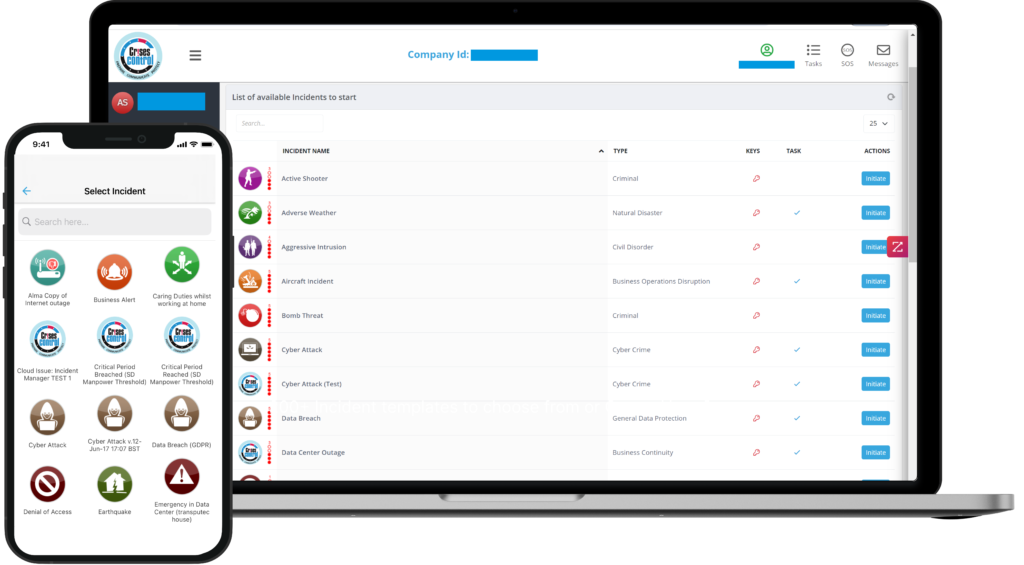
Interested in our Incident Management Software?
Flexible Incident Management Software to keep you connected and in control.
Step 4: Map Evacuation Routes and Muster Points for the Current Site Layout
This is the step most construction companies skip when updating. The muster point agreed at the start of the project may be completely inaccessible six months in. The evacuation route that avoided Plant Compound A may now cut through a live excavation.
The emergency response plan must include a version-controlled site map showing:
- Current evacuation routes for each zone of the site, updated as the layout changes
- Primary and secondary muster points with clear signage confirmed on the ground
- Locations of first aid kits, fire extinguishers, and defibrillators
- Entry and exit points are designated for emergency vehicle access
- The emergency services rendezvous point, with a named person responsible for meeting them
This map must be reviewed whenever the site layout changes materially. That means a formal review process built into the plan, not a one-off document produced at the start of the project.
Step 5: Establish an Accountability System That Accounts for Everyone
On a large construction site, knowing who is on site at any given moment is genuinely difficult. Subcontractors sign in and out independently. Workers arrive early and leave late. Visitors arrive without notice. Agency staff rotate daily.
The emergency response plan must answer these questions explicitly:
- How is the site register accessed when the site office is part of the incident scene?
- Who is responsible for accounting for each subcontractor’s workers at the muster point?
- What is the process if a person cannot be located after evacuation?
- How is the all-clear confirmed, and who communicates it to all parties?
Missing persons in the aftermath of a construction incident are not an edge case. They are common. The accountability process must be explicit, assigned to named individuals, and tested in drills.
Step 6: Train, Drill, and Update the Plan on a Regular Cycle
A plan that has never been practised is a document. A plan that has been drilled is a capability.
Training requirements for a construction emergency response plan include:
- Induction briefing for every new worker and subcontractor before they set foot on site
- Toolbox talks covering emergency procedures at least quarterly, with sign-off records
- Full evacuation drills at least twice a year, testing different scenarios and times of day
- Tabletop exercises for the incident management team covering communication and decision-making under pressure
- Debrief and update cycle after every drill and every real incident, with a formal log of changes made
The plan must also be reviewed formally at regular intervals: at a minimum when site conditions change significantly, when key personnel change, when the workforce composition changes substantially, or when an incident or near-miss reveals a gap in the existing process.
What Happens When the Emergency Response Plan Cannot Be Executed
The failure mode for construction emergencies is almost always the same. The plan exists. The people involved are not familiar with it. In the moment, they improvise.
Improvisation under stress produces predictable outcomes:
- Delayed emergency service notification because nobody knows the site address in the format the dispatcher needs
- Workers gathered at the wrong muster point because the map was never updated after the site changed
- No one logging actions, leaving the company exposed when the HSE investigation begins
- Leadership at head office unaware of what has happened for 45 minutes or more
- Subcontractors’ workers are unaccounted for because no single person was responsible for them
These failures carry direct consequences: lives, regulatory penalties under CDM 2015 and the Health and Safety at Work Act, and reputational damage that can affect contract pipelines for years after the event.
How Technology Closes the Gap Between Plan and Execution
Most emergency response plans in construction are static documents. They assume that people will read them, remember them, and act on them correctly when under pressure and possibly in danger. The evidence from incident investigations suggests otherwise.
Technology does not replace the plan. It makes the plan executable at the moment it needs to be. The critical capabilities are:
- Instant mass notification to all site personnel, including subcontractors, delivered via a single action
- Structured escalation so the right people are alerted in the right order, automatically
- Task management during the incident so actions are assigned, tracked, and confirmed in real time
- Real-time visibility for site managers and leadership, regardless of where they are located
- Automatic audit trail of every action taken from first alert to all-clear
This is the gap that conventional tools cannot bridge. WhatsApp, email, and phone trees were not built for structured crisis response. They carry no accountability layer, no audit trail, and no way to confirm that critical actions have been completed by the people responsible for them.
How Crises Control Supports Emergency Response on Construction Sites
Crises Control is a crisis and incident management platform built for organisations that cannot afford to improvise when something goes wrong. For construction companies, it provides the execution layer that turns a written emergency response plan into a live, coordinated response that everyone can follow.
Key capabilities for construction site emergency response:
- Mass notification across all site personnel, subcontractors, and leadership in under 60 seconds, delivered via app, SMS, voice call, and email. See mass notification
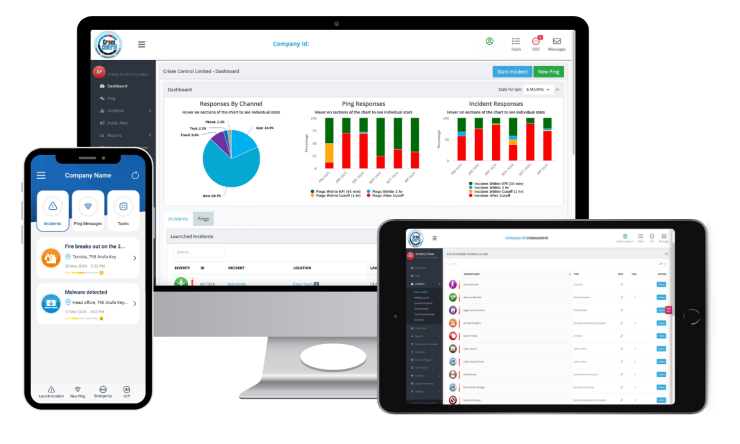
- Incident Manager: a structured command interface that assigns tasks, tracks completion, and maintains a real-time log of every action taken during the response. Learn more about Incident Manager
- Ping: a lone worker and SOS panic button for workers in remote or high-risk areas where radio coverage is unreliable
- Task Manager: role-specific task lists that activate automatically when an incident is declared, ensuring nothing is missed in the first critical minutes. See Task Manager
- Full audit trail: every alert, every action, and every status update is logged automatically, protecting the company during regulatory investigations and insurance proceedings. See compliance use cases
Most emergency communication tools tell people that something has happened. Crises Control coordinates what happens next: who does what, in what order, with full visibility and a complete record from first alert to all-clear.
See how Crises Control supports construction sector emergency response on the construction industry page, or request a demo to see it running against a live construction incident scenario.
FAQs
1. What must an emergency response plan for a construction site include?
An emergency response plan for a construction site must include a site-specific risk assessment, clearly defined incident roles with named deputies, a structured communication protocol, version-controlled evacuation routes and muster points, a personnel accountability process covering all subcontractors, and a training and drill schedule. Generic templates must be adapted to the actual conditions of the specific site before they can be considered usable.
2. How often should a construction emergency response plan be reviewed?
The plan should be reviewed whenever the site layout changes materially, when key personnel change, when the workforce composition changes substantially, or after any incident or near-miss. At minimum, a formal review should take place every six months. Evacuation routes and muster points in particular need to be checked against current site conditions, not just reviewed on paper.
3. Who is responsible for the emergency response plan on a construction site?
Legal responsibility for the emergency response plan sits with the principal contractor under the Construction (Design and Management) Regulations 2015. In practice, day-to-day ownership typically sits with the site manager or health and safety manager. The plan must also address the responsibilities of each subcontractor, who cannot be treated as outside the response process.
4. What is the difference between an emergency response plan and a business continuity plan?
An emergency response plan governs what happens in the immediate phase of an incident: evacuation, notification, first aid, emergency services contact, and stabilisation. A business continuity plan covers how the organisation recovers and continues operating after the incident has been contained. Both are necessary. On a construction site, the emergency response plan is the immediate priority because it directly governs the protection of life.
5. How does emergency communication software support a construction emergency response plan?
Emergency communication software closes the gap between a written plan and a live response. It enables instant mass notification across a dispersed, mixed workforce, including subcontractors; provides structured task management during the incident; maintains a real-time audit trail of every action taken; and gives leadership full visibility of the response from any location. Without it, coordination relies on informal channels that fragment under pressure and leave no defensible record.