Written by Anneri Fourie | Crises Control Executive
Incidents in defence and space manufacturing rarely unfold in a neat or predictable way. A fire alarm may trigger in a restricted production area. A safety incident may affect one site while leadership teams sit hundreds of miles away. Communications might be limited by secure zones, noise, or access controls. At the same time, there is immediate pressure to protect people, contain risk, and document every decision made.
Many organisations still rely on plans, drills, and experienced staff to carry them through these moments. The problem is not a lack of effort or intent. The problem is that traditional approaches struggle once pressure builds and events move quickly.
Incident management software is designed to solve this gap. It provides a structured way to coordinate people, actions, and information during live incidents, while creating a clear record of what happened and why. This article explores why the problem persists, where manual approaches fall short, and how a more practical, digital approach improves control, coordination, and confidence during high-risk events.
What is incident management software for defence and aerospace?
Incident management software for defence and aerospace is a digital platform that supports organisations in managing incidents as they happen. It brings together detection, communication, task coordination, and reporting in one controlled environment.
In practical terms, it allows teams to:
- Identify and escalate incidents quickly
- Assign clear actions to defined roles during live incidents
- Track progress in real time
- Maintain a secure, time-stamped record of decisions and actions
Unlike basic alerting tools, this type of software focuses on execution. It supports people through the full lifecycle of an incident, from first response to review, while maintaining safety, control, and compliance.
Why this problem still exists in mature defence organisations
It is reasonable to ask why well-funded, highly regulated organisations still struggle with incident response. The answer usually lies in how responsibility and systems have evolved over time.
Legacy tools and fragmented ownership
Incident response often sits across several functions. Safety teams own plans. Security teams manage access and escalation. Operations focus on keeping production moving. IT supports systems but may not lead responses. Each group may use different tools, documents, and processes.
During an incident, this fragmentation creates friction. Information moves slowly. Decisions rely on verbal updates. Accountability becomes unclear.
Overconfidence in plans and drills
Plans and exercises are essential, but they create a false sense of readiness when not supported by real-time coordination tools. In a live incident, people do not behave like they do in exercises. Stress, uncertainty, and competing priorities change how decisions are made.
Without digital support, even well-rehearsed plans are difficult to follow under pressure.
Secure and noisy environments
Defence and aerospace facilities present physical constraints that many tools are not designed for. Audible alarms may not be heard. Mobile coverage may be limited. Access to shared systems may be restricted.
These realities make manual coordination unreliable at the moment it matters most.
Why manual incident management breaks down under pressure
In high-risk environments, three common issues cause manual approaches to fail.
1. Limited access to information
Paper-based plans and shared documents are often inaccessible during incidents. Staff may not know where to find them or which version applies. When information is not immediately available, people improvise.
Improvisation increases risk.
2. Unclear task ownership
Verbal instructions and informal messaging make it hard to track who is responsible for what. Tasks may be duplicated, delayed, or forgotten altogether. Leaders are left chasing updates rather than directing response.
3. Poor visibility for decision-makers
When updates arrive through calls, emails, and messages, it becomes impossible to form a clear picture. Decisions are based on partial information, increasing the chance of mistakes.
These issues are not theoretical. They are common features of post-incident reviews across the sector.
The real-world consequences of outdated systems
Relying on disconnected tools and manual coordination leads to predictable outcomes:
- Delays in isolating hazards or accounting for staff
- Conflicting instructions issued by different teams
- Increased stress for those managing the response
- Weak evidence during audits or investigations
These consequences affect safety, operational continuity, and organisational trust. They also place unnecessary pressure on people who are already dealing with a stressful situation.
What effective incident management looks like in practice
A practical, digital approach focuses on helping people do the right thing at the right time.
Structured task assignment and real-time updates
Incident management software with task assignment and real-time updates ensures that actions are clearly defined and visible. Each task is linked to a role, not an individual name, making it easier to maintain continuity across shifts.
Leaders can see progress as it happens rather than relying on verbal reassurance.
Role-based coordination in secure environments
In defence settings, not everyone needs the same information. Digital platforms allow actions and updates to be shared based on role and clearance level. This supports security while still enabling coordination.
Responsibility remains clear, even as incidents evolve.
Communication with context
Sending alerts is only the first step. Effective systems combine alerts with instructions, task lists, and status updates. This reduces confusion and prevents message overload.
Escalation rules ensure that missed actions are followed up automatically rather than relying on manual chasing.
Platforms such as Crises Control support this by converting response plans into role-based, trackable actions rather than static documents.
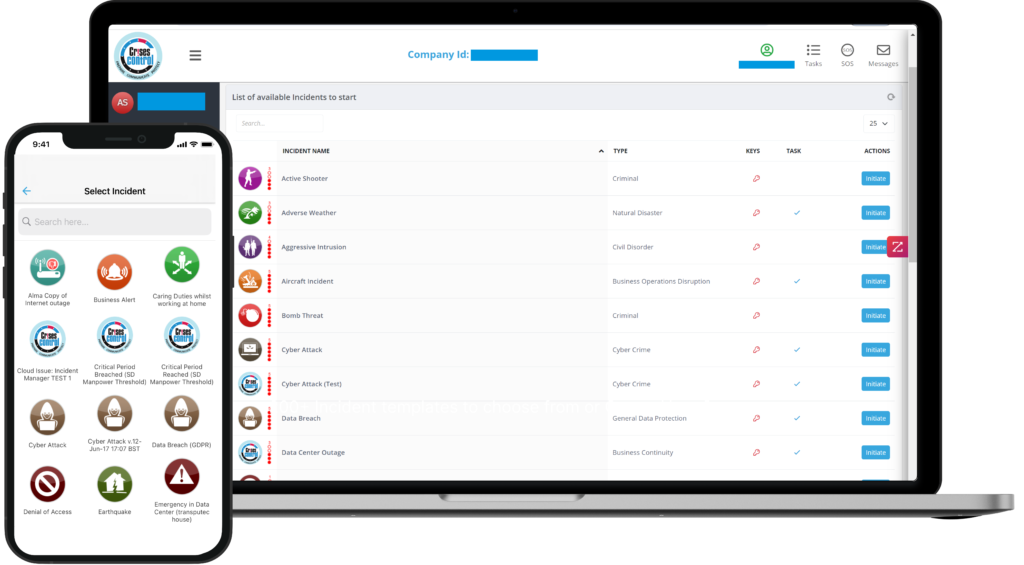
Interested in our Incident Management Software?
Flexible Incident Management Software to keep you connected and in control.
How to coordinate incident response across secure defence manufacturing sites
Large defence organisations often manage multiple sites with different layouts, risks, and local regulations. Coordinating response across these sites requires a balance between central oversight and local control.
A practical model includes:
- A central view that allows leadership to understand what is happening across locations
- Site-level authority so local teams can act without delay
- Consistent response logic so actions follow the same structure everywhere
Digital incident platforms support this model by sharing visibility without removing autonomy. Decisions scale across the organisation while execution remains close to the incident.
Supporting compliance through audit-ready reporting
Regulators, defence clients, and internal governance teams increasingly expect clear evidence of preparedness and response. This goes beyond stating that procedures exist.
Audit-ready incident response reporting for defence and aerospace compliance provides:
- Automatic timestamps for alerts and actions
- Clear records of task ownership and completion
- A structured narrative of how incidents were handled
This information can be produced without additional effort during an incident, reducing pressure on teams and improving confidence during inspections and reviews.
A common misconception: more alerts lead to better outcomes
It is easy to assume that sending more alerts improves safety. In reality, indiscriminate alerting often creates confusion. People receive messages that do not apply to them or lack clear instructions.
Over time, this reduces trust in alerts and encourages self-directed action, which increases risk in controlled environments.
Better outcomes come from targeted communication linked directly to actions. Clarity matters more than volume.
The human factor under stress
Incident response is ultimately about people. Stress affects memory, judgement, and communication. Systems that rely on people remembering procedures or chasing updates place unnecessary cognitive load on teams.
Digital tools reduce this load by:
- Presenting only relevant information
- Making task ownership explicit
- Showing progress visually
This allows people to focus on safe and effective action rather than administration.
Integrating incident management into wider resilience planning
Incident management should not sit apart from business continuity or operational resilience. Response, recovery, and learning are connected.
A joined-up approach supports:
- Faster transition from response to recovery
- Clear identification of lessons learned
- Continuous improvement of plans and training
Crises Control supports this integration by providing cloud-based access to plans, incident workflows, and reporting, even during system disruptions.
Practical questions to guide evaluation
When reviewing an incident management platform for defence manufacturing, decision-makers should ask:
- Can this system guide people through live incidents, not just store plans?
- Does it provide clear task tracking and visibility?
- Will it support secure communication across our environments?
- Can it produce credible evidence for audits and reviews?
These questions reflect operational reality rather than feature lists.
Take the next step
If your organisation still relies on manual coordination or disconnected tools during incidents, it may be time to reassess whether your current approach matches the risks you manage.
Crises Control works with defence and aerospace organisations to support clearer coordination, safer response, and stronger accountability.
Request a FREE Demo