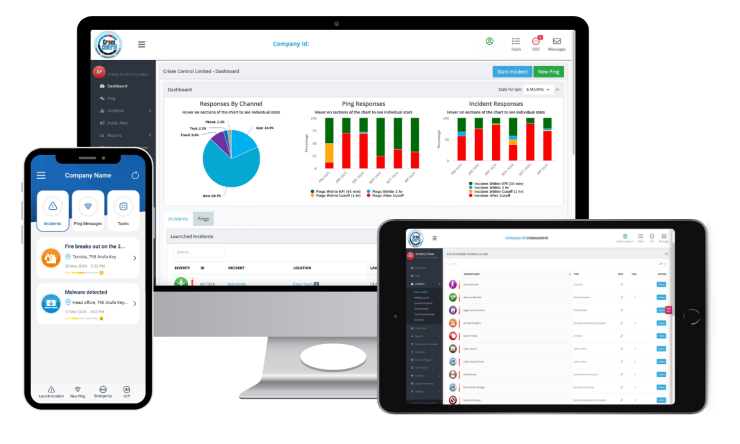
Written by Anneri Fourie | Crises Control Executive
When organisations invest in mass notification software, there is usually a simple belief behind the decision. If something goes wrong, a message will be sent and people will receive it.
That belief feels reasonable. It is also where many response strategies quietly fail.
In real incidents, messages are often sent exactly as planned. The problem is that delivery cannot be assumed. Email servers struggle under sudden load. Mobile networks slow down or drop out. Collaboration platforms depend on internet access that may no longer exist. Power failures remove access to corporate devices altogether.
When this happens, communication breaks down at the moment it is needed most.
The issue is not that alerts are slow. The issue is that they do not arrive. This is why mass notification software can no longer be judged on how quickly it sends a message on one channel. The real measure is whether communication still works when familiar tools do not.
Multichannel redundancy is no longer an advanced feature. It is the minimum requirement for reliable emergency communication.
This article explains why reliance on limited channels creates risk, how enterprise communication has changed, and how Crises Control supports organisations when core systems fail.
Mass Notification Software and the risk of single-channel thinking
Many organisations still approach notification with a narrow view. Email, SMS, or a collaboration tool becomes the default channel, with little planning for what happens if that channel is unavailable.
This approach usually comes from habit rather than strategy. Teams rely on tools they use every day and assume those tools will be there during a crisis.
That assumption rarely holds.
During major incidents, systems tend to fail in predictable ways:
- Email delivery slows or stops due to sudden volume increases
- Mobile networks become congested, delaying SMS and voice calls
- Collaboration platforms rely on internet access and third-party uptime
- Local outages remove access to laptops, desktops, and internal systems
When communication depends on one or two channels, failure is not a rare exception. It is a likely outcome.
An emergency mass notification system is built with this reality in mind. It assumes that some channels will fail and plans for communication to continue regardless.
What actually happens when Teams, email, or SMS fails
To understand why redundancy matters, it helps to look at how incidents play out in practice.
Imagine a regional power outage affecting several offices. Email servers remain technically available, but staff cannot access them. Mobile networks are congested as thousands of people try to call home. A Teams message is sent, yet only some employees see it.
From the outside, communication looks active. Inside the organisation, it feels silent.
Managers wait for confirmation that people are safe. Local teams are unsure whether they should escalate or wait. Leadership receives fragmented updates through phone calls and informal messages.
The situation becomes harder to manage, not because the incident is severe, but because communication is unreliable.
This is not a technology failure alone. It is a planning failure. Communication strategies are often designed around normal working conditions rather than disruption.
Mass notification software must be designed for failure, not convenience.
Mass Notification Software within Crisis Management
Notification does not sit on its own. It is the first step in crisis management and shapes everything that follows.
When alerts fail to reach people, response slows. When responses cannot be confirmed, leaders lose visibility. When communication fragments, coordination breaks down across teams and locations.
This is why enterprise platforms now treat notification as part of a wider crisis management capability. Alerts initiate action, request specific responses, and feed live information back into the response process.
A message is no longer just an announcement. It is the start of coordinated activity.
Crises Control approaches notification in this way. Communication is connected to roles, tasks, and accountability, so messages lead somewhere rather than disappearing into inboxes.
Why multichannel redundancy is now a minimum requirement
Enterprise risk has changed. Organisations operate across regions, time zones, and infrastructure environments. Partial system failure is common, even when full outages are rare.
Multichannel redundancy addresses this by design.
An effective emergency mass notification system should:
- Support multiple delivery methods across digital and voice channels
- Use channels that do not rely on the same infrastructure
- Switch automatically when primary delivery fails
- Continue operating when corporate systems are unavailable
Redundancy is not about sending more messages. It is about increasing the likelihood that at least one message reaches each person.
This is why analyst guidance increasingly treats multichannel redundancy as a baseline capability rather than a differentiator.
Emergency communication solutions for multi-site organisations
Multi-site organisations face a distinct challenge. Incidents rarely affect every location in the same way.
One site may lose power while another remains operational. One region may experience network disruption while another does not. A single global message can confuse people who are not directly affected.
Emergency communication solutions for multi-site organisations need to balance local relevance with central oversight.
This means:
- Targeting messages by location, role, or exposure
- Using different channels in different regions based on reliability
- Maintaining a single operational view for leadership
Crises Control allows organisations to define communication rules that reflect how they actually operate. Local teams receive relevant instructions, while leadership maintains visibility across the organisation.
Mass Notification Software for global teams
A mass notification system for global teams must account for more than geography. Time zones, language preferences, and local infrastructure all influence whether a message is received and understood.
Global incidents often unfold unevenly. What begins as a local issue can escalate across regions within hours. Communication needs to scale without losing clarity.
This requires:
- Channel diversity across regions
- Mobile app delivery that works independently of corporate networks
- Voice and SMS options when data connectivity is limited
- Central tracking of delivery and response
Crises Control supports global communication through app-based alerts combined with SMS, voice, email and Microsoft Teams. Messages do not depend on a single platform or network to get through.
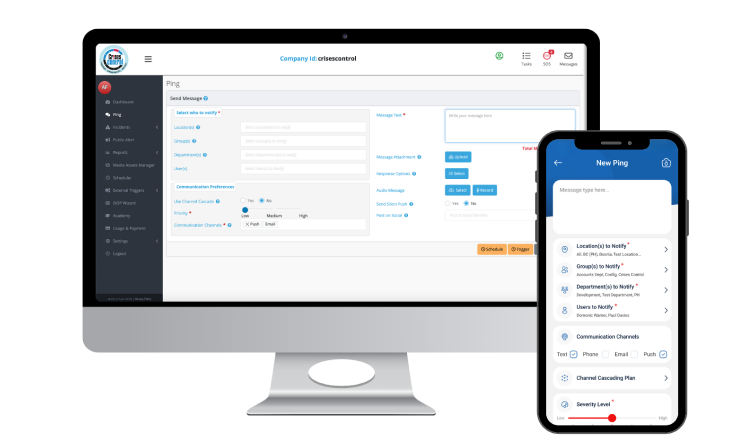
Interested in our Ping Mass Notification Software?
Efficiently alert everyone in seconds at scale with our Mass Notification Software.
Why app-based alerts matter during infrastructure failure
Mobile applications play an important role in modern notification strategies. When designed properly, they operate independently of email servers, internal networks, and collaboration tools.
An app-based approach provides clear benefits:
- Direct delivery to personal devices
- Push notifications that bypass congested channels
- Offline access to key information once received
- Secure authentication without reliance on corporate login systems
This does not replace SMS or voice. It complements them. Real resilience comes from combining channels that fail in different ways.
Crises Control uses app-based alerts as part of a layered communication approach, not as a single solution.
Redundancy without added complexity
A common concern is that more channels mean more complexity. More configuration, more training, and more room for mistakes.
This is where design makes the difference.
Effective mass notification software manages complexity behind the scenes. People sending alerts should not need to decide which channels are available during an incident. The system should handle that automatically based on predefined rules.
Crises Control allows organisations to set communication paths, escalation rules, and fallback options in advance. During an incident, teams focus on the message itself rather than the mechanics of delivery.
Governance, audit, and accountability
Communication during incidents is under increasing scrutiny. Regulators, insurers, and boards expect clear evidence of what was communicated, when it was sent, and who received it.
Single-channel tools often struggle to provide this clarity. Delivery failures are hard to confirm. Response tracking is inconsistent. Records are incomplete.
Enterprise-grade mass notification software provides:
- Confirmation of delivery across channels
- Visibility into response status
- A complete audit trail of communication activity
This supports governance and post-incident review, while also reducing uncertainty during live response.
How Crises Control supports resilient communication
Crises Control is designed around the reality that communication systems fail under pressure.
The platform brings together:
- App-based alerts for direct device delivery
- SMS, email, Microsoft Teams, and voice calls for network diversity
- Centralised visibility across all channels
Notification is integrated into wider crisis management workflows so messages lead to action, follow-up, and accountability.
This modular approach allows organisations to strengthen communication resilience without overcomplicating their response.
From notification to confidence
Reliable communication builds confidence during uncertainty. Teams move faster when they know messages will reach the right people. Leaders make clearer decisions when they can see what is happening.
Mass notification software plays a central role in this, but only when it is designed for failure rather than convenience.
Multichannel redundancy is no longer optional. It is the foundation of effective emergency communication.
If your organisation is reassessing whether its current approach would still work when Teams, email, or SMS is unavailable, seeing a resilient platform in action can help identify gaps.
Crises Control can show how multichannel, redundant communication supports clearer response and stronger coordination when disruption tests your organisation.
Request a FREE Demo