Written by Anneri Fourie | Crises Control Executive
Construction environments are complex, fast moving, and inherently high risk. Sites change daily, contractors rotate frequently, and workforces are distributed across multiple locations. When something goes wrong, whether it is a safety incident, power outage, severe weather event, or security issue, the ability to communicate clearly and quickly can be the difference between controlled response and escalating harm.
Increasing contractor reliance, tighter safety scrutiny, and more frequent operational disruptions have exposed the limits of informal communication approaches on construction sites. What once worked through personal networks and manual escalation often fails under pressure.
This is where mass notification software for construction plays a critical role. It provides a structured, reliable way to reach contractors, site staff, and management during disruptive events, even when normal communication channels are unavailable.
This article explains why communication breaks down so often during construction incidents, the practical consequences of those failures, and how modern digital approaches combining mass notification and incident management can improve safety, coordination, and compliance.
What is mass notification software for construction?
Mass notification software for construction is a digital system that enables organisations to send urgent, targeted alerts to contractors and site staff across multiple channels during incidents or operational disruptions.
In a construction context, it is used to reach supervisors, subcontractors, and head office teams through mobile app notifications, SMS, voice calls, and email. Messages can be targeted by role, location, or project, acknowledgements can be tracked, and delivery records are automatically logged.
Unlike informal messaging tools or manual call trees, these systems are designed for reliability, speed, and accountability. For organisations managing multiple sites and contractor networks, this capability underpins effective emergency response and business continuity.
Why communication failures are so common on construction sites
Communication challenges in construction are rarely caused by a lack of effort. They are structural problems created by how the industry operates.
A distributed and transient workforce
Construction workforces are rarely static. Contractors move between sites, subcontractors rotate, and roles change as projects progress. Contact lists become outdated quickly, and responsibility lines are not always clear.
When incidents occur, teams often rely on spreadsheets, personal phone contacts, or supervisors manually relaying information. This introduces delays, gaps, and inconsistency at the moment clarity is most needed.
Reliance on fragile communication channels
Many organisations still depend on a narrow set of tools such as landlines, email, or internal systems tied to head office infrastructure. Power outages, network failures, or telecom disruptions can make these tools inaccessible precisely when they are required.
In these situations, the assumption that people will simply pick up the phone or check email becomes a serious operational risk.
Unclear ownership during incidents
During incidents, uncertainty around responsibility is common. Without predefined workflows, tasks are duplicated, missed, or delayed. Communication becomes reactive rather than coordinated.
This challenge is amplified when incidents affect multiple sites or involve external contractors who are not embedded in internal communication structures.
The real world impact of poor incident communication
When communication fails during construction incidents, the consequences are tangible and measurable.
- Safety risks increase as workers do not receive timely or accurate instructions
- Response actions are delayed because responsibilities are unclear
- Incidents escalate due to inconsistent information across teams
- Organisations struggle to demonstrate compliance after the event
Consider a multi-site construction project where a power outage disables head office systems while severe weather impacts active sites. Without a reliable way to reach contractors directly, instructions are delayed, supervisors act on partial information, and response efforts fragment across locations.
In regulated environments, the inability to show who was notified, when messages were delivered, and how responses were coordinated can lead to enforcement action, contractual disputes, or reputational damage.
A common assumption that often fails in practice
A frequent assumption is that having an emergency response plan on paper is sufficient. Many organisations invest time documenting procedures but underestimate the difficulty of executing those plans under pressure.
Plans often assume that:
- Contact details are accurate
- Supervisors are available
- Systems are accessible
- People know exactly what to do
In reality, incidents rarely follow a script. People are under stress, systems may be degraded, and information is incomplete. Without digital support to activate plans, notify the right people, and guide response actions, even well written plans can fail.
Another common assumption is that site-level autonomy alone is sufficient. In practice, this often leads to inconsistent messaging, delayed escalation, and limited visibility when incidents affect more than one location.
How Crises Control’s Ping module supports emergency communication on construction sites
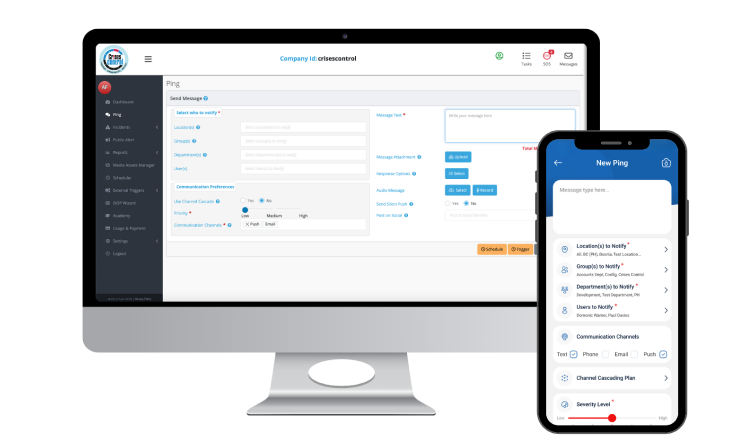
Crises Control Ping provides mass notification capabilities designed to operate in disrupted environments. For construction teams, this means communication remains possible even when traditional systems are unavailable.
Practical benefits include:
- Multi-channel alerts using mobile app, SMS, voice, Microsoft Teams, and email
- Role-based and location-based targeting for contractors and site staff
- Cloud-based access that remains available during local outages
- Acknowledgement tracking and channel cascading to ensure messages are received
Ping supports the immediate communication requirement during incidents by ensuring that clear instructions reach the right people quickly.
Why notification alone is not enough
Sending alerts is only one part of effective incident response. Once people are notified, organisations still need to manage actions, decisions, and follow-up.
This is where many organisations encounter a second failure point. Messages are delivered, but no one tracks who is responsible for which actions, whether tasks are completed, or how the situation is evolving.
Interested in our Ping Mass Notification Software?
Efficiently alert everyone in seconds at scale with our Mass Notification Software.
The Crises Control Incident Manager and coordinated response
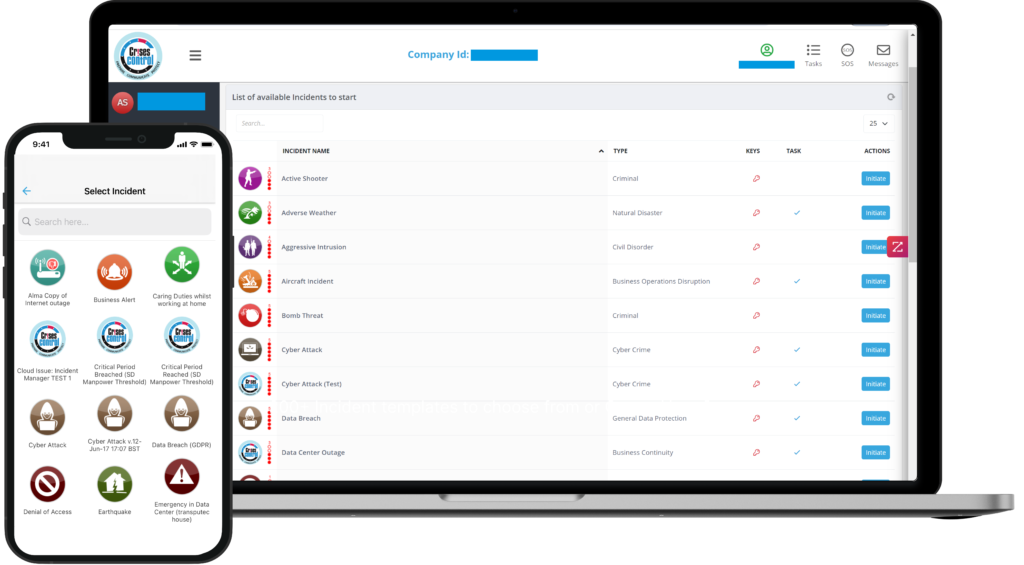
Crises Control Incident Manager complements mass notification by providing structure to the response phase.
It allows organisations to:
- Activate predefined incident workflows, sending alerts across multiple channels simultaneously
- Assign tasks to specific roles or individuals, with severity levels assigned to prioritise actions
- Track acknowledgements and task completion to maintain accountability
- Maintain a real-time view of incident status across sites, contractors, and head office teams
For construction incidents, this is particularly valuable when coordinating across sites, contractors, and head office teams. Responsibilities are clear, actions are visible, and progress can be monitored without relying on informal updates.
Supporting compliance across regions
Construction organisations often operate across multiple regions, each with its own regulatory expectations around worker safety and emergency preparedness.
While requirements vary, common expectations include:
- Clear emergency procedures
- Effective communication with workers
- Evidence of drills, alerts, and response actions
After incidents, the question is rarely whether an organisation had a plan, but whether it can demonstrate how that plan was executed. Crises Control provides detailed audit trails, including time-stamped alerts, acknowledgements, and response logs, giving organisations verifiable evidence that plans were followed. Informal communication cannot offer the same level of accountability or compliance assurance.
Interested in our Incident Management Software?
Flexible Incident Management Software to keep you connected and in control.
Building a practical framework for construction organisations
A realistic approach to improving emergency communication in construction includes:
- Defining who needs to be contacted for different incident types
- Maintaining accurate, role-based contact data for staff and contractors
- Using mass notification to deliver clear, consistent messages
- Using incident management workflows to coordinate response actions
- Reviewing reports and audit trails to improve future response
This approach moves organisations away from ad hoc communication toward repeatable, defensible practices.
Preparing for incidents before they happen
One of the most overlooked benefits of digital platforms is preparation. Scenario planning, message templates, and predefined workflows reduce reliance on improvisation during incidents.
Construction organisations that invest in preparation tend to respond faster, with less confusion and lower risk exposure.
Final thoughts
Construction environments will always carry risk, but organisations can control how effectively they communicate and respond when incidents occur.
Mass notification software, combined with structured incident management, provides a foundation for reliable, timely communication, safer sites, and clear accountability. Crises Control enables construction teams to maintain operational resilience even when systems are degraded or incidents are complex, providing audit trails, role-based workflows, and multi-channel alerts.
If you are reviewing how your organisation communicates with contractors and site staff during incidents, the question is not whether communication matters, but whether your current approach can withstand pressure and deliver consistent, verifiable results.
Request a FREE Demo