
Written by Dr Shalen Sehgal | Crises Control CEO
February 2024. A ransomware attack hits Change Healthcare, the company processing nearly one in three US patient records. Within hours, pharmacies can’t fill prescriptions. Hospitals can’t submit claims. Providers across all 50 states are flying blind.
The final damage? Over 100 million patient records exposed. Nearly $2.9 billion in estimated costs for parent company UnitedHealth Group. And thousands of healthcare providers scrambling to coordinate a response with phone trees, personal mobiles, and group texts that went nowhere.
That is what happens when a healthcare organisation faces a crisis without a purpose-built mass notification system for healthcare. Generic tools cannot handle the complexity of hospitals: the shift patterns, the patient safety obligations, the regulatory requirements. This guide explains exactly why healthcare crisis communication is different, what regulators require, and what your notification system needs to do when every second matters.
Why Healthcare Faces Unique Crisis Communication Challenges
A bank can send a company-wide email during a crisis. A tech firm can post in Slack. Healthcare does not have that luxury. The communication challenges in a hospital environment are fundamentally different from any other industry, and they require fundamentally different mass notification software.
Shift workers who are not at desks
Nurses are not checking email between patient rounds. Surgeons are not scrolling through an intranet update mid-procedure. Maintenance staff, porters, and lab technicians move between floors and buildings constantly. A crisis notification that relies on email or desktop alerts will miss the majority of your workforce at any given moment. You need alerts that reach people on mobile, through push notifications, via SMS, and over overhead paging simultaneously.
Multi-site complexity
Modern healthcare organisations are not single buildings. Hospitals, outpatient clinics, labs, pharmacies, rehabilitation centres, and administrative offices spread across a region, sometimes across a country. Each site has different staff, different risks, and different response procedures. When Ascension Health was hit by a ransomware attack in May 2024, the disruption cascaded across 140 hospitals in 19 states. Ambulances were diverted. Staff reverted to paper records. The scale of multi-site coordination overwhelmed conventional communication methods.
Patient safety obligations
Healthcare crisis management demands precise, role-specific communication. A Code Silver (active shooter) requires security to move toward the threat, nursing staff to lock down patient areas, and administration to coordinate with law enforcement. One generic blast message does not cut it. You cannot evacuate an ICU the same way you evacuate an office building.
HIPAA and regulatory constraints
Healthcare organisations cannot send patient information over unsecured channels. Every notification that touches protected health information must meet HIPAA compliant mass notification standards. That rules out consumer-grade messaging apps, unsecured group texts, and most off-the-shelf tools. According to the IBM Cost of a Data Breach Report, healthcare data breaches cost an average of $10.93 million per incident, more than double the global average across all industries. Healthcare has held the top spot for the costliest breaches for over a decade.
The Regulatory Case for a Mass Notification System for Healthcare
Compliance is not optional. If your hospital participates in Medicare or Medicaid, you are required to have a documented emergency communication plan. Here is what regulators expect.
CMS Conditions of Participation (SS482.15)
The CMS Emergency Preparedness Rule requires hospitals to maintain a communication plan covering all-hazards scenarios. This includes systems for notifying staff, coordinating with external agencies, and tracking the status of patients during emergencies. Ad-hoc tools, overhead paging alone, personal phone calls, or group texts do not meet the documentation and audit trail standards CMS requires.
Joint Commission Emergency Management Standards
The Joint Commission mandates annual emergency management exercises and evaluates communication capabilities during surveys. Your notification system must demonstrate that you can reach all relevant staff, confirm message receipt, and produce audit documentation on demand.
OSHA Workplace Violence Protections
Healthcare workers face workplace violence at rates far exceeding other industries. OSHA guidance includes the ability to rapidly notify staff of threats and initiate lockdown procedures. A hospital emergency notification system that can trigger Code Silver alerts across an entire facility in seconds is a safety imperative, not a nice-to-have.
State-level requirements
Numerous US states have passed or are considering legislation requiring panic alert systems in healthcare facilities, similar to Alyssa’s Law requirements in schools. These laws mandate that staff can trigger silent alerts to law enforcement directly from mobile devices or fixed panic buttons.
If you are relying on phone trees, overhead paging, and email alone, you are not meeting the standard. The next audit, survey, or real emergency will expose the gap.
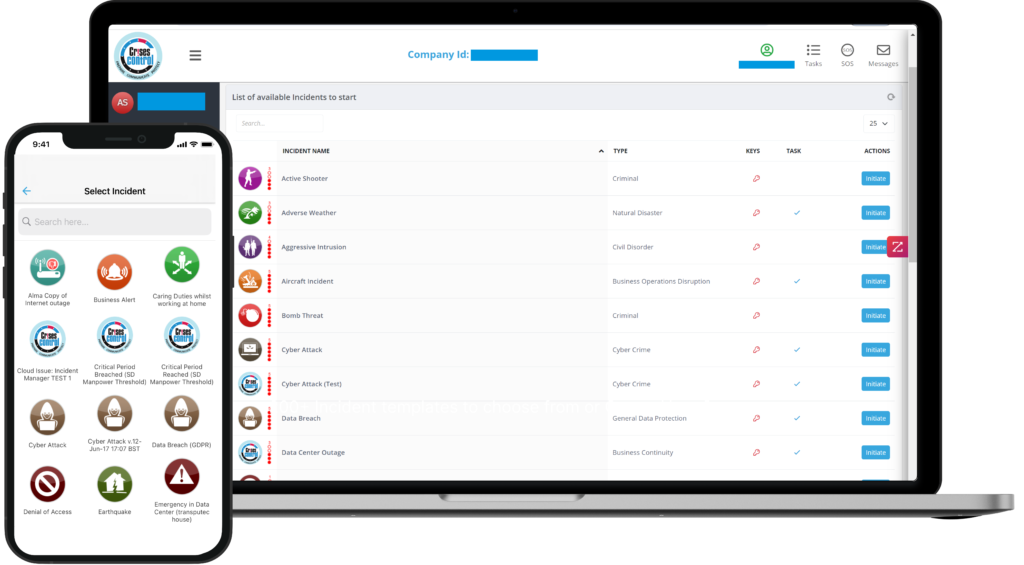
Interested in our Incident Management Software?
Flexible Incident Management Software to keep you connected and in control.
What a Mass Notification System for Healthcare Actually Needs to Do
Not all mass notification platforms are built for healthcare. Here is what separates a purpose-built system from a generic tool designed for corporate announcements.
Multi-channel delivery
Multi-channel mass notification delivers alerts across SMS, push notifications, voice calls, email, overhead paging integration, digital signage, and desktop pop-ups simultaneously. Not sequentially. Not ‘choose one.’ All at once. A nurse on the floor will not see an email. A surgeon in theatre will not hear the overhead page. Multi-channel delivery ensures the message reaches every person through at least one channel they will actually see, within seconds.
Pre-built code alert templates
When a crisis hits, nobody should be typing a message from scratch. Your system needs one-click activation of pre-built templates for every standard hospital code:
- Code Blue – Cardiac or respiratory arrest
- Code Red – Fire
- Code Silver – Active shooter or weapon threat
- Code Black – Bomb threat
- Code Orange – Mass casualty incident
- Code Grey – Infrastructure failure or severe weather
Each template should include pre-written instructions specific to the incident type, with the ability to customise location details and severity before sending.
1. Role-based messaging
During a Code Silver, your security team needs tactical details and the threat location. Nursing staff need patient lockdown procedures. Administration needs external communications and media protocols. A healthcare mass notification platform must support role-based distribution, sending tailored messages to specific groups based on function, location, and responsibilities. One-size-fits-all messaging creates confusion and delays response.
2.Two-way communication
Sending alerts is only half the equation. Staff must be able to confirm receipt, report their status, request assistance, or flag new information. Two-way communication transforms a broadcast tool into a coordination platform. During a mass casualty event, knowing that 94 percent of your trauma team has acknowledged the alert, and that 6 percent have not, is the difference between a coordinated response and a dangerous assumption.
3.Audit trail and compliance reporting
Every message sent must be logged with delivery confirmation, response timestamps, and acknowledgement records. Your system should generate compliance reports automatically: who was notified, when, through which channel, and how quickly they responded. When a Joint Commission surveyor asks to see your emergency communication documentation, you should be able to produce it in minutes.
4.Integration with clinical systems
A standalone notification tool creates silos. Your system should integrate with nurse call systems, electronic health records, building management systems, access control, and fire alarm panels. When a fire panel triggers, the notification system should automatically initiate a Code Red alert without waiting for someone to press a button. That level of integration with your incident management platform reduces response times from minutes to seconds.
Real-World Healthcare Crises Where Communication Made the Difference
Theory is one thing. Here is what happens in practice when healthcare organisations face crises, and what communication breakdown actually looks like.
1.Change Healthcare ransomware attack (February 2024)
The attack on Change Healthcare exposed 100 million patient records and caused an estimated $2.87 billion in losses for UnitedHealth Group in 2024 alone. But the financial damage was compounded by communication failures. Thousands of healthcare providers who depended on Change Healthcare’s systems had no centralised way to coordinate their response, inform affected patients, or redirect operations. Many learned about the attack through news reports rather than formal notifications.
2.Ascension Health ransomware attack (May 2024)
When ransomware struck Ascension Health, 140 hospitals across 19 states were thrown into chaos. Electronic health records went offline. Ambulances were diverted from emergency departments. Staff who had never worked with paper records were suddenly expected to manage patient care without digital systems. Coordinating across 19 states with no functional IT infrastructure required exactly the kind of multi-channel, mobile-first notification capability that most healthcare systems lacked.
3.NHS CrowdStrike outage (July 2024)
A faulty software update from CrowdStrike crashed 8.5 million Windows devices worldwide, including GP systems and pharmacy platforms across the UK’s National Health Service. Appointment booking systems, prescription management, and patient record access all went down simultaneously. GPs reverted to paper prescriptions. Pharmacies could not process digital records. The disruption lasted days. This was not even a targeted attack. Just a software update gone wrong.
4.Kettering Health ransomware attack (May 2025)
Kettering Health’s 14 medical centres were hit by the Interlock ransomware gang, forcing the cancellation of all elective inpatient and outpatient procedures. Call centres went offline. Scam callers began impersonating hospital staff to collect fraudulent payments from patients. The attack demonstrated how healthcare crisis communication failures do not just affect operations. They create secondary threats that exploit the chaos.
In every case, the organisations that contained crises fastest had pre-established, multi-channel communication systems that did not depend on the IT infrastructure under attack. Those relying on email, phone trees, and ad-hoc messaging failed, not because their people failed, but because their tools did.
The lesson in each of these incidents applies equally to cybersecurity incident response and natural disasters alike: your communication system must work independently of the systems that might be compromised.
How Crises Control Supports Healthcare Organisations
Crises Control was built with exactly these challenges in mind. The platform addresses the specific requirements that make healthcare crisis communication different from every other industry.
The Ping mass notification system delivers alerts across SMS, push notifications, voice calls, email, and integrated channels simultaneously, reaching shift workers, remote staff, and on-site teams regardless of where they are or what device they carry.
Pre-built incident templates cover standard hospital codes and can be activated with a single tap. Role-based distribution ensures that security, clinical, and administrative teams receive the specific instructions they need, not a generic broadcast.
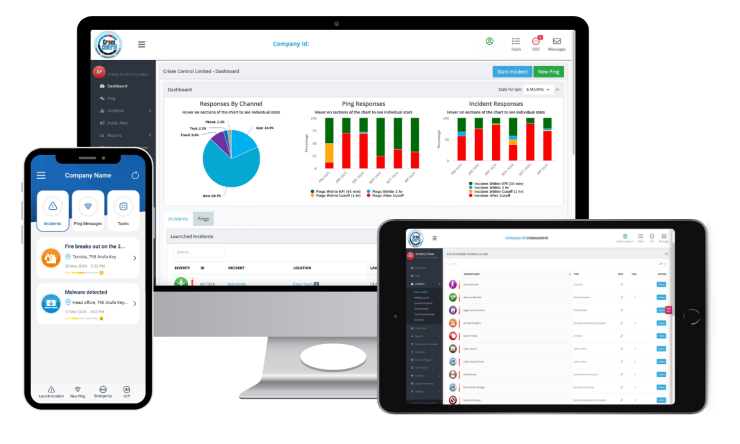
The platform’s incident management platform provides structured task assignment, escalation workflows, and real-time status tracking. Every action is logged automatically, creating the audit trail required for Joint Commission surveys and CMS compliance documentation.
Two-way messaging lets staff acknowledge alerts, report their status, and flag emerging issues in real time. The CRAiG AI assistant accelerates triage by helping incident managers assess situations faster and activate the right response protocols.
Because the platform operates independently of your internal IT infrastructure, it works when your systems do not. For organisations managing multiple sites, the healthcare incident management capabilities include location-specific alerting, cross-site coordination, and unified reporting across your entire network. Whether you are running three clinics or thirty hospitals, every site operates from a single platform with consistent procedures and centralised oversight.
The same principles that protect healthcare organisations apply across other sectors. Crises Control supports public sector notification requirements with equally rigorous compliance standards.
Your Communication System Should Not Be the Weakest Link
Healthcare crises do not wait for your IT department to draft a message. They do not pause while someone searches for the right phone number. And they certainly do not care whether your email server is online.
The organisations that respond fastest, that protect patients, coordinate staff, and satisfy regulators, are the ones that invested in dedicated mass notification systems for healthcare before the crisis hit. Not after.
If you are still relying on phone trees, group texts, or tools that were not built for the realities of healthcare, it is worth seeing what a purpose-built platform can do.
See how Crises Control helps healthcare organisations respond faster – request your free demo today.
FAQs
1. What is a mass notification system for healthcare?
A mass notification system for healthcare is a communication platform designed to send urgent alerts to hospital staff, administrators, and stakeholders across multiple channels simultaneously, including SMS, push notifications, voice calls, email, overhead paging, and digital signage. Unlike generic notification tools, healthcare-specific systems support HIPAA-compliant messaging, role-based distribution, pre-built hospital code templates, two-way communication, and full audit trails required for regulatory compliance.
2.Is a mass notification system HIPAA compliant?
Not all mass notification systems are HIPAA compliant. A HIPAA compliant mass notification system must encrypt data in transit and at rest, support access controls, maintain audit logs of all communications, and prevent protected health information from being transmitted over unsecured channels. Consumer-grade messaging apps and standard group text services typically do not meet these requirements. Purpose-built platforms like Crises Control are designed with these compliance standards built in.
3.What are the CMS requirements for hospital emergency communication?
Under CMS Conditions of Participation (SS482.15), hospitals must maintain a documented emergency communication plan covering staff notification, coordination with external agencies, patient tracking during emergencies, and communication with patients’ families. The plan must be tested through annual exercises and produce documentation demonstrating compliance. The CMS Emergency Preparedness Rule applies an all-hazards approach, requiring communication systems that function across scenarios from natural disasters to cyberattacks.
4. How does a healthcare mass notification system differ from a standard one?
Healthcare mass notification systems differ from standard platforms in several key ways: they support pre-built hospital code alerts (Code Blue, Code Silver, Code Red), enable role-based messaging so different teams receive tailored instructions during the same incident, integrate with clinical systems like nurse call and EHR platforms, maintain HIPAA-compliant audit trails, and operate independently of internal IT infrastructure so they function even during cyberattacks or system outages.
5.Can a mass notification system integrate with hospital paging and nurse call systems?
Yes. Advanced healthcare mass notification platforms integrate with hospital paging systems, nurse call systems, building management systems, fire alarm panels, access control systems, and electronic health records. These integrations enable automated alert triggering. For example, a fire alarm activation can automatically initiate a Code Red notification across all channels without manual intervention, significantly reducing response times.