Written by Anneri Fourie | Crises Control Executive
When an IT incident starts, the technical problem is rarely the hardest part. The real difficulty is getting the right people aware of the issue, aligned on what needs to happen next, and confident that someone is in control.
Too often, alerts are delayed, lost in inboxes, or sent to the wrong people. Engineers investigate while managers wait for updates. Service desks hear about problems from users before IT does. By the time a response is coordinated, the impact has already spread.
This is the gap that real-time incident alerts are meant to close. Not as another stream of noise, but as a structured way to move from detection to action. This article looks at how real-time alerting supports IT teams, where it commonly fails, and how a clear alerting approach improves response, communication and continuity across the organisation.
Why real-time incident alerts matter for IT teams
IT incidents rarely stay contained. A single failure can affect customer services, internal systems, data protection obligations and leadership confidence. When alerts are slow or unclear, the response becomes fragmented.
Real-time incident alerts give IT teams a shared starting point. Everyone involved receives the same message, at the same time, with a clear understanding of what has happened and what is expected of them.
For IT leaders, this creates three practical benefits:
- Faster awareness across complex and distributed environments
- Clear ownership from the moment an incident is identified
- Consistent communication during disruption, rather than reactive updates
Without this structure, even experienced teams fall back on informal messages, manual call lists and assumptions about who is responding.
Real-time incident alerts and the move from monitoring to action
Most organisations already monitor their systems. Logs, dashboards and alerts highlight performance issues and failures. The problem usually appears after detection.
Monitoring tools show that something is wrong. They do not coordinate people, decisions or communication. This is where real-time incident alerts come in.
A useful alert does more than flag an issue. It turns information into action. At a minimum, it should answer four questions:
- What has happened
- Who needs to respond
- What should they do first
- Where updates will be shared
When alerts fail to answer these questions, teams lose time clarifying details rather than fixing the issue.
Crises Control supports this shift by allowing organisations to link alerts to predefined roles, actions and escalation paths. This helps IT teams move straight into response mode rather than working out who should be involved.
Where real-time alerts make the biggest difference
Cyber incidents and unauthorised access
When suspicious activity is detected, multiple teams need to act in parallel. Security may focus on containment, IT operations on system stability, and leadership on risk and communication.
Real-time alerts ensure all parties are informed immediately and consistently. This reduces delays caused by handovers and avoids the risk of teams working at cross purposes. Alerts also create a record of who was notified and when, which supports later review.
Infrastructure and cloud outages
Outages often cut across responsibilities. Infrastructure teams, application owners and service desks all need awareness, yet they need different levels of detail.
Real-time alerts allow messages to be tailored by role. Engineers receive technical information. Service desks receive customer-facing guidance. Leadership receives a clear summary. This avoids confusion and repeated requests for updates.
Data centre and server failures
Physical or virtual failures escalate quickly if ownership is unclear. Alerts sent to on-call engineers, service owners and managers at the same time help prioritise recovery and avoid duplicated effort.
Software and platform incidents
Application failures often affect teams beyond IT. Controlled alerts allow technical resolution to continue without flooding the organisation with partial or conflicting updates.
The alerting mistakes IT teams see during real incidents
Many organisations believe they have effective alerting until a serious incident tests it. Common problems include:
- Alerts sent to too many people, leading to silence rather than action
- Messages that describe symptoms but not impact or priority
- No clear escalation when alerts are missed
- Different teams using different tools and channels
These issues reduce trust in alerting systems. Over time, teams start to ignore notifications or rely on informal messages instead.
Designing alerts with clear intent avoids this. An alert should prompt a response, not a discussion about what it means.
Designing alerts that support IT teams rather than overwhelm them
Effective real-time incident alerts follow a few practical principles.
- Relevance: Alerts should reach only those expected to act or decide. Broad distribution may feel safe, but it slows response.
- Clarity: Messages should state the issue, the affected service, and the first expected action. Technical detail can follow once response is underway.
- Escalation: If an alert is not acknowledged, escalation should happen automatically. Relying on manual follow-up introduces delay.
- Consistency: Predictable formats help teams process information quickly during stressful situations.
Crises Control allows organisations to define these rules in advance. Roles, groups and escalation paths are set before an incident occurs, so alerts still work when people are unavailable or working out of hours.
The role of Emergency Mass Notification Software in IT response
Emergency Mass Notification Software is often linked to physical safety, yet its value in IT response is increasingly clear.
During major IT incidents, communication needs extend beyond the technical team. Service desks, compliance teams and senior leaders all need timely, accurate updates. Sending these updates manually places extra strain on engineers at the worst possible time.
Mass notification supports IT teams by separating technical response from organisational communication. Engineers focus on resolution. Stakeholders receive clear updates without chasing for information.
Crises Control provides a single platform where IT alerts and wider notifications are managed together, while keeping messages appropriate for each audience.
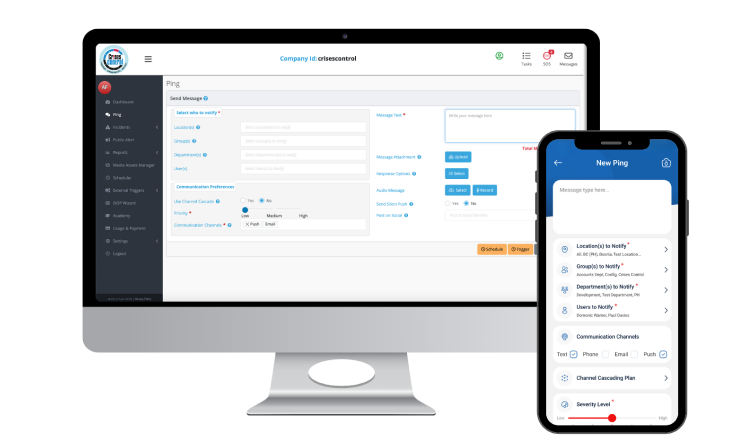
Interested in our Ping Mass Notification Software?
Efficiently alert everyone in seconds at scale with our Mass Notification Software.
Real-time incident alerts within a Crisis Alerting System
A Crisis Alerting System brings together alerting, coordination and communication. Real-time alerts act as the trigger that activates a structured response.
In a mature system, alerts are linked to:
- Defined incident types and severity levels
- Pre-agreed response steps
- Role-based notifications and approvals
- Centralised logging for review and compliance
Crises Control supports this approach by combining alerting with incident management features. IT teams can track actions, decisions and updates in one place, rather than switching between tools during an incident.
Supporting business continuity through real-time alerting
Business continuity depends on early awareness. When IT services support critical operations, delays in communication increase downtime and risk.
Real-time incident alerts support continuity by enabling faster activation of response plans and clearer communication with leadership. Decision-makers gain early visibility, even when full details are still emerging.
For organisations operating across multiple locations or cloud environments, Cloud-Based Mass Notification Software ensures alerts remain available even when local systems are affected. This resilience is essential during large-scale incidents.
Crises Control’s cloud-based platform is designed to support this availability, ensuring alerts can be sent when they are most needed.
Real-time alerts, governance and compliance
Regulators increasingly expect organisations to demonstrate how incidents are identified, managed and reviewed. This applies across data protection, operational resilience and sector-specific requirements.
Real-time incident alerts support governance by creating a clear timeline of notification and response. Logs show who was alerted, who acknowledged, and what actions followed.
Crises Control maintains detailed records of alerts and responses, supporting internal reviews and external reporting without adding manual effort during incidents.
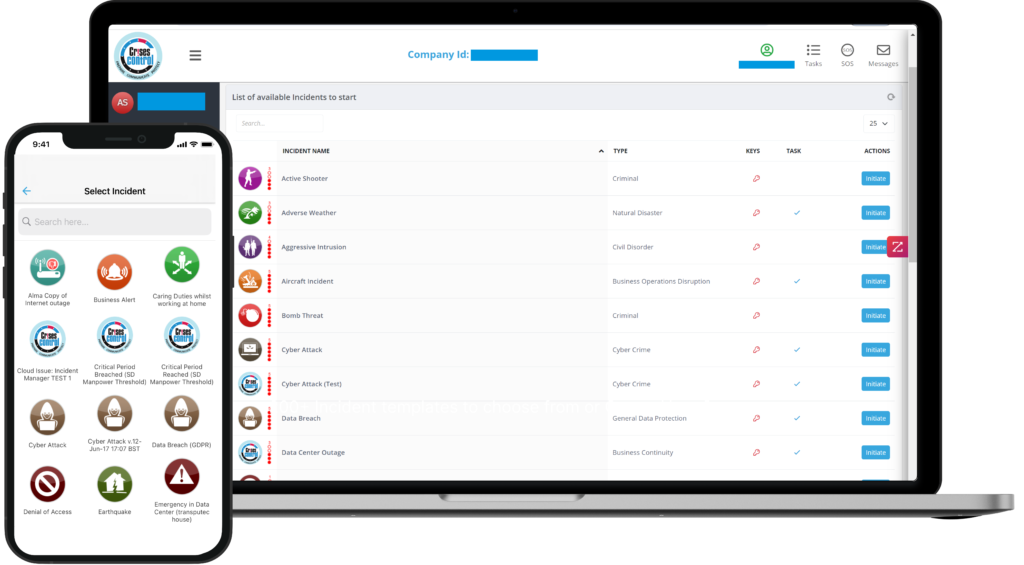
Interested in our Incident Management Software?
Customise your Crisis Incident Management Software to meet your specific needs with our flexible tools & stay connected and informed during the crisis and incident management process
Using Emergency Communication Solutions to manage stakeholders
During IT incidents, communication often becomes fragmented. Different teams share updates through different channels, leading to confusion and repeated questions.
Emergency Communication Solutions provide a structured way to manage this. Predefined messages and approval paths allow updates to be shared without exposing sensitive technical detail or creating conflicting narratives.
This approach reduces risk by ensuring leadership, customers and partners receive consistent information while IT teams focus on recovery.
Preparing IT teams before an incident occurs
Real-time alerts only work when the organisation is prepared. Preparation includes:
- Defining incident types and severity thresholds
- Assigning clear roles and responsibilities
- Testing alert delivery and escalation paths
- Training staff on response expectations
Crises Control supports regular testing and exercises, allowing IT teams to validate their alerting approach without affecting live systems. These tests build confidence and highlight gaps that may not appear on paper.
Measuring the effectiveness of real-time incident alerts
Improvement depends on measurement. After incidents, IT leaders should review how alerting performed.
Useful measures include:
- Time from detection to alert delivery
- Time to acknowledgement
- Frequency of escalation
- Overall incident duration
Crises Control provides reporting tools that help teams review these metrics and refine alerting rules over time.
How Crises Control supports real-time incident alerts for IT teams
Crises Control is built to support organisations managing complex incidents. For IT teams, this means:
- Immediate, role-based alerts across multiple channels
- Clear escalation when responses are missed
- Centralised tracking of actions and communication
- Cloud-based availability during disruption
Rather than replacing existing monitoring or security tools, Crises Control focuses on coordination and communication, areas where incidents often break down.
Bringing it all together
Real-time incident alerts are a foundation for effective IT response. They reduce confusion, support faster coordination and improve confidence across the organisation.
For IT teams, the aim is not speed alone. It is clear ownership, structured response and controlled communication that limit impact and support recovery.
If you want to see how Crises Control supports real-time incident alerts in practice, you can explore this through a live demonstration tailored to your IT environment.
Request a FREE Demo