Written by Anneri Fourie | Crises Control Executive
A pipe bursts in a teaching block just before registration.
Water spreads across corridors. Power may need to be cut. Students are arriving. Staff are walking in with coffee cups. Parents are already on the school run.
A message is sent to staff:
“Do not use Building B. Further updates to follow.”
The alert goes out quickly. The system works. The message is delivered.
But within minutes, leadership is asking harder questions.
- Who is checking the electrics?
- Who is redirecting students?
- Has safeguarding been informed?
- Has anyone logged decisions?
- Are we closing the whole campus or just one block?
- Who tells parents if the situation worsens?
This is the gap many institutions discover too late. A school mass notification system sends information. It does not organise response.
The problem is not speed. The problem is structure.
The solution is not more messages. The solution is coordinated activation, defined roles, and visible accountability from the moment an incident begins.
What A School Mass Notification System Actually Does
A school mass notification system allows educational institutions to send alerts to staff and students across multiple channels such as SMS, app notifications, email, voice, or desktop.
Its job is to distribute information quickly.
That is valuable. Schools need fast communication.
But communication answers one question only:
“Who knows about the issue?”
It does not answer:
“Who is doing what about it?”
That is where many institutions feel exposed.
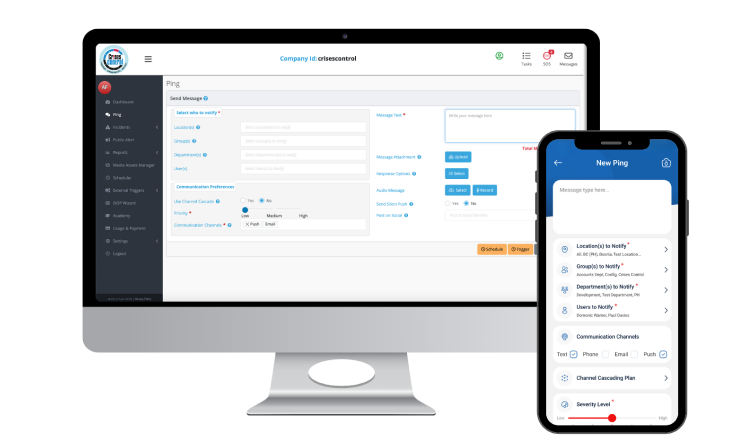
Interested in our Ping Mass Notification System?
Efficiently alert everyone in seconds at scale with our Mass Notification System.
When The Real Work Begins
Let us return to the flooded building.
The first message has gone out. Staff are aware. Some reply. Some do not. A few are on supply contracts and were not included in the original list.
Facilities teams start improvising. IT checks systems. Leadership holds an urgent discussion.
Within 30 minutes:
- Students are being redirected without clear supervision
- Contractors are arriving without context
- Social media posts appear with partial information
- A governor asks what has been formally recorded
Nothing here is dramatic. It is messy.
This is how most incidents feel in education. They are rarely cinematic. They are operationally complicated.
And complexity exposes weakness.
Why Communication Alone Creates False Confidence
There is a belief in many schools and colleges:
“If we can notify everyone quickly, we are covered.”
That belief creates comfort.
It also creates risk.
Schools are not judged on how quickly they inform. They are judged on whether they can show that they managed the situation properly.
Parents ask for clarity. Regulators ask for evidence. Governors ask for documentation.
An alert does not provide:
- Escalation pathways
- Assigned responsibility
- Real time visibility of task completion
- A defensible record of decisions
Without those elements, response becomes informal.
Informal response under pressure leads to inconsistent outcomes.
Why Email And WhatsApp Fail During School Emergencies
Many institutions still rely on familiar tools.
Email groups. Messaging apps. Phone trees.
They feel convenient. They feel human.
They are not designed for coordinated incident management.
The issues are practical:
- Messages are not role based
- Anyone can reply to everyone
- No structured escalation logic
- No confirmation of who is acting
- No single timeline of events
- Information spreads faster than leadership can contain it
In a multi-site trust or large university, this fragmentation multiplies quickly.
The result is not silence. It is noise.
And noise hides accountability.
The Governance Problem Schools Underestimate
Schools are collaborative environments. Day to day, that culture works well. People step in and help.
During an incident, collaboration without structure creates ambiguity.
Two people assume someone else has informed safeguarding.
Three people believe facilities are handling it.
No one formally records the decision to close a building.
Afterwards, leadership can explain what they meant to do. What they struggle to demonstrate is what actually happened and when.
That distinction matters when scrutiny arrives.
The Escalation Scenario
Now consider a more serious situation.
A staff member uses an installed mobile application to report suspicious behaviour on campus. The alert is flagged as safeguarding related.
In a structured environment, that report triggers:
- A predefined incident template
- Automatic notification of safeguarding leads
- Role specific instructions for security
- A visible dashboard for leadership
- Time stamped task allocation
The difference is immediate.
Instead of asking “What should we do?” the institution moves straight to “Follow the process.”
Institutions such as North Metropolitan TAFE embed their business continuity plans directly into structured workflows. When an incident activates, communication and coordination occur at the same time.
It is not about sending more alerts. It is about removing hesitation.
Why A School Incident Management System Changes Behaviour
A school incident management system shifts the focus from communication to control.
It answers critical questions instantly:
- Which template applies
- Which roles are responsible
- Which tasks must be completed
- Which stakeholders must be informed
- What escalation thresholds apply
Under stress, clarity reduces delay.
Delay increases exposure.
In education, exposure is not only operational. It is reputational and safeguarding related.
Structure protects people.
Multi Channel Reliability In Real School Settings
Not all campuses are equal.
Some operate across rural sites with poor reception. Others span large buildings with inconsistent signal. Some students rarely check institutional email. Some staff rely on personal devices.
This is where campus emergency communication software must work across channels.
Real world usage shows:
- Ping messages for minor disruptions such as pipe bursts
- Full incident activation for power outages or demonstrations
- SOS alerts for critical threats
- Desktop applications for low signal areas
- Acknowledgement tracking to confirm receipt
Delivery matters.
But delivery without coordination still leaves leaders blind.
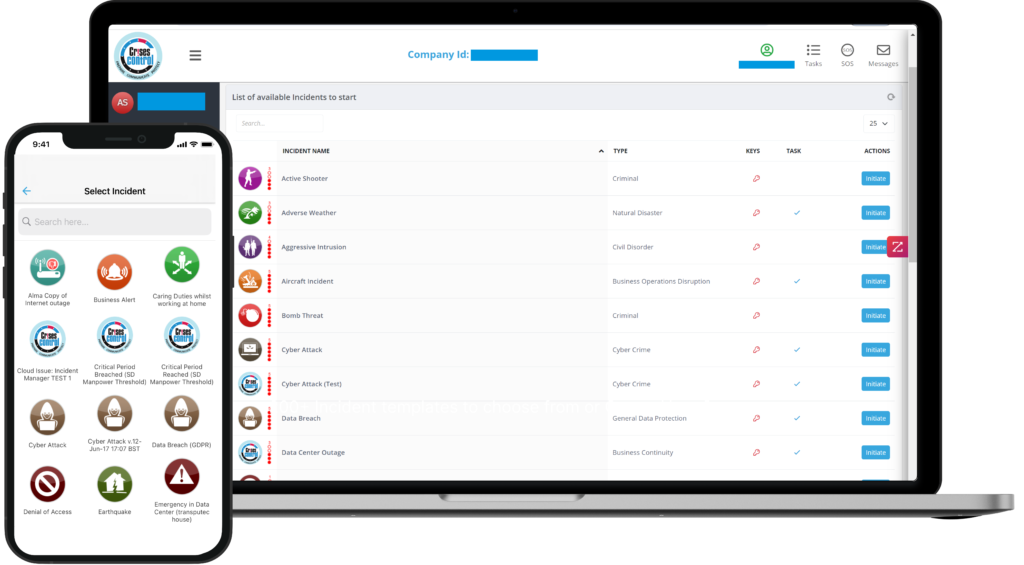
Interested in our Incident Management Software?
Flexible Incident Management Software to keep you connected and in control.
How To Coordinate Incident Response Across Multiple School Campuses
Multi campus institutions face a harder question. How do we maintain consistent control everywhere at once?
Coordination requires four elements.
Clear Activation Logic
Define the difference between a simple alert and a full incident.
If every issue triggers a major response, fatigue sets in. If nothing triggers structure, risk builds quietly.
Defined Role Ownership
Tasks must be assigned to roles, not groups.
“Facilities to assess” is vague.
“Site Manager Building B to isolate power and confirm by 08:30” creates accountability.
Visible Progress Tracking
Leadership needs to see:
- Who has acknowledged
- Which actions are complete
- What remains outstanding
Without visibility, response becomes assumption.
A Documented Timeline
Every decision, message, and task completion should be time stamped.
When parents ask for clarity or regulators review safeguarding processes, documented response protects the institution.
Embedding Plans Into Action
Many schools have thorough emergency response plans stored in shared drives or printed manuals.
The weakness is activation.
During stress, people do not search for PDFs. They look for guidance.
When business continuity plans are digitised and embedded into workflows:
- Activation automatically assigns tasks
- Communication aligns with action
- Escalation pathways are predefined
- Reporting becomes straightforward
The plan becomes active rather than theoretical.
Crises Control supports this approach by enabling institutions to build templates that reflect their existing procedures. It does not replace leadership judgement. It structures it so that response is consistent and visible.
Human Behaviour Under Pressure
Incidents in education involve children and young adults. Emotions escalate quickly.
Staff may hesitate to escalate for fear of overreacting. Junior employees may wait for permission. Rumours spread among students before official communication reaches them.
Structure reduces that hesitation.
Clear rules remove doubt.
Defined thresholds prevent overreaction.
Central visibility prevents duplication.
Crisis management in education is as much about behaviour as it is about technology.
The Real Risk Of “We Sent A Message”
A school mass notification system is essential. It ensures people are informed.
The risk arises when leadership believes the alert equals control.
Informing is the first step.
Coordinating is the responsibility.
Institutions that rely solely on broadcast communication often discover gaps only after an incident is reviewed.
The questions then become uncomfortable:
- Who made that decision?
- When was safeguarding notified?
- Was the escalation path followed?
- Where is the documentation?
Without structure, answers rely on memory.
Memory is not defensible.
Practical Questions For Education Leaders
If you are reviewing your current approach, consider:
- Can we see who is acting in real time?
- Are tasks triggered automatically when incidents activate?
- Can staff escalate without fear of creating panic?
- Do we maintain a complete audit trail?
- Can we coordinate multiple campuses simultaneously?
- Does communication reach low signal areas reliably?
If these answers are uncertain, your response model may still be communication led rather than coordination led.
Moving From Awareness To Assurance
Education institutions operate under duty of care expectations. They must protect students and staff and demonstrate preparedness.
A school mass notification system supports awareness.
A structured coordination platform supports assurance.
The difference is subtle but critical.
One tells people something is happening.
The other ensures something is being managed properly.
Organisations that embed structured workflows, role based tasks, and documented escalation move from reactive messaging to controlled response.
For institutions seeking a practical way to structure incident coordination without overcomplicating systems, Crises Control provides tools that align communication, activation, and documentation in one platform.
If you would like to explore how structured incident coordination can support your school or university environment, speak to the team.
Request a FREE Demo